Marcus had always believed that tragedy arrived like thunder—loud, immediate, impossible to ignore.
He learned the hard way that real tragedy often came quietly. It wore polished shoes, spoke in a calm voice, signed insurance forms with steady hands, and sat beside you at dinner pretending to love your child more than anyone else in the world.
That afternoon in the park, under the warm gold of an autumn sun, Marcus thought he was living through one of the worst chapters of his life. His daughter, Lily, had been losing her sight for months. Specialists had been consulted. Tests had been ordered. Hospital bills had stacked up on the kitchen counter in neat, suffocating piles. Their savings account had thinned. Their health coverage disputes had become a weekly nightmare. The family’s once-stable routine had been replaced by appointments, prescriptions, whispered arguments, and sleepless nights.
Marcus had stopped noticing the beauty around him. The orange leaves drifting from the trees, the low hum of distant laughter, the crisp smell of late October—it all felt like mockery. How could the world remain so beautiful when his little girl stood in darkness?
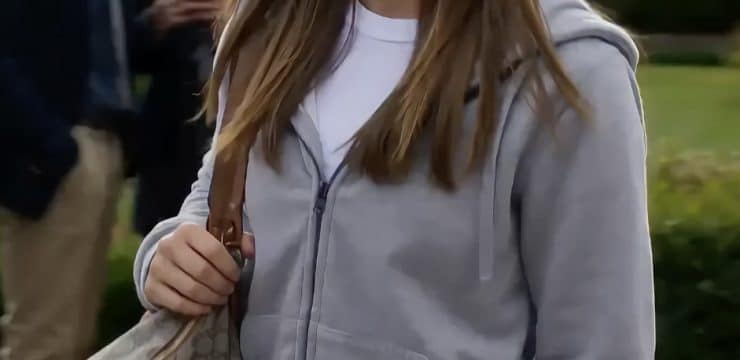
He sat near the wooden park bench with his jacket open and tie loosened, exhausted from another emotionally draining visit with a pediatric specialist. His shirt clung to his back. His temples shone with sweat, even in the cool air. Not far away, Lily stood with her white cane, dressed in the pink leopard-print jacket she insisted on wearing no matter the weather. Her oversized dark sunglasses hid her eyes, but they could not hide the sadness in the set of her mouth.
A few steps behind her, Veronica—Marcus’s wife—paced with frantic energy in her bright red coat. She was talking too fast again, listing things Marcus needed to do: call the neurologist, transfer money from their retirement account, speak to the bank, review another insurance denial, maybe consider a private clinic in Switzerland. Her voice had become the soundtrack of crisis.
Then came the boy.
He seemed to appear from nowhere, like a gust of cold wind cutting through a sealed room.
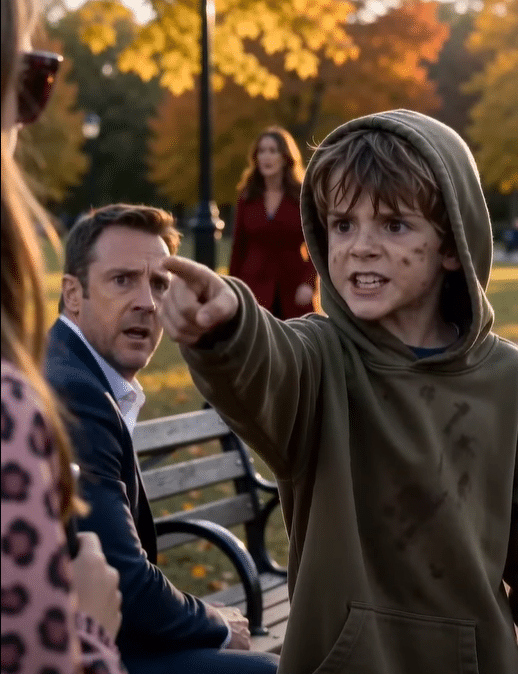
He was no older than ten, skinny, dirty, dressed in an oversized olive-green hoodie that looked two sizes too big. His brown hair was tangled. There was dirt on his cheek, and something wild in his eyes—not madness, Marcus would later realize, but urgency. The kind born from knowing something terrible and having no polite way to say it.
The boy marched straight toward Marcus and pointed past him at Lily.
“Your daughter is not blind!”
Marcus looked up so sharply his neck hurt.
For a second, he genuinely thought he had misheard him.
“What did you just say?”
The boy moved closer. He did not flinch, did not soften, did not seem intimidated by Marcus’s size or his anger or the expensive suit that still made him look, from a distance, like a man in control.
“She’s not sick,” the boy said, voice low and firm. “Someone is doing this to her.”
Marcus stared.
It was the kind of accusation that should have sounded absurd. Insane, even. But something about the boy’s face unsettled him. He wasn’t performing. He wasn’t begging for money. He wasn’t rambling.
He was warning him.
Marcus rose halfway from the bench. “Who are you?”
The boy ignored the question. He leaned in, eyes burning with a kind of grim certainty no child should possess.
“It’s your wife.”
Behind them, Veronica froze.
Then she snapped into motion.
“Marcus!” she shouted, hurrying forward. “Don’t listen to him!”
Her voice cracked on the last word.
Marcus turned toward her, and in that single instant something shifted. Not because of what she said, but because of how she said it. There was panic there—not offended outrage, not disbelief, but panic. The sort that comes when someone fears the truth more than the lie.
The boy jabbed a finger toward Marcus’s chest.
“I saw her,” he said. “At the fountain. She put drops in the girl’s drink. Not once. Lots of times.”
Marcus felt the ground tilt beneath him.
Veronica laughed, but it sounded wrong. Thin. Forced. “He’s a child, Marcus. Look at him. He doesn’t know what he’s talking about.”
The boy’s expression never changed.
“I know because she did it to my sister too.”
The park noise seemed to disappear.
Marcus heard leaves scraping along pavement. A dog barking far away. His own heartbeat, pounding like a fist against a locked door.
“What?” he whispered.
The boy swallowed, and for the first time his age showed. Beneath the hardness was grief. Old grief. The kind that settles into the bones and turns children into watchful, haunted little adults.
“My sister worked for rich people,” he said. “Cleaning houses. Babysitting. Your wife hired her once. Then she said my sister stole a bracelet. She ruined her. No one would hire her after that. We were living in a shelter. My sister got sick, really sick. She kept saying someone was putting stuff in her tea at the place she worked before. Nobody believed her. She lost her vision for a while. Then she…” He stopped. His jaw tightened. “She didn’t make it.”
Marcus felt his stomach twist.
Veronica threw up her hands. “This is ridiculous! Marcus, do you hear this? He’s making up some story because he wants money!”
But Marcus wasn’t looking at her anymore.
He was looking back.
At Lily.
She stood near the path, cane in hand, face lifted slightly toward the sunlight. She was very still. Too still. And now, as Marcus watched, a tear slid out from beneath her sunglasses.
“Lily?” he called.
She turned toward his voice.
Slowly, uncertainly, she whispered, “Daddy…”
Marcus crossed the space between them in three strides and dropped to his knees.
“What is it, sweetheart?”
Her lips trembled.
“I see light.”
Everything inside him went silent.
He looked at the sunglasses. At the white cane. At the child he had carried into clinics and testing rooms, the child he had held while doctors explained degenerative conditions and rare neurological possibilities. He remembered every report Veronica had summarized for him when he was too overwhelmed to read. Every medicine she insisted Lily needed. Every sympathetic look she collected from neighbors. Every fundraiser post, every trembling prayer circle, every conversation that placed Veronica at the glowing center of a family tragedy.
Marcus reached up with shaking hands and removed Lily’s sunglasses.
Her eyes blinked hard against the late afternoon sun.
Not blind.
Disoriented, yes. Frightened, absolutely. But not blind.
He turned his head so slowly it felt mechanical.
Veronica had stopped moving.
The red coat that had once made her look vibrant now made her look like a flare in the middle of a disaster.
“What did you do?” Marcus asked.
She took one step back.
“You don’t understand.”
“No,” Marcus said, rising to his feet. “I think I finally do.”
The unraveling was not cinematic. No confession delivered in perfect dramatic timing. No immediate police sirens. No villainous monologue. Real evil, Marcus discovered, often tried to survive by sounding reasonable.
At first Veronica denied everything. Then she blamed stress. Then she claimed Lily’s symptoms had been real, just misunderstood. Then, when Marcus demanded her bag, she clutched it to her chest too tightly.
Inside were eye drops not prescribed to Lily, sedatives from an old prescription bottle, and a second phone Marcus had never seen before.
That phone destroyed whatever remained of her lies.
Messages. Searches. Notes.
How to mimic pediatric symptoms.
Non-lethal toxins causing blurred vision.
Insurance payout timelines for chronic illness claims.
Support group messages where Veronica described herself as the exhausted mother of a dying child.
There were even drafts of a lifestyle blog partnership pitch built around caregiving, resilience, and “authentic family struggle.” Pain had become her business model. Sympathy was her currency. Attention was her oxygen.
Marcus felt sick.
It turned out that money had not been the only motive, though it had certainly mattered. Their finances had been strained before Lily got “sick.” Veronica had debts Marcus knew nothing about—luxury purchases hidden behind rotating credit accounts, personal loans, and a private gambling habit disguised as harmless online gaming. Insurance reimbursement, public sympathy, charitable donations, and the emotional control that came from being indispensable had given her a twisted sense of power.
Lily’s suffering had been turned into a strategy.
By the time authorities became involved, the story widened in ways Marcus could barely process. Investigators found evidence linking Veronica to fraudulent crowdfunding efforts and possible harm in at least one previous employment-related case. The homeless boy’s sister, whose death had been brushed aside as a tragic spiral of poverty and illness, was suddenly seen in a different light.
The boy’s name was Noah.
He had been watching Veronica for weeks.
After seeing her in the park slip something into Lily’s cup while Marcus was on a call with the bank, Noah had followed them from a distance, desperate for a chance to intervene. He recognized the pattern because pain had taught him to. Adults had ignored him before. This time, he refused to stay silent.
And yet his final words in the park stayed with Marcus more than anything else.
You’re too late.
At first Marcus thought Noah meant Lily’s vision—that whatever had been done might become permanent if not stopped in time. Thankfully, with treatment and careful monitoring, much of the damage proved reversible. Lily’s eyesight returned gradually over the following weeks, like dawn pushing back a long and unnatural night.
But Noah had meant something deeper too.
Marcus was too late to be the father who noticed sooner.
Too late to question the woman he trusted without examining the contradictions.
Too late to read the reports himself, to ask why symptoms worsened in private and improved in unpredictable moments, to wonder whether every medical emergency somehow centered Veronica as much as Lily.
That truth nearly crushed him.
In the months that followed, Marcus rebuilt his life in pieces.
He moved with Lily into a quieter apartment across town, one closer to her new school and farther from the house that had become unbearable. He learned how to make pancakes without burning them. He attended every medical follow-up himself. He sat with financial advisors and untangled the damage to their accounts, their credit, their future. He spoke with lawyers, therapists, doctors, and child advocates. He discovered that recovery was not a dramatic turning point but a long series of ordinary decisions made with extraordinary consistency.
Lily changed too.
Once timid and withdrawn, she slowly became talkative again. The cane was put away. The sunglasses disappeared. She began painting sunflowers in thick, fearless strokes of yellow and gold. One afternoon she told Marcus she liked autumn now because it looked like trees were “on fire in a nice way.”
He cried after she left the room.
As for Noah, he entered Marcus and Lily’s life in the most unexpected way.
Marcus tracked him down through a local outreach program and learned the truth of his circumstances. Noah had no stable home, no reliable adult, and no reason to trust promises made by men in suits. Marcus did not try to “save” him with one grand gesture. Instead, he showed up. Again and again. Food first. Then school support. Then legal assistance. Then a room of his own when the courts and caseworkers finally approved placement.
Noah never asked for gratitude.
He only asked one thing of Marcus on the day he moved into their home.
“Believe kids the first time,” he said.
Marcus nodded.
“I will.”
Karma, Marcus came to understand, was not magic. It did not always strike fast, and it did not erase what had already been lost. Sometimes it looked like a courtroom. Sometimes it looked like evidence. Sometimes it looked like a frightened child finding the courage to speak when every adult around him preferred comfort over truth.
And sometimes karma looked like this:
A woman who had built her life on manufactured sympathy now facing a world that finally saw her clearly.
A father once blinded by trust learning to see.
A daughter stepping into sunlight without fear.
A boy the world ignored becoming the one voice that changed everything.
On the first anniversary of that day in the park, Marcus took Lily and Noah back to the same bench.
The leaves were turning again, yellow and orange under another golden sky.
Lily ran ahead without a cane.
Noah walked slower, hands in his pockets, watchful as ever but no longer alone.
Marcus sat down and looked at the path where his life had split into before and after.
“Do you ever think about that day?” he asked.
Lily smiled softly. “I think about the light.”
Noah kicked at a leaf. “I think about how nobody listened until it was almost over.”
Marcus let that sit between them. Honest. Sharp. Necessary.
Then Lily slipped one hand into his, and Noah dropped onto the bench beside him with the casual confidence of someone who had finally decided to stay.
The sun dipped lower.
Around them, the park glowed.
And for the first time in a long time, Marcus did not mistake peace for blindness.
He saw everything.
And that changed everything.