Act I: The Coffee on Her Coat
I heard his voice before I saw my mother.
“This table’s not for drifters. Move.”
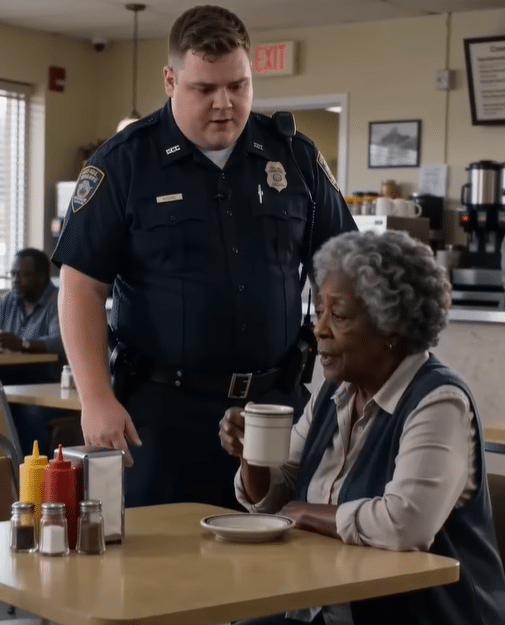
The café on Mercer Street was small, bright, and always too full of noise for cruelty to feel private. Ceramic cups clinked. The espresso machine hissed. A local weather report murmured from a mounted television while the lunch crowd pretended not to listen to the scene unfolding near the front window.
Then my mother answered him.
“I’m just having my coffee.”
Her voice was calm.
That was Evelyn Bennett’s way. She had learned, over the course of sixty-eight years in this county, that calm frightened some men more than anger ever could. Calm left them alone with what they were doing.
Deputy Owen Gibbons was too young to understand that.
He stood beside her table in tan uniform with one hand near his belt and the other resting on the back of the empty chair across from her. He had the clean haircut, sharp jaw, and easy arrogance of a man who had been mistaken for authority often enough to think the mistake was permanent.
My mother sat in a navy coat and small gold earrings, a paperback closed beside her saucer. She looked exactly like what she was: a respectable older woman having coffee at noon on a Tuesday.
But to Gibbons, she was something else.
An audience.
A target.
A person he thought the room would let him humiliate without consequence.
When I reached the doorway, he leaned closer and smiled.
“Learn your place,” he said.
Then he tipped her coffee over her.
The liquid spread across her coat in a dark, blooming stain. It ran down the front of her blouse and dripped onto the edge of the table. A few people gasped. One woman near the register let out an involuntary “Jesus Christ” under her breath.
And somewhere behind a sugar display, a phone camera stayed trained on all of it.
I crossed the room before I had fully registered moving.
“Deputy Gibbons,” I said, “step back from my mother. Now.”
He turned.
For one second, confusion flashed across his face before it became defiance. He looked at me like I was just another man in a dark coat inserting himself into a scene he didn’t understand.
Then he recognized the badge clipped at my waist.
State Bureau of Investigation.
Captain Marcus Bennett.
His expression shifted.
Not enough.
“Now what… what mother?” he said.
The stammer did not come from guilt. Not yet. It came from the sudden panic of a bully discovering the person he chose to demean was attached to someone he couldn’t casually dismiss.
I went to my mother first.
That mattered.
I took the napkins from the metal dispenser, knelt beside her chair, and pressed them lightly against the soaked front of her coat. Her hands were steady. Mine were not. She touched my wrist once, very briefly, and that was her way of telling me not to lose myself in public.
Across from us, Gibbons had stopped performing.
He was looking around the café now, at the witnesses, the phones, the barista frozen at the espresso machine, the college kid in the booth who had clearly captured the entire thing from start to finish. His body was beginning to understand what his ego still hadn’t: this wasn’t a small-town power game anymore.
It was evidence.
My mother glanced down at the brown folder tucked under her table.
That was when I remembered why she had asked me to meet her there in the first place.
And I realized the coffee on her coat was the smallest problem either of us had that afternoon.
Act II: Why My Mother Never Trusted the Station
My mother had spent twenty-seven years inside the Maple County Sheriff’s Office.
Not as a deputy.
Not as a dispatcher.
As the civilian records supervisor on the lower level, in the windowless archive room where bad men assumed no one noticed the difference between a file being moved and a file being erased.
They were wrong about a lot of things.
My father, Daniel Bennett, was arrested on a roadside outside Hollow Creek when I was eleven. The official report called it a combative stop followed by a medical emergency. My mother called it what she could prove only in fragments: a man went into county custody alive and did not come back that way.
She did not cry at the funeral where anyone could see.
She applied for a records job six weeks later.
I didn’t understand it at the time. I thought grief had broken something practical inside her. Only years later did I realize she had gone to work in that basement for the same reason people learn safe combinations after being robbed.
She wanted to know what the building did when it thought no one righteous was watching.
What she found was not one lie.
It was a system.
Complaints against deputies disappearing before official review. Use-of-force narratives rewritten after shift supervisors “clarified” them. Camera footage lost. Booking timestamps altered. Names drifting out of the record in ways that seemed random until you looked long enough to see the pattern.
Poor men.
Black men.
Women without money.
Elderly people labeled confused when they protested seizures or searches.
My mother copied quietly.
Index cards.
Misfiled supplements.
Original intake sheets before supervisors replaced them with cleaner versions.
For years she said nothing to me beyond the bare minimum. She knew I wanted revenge when I was young and righteousness when I got older, and neither of those emotions survive long inside a building like that unless they learn patience.
I became a cop anyway.
That nearly broke her.
Not because she thought all law enforcement was the same. Because she knew exactly how institutions digest their own children if those children arrive hoping to fix them. We went three months speaking mostly in weather and grocery lists after I entered the academy.
But when I was later recruited into the State Bureau and moved into internal casework, something between us softened. She started sending me little questions that weren’t really questions.
You still have access to pre-indictment evidentiary review?
How long do deleted incident logs remain on mirrored servers?
Do state warrants apply to county pension misuse?
That last one stayed with me.
Three nights before the café incident, she called and told me she was ready.
“I found the thread they’ve been hiding under all the others,” she said.
She wouldn’t say more on the phone.
“Not the station,” she told me. “Meet me at Mercer Street. Noon. Window table.”
So I came.
And while she sat there with coffee cooling in front of her, waiting to hand me twenty years of buried county history, Owen Gibbons walked in and decided she looked like someone he could move for sport.
There was one more layer to it, though I didn’t understand that until I opened the folder.
On the first page, clipped above altered complaint logs and pension-transfer summaries, was a photograph I had never seen before.
My father, hands behind his back at roadside.
And standing beside him, younger and broader and wearing a deputy’s tan uniform from another era, was Sergeant Howard Gibbons.
Owen’s father.
I looked up from the folder and saw my mother watching me over the rim of her now-empty saucer.
Only then did I understand.
Owen Gibbons was not just some arrogant deputy repeating a county habit.
He was the second generation of a family my mother had been documenting for thirty years.
And tucked behind the photograph was a white envelope marked in her handwriting with two words that made my throat go cold.
TODAY ONLY.
Act III: The Message He Was Never Supposed to See
I opened the envelope while Gibbons stood three feet away pretending he still had a professional footing.
Inside were printed screenshots.
Text messages.
One number belonged to Owen Gibbons. The other belonged to Sheriff Dale Mercer.
I didn’t need the metadata to know what I was looking at. My mother had highlighted timestamps in yellow.
11:08 a.m. — She’s at Mercer Street.
11:09 a.m. — Stall her.
11:10 a.m. — Bennett gets nothing until I say so.
I read them once.
Then again.
My mother hadn’t been harassed by accident.
She had been intercepted.
Gibbons must have recognized her when he walked in, or been given a description good enough to make it happen on command. The “drifter” routine wasn’t random cruelty. It was a tactic—run her off, embarrass her, make her leave before I arrived.
That explained the speed. The confidence. The way he kept escalating in front of witnesses as if he had some invisible permission running beneath him.
He did.
It came from the sheriff.
I stood slowly and turned the papers so Gibbons could see the print.
His face changed so fast it was almost educational.
First denial.
Then calculation.
Then the stunned, hollow look of a man realizing he has been caught inside a bigger scheme than he was ever important enough to understand.
“You want to explain this?” I asked.
He opened his mouth and closed it again.
The café had gone nearly silent by then. Even the grinder behind the counter had stopped. My mother sat very still while coffee dried on her coat. The young barista, a woman with trembling hands and a pierced eyebrow, had lowered her phone but not put it away.
“I don’t know what that is,” Gibbons said.
It was a weak lie.
The kind weak men tell when they’ve confused authority with immunity for too long.
My mother reached into her bag and withdrew one more item: a cheap prepaid phone with a cracked screen. “That one came from June Holloway,” she said.
The name hit me immediately.
June had been a county dispatcher for fifteen years before taking early retirement after a nervous collapse no one ever explained publicly. Quiet woman. Two sons. Good record. Once wrote an internal note questioning why complaint intake numbers never matched public summaries.
“What came from her?” I asked.
My mother met my eyes.
“She called this morning. Said if anything happened to her, I was to give it to you.”
I powered the phone on.
One voicemail.
Thirty-two seconds.
June’s voice was ragged, terrified, and trying very hard to remain clear.
Marcus, if you’re hearing this, they know about the basement archive. Mercer moved the old sealed boxes two nights ago. Howard Gibbons’s files are in there, and your father’s original intake sheet too. Don’t go through local. Don’t trust county IT. They’re wiping whatever they can—
The message cut out.
I looked up.
Gibbons had gone white.
Not pale from embarrassment.
White from recognition.
That told me June was telling the truth.
“Where is she?” I asked him.
He shook his head too quickly. “I don’t know.”
“Wrong answer.”
He looked toward the café door.
That was his second mistake.
The first was pouring coffee on my mother.
I stepped into his line of escape before he could fully decide whether to bolt. “Take off your body camera,” I said.
“What?”
“Now.”
He hesitated.
Then slowly unclipped it and handed it over.
Good.
That told me he understood, at last, which version of power had entered the room.
I passed the camera to the barista. “Ma’am, did you record what happened?”
She nodded.
“Keep that file. Don’t send it to anyone yet. An SBI agent will take your statement within the hour.”
Her eyes widened, but she nodded again.
My mother rose then, coffee stain and all, and stood beside me with a dignity that made the entire café feel smaller around her. “Marcus,” she said quietly, “if June was right, the boxes aren’t the only thing they moved.”
I knew what she meant.
Records don’t migrate at noon unless something bigger is already in motion.
And if Sheriff Mercer was willing to use a deputy to publicly run my mother off before I got there, then whatever sat beneath the courthouse was serious enough to make him reckless.
By the time my field team arrived, I had already called for a state judge.
Because the truth was no longer in the café.
It was waiting under the building my mother had spent half her life watching from the archive room.
Act IV: The Basement Beneath the Courthouse
Maple County Courthouse had been renovated twice above ground and almost never below it.
The public sees columns, flags, nice masonry, and a sheriff’s office polished for photographs. It doesn’t see the lower service levels where records, old equipment, and inconvenient history get stored until someone powerful decides storage isn’t safe enough anymore.
We entered through the loading ramp at 4:17 p.m. with a state warrant, two digital forensics specialists, and one very unhappy county attorney who kept insisting there had been some miscommunication between agencies. Men like him always arrive with that exact tone, as if corruption is a scheduling error.
Sheriff Mercer met us at the basement door.
He was tall, gray at the temples, and had the smooth good manners of a man who had spent years teaching county voters to confuse steadiness with decency. He looked at my mother’s coffee-stained coat, then at the warrant, then at me.
“Marcus,” he said, too softly. “This is unnecessary.”
That was when I knew we were close.
Bad men tell you something is unfortunate when they think they can still survive it. They call it unnecessary when they’ve started imagining prison.
The basement smelled like dust, mildew, and overheated server fans. Half the overhead lights were out. Metal shelves ran in long rows under concrete beams, and near the far wall stood six sealed archive boxes on a maintenance cart that had not been there when my mother last came down two weeks earlier.
She didn’t say I told you so.
She didn’t need to.
The first box held old complaint ledgers from 1997 to 2004.
The second held supplemental reports marked destroyed in the official index.
The third contained something I had wanted and dreaded in equal measure for most of my life.
My father’s original intake file.
Not the cleaned copy my mother had once obtained through public channels after all the critical pages were missing. The real one. Emergency vitals sheet. Booking delay log. Handwritten note from a jail nurse indicating visible distress and delayed transport. Two witness statements that never made it into the final investigative record.
And clipped beneath them, yellow with age and fury, was Sergeant Howard Gibbons’s first incident summary.
It didn’t match the official version in almost any important detail.
My mother sat down on an overturned records crate when she saw it.
Not because she was weak.
Because vindication at that age and after that kind of waiting can hit the body like a physical blow.
I kept reading.
The rot widened fast.
Pension skims hidden inside reserve reallocations. Off-duty construction overtime billed to deputies who never worked it. Seized cash inconsistencies. Civil-rights complaints misrouted or recoded before state review. Howard Gibbons’s name appeared repeatedly in the early years. Dale Mercer’s appeared later, always in the cleaner phases, the approvals, the administrative signatures that make dirty systems survive retirement.
Then my forensics lead called my name from the server alcove.
County IT hadn’t just been archiving.
They had been purging.
Night-by-night deletion scripts against misconduct folders. Complaint spreadsheets altered two days before state reporting deadlines. One remote admin credential used over and over from the sheriff’s office after midnight.
June Holloway hadn’t been paranoid.
She had been late.
Owen Gibbons, meanwhile, had folded faster than I expected.
Two hours after we put him in an interview room with his bodycam footage, the café video, the texts, and his father’s original file on the table, he stopped trying to be a deputy and became what he had probably always been underneath the uniform: a son who learned character from the wrong man and fear from the right one.
He told us Mercer had warned him that “the Bennett woman” liked to cause trouble with old files. He said his father taught him that people like my mother weaponized victimhood to destroy good men. He admitted Mercer texted him to run her off before I arrived. He admitted he thought humiliating her in public would be easy.
That last line stayed with me longer than the confession.
Easy.
That was the word at the center of nearly every abuse system I’ve ever investigated.
They do it because they think they can.
Near midnight, we found June Holloway in a motel off Route 6 under a false name, terrified but alive. She had copied the purge logs and fled when she realized Mercer’s office knew she had access.
By then, I no longer needed a theory.
I needed handcuffs.
And as I held my father’s real intake sheet in my hands for the first time, I understood that the next morning would not be about internal discipline anymore.
It would be about collapse.
Act V: The Table by the Window
Sheriff Dale Mercer was arrested at 8:12 a.m. outside his own office.
He did not resist.
Men like Mercer almost never do. Resistance would imply the kind of obvious guilt they’ve spent whole careers teaching the public to associate only with poorer, louder, less polished people. Instead, he submitted with dignified outrage, which is just another costume.
Owen Gibbons was suspended, charged, and later indicted on obstruction and civil-rights counts tied to the café incident and the text chain. Howard Gibbons, retired and living two counties over on a boat he claimed he bought with “good pension planning,” was brought in before sunset.
The department began eating itself by noon.
Deputies who had stayed silent started finding voices. Clerks remembered missing boxes. A former jail nurse came forward. Two county commissioners suddenly wanted very much to clarify that they had always supported transparent oversight. The same local paper that once described my father’s death as a tragic roadside escalation ran a front-page headline the next morning using the words falsified records and buried complaints.
My mother read that headline in the same café where Owen Gibbons poured coffee on her.
She wore a dry cream-colored coat this time.
The owner had closed our corner off for an hour before opening and insisted on bringing the coffee himself. No one asked her to move. No one called her out of place. The window table had never looked less like a battleground and more like what it had always been meant to be.
A table.
That was the thing I kept coming back to.
Gibbons looked at my mother and saw a drifter.
Mercer looked at her and saw a nuisance with old memories.
Howard Gibbons looked at my father and saw a Black man he thought the county would forget.
They were all wrong in slightly different ways, but the shared mistake was simple: they kept mistaking people for positions they could assign.
My mother unfolded the paper neatly, took one sip of coffee, and looked at me over the rim of the cup.
“You look tired,” she said.
I laughed.
There it was again—her gift for bringing even the ugliest moments back to human scale. Indictments, warrants, career-ending disclosures, and somehow she still sounded like a woman noticing her son needed sleep.
“I’ve waited thirty years for you to tell me that at a café table,” I said.
She smiled, but only with half her mouth.
“Don’t get sentimental. It was bad coffee yesterday.”
We sat in the morning light a while after that.
People outside slowed when they saw her through the glass. Some recognized her from the news already spreading. Some didn’t. But those who entered greeted her with a care I suspect came from more than manners. Public truth, once exposed, changes the air around a person. They were no longer looking at an older Black woman alone at a window table.
They were looking at the woman an entire department had tried and failed to erase.
I reached into my briefcase and slid one paper across to her.
It was a certified order restoring the original findings in my father’s file to active wrongful-death review. No promises. No miracle language. Just the first honest line the state had written about him in thirty years.
She touched the page with two fingers.
Then closed her eyes for one second.
When she opened them again, there were tears there, but she didn’t let them fall.
“Your father would’ve liked this place,” she said softly.
I looked around the café.
The chipped sugar caddies. The old tile floor. The barista with the eyebrow ring wiping down the counter and pretending not to look over too often. Sunlight on the front window where yesterday a deputy thought authority meant picking the right person to degrade.
“He’d have liked the pie,” I said.
That got the full smile.
By the time we left, someone had quietly taken the liberty of placing a small brass sign on the windowsill beside her usual table. It wasn’t official. Probably just the owner’s idea. Maybe sentimental. Maybe sincere.
It read:
Reserved.
She snorted when she saw it.
“Now that,” she said, “is entirely too much.”
Maybe it was.
But I understood why he did it.
Because Gibbons had walked up to that same table and said it wasn’t for drifters. He thought he was defending order. What he was really defending was the illusion that dignity could be rationed by uniform, whiteness, or permission.
He was wrong.
That table had belonged to my mother long before he entered the room.
Not because anyone gave it to her.
Because she sat there, stayed there, and carried the truth long enough for the county to finally be forced to look back at her.
And once it did, everything that thought itself safely buried underneath the courthouse had no choice but to come up with it.