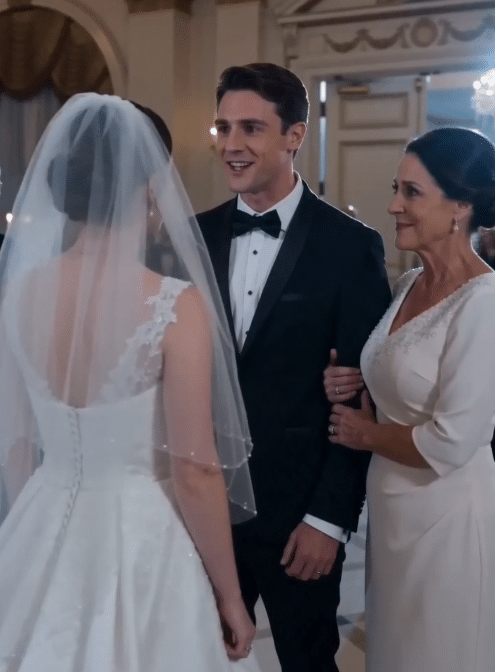
Act I
The ballroom went silent before the bride even hit the floor.
One moment, Captain Naomi Carter was standing beneath a white floral arch in a lace wedding gown, looking at the man she had promised to love. The next, his mother’s hands were on her shoulders, shoving her backward in front of three hundred guests.
Naomi stumbled.
Her train twisted around her legs.
Then she fell hard onto the polished marble, the room gasping as her veil slid loose and scattered over the floor like something broken.
The groom did not move.
Grant Whitmore stood at the altar in his black tuxedo, his jaw tight, his eyes cold, as if the woman on the floor had embarrassed him by falling.
“I’m not marrying you,” he said.
Naomi looked up at him, stunned.
A few minutes earlier, soft music had filled the grand ballroom of the Washington, D.C. hotel. Chandeliers had burned like captured stars above rows of senators’ wives, defense executives, old-money families, and men who knew how to smile for photographs while destroying lives behind closed doors.
Now every eye was on Naomi.
Grant’s mother, Vivian Whitmore, stood behind him in an off-the-shoulder white designer gown that looked almost bridal itself. Pearls gleamed at her throat. Her blonde hair was pulled into a sleek bun. Her face carried the vicious satisfaction of someone who had waited months for this moment.
Grant lifted his chin.
“Your family is nothing,” he said. “And so are you.”
Naomi did not answer.
The words landed deeper than the fall.
She could hear whispers starting already, sliding through the ballroom like smoke.
Nothing?
Who is her family?
Did he just leave her at the altar?
Naomi’s hand pressed against the marble. Her fingers trembled, but she refused to cry in front of them. Not in front of Grant. Not in front of Vivian. Not in front of guests who had smiled at her five minutes ago and now watched her like she was a scandal unfolding for their entertainment.
Vivian stepped forward and looked down at her.
“Get up,” she said quietly, but loud enough for the front rows to hear. “You have embarrassed this family long enough.”
That almost made Naomi laugh.
Embarrassed this family.
As if she had not endured six months of whispered insults about her background. As if she had not smiled through dinners where Vivian introduced her as “Grant’s little surprise” and waited for people to ask what she meant.
As if Grant had not held her hands the night before and promised, “Tomorrow, none of this matters. It’s you and me.”
But now he would not even look at her like a person.
“You lied to me,” he said.
Naomi’s breath caught.
“No,” she whispered. “I didn’t.”
“You let me think you belonged here.”
Vivian’s smile widened.
Naomi looked around the ballroom. The white roses. The champagne towers. The gold-rimmed plates. The guests in black tie, all frozen between horror and curiosity.
She had never wanted any of this.
She had wanted a small ceremony.
Grant had insisted on the ballroom.
Vivian had insisted on the guest list.
And now Naomi finally understood why.
This was not a broken wedding.
It was a public execution.
Then the grand double doors burst open.
The sound cracked through the room like thunder.
Every head turned.
A distinguished Black man in formal Army dress uniform marched into the ballroom, medals catching the chandelier light with each measured step. Two soldiers moved behind him in perfect formation.
The crowd parted before they even understood why.
Naomi looked up from the floor.
Her eyes widened.
One word escaped her.
“Father…”
Grant went pale.
Vivian’s hand flew to her chest.
And General Marcus Carter stopped in front of his daughter with a face carved from grief, fury, and pride.
“Captain Naomi Carter,” he said, reaching down to lift her with both hands, “Father is late.”
Naomi rose slowly, the lace of her gown falling back into place around her.
The general looked at Grant.
Then at Vivian.
Then at the silent room.
“It is time,” he said, “to reclaim your honor.”
And that was when the Whitmores realized they had not humiliated a helpless bride.
They had humiliated the wrong soldier.
Act II
Naomi Carter had spent her whole life learning how to stand still under pressure.
Not because she was cold.
Because she had been raised by a man who believed dignity was not something people gave you. It was something you carried into every room, especially the ones designed to make you feel small.
Her mother died when Naomi was twelve. After that, General Marcus Carter became father, mother, teacher, protector, and sometimes the one person Naomi fought hardest to escape.
He was strict, proud, and impossible to impress.
But he loved her with the quiet devotion of a man who polished her shoes before academy interviews, left handwritten notes in her textbooks, and never missed a promotion ceremony unless duty dragged him across the world.
When Naomi became an Army captain, Marcus wept in private.
She only knew because she found the handkerchief later.
Grant Whitmore had met her at a veterans’ fundraising gala eighteen months before the wedding. He was charming then, almost shy, with dark hair, bright ambition, and a talent for making Naomi feel seen in a city where everyone usually looked past people to search for connections.
He did not ask about her family name.
At least not at first.
He asked what music she liked. What books had stayed with her. Whether she ever got tired of being brave.
That last question had disarmed her.
Naomi had spent years being saluted, tested, underestimated, and praised for resilience she had never asked to need. Grant made weakness sound safe.
So when he assumed she came from “ordinary military people,” she let him.
Not because she was ashamed.
Because she wanted to know who he would be if he thought there was nothing to gain.
For a while, he was wonderful.
He brought coffee to her office. He waited through late-night calls. He told her his mother was difficult but harmless, old-fashioned but loyal.
Vivian Whitmore was not harmless.
She was a woman who treated kindness like poor breeding. She came from a family that had turned proximity to power into an inheritance. Her late husband had built Whitmore Strategic Group, a private consulting firm that lived on defense contracts and political favors. Vivian had spent decades polishing the family name until it shone brightly enough to hide the cracks.
She did not want a daughter-in-law.
She wanted an asset.
The first time Naomi met her, Vivian smiled, looked her up and down, and said, “How inspiring. Grant has always had such a generous heart.”
Naomi understood the insult immediately.
Grant pretended not to.
Over time, the insults became sharper.
Vivian asked whether Naomi’s father would be able to “contribute anything meaningful” to the wedding. She suggested Naomi wear a simpler gown because “some women look overwhelmed by luxury.” She once told a table of guests that Naomi had “done remarkably well for someone with no real society training.”
Naomi wanted to walk away.
Grant begged her not to.
“She’s scared of losing me,” he said. “Give her time.”
So Naomi gave time.
She gave patience.
She gave grace to people who saw grace as permission.
Two weeks before the wedding, Vivian changed.
She became too sweet. Too calm. She stopped making cutting remarks in public and began watching Naomi with a secretive little smile.
Naomi noticed.
Soldiers notice shifts in atmosphere.
They notice doors left half-open, voices lowering when they enter, people pretending not to hide things.
Then Grant became distant.
He missed calls. He stopped asking about her day. He started spending long evenings in his mother’s suite at the hotel, claiming final wedding stress.
Naomi asked him once, “Are you still sure?”
He kissed her forehead.
“Of course.”
But his eyes moved away too quickly.
The night before the wedding, Naomi found a folder outside Vivian’s sitting room.
Her name was on it.
Inside were printed records, private photographs, financial summaries, and a background report so incomplete it was almost funny. It listed Naomi as a career officer with “limited personal assets,” “no known elite family connections,” and “unknown paternal influence.”
Unknown paternal influence.
Naomi stared at the phrase for a long time.
Then she heard Vivian’s voice through the door.
“She trapped you, Grant. She let you think she was more than she is.”
Grant’s answer came low.
“It’s tomorrow.”
“Then tomorrow is when you end it,” Vivian said. “In front of everyone. Before she attaches herself to this family forever.”
Naomi should have left then.
Instead, she closed the folder, placed it back exactly where she found it, and walked away.
Because one page in that file had changed everything.
It was not about her.
It was about Whitmore Strategic Group.
And Naomi finally understood that Vivian’s sudden cruelty was not just about status.
It was about fear.
Act III
The ballroom did not know what to do with General Marcus Carter.
Washington society understood power when it arrived in limousines, private security details, donor circles, or quiet introductions near the Senate dining room.
But this was different.
Marcus Carter did not ask permission to command attention.
He carried it.
He stood beside Naomi beneath the wedding arch, one hand steady at her back, and looked at the man who had just called his daughter nothing.
“Mr. Whitmore,” he said, voice calm enough to chill the room. “You will repeat what you said.”
Grant’s mouth opened.
No sound came out.
Vivian recovered first.
“This is a private family matter,” she said, forcing a smile. “I don’t know who you think you are, but—”
“You know exactly who I am.”
The room shifted.
Someone in the second row whispered, “That’s General Carter.”
Another guest leaned forward, suddenly pale.
Grant looked at Naomi.
“Naomi,” he said, but her name sounded different now. Less like love. More like calculation.
She met his eyes.
For the first time all day, she did not look wounded.
She looked awake.
“You said my family was nothing,” she said. “So say it again.”
Grant swallowed.
Vivian’s fingers dug into his sleeve.
“Naomi, sweetheart,” Vivian said, trying to soften her voice. “This has all become very emotional.”
Naomi smiled faintly.
That smile frightened Vivian more than tears would have.
“Don’t call me sweetheart.”
The general turned slightly.
One of the soldiers behind him stepped forward and handed him a sealed leather folder.
Vivian’s face tightened.
Marcus opened it.
“Whitmore Strategic Group has spent the last four years presenting itself as a patriotic consulting firm supporting military readiness, veteran housing, and overseas logistics,” he said.
Grant stiffened.
The guests began whispering again.
Naomi’s eyes stayed on Vivian.
“A week ago,” Marcus continued, “Captain Carter discovered irregularities connected to a charity procurement channel your company helped manage. Missing funds. Forged approvals. Payments routed through shell vendors.”
Vivian laughed, too loudly.
“This is absurd.”
Marcus looked at her.
“My daughter was not assigned to investigate you. She found the pattern by accident while reviewing veteran housing grant complaints. Then she did something your family apparently forgot honorable people still do.”
He paused.
“She reported it.”
The words rolled across the ballroom.
Grant turned toward Naomi in disbelief.
“You reported my family?”
Naomi’s expression did not change.
“I reported evidence.”
Vivian stepped forward, her pearls trembling against her throat.
“You little hypocrite. You smiled in my house while digging through our business?”
Naomi’s voice stayed quiet.
“I smiled in your house while you insulted my father, my service, my background, and every person you thought was beneath you.”
Vivian’s face flushed.
“You deceived us.”
“No,” Naomi said. “You underestimated me.”
That was the first blow.
The second came from Marcus.
He lifted one document from the folder.
“Your private investigator did not fail to find Naomi’s father because he was insignificant,” he said. “He failed because you paid for gossip, not truth.”
A few guests lowered their eyes.
Others stared openly now.
“Captain Naomi Carter,” Marcus said, “graduated with honors, served two deployments, led logistics operations under hostile conditions, and returned home to build housing support for wounded veterans. She did not need your name, your ballroom, or your approval.”
Naomi breathed in slowly.
Her veil still hung crooked.
Her dress still bore the mark of the fall.
But the shame was leaving her.
It had never belonged to her.
Grant’s face twisted.
“You could have told me.”
“I wanted to,” Naomi said. “Many times.”
“Then why didn’t you?”
She looked at him with deep sadness.
“Because every time your mother looked down on me, I waited to see whether you would stand beside me.”
Grant looked away.
That answer hurt because it was true.
He had not stood beside her once.
Then Marcus turned toward Vivian.
“And as for laying hands on my daughter…”
The ballroom went completely still.
Vivian took a step back.
Her earlier triumph had curdled into panic.
“I barely touched her.”
Naomi looked at the marble floor where she had fallen.
Then she looked back at Vivian.
“You shoved me because you thought no one powerful would defend me.”
Vivian’s mouth trembled.
Grant reached for Naomi’s arm.
She stepped away before he could touch her.
“No,” she said.
It was one word.
But it ended everything.
Then the ballroom doors opened again.
This time, two federal investigators entered quietly with hotel security behind them.
Vivian’s face turned white.
And Grant finally understood that the wedding had not been interrupted.
It had become evidence.
Act IV
Nobody moved as the investigators approached the altar.
The string quartet had stopped playing long ago. The flowers still framed the aisle. The champagne still waited untouched along the far wall. But the wedding had transformed into something colder, sharper, and far more honest than celebration.
Vivian whispered, “Grant, fix this.”
Grant stared at Naomi, as if she might still save him from the consequences of choosing his mother over her.
That was the tragedy of him.
Even then, he wanted Naomi to protect the family that had humiliated her.
“Naomi,” he said quietly, “we can talk.”
She looked at his hand, then at his face.
“You had the whole morning to talk.”
His jaw tightened.
“I was angry.”
“No,” she said. “You were obedient.”
The word struck him.
Vivian snapped, “How dare you speak to him that way?”
Naomi turned.
The entire room turned with her.
For months, Vivian had controlled every table, every guest list, every flower, every insult wrapped in politeness. But now her voice sounded small inside the ballroom she had designed as a throne room.
Naomi walked toward her.
Not quickly.
Not dramatically.
Just steadily.
Her train followed behind her across the marble. A torn edge of lace brushed the floor. Someone in the front row began to cry softly, though Naomi did not know who.
“You wanted me exposed,” Naomi said. “So let’s be exposed.”
Vivian’s lips parted.
“You told your friends I was after Grant’s money. You told your board I had no pedigree. You told your son I would drag him down.”
She stopped an arm’s length away.
“Now tell them why you were really afraid of me.”
Vivian said nothing.
Marcus handed another page to one of the investigators.
The man reviewed it, nodded once, and spoke in a low voice to hotel security.
Grant saw the movement and panicked.
“Mother,” he whispered.
Vivian’s composure shattered.
“You stupid boy,” she hissed. “You were supposed to end it before this happened.”
The microphone near the arch was still live.
Her words carried across the entire ballroom.
A wave of shock passed through the guests.
Grant froze.
Naomi closed her eyes for half a second.
There it was.
Not the full confession.
But enough to reveal the design.
This had not been a sudden rejection. It had been planned. The altar, the guests, the humiliation, the shove. Every piece of it had been chosen to make Naomi look discarded before anyone could ask what she knew.
Marcus looked at his daughter.
Naomi gave him the smallest nod.
He stepped forward.
“Mrs. Whitmore, you and your company are now under formal investigation. You will have the chance to respond through counsel.”
Vivian’s face twisted.
“You think medals make you untouchable?”
Marcus did not blink.
“No,” he said. “I think truth makes you vulnerable.”
Grant turned to Naomi again, desperate now.
“I didn’t know about the money.”
Naomi’s expression softened, but not in forgiveness.
In farewell.
“You knew about the cruelty.”
That silenced him.
Because money could be hidden in accounts, contracts, and signatures.
Cruelty had stood in the open.
He had watched his mother humiliate Naomi at dinner. He had watched her reduce Naomi’s service to a costume. He had watched her treat a decorated officer like a charity case.
And at the altar, when Naomi fell, he had watched that too.
Naomi reached up and removed her veil.
The room seemed to hold its breath.
She placed it carefully on the floral arch, where moments earlier she had stood ready to become Mrs. Grant Whitmore.
Then she turned to the guests.
“My father used to tell me honor is not what people call you when they are impressed,” she said. “It is what remains when they try to strip everything else away.”
Her voice trembled only once.
“I came here today prepared to become a wife. Instead, I remembered I was already someone.”
Marcus’s eyes glistened.
Grant looked ruined.
Vivian looked cornered.
Naomi looked free.
She took off the engagement ring and held it out.
Grant stepped forward automatically.
But Naomi did not give it to him.
She placed it on the floor between them.
The diamond caught the chandelier light, bright and useless.
“I won’t throw it,” she said. “That would make it seem like it mattered.”
Then she walked past him.
The soldiers moved with her.
Marcus stayed one moment longer, facing Grant and Vivian beneath the arch they had turned into a weapon.
“You mistook humility for weakness,” he said. “That mistake will cost you more than this wedding.”
And for the first time in her life, Vivian Whitmore had no room left to perform.
Only consequences.
Act V
Naomi did not cry until she reached the empty corridor outside the ballroom.
The doors closed behind her, muffling the chaos inside. Reporters had not arrived yet. Guests were still whispering. Hotel staff moved carefully, pretending not to stare.
Naomi stood beneath a wall of golden light, one hand pressed against her ribs, breathing like she had just marched out of battle.
Marcus stepped beside her.
For a moment, he was not a general.
He was only her father.
“I am sorry I was late,” he said.
Naomi laughed once through tears.
“You always make an entrance.”
He smiled, but it broke quickly.
“I should have been here before they touched you.”
She looked down at her gown.
“I thought I could handle it.”
“I know.”
“I thought if I stayed graceful enough, patient enough, kind enough, they would eventually see me.”
Marcus shook his head.
“People committed to looking down rarely look closer.”
Naomi wiped her cheek.
Her makeup had begun to blur at the edges, but somehow she looked more beautiful than she had at the altar. Not polished. Not perfect. Real.
“I loved him,” she said.
“I know.”
“That’s the humiliating part.”
“No,” Marcus said gently. “That’s the human part.”
Those words undid her.
Naomi leaned into her father, and he held her carefully, mindful of the gown, the medals, the years, and the little girl who used to fall asleep against his uniform after nightmares.
Inside the ballroom, Vivian Whitmore was escorted into a private room with counsel on speakerphone. Grant remained near the altar, staring at the ring on the floor until one of his groomsmen finally picked it up and placed it in his hand.
He tried to call Naomi that evening.
Then again at midnight.
Then the next morning.
She never answered.
By sunrise, the story had spread through Washington.
Not the version Vivian had planned.
Not the tale of a poor bride rejected by a powerful family.
The real one.
A decorated Army captain had been publicly humiliated at her own wedding by a groom and mother-in-law who thought she had no status, no protection, and no name worth fearing. Moments later, her father, General Marcus Carter, entered with evidence tied to a federal investigation into the groom’s family business.
The headlines were merciless.
The guests were even worse.
People who had smiled at Vivian for years suddenly remembered things. Remarks she had made. Deals that felt strange. Fundraisers that raised money no one could trace. Contractors who had vanished after asking questions.
Power did what power always does when weakness appears.
It moved away from her.
Within two weeks, Whitmore Strategic Group lost three major partnerships. Within a month, Grant resigned from the board. Vivian stopped appearing at charity events where she had once floated from table to table like royalty.
Naomi returned to work quietly.
There were flowers waiting at her office. Letters from women she had never met. Notes from veterans who had heard what happened and wanted her to know she had not fallen alone.
She kept only one card on her desk.
It was from her father.
Four words.
Proud of you. Always.
Three months later, Naomi attended a military charity gala in the same city.
Not as someone’s fiancée.
Not as someone’s almost-wife.
As Captain Naomi Carter.
She wore midnight blue, her hair swept back, her posture calm and unshaken. When she entered the room, conversations paused for a very different reason than they had at the wedding.
Respect has a sound.
Sometimes it is silence.
Across the hall, Grant saw her.
He looked thinner, humbled by the kind of loss that teaches too late. He approached slowly, stopping several feet away.
“Naomi,” he said.
She turned.
For a moment, she saw the man she had loved. The soft smile from the gala. The coffee cups. The late-night promises. The version of him that might have been real if he had been braver.
“I’m sorry,” he said.
She believed him.
That surprised her.
But belief was not the same as return.
“I hope you become someone who would have stood up for me,” she said.
Grant’s eyes filled.
Then Naomi walked away.
Near the balcony, Marcus waited with two glasses of sparkling water.
“You all right?” he asked.
Naomi took one glass.
“I am.”
He studied her face.
This time, she meant it.
The ballroom lights shimmered behind them, softer than the chandeliers at the wedding, less cruel somehow. Outside, Washington moved under a cold evening sky, full of secrets, ambition, and people trying to prove they belonged.
Naomi no longer felt the need to prove anything.
She had been pushed to the floor in front of everyone.
But she had risen as herself.
And that was the part Vivian Whitmore never understood.
Honor cannot be inherited through pearls, gowns, money, or a famous last name.
It is revealed when the room turns against you, when the person who promised to choose you does not, when every cruel voice waits for you to stay down.
Naomi Carter did not stay down.
She stood.
And by standing, she made everyone else look small.