Act I
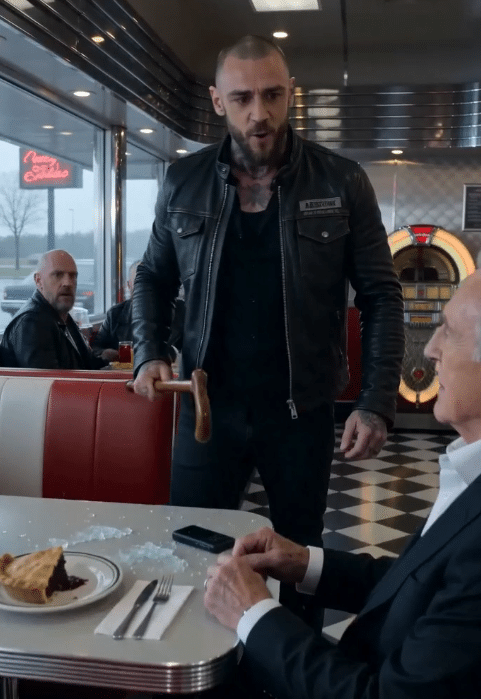
The diner went silent when the cane hit the table.
A plate split down the middle. A glass jumped, tipped, and rolled off the edge, shattering across the black-and-white tile floor. Coffee splashed onto napkins. A little girl in the corner booth grabbed her mother’s sleeve and buried her face in it.
The biker leader laughed.
He was a huge man with a shaved head, thick arms, and a gray goatee trimmed like he had planned the intimidation before walking in. His black leather vest was heavy with patches: an eagle on the chest, an American flag on one side, and a row of silver chains that clinked when he moved.
Behind him, two men in matching leather vests laughed louder than the joke deserved.
The old man in the booth did not.
He sat with one hand resting on the table, long white hair falling around his shoulders, his full beard making him look older than he probably wanted to be. His gray button-down shirt was plain. His jeans were worn. His wooden cane had been leaning against the booth a moment earlier.
Now it was in the biker’s hand.
“What now, king?!” the biker shouted.
The word king made the two men behind him laugh again.
The old man looked up slowly.
Not frightened.
Not confused.
Disappointed.
Across from him sat a younger man in a dark jacket who had gone pale the moment the biker grabbed the cane. He reached toward the old man as if begging him not to stand, not to answer, not to become whatever the room was suddenly afraid he might be.
But the old man only lifted two fingers to his ear, touching a small device hidden beneath his hair.
“It’s me,” he said quietly. “Bring them.”
The biker’s smile widened.
“Oh, listen to that,” he said, turning toward the diner. “Grandpa’s calling his army.”
No one laughed this time.
Outside the windows, the evening street darkened behind a row of black SUVs that had already been parked along the curb. Their tinted windows reflected the diner’s neon sign. For a moment, they looked empty.
Then their lights flashed.
Not red and blue.
White.
Sharp.
Silent.
Three more black SUVs rolled into the lot, fast and controlled, blocking the exits in a perfect line. Doors opened almost at once. Men in dark suits stepped out, not rushing, not shouting, just moving with the calm precision of people who did not need to prove they were dangerous.
The biker leader turned toward the window.
His laughter died.
The old man placed both palms on the table and pushed himself upright. Without his cane, it took effort. He grimaced slightly, but his eyes never left the biker.
Then he stepped forward.
Slowly.
The two men behind the biker stopped smiling.
The old man reached out and took the cane from the biker’s hand.
The big man did not resist.
He couldn’t.
Not after seeing the black SUVs.
Not after seeing the men outside.
Not after hearing the old man say, in a voice that seemed to belong to someone the whole room should have known:
“What is this, Mason?”
The biker froze.
The old man’s jaw tightened.
“You just stole your grandfather’s cane.”
And that was when everyone in the diner understood the fight had never been between a biker and an old man.
It was between a grandson and the ghost he had spent his life pretending not to need.
Act II
Before he became the man with the cane, Arthur Kane had been called King.
Not by reporters.
Not by admirers.
By men who had learned, sometimes the hard way, that his word could end a fight before the first punch was thrown.
He had not chosen the name. Men like Arthur rarely choose their legends. Other people build them from fear, loyalty, stories told late at night, and mistakes that somehow survive long enough to become myths.
In his youth, Arthur rode with the Iron Eagles, a motorcycle club that began as a brotherhood of veterans and mechanics on the outskirts of Pennsylvania. Back then, the club fixed bikes, raised money for widows, and gave lost men a place to belong when the country had no idea what to do with them.
Arthur believed in that version.
He believed in loyalty.
He believed in the patch on a man’s back meaning something more than power.
Then the club changed.
Money came in. Bad men came with it. Younger riders wanted fear instead of respect. They liked the way people stepped aside when engines roared down Main Street. They liked the way silence could be mistaken for obedience.
Arthur fought it until fighting from the inside was no longer enough.
By the time he walked away, the Iron Eagles had split in two. One branch stayed clean. The other became something rotten wearing the same colors.
That was the branch Mason Kane inherited.
Mason was Arthur’s grandson, though he had spent most of his life treating the word like an insult.
His father, Daniel, had died when Mason was thirteen, leaving behind a garage full of old tools, unpaid bills, and a boy with too much grief and no patience for anyone who spoke softly. Arthur tried to take him in. He tried to teach him to fix engines, to hold anger without letting it hold him back.
Mason wanted none of it.
“You think being calm makes you strong,” Mason shouted at him once, fifteen years old and shaking with rage. “It just makes people think they can take from you.”
Arthur remembered that night too clearly.
The broken porch light.
The rain in the yard.
The boy who looked exactly like Daniel and nothing like him at all.
Arthur had said the wrong thing then. He knew that now.
“Real men don’t need to scare people,” he told Mason.
Mason heard only judgment.
A week later, he ran.
By twenty, Mason wore the Iron Eagle patch. By thirty, he had made himself leader of the worst version of it, surrounding himself with men who called cruelty strength and treated the world like it owed them fear.
Arthur watched from a distance.
He never stopped sending help.
A lawyer when Mason was arrested.
Money when Mason’s mother needed surgery.
A warning when federal agents began circling the club.
Mason never answered.
Then, two months ago, Arthur received a call from a woman named Nora Bell.
She owned the diner off Route 19, the one with red vinyl booths and pie cooling behind glass. Arthur knew the place. Everyone in the county knew it. Nora’s husband had served with Daniel. Her son had grown up sweeping the floors after school.
Her voice shook when she called.
“Mason’s men came in again,” she said. “They say I owe protection money.”
Arthur closed his eyes.
The word protection had always disgusted him when used by men who created the danger.
“How much?” he asked.
“It’s not about the money,” Nora said. “They hit my son.”
Arthur did not speak for several seconds.
Then Nora added, quieter, “Mason was with them.”
That was why Arthur came to the diner.
Not with weapons.
Not with threats.
With a cane, a lawyer, and enough federal attention outside the window to remind the rotten branch of the Iron Eagles that the world still had laws.
The younger man in the booth was Elliot Shaw, Arthur’s attorney and Daniel’s godson. He had spent three years helping investigators build a case against the criminal side of the club. Extortion, stolen property, witness intimidation, fraudulent charity accounts.
They had names.
They had bank records.
They had recordings.
But Arthur had insisted on one thing before warrants went public.
“I want to look Mason in the eye,” he said.
Elliot warned him against it.
“He won’t listen.”
Arthur looked at the cane leaning beside his chair.
“He might not,” he said. “But I owe Daniel one last attempt.”
The cane was Daniel’s.
Hand-carved after a factory accident injured Arthur’s leg years earlier. Daniel had made it in high school woodshop, sanding the handle by hand, burning a tiny eagle into the curve where Arthur’s palm rested.
For decades, Arthur carried that cane like a piece of his son still walking with him.
Mason had seen it once as a child.
He used to trace the carved eagle with his thumb.
Now he had used it to smash a plate in a diner and call his grandfather king like it was a joke.
But Arthur knew something Mason did not.
The cane held more than memory.
And the boy who once traced the eagle had just put his fingerprints all over the past.
Act III
“Mason,” Arthur said again.
The biker leader’s face hardened at the sound of his own name.
Not because he hated it.
Because for one dangerous second, he had looked like a child caught doing something shameful.
Then the mask came back.
“You shouldn’t have come here,” Mason said.
Arthur leaned on the cane, the carved eagle fitting into his palm as if it had been waiting there all along.
“I was told you were harassing Nora Bell.”
Mason snorted. “Business dispute.”
“You smashed her son’s hand in a car door.”
One of the bikers behind Mason shifted.
The diner went colder.
Mason looked around at the watching patrons, the phones half-hidden beneath tables, the suits outside the windows, the SUVs blocking the lot.
“You trying to embarrass me?”
Arthur’s face tightened.
“No. I’m trying to find what’s left of you.”
Mason stepped forward.
The two suited men nearest the window moved in response. Not much. Just enough.
Mason noticed.
“You brought federal dogs to a family conversation?”
Elliot stood from the booth.
“You brought extortion to a diner.”
Mason’s eyes cut to him. “Sit down, lawyer.”
Arthur lifted a hand.
Elliot stopped.
The old man looked tired suddenly. Not weak. Tired in the way of someone who had carried too many second chances and knew this one might be the last.
“You think that vest makes you Daniel’s son?” Arthur asked.
Mason’s jaw twitched.
“Don’t say his name.”
“I knew him before you did.”
“You left the club,” Mason snapped. “Dad stayed loyal.”
Arthur’s eyes sharpened.
“No. Your father stayed to pull men out before the club swallowed them. There’s a difference.”
Mason laughed, but it had no joy.
“That what you told yourself all these years?”
Arthur reached into his shirt pocket and removed a folded photograph.
He placed it on the table, away from the broken glass.
Mason looked despite himself.
In the photo, Daniel Kane stood outside the same diner twenty years earlier, younger than Mason was now, one hand on a motorcycle, the other resting on the shoulder of a little boy with messy hair and a serious face.
Mason.
On the back, in Daniel’s handwriting, were the words:
Keep him away from the darkness if I don’t make it.
Mason stared at it.
The room held its breath.
Then he knocked the photo off the table.
“Cheap trick.”
Arthur closed his eyes briefly.
When he opened them, something in him had changed.
A door had shut.
Elliot saw it first.
So did Mason, though he did not understand it yet.
Arthur tapped the cane once against the floor.
“Mason, who gave you permission to use the Iron Eagle name to threaten families?”
Mason smiled.
“There it is.”
“What?”
“The old king voice.” Mason leaned closer. “You want your throne back? Is that it?”
Arthur looked at the men behind Mason.
“You boys know what that patch used to mean?”
Neither answered.
“Of course you don’t,” Arthur said. “Because men like Mason don’t teach history. They only use symbols.”
Mason’s face flushed.
“You’re done talking.”
He reached for the cane again.
This time, Arthur did not let him take it.
The grip was sudden.
Hard.
For the first time, everyone saw that the old man’s hands were still strong.
Mason tried to pull back.
Arthur held the cane between them.
“You already stole it once,” Arthur said. “You don’t get to steal it twice.”
Mason’s eyes dropped to the carved eagle.
Something flickered.
A memory, maybe.
Or guilt.
Then the diner door opened.
Two federal agents stepped inside.
Behind them came Nora Bell, small, gray-haired, and furious in an apron dusted with flour.
Her right hand was wrapped around her son’s arm.
His fingers were bandaged.
Mason’s face darkened.
Arthur turned toward Nora.
“I’m sorry,” he said.
Nora’s eyes filled, but her voice stayed firm.
“Don’t apologize for him.”
Mason scoffed. “This is pathetic.”
Nora looked at him.
“You came into my diner and told my son you owned this town.”
Mason spread his arms. “Looks like I was wrong.”
“No,” Nora said. “You were never wrong about owning things.”
She lifted her chin.
“You were wrong about people.”
One of the agents stepped forward.
“Mason Kane, we have a warrant.”
Mason looked at Arthur, and for one last second, the arrogance cracked open into betrayal.
“You set me up.”
Arthur’s answer was quiet.
“No. I gave you one last chance to walk out as Daniel’s son.”
He looked at the broken plate on the table.
“You chose to stay as this.”
And then Elliot reached for the cane.
Not to take it.
To open it.
Act IV
There was a hidden latch beneath the carved eagle.
Mason had never noticed it as a child.
Arthur had not known about it for years either. Daniel had been clever with wood, clever with secrets, clever enough to understand that if he hid something in a safe, the wrong men might find it.
So he hid it in the one thing no one would take from an injured father.
His cane.
Elliot pressed the latch. The handle shifted with a faint click.
Inside was a narrow metal tube.
Arthur removed it slowly, his thumb trembling for the first time all evening.
Mason stared.
“What is that?”
“The reason your father died,” Arthur said.
The words struck harder than any shout.
Mason went still.
For years, he had believed his father died in a warehouse fire started by a rival crew. That story had been repeated so often it became family fact. He had built his anger on it. Built his identity on it. Built his loyalty to the Iron Eagles on the belief that enemies outside the club had taken Daniel from him.
Arthur opened the tube.
Inside was a small roll of film, brittle with age, and a folded letter sealed in plastic.
Elliot took the film carefully and handed it to one of the agents.
Arthur kept the letter.
His eyes stayed on Mason.
“Daniel found out club officers were using veteran charity runs to move stolen goods. He copied their ledgers. He planned to turn them over.”
Mason shook his head.
“No.”
“He hid the evidence in this cane the day before the fire.”
“No.”
Arthur’s voice roughened.
“He was not killed by enemies of the club.”
Mason’s face drained.
“He was killed by men wearing the same patch you wear now.”
The diner was silent enough to hear the hum of the neon sign.
One of Mason’s men whispered, “Boss…”
Mason turned on him. “Shut up.”
But his voice had lost its weight.
Arthur unfolded the letter.
He did not read all of it aloud.
Only the part Mason needed to hear.
If Mason grows up angry, don’t let them turn that anger into a uniform. Tell him I loved the road, but I loved coming home more. Tell him a patch is only worth wearing if it protects the people who can’t protect themselves.
Arthur stopped.
His eyes shone, but he did not let the tears fall.
Mason stared at the letter like it was a weapon pointed at everything he had become.
“You had that this whole time?” he whispered.
“I didn’t know it was there until last year.”
“Liar.”
Arthur stepped closer.
“I am many things. But not that.”
Mason looked out the window at the SUVs. At the agents. At Nora. At her son. At the smashed plate. At the cane.
His whole life had arranged itself around one story.
Now the story was collapsing.
And underneath it was a boy who had never learned what to do with grief except turn it outward.
The lead agent spoke again.
“Mason Kane, you are under arrest for conspiracy, extortion, assault, and witness intimidation.”
One of Mason’s men bolted toward the back hallway.
He made it three steps before two agents entered from the kitchen and stopped him without drama.
The second biker raised his hands immediately.
Mason did not move.
He looked at Arthur.
“You think this fixes anything?”
“No.”
“You think I’m suddenly sorry?”
Arthur’s face broke, just slightly.
“No.”
“Then why show me?”
Arthur glanced at Daniel’s letter.
“Because punishment without truth only makes martyrs. I wanted you to know exactly what you betrayed.”
For once, Mason had no answer.
The agents moved in.
He did not fight them.
But as they turned him toward the door, his eyes landed on the cane one more time.
“The eagle,” he said quietly.
Arthur paused.
Mason swallowed.
“I remember it.”
The old man’s hand tightened around the handle.
“I know.”
Then the agents led Mason outside, past the black SUVs, past the stunned faces pressed to the diner windows, past the town he had spent years trying to make afraid of him.
And Arthur Kane sat back down in the booth because his legs could carry him no farther.
Act V
The story hit the county before sunrise.
Not as legend.
As indictment.
By morning, reporters stood outside the diner, filming the broken plate still sitting in a box behind the counter. By noon, old club members began calling Arthur. Some apologized. Some denied everything. Some cried. A few tried to threaten him until they learned the federal case had already swallowed more names than anyone expected.
The Iron Eagles split again.
But this time, the rotten branch did not ride away proud.
It scattered.
Bank accounts froze. Garages were searched. Charity funds were audited. Men who had hidden behind patches and engines discovered that fear worked poorly under oath.
Nora Bell reopened the diner two days later.
Arthur arrived before dawn.
He found her sweeping the entrance alone, her son stacking chairs inside with his bandaged hand protected in a brace.
“You shouldn’t be working,” Arthur told him.
The young man smiled faintly.
“Mom says if I can complain, I can wipe menus.”
Nora pointed the broom at Arthur.
“And you shouldn’t be here without eating.”
So he sat in his old booth.
The glass was replaced. The plate was gone. But the table still had a small dent where the cane had come down.
Nora brought coffee without asking.
Arthur stared at it for a long time.
“I failed him,” he said.
Nora slid into the seat across from him.
“Daniel?”
Arthur shook his head.
“Mason.”
Nora’s face softened, but not enough to lie.
“Maybe.”
He looked up.
“Maybe you did,” she said. “Maybe his mother did. Maybe grief did. Maybe every man who handed him rage and called it strength did too.”
Arthur looked toward the window.
The SUVs were gone.
The street looked ordinary again.
That almost made it worse.
Nora touched the table.
“But he made choices, Arthur. Don’t steal responsibility from him just because you love him.”
He closed his eyes.
The words hurt because they were kind enough to be true.
Mason’s trial took months.
He did not testify. He did not apologize publicly. He sat in court wearing a suit that looked wrong on him, his head shaved clean, his hands folded while witnesses described the damage he had done.
Nora’s son spoke.
So did business owners.
So did former club members who had once laughed behind him and now wanted distance from the wreckage.
Arthur attended every day.
He never sat in the front row.
He never tried to catch Mason’s eye.
But he was there.
On the final day, before sentencing, Mason turned around.
Just once.
His gaze found Arthur.
For a moment, he looked again like the boy in the old photograph outside the diner. Serious. Angry. Lost. Still waiting for someone to tell him which story was true.
Arthur lifted the cane slightly.
Not as forgiveness.
Not as victory.
As memory.
Mason looked away first.
He was sentenced that afternoon.
There were no dramatic speeches afterward. No shouting in the hallway. No thunderstorm waiting outside to make the moment cinematic. Just reporters, court officers, fluorescent lights, and Arthur walking slowly down the courthouse steps with Daniel’s cane in his hand.
Elliot met him at the bottom.
“You did the right thing,” he said.
Arthur looked at him.
“I did the late thing.”
Sometimes that is all justice gets.
Late truth.
Late courage.
Late love, arriving after the damage, carrying whatever pieces are left.
A month later, Arthur returned to the diner with a small wooden box.
Nora had reserved the back wall for it.
Not the wall with the jukebox. Not the wall with the old license plates and faded road signs. The quiet wall near the booth where Mason had stood laughing with Daniel’s cane in his hand.
Inside the box was the carved eagle handle.
Arthur had replaced it after the trial, not because it was broken, but because it had become something else now. Evidence. Memory. Warning.
Beneath it, Nora placed a brass plaque.
A patch does not make a man. What he protects does.
Old Iron Eagles came to see it.
Some stood silently.
Some touched the glass.
One man removed his vest before leaving the diner and never wore it again.
Arthur kept the rest of the cane. He still needed it. His leg was worse in cold weather, and age had a way of turning pride into practicality. But every time his palm closed around the new handle, he felt the absence of the carved eagle.
And sometimes, strangely, that absence helped.
It reminded him that memory was not meant to be held so tightly it could not change shape.
Winter passed.
Then spring came soft along Route 19, bringing motorcycles back onto the roads and pie back into the diner display. Nora’s son healed. The town stopped flinching at engine noise. The Iron Eagle name, at least in that county, became less a threat than a cautionary tale.
One evening, Arthur sat in the same booth with Elliot across from him, watching sunlight fade through the front windows.
A boy from the next booth, maybe seven years old, stared at Arthur’s cane.
“Were you really a king?” the boy asked.
His mother went red. “Sorry.”
Arthur smiled.
“No,” he said. “Just a man people told stories about.”
The boy considered that.
“Were they good stories?”
Arthur looked at the wall where the carved eagle rested behind glass.
“Some were,” he said. “Some weren’t.”
The boy nodded as if this made perfect sense.
Then he asked, “Can bad stories get better?”
Arthur’s throat tightened.
Elliot looked down at his coffee.
Across the diner, Nora stopped wiping the counter.
Arthur thought of Daniel. Of Mason. Of the broken plate. Of the letter hidden for decades inside a cane made by a son who had understood loyalty better than the men who claimed to own it.
Finally, he answered.
“They can’t become good,” he said. “But they can become honest.”
The boy seemed satisfied and returned to his fries.
Arthur leaned back in the booth.
Outside, the road was clear. No black SUVs. No flashing lights. No men in suits. Just the evening traffic rolling past a diner that had seen fear come through its doors and leave in handcuffs.
Arthur placed his cane against the seat beside him.
This time, no one touched it.
And for the first time in years, the old man called King did not feel like a legend, a failure, or a ghost from a club that had lost its soul.
He felt like a grandfather who had finally told the truth.
Too late to save Mason from consequences.
But not too late to save the story from becoming another lie.