Act I
The man came through the diner doors holding the little girl too tightly.
That was the first thing Hank Mercer noticed.
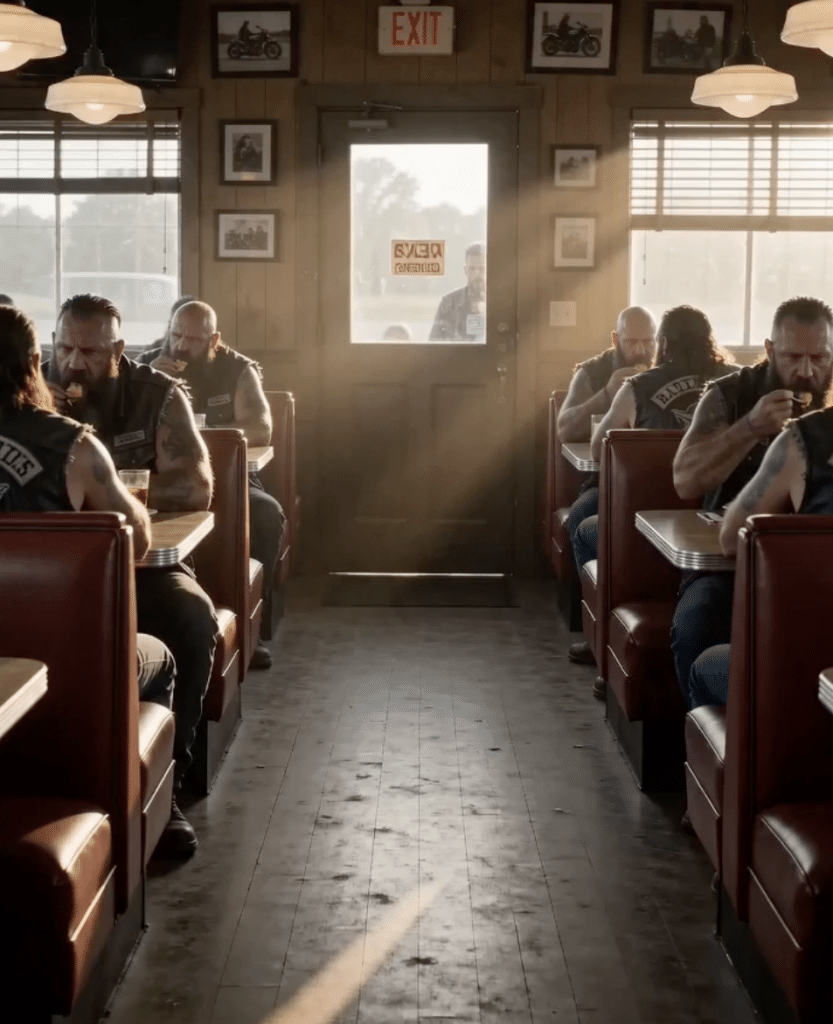
Not the dirt on her shirt. Not the fear in her wide blue eyes. Not the way the sunlight poured in behind them, filling the old roadside diner with dust and gold.
The grip.
The man’s fingers were wrapped around her small hand like a lock.
He had dark, messy hair, a full beard, and the tense look of someone pretending to be calm while searching for every exit. His tan T-shirt was damp at the collar. His jeans were dusty. He moved fast, almost dragging the child past the counter, past the red leather booths, past the framed photographs of motorcycles and veterans on the wall.
Every biker in the diner stopped eating.
Hank stood first.
He was the kind of man people noticed even sitting down. Large, gray-bearded, broad-shouldered, with long hair tied back and tattoos climbing his arm beneath a black leather vest. The patches read RICHMOND and ROCKETS, but the regulars knew those patches meant more than a club.
They meant nobody helpless got carried through that diner without questions.
Hank stepped into the man’s path.
The stranger stopped hard.
The girl nearly stumbled.
Hank’s eyes stayed on the child. His voice softened in a way that made the whole room lean in.
“You okay, sweetheart?”
The man answered too quickly.
“She’s fine.”
Hank did not look at him.
“I asked her.”
The little girl stared up at Hank. Her blonde hair hung in tangled strands around her face. Dirt smudged her cheek. Her lower lip trembled, but she did not cry.
The man squeezed her hand.
“She’s shy,” he said.
Hank slowly crouched, bringing himself down to the child’s level. Around him, chairs creaked as the other bikers shifted, watching the man’s every movement.
“What’s your name?” Hank asked.
The girl opened her mouth, then closed it.
The man smiled. “Lily. Her name’s Lily.”
Hank saw the girl flinch.
There it was.
Not a big movement.
Not enough for a careless person to notice.
But Hank Mercer had spent too many years watching frightened people try to stay alive inside small gestures.
He held out one large hand, palm up, not touching her.
“You don’t have to say anything loud,” he said. “Just tell me if you need help.”
The girl looked at the man beside her.
Then she leaned toward Hank.
Her whisper was so small it nearly disappeared beneath the hum of the old refrigerator behind the counter.
“That’s not my dad.”
The diner went still.
Hank’s face changed.
Not dramatically. Not with rage spilling everywhere. It changed the way a door changes when the lock turns from the inside.
He straightened to his full height and placed himself between the child and the man.
The stranger’s eyes darted toward the glowing EXIT sign above the door.
Hank’s voice dropped.
“Then who are you?”
And for the first time since walking in, the man had no answer ready.
Act II
The diner was called Rosie’s, though Rosie had been gone for almost twelve years.
Her name still glowed in red neon above the front windows. Her pie recipes were still taped inside the kitchen cabinet. Her photograph still hung near the register, showing a laughing woman in a blue dress standing between two motorcycles, one hand on Hank Mercer’s shoulder and the other waving at whoever held the camera.
Rosie had believed every town needed one place where the wrong people could come in and find the right kind of help.
After she died, Hank kept the diner open.
People assumed it was because bikers needed somewhere to drink coffee and talk engines. That was only half true.
The other half lived in a quiet rule written on a chalkboard behind the counter.
If you need help and cannot say it, ask for the blueberry pie.
No one outside the diner understood it.
Runaways had used it. Women with bruised spirits and shaking hands had used it. Truckers had sent frightened hitchhikers there. Once, a teenage boy came in asking for blueberry pie three times in a row, even though there was no blueberry pie in the display case. Hank drove him to his aunt’s house two counties over and waited outside until she opened the door.
The Richmond Rockets had not always been protectors.
Hank knew that better than anyone.
In the old days, they had been loud, reckless, and too proud of being feared. They rode like thunder and mistook intimidation for respect. Hank had worn that arrogance like armor when he was young.
Then his daughter disappeared.
Her name was Emily.
She had been nineteen, stubborn, sharp-tongued, and too much like him for either of them to survive each other peacefully. She wanted to leave town. Hank wanted her to stay. She had fallen for a smooth-talking man named Caleb Voss, and Hank had hated him from the first handshake.
Not because he looked dangerous.
Because he didn’t.
Caleb was polite. Clean. Soft-spoken. The kind of man who made fathers look unreasonable for distrusting him.
Emily left after one final argument.
“You don’t protect people,” she shouted at Hank from the porch. “You control them and call it love.”
He never forgot that.
Two months later, she sent a letter.
Not a phone call.
A letter.
Dad, I was wrong about some things. If I come home, don’t yell first. Please.
Hank read it too late.
By the time he reached the return address, the apartment was empty. Neighbors said a man had loaded boxes into a truck at night. A landlord said Emily left willingly. Police said she was an adult and had the right to disappear.
Hank searched anyway.
For years.
He followed rumors, paid private investigators, rode through storms to towns that had never heard her name. Every lead ended in silence.
Then Rosie died, and grief turned Hank into something quieter.
He rebuilt the Rockets from the inside. No more terrorizing towns. No more pretending fear made men powerful. He made them volunteer at food drives, repair cars for single mothers, escort stranded travelers, and sit in that diner long enough for anyone scared to know they were not alone.
Some men left.
The ones who stayed became better.
Hank never found Emily.
But he kept the door open.
That afternoon, as the stranger stood frozen under the EXIT sign and the little girl trembled behind Hank’s leg, the old wound inside him stirred.
Not because the child looked like Emily.
Though she did.
Not because the man’s tense smile reminded him of Caleb Voss.
Though it did.
But because when Hank glanced down at the girl’s wrist, he saw a faded red bracelet tied around it.
Tiny white letters had been stitched into the cloth.
R.R.
Richmond Rockets.
Hank felt the air leave his chest.
He knew that bracelet.
Rosie had made a dozen of them years ago for a charity ride. Emily had taken one before she left.
She had said it was ugly.
She wore it anyway.
Hank looked back at the stranger.
This was no random child.
This was a message walking in dirty jeans.
Act III
The stranger tried to laugh.
It was a bad choice.
In a room full of men trained by regret to notice false confidence, the sound landed wrong.
“Look,” he said, raising one hand while keeping the other near his pocket, “this is a misunderstanding. She gets confused when she’s tired.”
The girl shook her head.
Hank did not take his eyes off the man.
“What’s her name?”
“I told you. Lily.”
The little girl whispered, “No.”
The word barely had sound, but everyone heard it.
The stranger’s face tightened.
Hank crouched slightly again, keeping his body between them.
“What is your name, sweetheart?”
She looked at him, then at the men around the diner. Her fear fought with something her mother must have planted inside her before everything went wrong.
“My name is Sophie,” she said.
Hank’s heart stopped.
Sophie.
Emily’s favorite name.
When she was fifteen, she had said if she ever had a daughter, she would name her Sophie because it sounded like someone who would own too many books and never apologize for it.
Hank’s hand closed around the edge of the booth beside him.
Behind him, one of the bikers muttered, “Boss?”
Hank looked at the bracelet again.
“Sophie what?”
The stranger snapped, “Enough.”
The room shifted.
The Rockets rose.
Not all at once. Not with theatrical threats. They simply stood, one by one, until the man realized he had walked into a diner full of witnesses who were no longer pretending not to understand.
Sophie reached into the pocket of her dirty jeans.
The stranger lunged.
Hank caught his wrist before he reached her.
No one cheered. No one shouted. The movement was quick, controlled, and final.
Sophie pulled out a folded piece of paper.
It was soft from being carried too long and damp at one corner from tears or rain. She held it up to Hank with both hands.
“Mom said give this to the man with the gray beard,” she whispered.
Hank took it.
His fingers felt too large, too clumsy, as he unfolded the page.
The handwriting hit him first.
Emily’s.
Dad, if Sophie gets to you, believe her before anyone else speaks. I should have come home years ago. I was ashamed. I was scared. Caleb isn’t who I thought he was. He has people helping him, and they will say I’m unstable. They will say Sophie belongs with them. She doesn’t. She is my daughter. She is your granddaughter. Please, Dad. Don’t yell first.
The last line blurred.
Hank lowered the letter.
The stranger saw his face and understood too late that the diner had changed shape around him.
“You can’t prove anything,” he said.
Hank’s voice was rough. “Where is Emily?”
The man’s eyes flicked toward the door.
That was answer enough.
A chair scraped near the back.
“Lock the front,” Hank said.
One biker moved to the door.
“Call Sheriff Dana,” Hank said.
Another reached for the phone behind the counter.
The stranger’s panic sharpened.
“You people have no authority.”
Hank looked at the hand still gripping Sophie’s wrist.
“Let go of my granddaughter.”
The word landed with a force no fist could match.
Granddaughter.
Sophie stared up at him.
Her face folded, not into relief exactly, but into the first fragile possibility of it.
The stranger released her.
Sophie ran behind Hank and wrapped both arms around his leg.
The whole diner saw Hank Mercer close his eyes.
For one breath, he was not the biker leader of the Richmond Rockets.
He was an old father reading his daughter’s plea eighteen years too late.
Then tires crunched outside.
Not one vehicle.
Several.
Hank opened his eyes.
Through the dusty window, three black pickup trucks rolled into the lot.
The stranger smiled.
And Hank realized Caleb Voss had not sent one man for Sophie.
He had sent a crew.
Act IV
The first truck door opened before the engine died.
Men stepped out into the sunlight wearing work jackets, ball caps, and the dead-eyed confidence of people who expected small towns to look away. There were five of them. Then seven. Then nine.
Sophie pressed closer to Hank.
“They came to the motel,” she whispered. “Mom hid me in the laundry room.”
Hank looked down.
“Where is your mother now?”
Sophie’s mouth trembled.
“She told me to run to the road. She said if I found motorcycles, I should ask for the Rockets.”
Hank turned toward the kitchen.
“Cole.”
A broad man with a black beard stepped forward.
“Take Sophie to the back office. Stay with her. Nobody gets through that hall.”
Sophie grabbed Hank’s vest.
“No. Please.”
Hank knelt in front of her.
He wanted to promise her everything. That her mother was safe. That no one would ever scare her again. That he had not failed Emily once and would not fail her child now.
But children who have survived fear can recognize a lie dressed as comfort.
So he gave her the strongest truth he had.
“I’m not leaving this building,” he said. “And neither are they taking you out of it.”
She searched his face.
Then nodded once.
Cole guided her toward the back, blocking her view as the first man entered the diner.
He was tall, narrow-eyed, and clean-shaven. Not the man from Hank’s memories, but the years had not erased enough.
Caleb Voss.
Older now. More expensive clothes. Same empty charm.
He smiled at Hank like they were meeting at a reunion instead of standing over the wreckage of his daughter’s life.
“Hank Mercer,” Caleb said. “Still playing cowboy?”
Hank stepped into the center aisle.
“Where’s Emily?”
Caleb sighed.
“She’s having one of her episodes. You know how she gets.”
Hank’s face did not move.
“No, I don’t.”
The sheriff arrived before Caleb could answer.
Dana Whitlock was sixty, sharp-eyed, and not easily impressed by leather vests or polished liars. She entered through the side door with two deputies behind her and one hand resting near her radio.
“What’s going on?”
Caleb’s smile returned instantly.
“Thank God, Sheriff. My daughter was taken by these men.”
Hank let the lie hang in the air.
Then he handed Dana the letter.
She read it once.
Her expression changed.
Caleb noticed.
“That’s forged,” he said.
Dana looked up. “I didn’t ask.”
The room held still.
The kidnapper in the tan shirt began edging toward the door.
One of the bikers blocked him with nothing but a step.
Dana’s deputy moved in and guided the man aside.
Caleb’s jaw tightened.
“You are making a mistake. I have custody documents.”
“I’d love to see them,” Dana said.
Caleb snapped his fingers toward one of his men, who brought in a folder.
The papers looked official.
Too official.
That was what made Hank suspicious. Real life was messy. These documents were spotless, crisp, and ready, as if Caleb had expected the performance.
Dana read them slowly.
Then she looked toward Hank.
“These say Emily Voss was declared medically unfit two weeks ago.”
Hank’s voice went cold.
“By whose doctor?”
Caleb smiled.
“My wife has struggled for years.”
From the back office, a small voice cried out.
“He’s lying!”
Sophie pushed past Cole before anyone could stop her. She ran into the diner holding something in her hand.
A phone.
“My mom recorded him,” she said.
Caleb’s face changed.
Sophie gave the phone to Dana.
Her little hands shook so badly Dana had to take it gently.
The video began in darkness.
Emily’s voice came first, breathless but clear.
If anything happens, my name is Emily Mercer Voss. Caleb forged the papers. Dr. Harlan never examined me. He signed because Caleb paid him. Sophie is not safe with him.
Then Caleb’s voice entered, low and furious.
You should have stayed grateful. I gave you a house, a name, a life.
Emily answered.
You gave me a cage.
The recording ended with hurried movement, a door opening, and Emily whispering one final instruction.
Sophie, run.
The diner was silent.
Even the men outside stopped moving.
Dana lowered the phone.
Caleb’s mask slipped fully now.
For the first time, Hank saw not the charming boy who had taken Emily away, but the frightened man beneath him. A man whose power depended on nobody believing the women and children who ran from him.
Dana turned to her deputies.
“Detain them.”
Caleb stepped back. “On what charge?”
Dana’s eyes hardened.
“Start with child endangerment and attempted custodial interference. We’ll keep reading from there.”
Caleb looked at Hank.
“You think this makes you a hero?”
Hank’s answer was quiet.
“No.”
He looked toward Sophie.
“It makes me late.”
And just then, a motorcycle engine roared into the lot.
Act V
Emily arrived on the back of a deputy’s motorcycle, wrapped in a borrowed jacket and shaking from exhaustion.
Hank saw her through the diner window and forgot how to breathe.
For years, memory had kept her young. Nineteen. Angry. Standing on the porch. Shouting through tears. Leaving before he could decide whether pride mattered less than love.
But the woman climbing off the motorcycle was not nineteen.
She was older. Thinner. Her hair was shorter. Her face carried years Hank had not protected her through, years she had survived without him, years that could not be repaired by one afternoon in a diner.
Then Sophie screamed.
“Mom!”
Emily turned.
The sheriff barely had time to open the door before Sophie ran across the diner and into her mother’s arms.
Emily dropped to her knees and caught her.
The sound she made was not a sob exactly.
It was the sound of a person holding the only thing that kept the world from going completely dark.
Hank stood frozen.
He wanted to go to her.
He was afraid to.
Emily looked over Sophie’s shoulder.
Their eyes met.
The diner faded around them.
Hank saw everything in that look. Fear. Anger. Relief. Exhaustion. The child she had been. The woman she had become. The daughter who had asked him not to yell first.
So he didn’t.
He walked slowly toward her and stopped several feet away.
“I got your letter,” he said.
Emily’s face crumpled.
“I didn’t know if she’d make it.”
“She made it.”
Sophie clung to her mother.
Emily looked at Hank’s vest, at the familiar patches, at the men standing behind him like a wall that had finally learned what it was for.
Then her eyes filled.
“I wanted to come home.”
Hank nodded.
The truth was too big for quick forgiveness.
“I should have made home easier to come back to.”
That broke her.
Emily reached for him with one hand.
Hank knelt, and for the first time in eighteen years, his daughter let him hold her.
Nobody in the diner spoke.
Even the men who had known Hank for decades looked away, giving the family what privacy could exist in a room full of witnesses.
Caleb Voss and his men were taken away before sunset.
He shouted legal threats as the deputies guided him outside. He called Emily unstable. He called Hank dangerous. He called the bikers criminals. Each word sounded smaller than the last because Sophie was safe, Emily was standing, and the phone in Sheriff Dana’s hand kept the truth from being buried again.
The case did not end quickly.
Men like Caleb leave paper trails designed to look like walls. Custody orders. Medical statements. Bank accounts. Signatures from professionals who should have known better and people who knew exactly what they were doing.
But this time, Emily was not alone.
Dana reopened the case. A family court judge suspended Caleb’s custody claim. Dr. Harlan lost his license after investigators proved he had signed evaluations without ever meeting Emily. The man who dragged Sophie into the diner admitted he had been paid to “retrieve” her and told Caleb where to find them.
The word retrieve made Hank leave the room.
Not because he wanted to hurt anyone.
Because he did not trust his face not to show how badly he wanted to.
Emily and Sophie moved into the small apartment above Rosie’s diner.
At first, Sophie would not sleep unless the bedroom door stayed open and the hallway light remained on. Hank bought nightlights shaped like stars. Cole installed a stronger lock. Dana gave Sophie a whistle and told her it was not because she should be scared, but because she deserved to know people would come if she called.
The Richmond Rockets changed again.
They had already become better men.
Now they became useful ones.
They started a roadside safety network with diners, gas stations, and repair shops across the county. A child, a runaway, or anyone in danger could ask for blueberry pie, even if the place did not sell pie. The phrase traveled faster than Hank expected.
Truckers knew it.
Waitresses knew it.
Bus drivers knew it.
And every Richmond Rocket carried a small card with numbers for shelters, legal aid, and Sheriff Dana’s office.
Hank kept one card tucked inside his vest beside Emily’s letter.
Fatherhood came back to him awkwardly.
He burned pancakes for Sophie. Bought the wrong cereal. Tried to fix every problem with tools, money, or motorcycles until Emily reminded him that some things needed listening, not engines.
“You can’t repair us like a bike,” she told him one evening.
Hank looked down.
“I know.”
“No, Dad. You don’t.”
He nodded slowly.
“Then teach me.”
So she did.
Not all at once.
She told him what Caleb had been like at first. Charming. Patient. Careful. How he made isolation feel like romance, then safety, then a locked door. She told him how ashamed she had been to admit he was right about Caleb after all.
Hank listened.
He did not say, I told you so.
That was the first lesson.
Months later, the diner held a birthday party for Sophie.
Seven years old.
There were balloons tied to the booths and a cake Rosie would have called too sweet. The bikers wore paper crowns because Sophie ordered them to, and no man in the room was brave enough to refuse.
Sheriff Dana came with a gift.
Cole cried during the birthday song and denied it.
Emily stood near the counter, watching Sophie laugh as Hank helped her cut the cake with solemn seriousness.
“She looks like you,” Hank said.
Emily smiled faintly.
“She looks like herself.”
He nodded.
“That too.”
After the party, when the plates were cleared and the neon sign buzzed softly against the dark window, Sophie climbed into Hank’s booth carrying the red bracelet.
The old R.R. stitches were faded almost white.
“Mom said Grandma Rosie made this,” she said.
“She did.”
“Was she nice?”
Hank looked at the photograph near the register.
“She was the best of us.”
Sophie studied the bracelet.
“Can I keep it?”
Hank’s throat tightened.
“It’s yours.”
She slid it onto her wrist, then leaned against him like she had always known he was safe.
Outside, the road stretched dark and quiet beyond the diner windows. The EXIT sign glowed above the door where Caleb had once tried to leave with a child who did not belong to him.
Hank looked at that sign for a long time.
For years, he had thought exits meant loss.
Emily leaving.
Rosie dying.
His family disappearing down roads he could not follow.
But now, sitting in the red booth with his granddaughter beside him and his daughter laughing softly in the kitchen, he understood something different.
Sometimes the exit was not where people disappeared.
Sometimes it was where they escaped.
And sometimes, if the right door stayed open long enough, it was where they finally came home.