Act I
Clara heard the words through a half-open door five minutes before she was supposed to become his wife.
“I don’t care about her.”
The sentence did not crash into the room. It slipped through the warm air like a blade wrapped in silk.
She stood frozen behind the white doorframe of the bridal suite, one hand clamped over her mouth, her lace sleeve brushing against the painted wood. Beyond the door, the suite glittered with gold-framed mirrors, white roses, crystal perfume bottles, and the soft chaos of a wedding day that had cost more than most people’s homes.
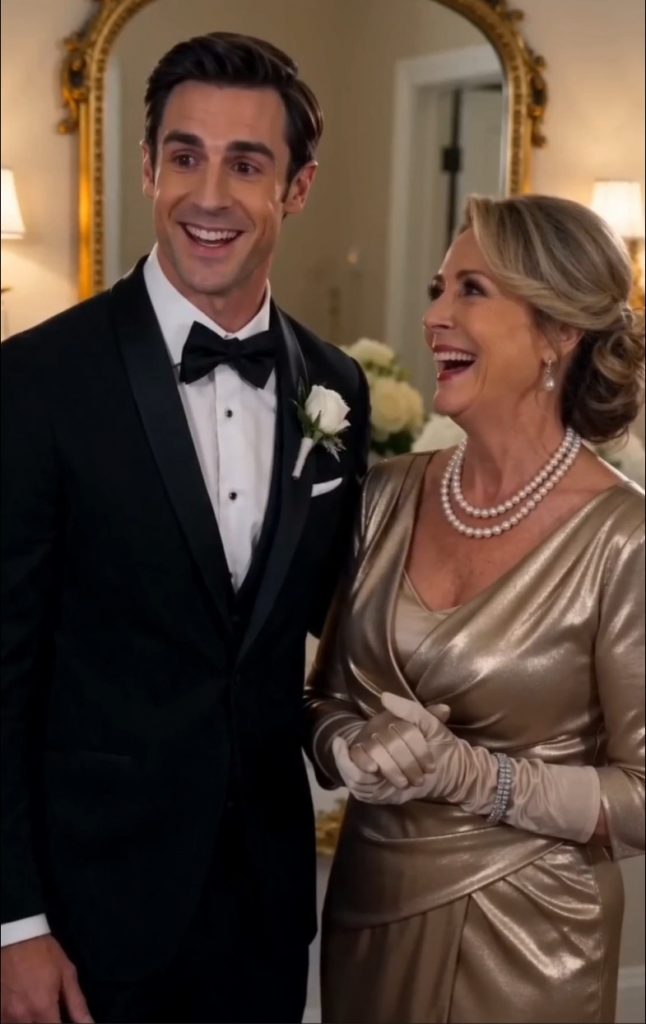
Ethan stood in the adjoining room in his black tuxedo, handsome enough to make strangers stop and look twice. His mother sat beside him in a gold satin gown, her pearls shining against her throat as if she had dressed for a coronation, not a wedding.
Clara had gone looking for her bouquet.
Instead, she found the truth.
Ethan leaned closer to his mother and smiled with the private ease of a man who believed no one could hear him.
“I only want her money.”
His mother laughed.
Not nervously. Not with shock. With delight.
Clara’s knees weakened, but she did not fall. She pressed herself harder against the wall, swallowing the sound that tried to escape her throat. Tears spilled down her face, hot and silent, carving through the careful makeup her bridesmaids had praised twenty minutes earlier.
On her right wrist hung a tiny white rectangular bag, delicate and expensive, chosen because it matched the pearls sewn into her gown.
Inside it, her phone was standing upright.
Recording.
She had not planned to record betrayal. She had only set the phone there because her maid of honor kept calling from the next room, asking about the missing hairpin, and Clara had slipped it into the little bag without thinking.
But fate has a cruel sense of timing.
The camera faced the next room perfectly.
Ethan kept talking.
He spoke of her inheritance as if it were a locked safe he had finally found the key to. He spoke of her father’s company, the trust, the charitable foundation, the downtown properties, the old family house on the hill.
He never once said her name with love.
His mother adjusted one pearl strand and said, “After today, darling, she won’t be able to move a dollar without you knowing.”
Clara lowered her hand from her mouth.
Something inside her changed in that instant. The pain did not disappear. It hardened.
Her reflection appeared faintly in the mirror across the room: a bride with tear-streaked cheeks, dark eyes, white lace, and a face that no longer belonged to a woman about to be rescued by love.
It belonged to a woman who had just awakened in the middle of her own funeral and decided not to stay buried.
A knock came at the outer door.
“Clara?” her maid of honor called softly. “It’s time.”
Clara picked up her bouquet of white roses.
Then she walked toward the cathedral with the recording still hidden at her wrist.
And Ethan, waiting at the altar, had no idea the bride was bringing more than vows.
Act II
Everyone stood when Clara entered the cathedral.
The music rose beneath the arched ceiling, swelling through the stone nave like something holy and ancient. Sunlight poured through stained glass and scattered color across the aisle. Guests turned with soft smiles. Some dabbed at their eyes.
To them, she looked perfect.
A bride in white lace. A woman stepping into the happiest day of her life.
Only Clara knew she was walking through the ruins of it.
Her mother had died when she was nineteen. Her father, Henry Whitmore, had raised her alone after that, teaching her how to read people the way other fathers taught daughters to change tires or balance checkbooks.
“Charm is easy,” he used to say. “Character shows up when no one is clapping.”
Ethan had clapped louder than anyone.
He had come into Clara’s life three years after Henry’s sudden death, when she was still young enough to mistake attention for devotion and grief for loneliness. He sent flowers to her office. He remembered her mother’s birthday. He listened when she spoke about the foundation she wanted to build in her parents’ names.
He never rushed her, and that was what made him dangerous.
A greedy man who waits looks patient. A liar who listens looks kind.
Ethan had studied her pain before he touched her heart.
His mother, Vivienne, had been even more careful. She called Clara “darling” and “the daughter I never had.” She introduced her to the right donors, the right board members, the right society wives who measured people by surnames and table placements.
Clara had wanted a family.
The Ashfords gave her a performance.
Slowly, Ethan became part of every decision. He asked innocent questions about the trust. He made suggestions about “modernizing” the foundation. He introduced lawyers who smiled too warmly and bankers who never looked Clara directly in the eye.
At first, she pushed back.
Then Vivienne began to speak of marriage as if it were stability. As if love meant sharing everything. As if Clara’s hesitation was proof she had not healed.
By the time Ethan proposed under a canopy of winter lights, Clara believed saying yes meant she had finally stepped out of grief.
In truth, she had stepped into a trap.
Two weeks before the wedding, her father’s oldest friend, a retired attorney named Miriam Vale, had asked to see the prenuptial agreement.
Clara had laughed it off. Ethan had insisted it was just a formality. Vivienne had called it “practical.”
Miriam read the document in silence.
Then she looked over her glasses and said, “This is not a prenup. This is a surrender.”
Clara remembered the chill in that office. The way Miriam turned the pages slowly, as if each clause had offended her personally.
The agreement granted Ethan financial oversight after marriage. It tied several inherited assets to joint marital management. It created pathways for him to influence the foundation board. It even gave him limited authority in the event Clara became “emotionally or medically unable” to manage her affairs.
“It’s dressed up nicely,” Miriam said. “But whoever drafted this wanted access, control, and protection from consequences.”
Clara had confronted Ethan that night.
He cried.
That was the worst part. He cried beautifully.
He said his family lawyer had handled it. He said he barely read the thing. He said he would sign anything she wanted, burn anything she hated, give up every claim if it proved his love.
So Clara let herself believe him.
But Miriam did not.
Quietly, without telling Ethan, Clara signed a different document. A strict amended agreement. Separate assets. No joint control. No foundation authority. No management rights. Nothing transferred by marriage.
Ethan signed it too, smiling for the notary, because he thought the original version still sat ready to be filed after the ceremony.
He did not know Miriam had already filed the amendment.
He did not know Clara had begun watching.
And he did not know that the little white phone in her bridal bag had captured the final piece Miriam had warned her might come.
Proof.
At the altar, Ethan looked at Clara as if she were a treasure chest arriving on legs.
The priest opened his Bible.
Vivienne sat in the front pew, pearls gleaming, chin raised, already victorious.
Clara placed her bouquet between her hands and felt the phone against her wrist like a pulse.
Then the priest asked the question.
“Clara, do you take Ethan to be your lawfully wedded husband?”
For one breath, the whole cathedral waited for a yes.
Instead, Clara lifted her head.
“Before I answer,” she said, her voice clear enough to reach the last pew, “there’s something everyone in this room deserves to hear.”
Ethan’s smile vanished.
Because he knew.
Act III
At first, no one moved.
The priest blinked behind his glasses. A bridesmaid gasped. Somewhere in the back pews, a child whispered and was quickly hushed.
Ethan leaned toward Clara, lowering his voice into the polished tone he used whenever he wanted to control a room without seeming to.
“Clara,” he said, “this is not the time.”
She looked at him then, truly looked at him.
For three years, she had mistaken his calm for strength. Now she saw it for what it was: calculation wearing cologne.
“It is exactly the time,” she said.
A murmur passed through the cathedral.
Vivienne rose halfway from her seat, one gloved hand gripping the pew in front of her. Her face had tightened, but her smile remained, thin and sharp.
“Darling,” Vivienne called, “you’re overwhelmed. Weddings can be emotional.”
Clara turned toward her.
“That’s what you were counting on.”
Then she reached into the tiny white bag at her wrist and removed her phone.
The movement was small, but it changed the temperature of the entire room.
Ethan went pale.
Clara tapped the screen.
For half a second there was only static and fabric rustle.
Then Ethan’s voice filled the cathedral.
“I don’t care about her.”
The room went dead silent.
The words echoed against stone and glass, louder than any vow he had planned to make.
A few guests turned toward Ethan. Others stared at Clara’s phone as if it had become something alive.
Then the recording continued.
“I only want her money.”
This time the sound that moved through the cathedral was not a murmur.
It was a wave.
Someone in the front row whispered, “Oh my God.”
Ethan lunged forward, but Clara stepped back before he could reach the phone.
“Enough!” he snapped, forgetting the crowd, forgetting the priest, forgetting the mask.
That single word did more damage than the recording. It showed everyone the man beneath the tuxedo.
The phone kept playing.
Vivienne’s laugh spilled through the speakers, bright and cruel.
“After today, darling, she won’t be able to move a dollar without you knowing.”
Clara stopped the recording.
For several seconds, Ethan simply stared at her. His mouth opened, but no lie came quickly enough.
Then he found one.
“It was a joke,” he said, turning toward the guests with an injured smile. “A terrible joke. Clara misunderstood.”
Miriam Vale stood from the second row.
She was small, gray-haired, and dressed in navy, but the guests made way for her as if something official had entered the room.
“No,” Miriam said. “She did not.”
Vivienne’s eyes flashed.
“You,” she hissed.
Miriam walked calmly into the aisle carrying a sealed folder.
Clara had not known she would stand. They had planned only for the recording if it became necessary. But Miriam had always believed truth should enter a room with witnesses.
“For those who don’t know me,” Miriam said, “I represented Clara’s father for twenty-seven years. I also reviewed the agreement Ethan Ashford attempted to have Clara sign before this wedding.”
Ethan’s jaw tightened.
Vivienne sat down slowly.
Miriam opened the folder.
“The original document would have granted Mr. Ashford substantial influence over Clara Whitmore’s inherited assets and foundation after marriage. It also included provisions that could have allowed him to challenge her decision-making authority under certain conditions.”
The priest lowered his Bible.
A ripple of disbelief moved through the pews.
“That document,” Miriam continued, “was rejected. A corrected agreement was signed instead. Filed. Certified. Effective before today.”
Ethan’s eyes darted to Clara.
It was the first honest expression he had shown all day.
Fear.
Clara felt it then, the strange quiet that comes when heartbreak finally steps aside and leaves room for clarity.
“You signed it,” she said softly. “You smiled while you did.”
Ethan took one step toward her.
“Clara, listen to me.”
“No,” she said. “Everyone listened to you already.”
But Miriam was not finished.
She removed a second page from the folder.
“And after reviewing related correspondence this morning,” she said, “I found something else.”
Vivienne’s face drained of color.
Clara turned toward Miriam, confused.
This had not been part of the plan.
Miriam looked at her with sorrow.
“Clara,” she said, “your father suspected this family long before you met Ethan.”
The cathedral seemed to tilt.
Ethan whispered, “Don’t.”
And with that one word, Clara understood there was another betrayal waiting behind the first.
Act IV
Miriam held up a letter, old enough that the fold lines had softened.
“It was written by Henry Whitmore six months before his death,” she said. “He left it in a private file with instructions that it be opened if anyone from the Ashford family attempted to gain access to Clara’s inheritance.”
Clara could barely breathe.
“My father knew them?”
Vivienne’s lips pressed together so tightly they almost disappeared.
Miriam nodded.
“Henry believed Vivienne Ashford and her late husband had helped conceal a financial fraud connected to one of his early companies. He couldn’t prove the full scheme before he died, but he documented enough to warn you.”
The cathedral erupted.
Ethan spun toward his mother. “You said that was buried.”
The words slipped out before he could stop them.
Every head turned.
Vivienne closed her eyes for the briefest moment.
Then she stood with the practiced dignity of a woman who had survived decades by making shame look like insult.
“This is absurd,” she said. “A wedding is being turned into a circus by a bitter old lawyer and a hysterical bride.”
Clara flinched at the word, but only for a second.
Hysterical.
That was always the final weapon. When a woman had proof, call her unstable. When she had pain, call her dramatic. When she had the courage to speak, call her emotional.
Clara walked down the altar steps until she stood in the center of the aisle.
“No,” she said. “I was emotional when I thought I had lost the man I loved. I am calm now.”
She looked at the guests, at the board members of her foundation, at Ethan’s friends, at Vivienne’s society circle, at the people who had come to witness a marriage and instead found themselves sitting inside a reckoning.
“My father built everything I have from nothing,” Clara said. “He left me money, yes. But more than that, he left me responsibility. Ethan knew that. His mother knew that. They didn’t want a daughter. They wanted a key.”
Ethan’s face twisted.
“That’s not true.”
Clara turned to him.
“Then say it,” she replied. “In front of everyone. Say you would marry me today if I had nothing.”
He stared at her.
The silence answered for him.
A man near the back stood up and left. Then another. Then two women in the Ashfords’ row began whispering urgently to each other.
Vivienne saw the room slipping away.
So she did what she had always done. She attacked the weakest-looking place.
“You think you’re powerful because of documents?” she said. “You’re still a lonely girl in a dead man’s house, desperate for someone to choose her.”
The cruelty landed.
Clara felt it. Everyone did.
For a moment, she was nineteen again, standing beside her father’s closed office door, holding the last birthday card he had ever written her.
Then Miriam moved beside her and placed the old letter in her hands.
Clara unfolded it.
Her father’s handwriting filled the page.
My Clara,
If you are reading this, someone has come close enough to make you doubt your own judgment. I’m sorry I’m not there to stand between you and them.
But I raised you to stand.
Do not confuse being loved with being useful. The people who truly love you will protect what matters to you, not circle it like property.
Trust Miriam. Trust the records. Most of all, trust the part of yourself that knows when kindness has started to feel like a cage.
I loved you before you inherited a cent. I will love you after every room forgets your name.
Dad
Clara read the final line twice.
Her hands trembled, but her voice did not.
When she lowered the letter, the cathedral was changed.
People were no longer watching a scandal.
They were witnessing a daughter receive her father’s final protection.
Ethan tried one more time.
He stepped forward, tears gathering in his eyes with professional precision.
“Clara,” he said, “I made a mistake. I was scared. My mother pressured me. But I love you.”
Clara almost laughed.
Not because it was funny.
Because three hours earlier, those words would have saved him.
Now they sounded like a door closing from the wrong side.
“You love what my name opens,” she said. “You love what my father left. You love the life you imagined standing beside me. But you do not love me.”
Ethan’s mask cracked completely.
“You think you’re untouchable?” he snapped. “Do you know how many people in this room came because of us? Because of my family? You’ll be humiliated for this.”
Clara looked around the cathedral.
At the guests who had heard everything.
At the priest who had closed his Bible.
At Vivienne, whose pearls no longer looked regal, only heavy.
Then she turned back to Ethan.
“No,” she said. “For the first time today, I’m not the one being humiliated.”
And at the back of the cathedral, two men in dark suits stepped quietly through the doors.
Act V
They were not police officers.
Not yet.
They were investigators from the state attorney’s financial crimes division, brought in quietly by Miriam after she uncovered links between the Ashfords’ old accounts and the company Henry Whitmore had suspected years earlier.
Clara had not known they would come.
Miriam had.
One of the men approached Ethan and Vivienne with the calm expression of someone who had spent years watching powerful people discover that marble floors did not protect them.
“Mr. Ashford,” he said, “Mrs. Ashford. We need to speak with you regarding several financial documents and attempted asset transfers connected to Whitmore Holdings and the Whitmore Foundation.”
Vivienne lifted her chin.
“You have no right to do this here.”
The investigator glanced around the cathedral.
“No, ma’am. You did that.”
For the first time, Vivienne had no answer.
Ethan looked at Clara, and the rage in his face gave way to something smaller. Panic. The kind that comes when a man realizes the future he stole in his imagination has vanished before he ever touched it.
“You planned this,” he said.
Clara shook her head.
“No. You planned this. I just finally listened.”
The priest stepped forward slowly.
“Clara,” he said gently, “do you wish to continue with the ceremony?”
A sad smile touched her mouth.
The question was formal. Kind. Almost absurd.
She looked at the flowers, the candles, the guests, the man in the tuxedo who had mistaken her grief for weakness.
“No, Father,” she said. “There will be no wedding today.”
A sound moved through the room, not shock this time, but release.
Her maid of honor began crying openly. Miriam placed a steady hand on Clara’s shoulder. Somewhere behind them, someone started clapping.
It was not loud at first.
One pair of hands.
Then another.
Then the cathedral filled with applause, not for a bride, not for a ruined wedding, but for a woman who had walked to the altar with a broken heart and left with her life still belonging to her.
Ethan was escorted to a side chamber for questioning. Vivienne followed, stiff-backed, refusing to look at anyone. But the front she had polished for decades had finally cracked in public, and no amount of satin or pearls could repair it.
Clara remained in the aisle.
For a moment, she did not know what to do with her hands. Brides were supposed to hold bouquets. Wives were supposed to hold vows. Daughters were supposed to hold memories.
She held her father’s letter.
Outside, the cathedral bells began to ring because no one had told the bellman the wedding was over.
The sound rolled across the city, bright and solemn.
Clara walked out alone beneath it.
At the top of the cathedral steps, the wind lifted the edge of her veil. Reporters had not arrived yet. The world had not yet turned her pain into headlines. For a few precious seconds, there was only sunlight, stone, and the quiet after truth.
Miriam came to stand beside her.
“Your father would be proud,” she said.
Clara looked down at the letter again.
“I almost married him,” she whispered.
“But you didn’t.”
That was the sentence that finally broke her.
Not the recording. Not Ethan’s betrayal. Not Vivienne’s cruelty.
The mercy of the words.
You didn’t.
Clara covered her face and cried, not like the woman behind the doorframe, swallowing her pain so no one would hear, but openly. Freely. Like someone who had survived the moment that was meant to destroy her.
Her bridesmaids gathered around her, not fussing over the dress anymore, not worrying about photographs or schedules or reception timing. They simply held her.
Inside the cathedral, guests began to leave in hushed clusters. Some looked ashamed. Some looked stunned. Some looked as if they were replaying every dinner, every smile, every toast the Ashfords had ever given.
By evening, the wedding flowers were donated to the hospital where Clara’s mother had once volunteered. The untouched reception meals went to a shelter funded by the Whitmore Foundation. The champagne remained unopened.
Clara returned to her father’s house just before sunset.
She did not take off the dress right away.
Instead, she walked into Henry’s old study, the room she had avoided for years because it still smelled faintly of leather, cedar, and the wintergreen mints he kept in the top drawer.
She placed his letter on the desk.
Then she removed the engagement ring and set it beside the envelope.
For a long time, she stood there in silence.
There was no dramatic speech. No perfect healing. No instant victory that erased the ache.
Betrayal leaves bruises where no one can see them.
But something had shifted.
The house no longer felt like a mausoleum. It felt like a witness. Like her father’s love had been waiting in the walls, patient and stubborn, until she was ready to hear it again.
The next morning, Clara called an emergency meeting of the foundation board.
By noon, every Ashford-linked advisor had been suspended pending review.
By the end of the week, investigators had uncovered forged correspondence, hidden debt, and a string of introductions Ethan had made under the pretense of helping Clara “streamline” her family’s legacy.
The scandal spread quickly.
But Clara refused to become its victim in public.
When a reporter asked whether she regretted exposing Ethan at the altar, Clara paused.
She thought of the doorframe. The recording. The laughter. The priest’s question. Her father’s letter shaking in her hands.
Then she said, “I regret that I ignored myself for so long. I don’t regret the moment I stopped.”
Months later, the cathedral hosted another ceremony.
Not a wedding.
A memorial concert for the Whitmore Foundation, raising money for young women rebuilding their lives after financial abuse and coercion. Clara stood at the front in a simple navy dress, her hair loose around her shoulders, no veil, no pearls, no performance.
Miriam sat in the first row.
The priest was there too.
And when the music rose beneath the same arched ceiling, Clara did not think about the man who had waited for her at the altar with a lie in his mouth.
She thought about the girl behind the door.
The one who had cried silently.
The one who had almost walked into a cage because it looked like love.
The one who had lifted her head and chosen truth before vows.
Clara knew people would always remember that wedding as the day a groom was exposed.
But she remembered it differently.
It was the day she stopped asking to be chosen by people who only wanted to own her.
It was the day she chose herself.