Act I
The rain had turned the cemetery into a field of ghosts.
White headstones stretched in every direction, disappearing row by row into a fog so thick it looked almost alive. The grass was soaked. Water gathered in the carved letters of names that had once belonged to soldiers, husbands, daughters, and fathers.
At the center of it all stood one black granite headstone.
LAURA.
Marcus Hale stood behind it with both hands over his face.
He had survived two deployments, three roadside explosions, and the kind of nights men never fully come home from. But this grave had done what war could not. It had broken him in a quiet place, far from gunfire, beneath a gray sky that would not stop weeping.
His shoulders shook. His breath came in short, muffled sounds he hated himself for making.
Beside the grave, Max stood perfectly still.
The German Shepherd’s fur was dark with rain, matted along his neck and back. He had sat by Laura’s grave every Sunday for eight months, head low, ears drooping, as if he understood that the little girl who used to sneak him bacon under the table was never coming home.
But today was different.
Max was not mourning.
He was sniffing.
His nose cut sharply through the wet air. His ears lifted. His body stiffened with sudden purpose.
Then he bent his head and picked something up from the grass beside the headstone.
A bright blue bandana.
Marcus lowered his hands.
For one second, he only stared.
The bandana hung from Max’s mouth, soaked at the edges, patterned with tiny white stars. Marcus knew every stitch of it. He had tied it around Laura’s wrist the morning she disappeared, because she had said it made her feel brave.
His grief vanished so fast it left terror behind.
“No,” he whispered.
Max stared back at him.
Marcus stepped around the grave, his boots sinking into the mud. His face had gone pale beneath his silver-gray beard.
“That’s hers,” he gasped. “She had that with her.”
His voice cracked.
“Where did you get that?”
Max dropped the bandana at his feet.
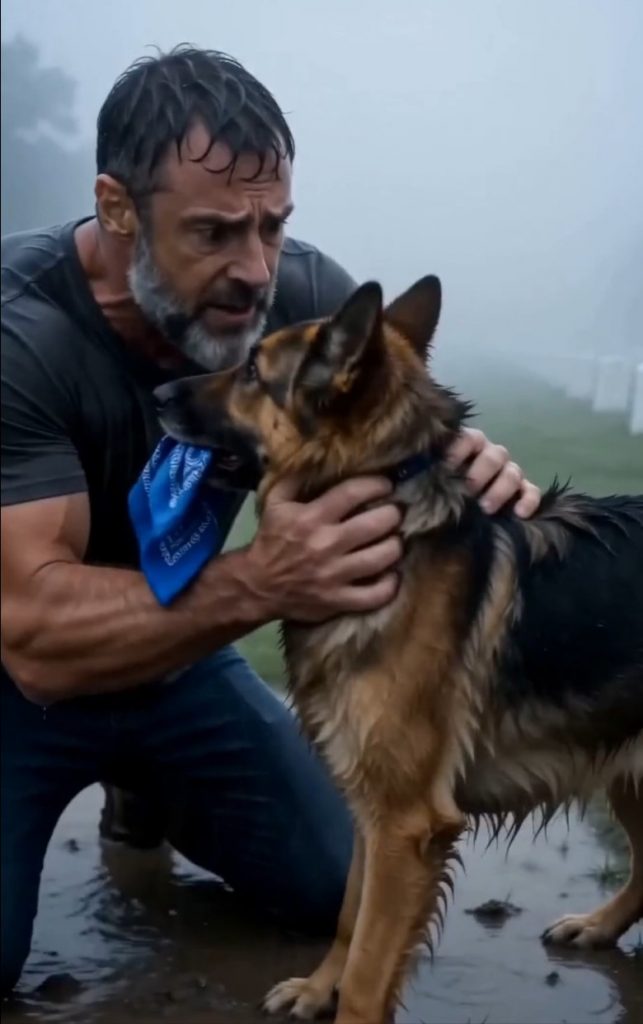
Marcus fell to one knee in the wet grass and grabbed the dog by both shoulders, not hard enough to hurt him, but with the desperation of a man gripping the last thread of the world.
“Max,” he said, breathless. “Where is she?”
The dog barked once.
The sound cracked through the fog.
Marcus’s hands began to tremble.
“Take me to her,” he ordered. “Move.”
Max barked again, sharper this time, then spun and launched himself into the mist between the endless rows of white stones.
Marcus scrambled up and ran after him.
Behind them, rain continued falling on Laura’s name.
And at the base of the black headstone, fresh in the mud where no one had been standing moments before, was the small footprint of a child.
Act II
Eight months earlier, Laura Hale had vanished from a memorial ceremony with two hundred witnesses and not one useful answer.
She was nine years old.
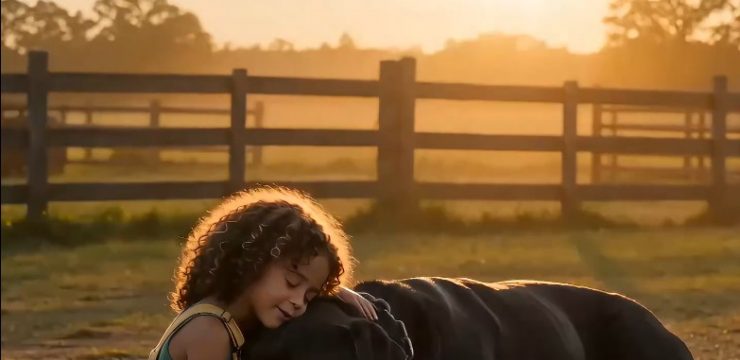
She had her mother’s brown eyes, Marcus’s stubborn jaw, and a laugh so bright it could change the weather inside a room. She wore mismatched socks because she said matching was “for people with no imagination.” She collected smooth stones. She named every spider she found in the garage.
And she loved Max more than anything.
Max had been Marcus’s military working dog before a leg injury retired him from service. At first, Marcus had brought him home because he thought they could heal together.
Then Laura met him.
She walked straight up to the scarred German Shepherd, held out a chicken nugget, and said, “You look like you need a best friend.”
From that day on, Max slept outside her bedroom door.
When nightmares came for Marcus, Laura would creep down the hall and find Max already there, leaning against him, anchoring him to the present. Sometimes Laura would sit on the floor beside them and whisper stories until the house felt safe again.
That was what Marcus remembered most.
Not the case files. Not the search teams. Not the reporters.
The quiet mornings.
Laura at the kitchen table, swinging her feet, asking if angels wore boots because her mother had been buried in uniform.
Her mother, Captain Elena Hale, had died when Laura was five. The cemetery became part of their lives after that. Marcus visited often, and Laura always came with him, carrying flowers too big for her arms.
The day Laura disappeared, they had gone to the cemetery for a ceremony honoring Elena’s unit.
Marcus had been asked to speak.
He hated public speeches, but Laura insisted.
“Mom would want you to,” she had said, tying the blue bandana around her wrist like a superhero cuff. “And I’ll be right there.”
She had been right there.
Then she was not.
One minute she was standing near the memorial wall with Max beside her. The next, Max was barking so violently that people turned.
Laura was gone.
The police searched the cemetery, the service roads, the woods beyond the fence, the drainage tunnels, the nearby highway. Volunteers came with flashlights and dogs and drones. Her photo went up on every news station within the state.
Three days later, a child’s jacket was found near the river.
The current was high from storms. The search shifted downstream. People began lowering their voices around Marcus.
No body was ever recovered.
But after six weeks, the investigation slowed.
After three months, the news moved on.
After six, the court allowed a memorial marker.
Marcus fought it at first.
He refused to bury an empty box. He refused to let people use soft voices and say things like closure. But the cemetery committee offered a black granite stone beside Elena’s section, a place where Laura’s name could stand near her mother’s.
Marcus agreed only because he thought Max needed somewhere to mourn.
But Max never accepted the grave.
He sat there, yes. He lowered his head. He whined when Marcus cried.
But sometimes, when the wind shifted, Max would stand and stare toward the old east gate, ears high, body locked in attention.
Marcus told himself it was training.
Instinct.
Memory.
Hope could become a sickness if you fed it too long.
So he buried his questions beneath routine. Sunday visits. Fresh flowers. A hand on the cold black stone. A father whispering apologies to a daughter he had failed to protect.
Until the blue bandana appeared on the grass.
Until Max ran.
Marcus followed him past the military rows, past the old oaks dripping rain, past flags snapping weakly in the wind.
“Max!” he shouted.
The dog did not slow.
He cut left between the markers, then right toward the older part of the cemetery, where the fog hung thicker and the groundskeepers rarely went during storms.
Marcus’s lungs burned.
His boots slipped in the mud.
The bandana was clenched in his fist.
By the time Max reached the rusted east gate, Marcus was close enough to see what had caught the dog’s attention.
The gate was open.
It had been locked for years.
And beyond it, in the mud leading toward the abandoned service road, were more small footprints.
Act III
Marcus stopped breathing.
The footprints were faint, already softening beneath the rain, but they were real. Small shoes. Uneven steps. A child moving fast or being hurried.
Max lowered his nose to the ground and whined.
Then he looked back at Marcus.
It was the same look he used to give during service when he found something important and needed permission to move.
Marcus’s hand tightened around the blue bandana.
“Go,” he said.
Max surged through the gate.
The service road beyond the cemetery had once been used by maintenance trucks before the city closed it after a landslide. Now weeds grew through cracked asphalt, and the trees leaned over it like they were trying to hide what lay ahead.
Marcus ran until the cemetery disappeared behind him.
Fog pressed against his face. Rain drummed on leaves. Max moved like an arrow, never hesitating, stopping only twice to sniff broken branches near the roadside.
Then Marcus saw the cabin.
It stood beyond a cluster of wet pines, half-collapsed and gray, its windows boarded, its roof patched with black plastic. A place no one would choose unless they did not want to be found.
Max froze thirty yards away.
His body lowered.
Marcus dropped beside him, chest heaving, every old instinct waking at once.
There was a van parked behind the cabin.
Dark green. Mud across the plates. One rear tire low.
Marcus took out his phone with shaking hands and called Detective Rowan, the last officer who had ever treated Laura’s disappearance like a living case instead of a tragedy to file away.
“Rowan,” Marcus said when the call connected. “I found something.”
“Marcus?”
“The east gate. Footprints. Max tracked them to a cabin off the old service road.”
A pause.
Then Rowan’s voice sharpened.
“Do not go inside.”
Marcus stared at the cabin.
A curtain moved in one of the windows.
His heart slammed against his ribs.
“Marcus,” Rowan repeated, “listen to me. Stay where you are. I’m sending units.”
But then he heard it.
Not clearly.
Not loudly.
A sound from inside the cabin.
A child’s voice.
Marcus forgot the rain. Forgot the detective. Forgot every rule he had ever learned.
He moved.
Max went with him, silent now, close to his left side.
They crossed the yard low and fast. The cabin smelled of rot, damp wood, and old smoke. Marcus reached the porch and saw fresh mud smeared across the boards.
A blue thread was caught on a nail beside the door.
The same blue as the bandana.
He pushed the door.
Locked.
From inside came a small thump.
Then a whisper.
“Max?”
Marcus nearly fell apart right there.
His hand hit the doorframe. His eyes burned. He leaned close to the wood.
“Laura?”
Silence.
Then, smaller than rain.
“Daddy?”
The word went through him like light breaking into a sealed room.
Marcus stepped back once.
Then he drove his shoulder into the door.
The old frame cracked, but held.
He hit it again.
Max barked wildly beside him.
On the third strike, the lock tore loose and the door flew inward.
The cabin was dim, lit only by a broken window covered in plastic. Marcus saw overturned chairs, a table, a cot with blankets, a metal bowl on the floor.
And in the corner, behind a stack of crates, stood Laura.
She was thinner. Her hair was shorter, cut unevenly around her face. She wore an oversized gray sweatshirt and shoes caked with mud.
But she was alive.
For one impossible second, neither of them moved.
Then Max crossed the room in a blur.
Laura dropped to her knees and wrapped her arms around his neck. The dog pressed himself against her, whining, trembling, licking her face as she sobbed into his fur.
Marcus tried to say her name again.
No sound came out.
Laura looked up.
Her eyes found him through the dimness.
“Daddy,” she cried.
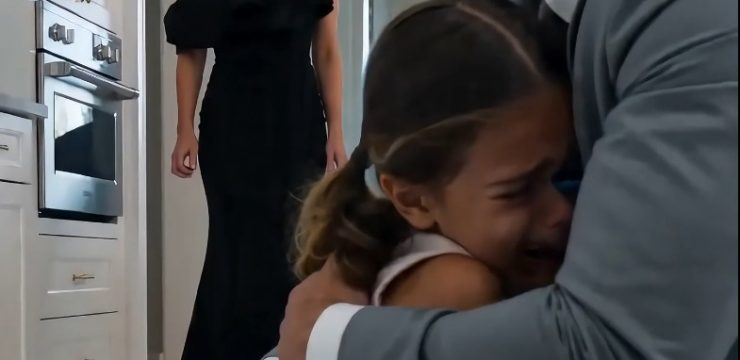
Marcus crossed the room and gathered her into his arms.
He held her like the whole world might try to take her again if he loosened his grip.
She was shaking. He was shaking harder.
“I found your bandana,” he whispered. “Max found it. He found you.”
Laura buried her face in his shoulder.
“I knew he would,” she said.
Then her small fingers grabbed his shirt.
“She’s coming back,” Laura whispered.
Marcus went still.
“Who?”
Laura’s eyes lifted toward the broken window.
“The woman who said you stopped looking.”
Outside, beyond the rain, a car engine turned over.
Act IV
Marcus carried Laura out of the cabin with Max at his side.
The green van was still there, but the sound came from beyond the trees. A second vehicle, hidden down a narrow trail, was trying to leave.
Marcus saw the red glow of taillights through the fog.
“Hold on to me,” he told Laura.
She clung to his neck.
He did not chase the car.
Every instinct in him wanted to. Every broken part of him wanted the person behind that wheel dragged back into the rain and made to answer for every night Laura spent afraid.
But Laura was in his arms.
That was the mission now.
Max barked toward the trail as sirens finally rose in the distance.
Detective Rowan arrived first, his sedan skidding on the wet road. Two patrol cars followed, then an ambulance.
When Rowan saw Laura, his face changed completely.
For months, he had carried guilt like a stone in his pocket. Marcus saw it now, the shock, the relief, the shame.
“Call it in,” Rowan shouted to the officers. “She’s alive. We need roadblocks on every exit east of the cemetery.”
Laura refused to let go of Marcus.
The paramedic wrapped a blanket around her shoulders while Marcus kept one arm locked around her and one hand buried in Max’s wet fur.
No one rushed her questions.
No one raised their voice.
But slowly, between sips of water and trembling breaths, Laura began to explain.
The day of the memorial, a woman had approached her near the east wall. She knew Laura’s name. She knew Elena’s name too. She said Marcus had been hurt and that Laura needed to come quickly.
Laura followed because she was nine.
Because adults were supposed to be safe.
Because the woman wore a cemetery volunteer badge.
Max had tried to stop it. He had barked, lunged, pulled at Laura’s sleeve. The woman dragged Laura through the old east gate and into a waiting van before anyone understood what was happening.
“She told me not to scream,” Laura whispered. “She said if I was good, she’d let me write to you.”
Marcus closed his eyes.
Rowan’s jaw clenched, but his voice stayed gentle.
“Do you know her name, sweetheart?”
Laura nodded.
“She said her name was Maren.”
The name struck Marcus like a blow.
Maren Voss.
Elena’s younger sister.
Laura’s aunt.
For years, Maren had blamed Marcus for Elena’s death, though Elena had died in service, far from his command, far from any choice he could have made. Grief had twisted Maren into something bitter and hungry. She wanted Laura. Not as a daughter to love, but as the last piece of Elena she believed Marcus did not deserve.
After Laura disappeared, Maren had been at every search.
She had hugged Marcus at the memorial.
She had stood beside him when the black headstone was installed, crying into a handkerchief while Max stared at her with a low growl in his throat.
Marcus remembered silencing the dog.
That memory would haunt him for years.
But Laura was not finished.
“She said everyone believed I was gone,” Laura whispered. “She showed me a newspaper. She said you had a grave for me.”
Marcus looked toward the cemetery through the trees.
The black stone.
The flowers.
The Sundays spent apologizing to an empty name.
Laura reached into the blanket and pulled out a small scrap of blue fabric.
“I kept pieces of the bandana,” she said. “I waited until she brought me near the cemetery today. She said she wanted to see if people still came to my grave. I dropped it when she wasn’t looking.”
Marcus stared at her.
Laura’s chin trembled.
“I thought Max would smell it.”
Max pressed his head against her knee.
Detective Rowan turned away for a moment, speaking quickly into his radio. Roadblocks were already going up. Maren’s photo was being sent to every unit in the county.
But Marcus barely heard him.
He was looking at his daughter.
Small. Soaked. Terrified.
Braver than any soldier he had ever known.
“You did everything right,” he said.
Laura’s face crumpled.
“I was scared you forgot me.”
The words nearly destroyed him.
Marcus pulled her close, his voice rough against her hair.
“Never,” he said. “Not for one second.”
Then, through the fog beyond the cabin, a radio crackled.
A deputy’s voice came through.
“We’ve got the vehicle. Suspect stopped at Mill Road.”
Marcus held Laura tighter.
The woman who had buried her alive in everyone’s grief had finally run out of road.
Act V
They did not take Laura back through the cemetery.
Marcus refused.
The ambulance drove the long way around, away from the headstones, away from the black granite lie with her name carved into it. Max rode beside her, his head on the edge of the stretcher, refusing to move even when the paramedics tried to make room.
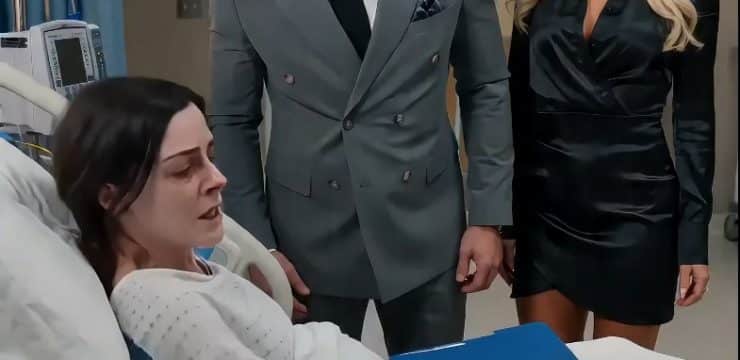
At the hospital, Laura was examined, warmed, fed, and wrapped in blankets fresh from a heated cabinet.
Marcus stayed beside her bed.
When nurses asked him to step out, Laura’s fingers tightened around his wrist.
So they let him stay.
Max slept on the floor under the bed, one ear still alert.
Detective Rowan came just after midnight. His raincoat was dripping, his face drawn with exhaustion.
“Maren Voss is in custody,” he said quietly.
Marcus did not ask for details.
Not then.
He looked at Laura, asleep at last, one hand resting over Max’s collar.
“Did she confess?”
Rowan nodded.
“Enough. We also found journals, fake documents, cash, and plans to move out of state. She’d been preparing for years.”
Marcus stared at the wall.
Years.
While he had been learning how to raise Laura alone, someone close enough to know their routines had been waiting for a chance to steal what grief had not already taken.
Rowan stepped closer.
“Marcus,” he said, “you need to know something. Max was right from the beginning. The day she disappeared, he tracked to the east gate. The first search team dismissed it because the gate was supposed to be sealed.”
Marcus looked down at the dog.
Max opened one eye as if he had heard his name, then closed it again.
“I dismissed him too,” Marcus said.
“You were a father in shock.”
“I was her father,” Marcus replied.
Rowan said nothing, because some pain does not need correction. It only needs witness.
By morning, the news had spread through the hospital.
Nurses cried in the hallway. Officers who had searched for Laura months earlier came by quietly, leaving stuffed animals, notes, and one plastic bag full of mismatched socks.
Laura woke near noon and asked for pancakes.
Marcus laughed for the first time in eight months.
It came out broken, but it was real.
Three days later, they returned to the cemetery.
The rain was gone. The fog had lifted. Sunlight touched the rows of white stones, making them look less like ghosts and more like witnesses.
Marcus walked with Laura’s hand in his left and Max’s leash in his right.
They stopped first at Elena’s grave.
Laura placed white flowers against her mother’s headstone.
“Hi, Mom,” she whispered.
Marcus looked away, giving her a private moment that was not private at all, because love stays in the air around people even when they are silent.
Then they walked to the black granite marker.
LAURA.
Laura stood in front of her own name for a long time.
Her small face was unreadable.
Marcus wanted to smash the stone. He wanted to tear it out of the earth with his bare hands and throw it into the road.
But Laura reached out and touched the letters.
“I don’t want it here,” she said.
Marcus knelt beside her.
“It’s coming down.”
She nodded.
Then she looked at him.
“Can we put something else?”
“What do you want?”
Laura thought about it.
“A bench,” she said. “For kids who get lost. So people can sit and wait for them.”
Marcus swallowed hard.
“A bench it is.”
The cemetery approved it within a week.
The black marker was removed. In its place, near Elena’s grave, they installed a simple stone bench with a small brass plaque.
For those still being searched for.
For those who come home.
For those who never stopped believing.
Marcus visited less after that.
Not because he loved Elena less. Not because the place stopped mattering.
Because his home was no longer silent.
Laura’s room filled again with drawings, stones, mismatched socks, and the thump of Max’s tail against the floor. She had hard nights. So did Marcus. Healing did not arrive like a parade. It came quietly, in small ordinary miracles.
The first time Laura laughed in the kitchen.
The first time she slept through the night.
The first time Max left her bedroom door and returned to his old spot beside Marcus, as if finally convinced the pack was whole again.
Months later, Marcus found the blue bandana folded in Laura’s dresser.
It had been washed carefully, though one corner was torn and faded. The fabric looked too small to have carried such a heavy truth.
He picked it up and stood there, remembering the rain, the grave, Max’s sudden stillness, and the impossible moment when despair turned into direction.
Laura appeared in the doorway.
“You can keep it,” she said.
Marcus shook his head.
“No. It’s yours.”
She walked over, took the bandana, and tied it gently around Max’s collar.
The dog stood tall, proud and still, as if he understood the honor.
Laura smiled.
“He found me,” she said.
Marcus looked at his daughter, alive in the afternoon light.
“No,” he said softly. “You found a way to be found.”
That Sunday, they went back to the cemetery together.
Not in rain. Not in fog.
In sunlight.
Laura sat on the bench beside her father while Max lay at their feet, the blue bandana bright against his fur. Around them, the white headstones stretched into the distance, no longer endless, no longer swallowing the horizon.
Marcus reached for Laura’s hand.
She took it.
For eight months, he had stood in that cemetery believing the worst day of his life had already happened.
But the truth had been waiting in the mist.
A dog had known it.
A child had trusted it.
And a father, broken by grief, had run hard enough to catch hope before it disappeared again.