Act I
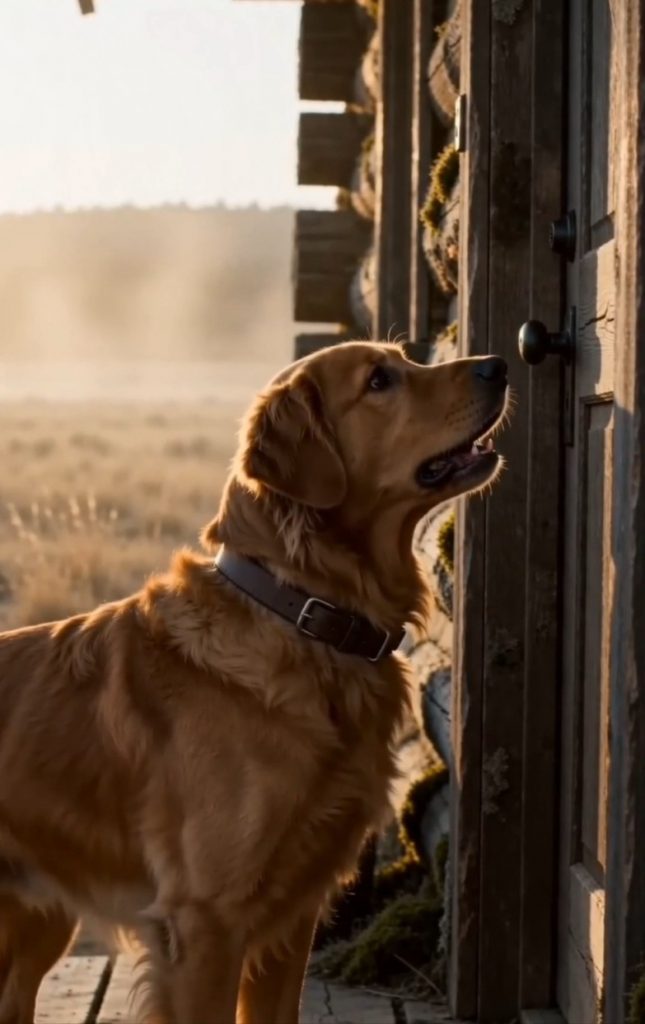
Max hit the cabin door like something was chasing the daylight itself.
His paws slammed against the weathered timber again and again, claws scraping deep white scars into the old wood. Dust lifted from the porch boards beneath him, glowing in the late sun like smoke.
The Golden Retriever barked until the sound tore across the empty field.
Inside the cabin, Elias Rourke woke with a start.
For one stunned second, he lay on the narrow couch beneath a faded quilt, listening to the frantic pounding outside. He had fallen asleep after fixing the well pump, his boots still on, a half-empty coffee cup cooling beside him.
Then Max barked again.
Not hungry.
Not bored.
Not warning off coyotes.
This was terror.
Elias shoved himself upright, heart already hammering. The cabin was quiet except for the dog and the low groan of wind moving through the dry grass beyond the windows.
“Max?” he called.
The barking only grew sharper.
Elias crossed the room, grabbed the rifle from above the door out of habit, then stopped himself. Max was not barking at something outside.
He was begging Elias to come out.
The door creaked open into golden light.
Max dropped to all fours instantly, chest heaving, eyes wide and desperate. Dust clung to his honey-colored coat. His leather collar sat crooked around his neck, as if he had been running through brush.
“Max,” Elias said, squinting. “What is it? What’s the problem, boy?”
Max lunged forward and clamped his teeth around Elias’s work trousers.
“Hey—”
The dog pulled.
Hard.
Not playful. Not confused.
He dragged Elias toward the porch steps, growling through the fabric, every muscle in his body locked with purpose.
Elias looked past him.
The field rolled out beyond the cabin, dry and amber under the sinking sun. A narrow dirt path cut through it toward a lone cottonwood tree standing near the edge of the old creek bed.
That tree had been there longer than the cabin.
Longer than Elias’s grief.
Longer than the lie everyone in Mason County had agreed to believe.
Max released his trousers and bolted.
He ran twenty yards, stopped, looked back, and barked once.
Follow me.
Elias felt the first cold thread of dread move through him.
“Max!”
The dog barked again and sprinted toward the tree.
Elias ran after him.
His boots struck the hard dirt path. His breath came rough. The field blurred around him in streaks of gold and brown, grass snapping against his legs as Max led him straight toward the old cottonwood.
As he got closer, Elias saw the dog’s tracks in the dust.
But not only the dog’s.
There were tire marks near the creek bed.
Fresh ones.
Elias slowed.
Max stood at the base of the tree, no longer barking. His head was lowered. His tail hung still.
Beside one of the thick roots, the earth had been disturbed.
Not by an animal.
By a shovel.
Elias took one step closer.
Then another.
Something pale blue peeked through the broken soil.
He bent down, reached with a hand that had suddenly gone numb, and brushed the dirt away.
It was a child’s hair ribbon.
Sun-faded. Frayed at the edges.
But he knew it.
He knew the tiny embroidered stars stitched along one side. He knew the way the ribbon had been tied in a crooked bow because his daughter had refused to let anyone but him do it.
Elias stopped breathing.
Nine years fell away in a single second.
He dug faster with his hands, tearing through loose soil until his fingers struck metal.
A small lunchbox emerged from the earth.
Pink once.
Rusted now.
On the lid, scratched through years of dirt, was a name written in black marker.
LUCY ROURKE.
Elias collapsed to one knee.
Max stood beside him, silent and somber.
The entire field seemed to hold its breath.
Then Elias opened the lunchbox.
And what he found inside proved his daughter had not simply disappeared.
Someone had buried the truth right outside his home.
Act II
For nine years, Elias had been known as the man whose daughter vanished on his watch.
No one said it to his face anymore.
They did not have to.
He heard it in the grocery store when conversations died as he passed. He saw it in the way mothers pulled their children closer at the county fair. He felt it every Sunday when the church pew beside him stayed empty, even though it had once held his wife and a little girl who could not sit still for more than five minutes.
Lucy had been seven years old when she disappeared.
She had hair the color of wheat in summer and a laugh that made strangers smile before they knew why. She loved blue ribbons, peanut butter sandwiches, and naming every stray animal that wandered near the cabin.
Max had been her birthday present.
Back then, he had been a clumsy puppy with oversized paws, forever sleeping under Lucy’s bed and stealing her socks. She called him Sir Max because she said every princess needed a knight.
On the last day Elias saw his daughter, Lucy had worn a yellow dress, muddy boots, and that blue ribbon in her hair.
It was a Saturday in late August.
Elias had been repairing a fence near the creek bed. Lucy had been playing under the cottonwood with Max, building a pretend castle out of sticks and flat stones.
He looked away for three minutes.
Three minutes.
When he turned back, Lucy was gone.
Max was whining at the tree, leash tangled around a root, scratching at the dirt until his paws bled. Elias had run into the field calling Lucy’s name until his throat burned raw.
The search lasted eleven days.
Neighbors came first. Then deputies. Then state police. Then reporters.
They checked the creek, the barns, the abandoned wells, the highway, the ravines beyond the property. Dogs lost the scent near the dirt road west of the cabin.
After the first week, whispers began.
By the second, Elias was not a grieving father anymore.
He was a suspect.
Sheriff Wade Harlan never arrested him. He never found enough evidence. But he did not need evidence to ruin a man in a small county.
He held press conferences with his jaw tight and his hat low.
He said Elias had been “uncooperative.”
He said there were “inconsistencies.”
He said the family had been under “financial strain,” though the strain came only after the town stopped hiring Elias for carpentry work.
Elias’s wife, Mara, tried to stand beside him.
At first.
She held his hand during interviews. She defended him in parking lots. She screamed at reporters from the porch until her voice broke.
But grief is a flood, and suspicion is poison.
Together, they became too much.
A year after Lucy disappeared, Mara left the cabin with one suitcase and a silence Elias understood better than words. She did not say she believed he hurt their daughter.
She did not say she believed he was innocent either.
That was worse.
Elias stayed.
Not because he wanted the cabin.
Because leaving felt like abandoning Lucy twice.
Every morning, he walked to the cottonwood. Every evening, Max walked with him. The dog would sniff the roots, circle the trunk, then sit facing the road as if waiting for something to return.
People told Elias to move on.
He began to hate that phrase.
Move on meant accept.
Move on meant bury.
Move on meant make peace with a story that had no ending.
But Max never made peace with it.
The dog remained restless around the tree. Some nights, Elias woke to find him standing at the door, staring through the glass toward the field.
Then, three days before the lunchbox appeared, Max began digging.
Elias had pulled him away the first time.
“Leave it,” he said, tired and irritated. “There’s nothing there.”
Max had looked at him with eyes so wounded Elias felt ashamed.
The next day, Elias found dirt on the dog’s paws again.
On the third, Max came to the door barking like the sky was falling.
And now Elias knelt beneath the cottonwood, holding a buried lunchbox that had belonged to his missing daughter.
Inside were three things.
A brittle photograph.
A silver bracelet.
And a folded piece of paper sealed in a plastic sleeve.
The photograph showed Lucy under the cottonwood, smiling with Max in her lap.
The bracelet was one Elias had made himself from a thin strip of hammered silver. He had engraved tiny letters on the inside.
Daddy’s brave girl.
His vision blurred.
Then he unfolded the paper.
At the top was a child’s handwriting.
But beneath it, in another hand, were four words that turned Elias’s grief into something colder.
Harlan made us hide.
Elias looked toward the road.
The old sheriff had lied.
And whoever had buried the lunchbox had come back.
Act III
Elias called the state police, not the county office.
He had learned that lesson the hard way.
When the dispatcher asked for his emergency, his voice nearly failed him. He forced the words out anyway.
“My daughter disappeared nine years ago,” he said. “I just found evidence buried on my property. And it names Sheriff Wade Harlan.”
There was a pause.
Then the dispatcher’s tone changed.
“Sir, stay where you are. Do not touch anything else.”
Elias almost laughed.
He was kneeling in the dirt with nine years of pain in his hands. Telling him not to touch the past was like telling a drowning man not to reach for air.
Max nudged his shoulder.
Elias looked down at the paper again.
The child’s handwriting was faint, shaky, uneven.
Daddy, I was here. Max heard me. I tried to come home.
Elias pressed his fist against his mouth.
Not because the words hurt.
Because they lived.
Lucy had been alive after she vanished.
The official story had always been that she disappeared without a trace. That maybe she wandered off. That maybe someone passing through took her. That maybe the desert swallowed her the way deserts swallow so many things.
But the note changed everything.
Someone had taken her.
Someone local.
Someone powerful enough to make deputies look away.
The state investigators arrived after sunset.
Three vehicles. No sirens.
They brought lights, cameras, evidence bags, and a quiet seriousness that made Elias feel both grateful and sick. They photographed the disturbed soil. They lifted the lunchbox. They measured the tire tracks.
Max stayed beside Elias the entire time.
A woman in a dark jacket introduced herself as Special Agent Claire Benton.
She did not treat Elias like a suspect.
That alone almost broke him.
“We’re going to process this carefully,” Benton said. “But I need to ask you something. Has anyone been on your property recently?”
Elias thought of the tire tracks.
“Someone came in while I was asleep.”
“Any enemies?”
He looked at her.
She seemed to realize the cruelty of the question.
“Right,” she said softly.
Elias swallowed.
“Sheriff Harlan retired two years ago. Bought a ranch up north. But his son still runs half the county. His deputies still drink coffee at the same diner. If Lucy wrote his name, he knew something.”
Benton’s eyes moved to the note.
“Maybe more than something.”
Two hours later, they found the second marker.
Max found it first.
While the investigators worked near the cottonwood, he pulled away from Elias and trotted toward the dry creek bed. He sniffed along the cracked earth, paused near a cluster of stones, then barked.
Not frantic this time.
Certain.
An investigator shone a light over the ground.
There, half-hidden beneath a flat rock, was a rusted key.
Attached to it was a plastic tag from the old Starlight Motel off Route 16.
Room 6.
Elias knew the place.
Everyone did.
It had closed the year after Lucy disappeared, after a fire damaged the office and the owner moved away without rebuilding. For nearly a decade, the motel had sat empty on the edge of town, windows boarded, sign leaning toward the highway.
“Why would there be a motel key buried here?” Agent Benton asked.
Elias looked at Max.
The dog stared toward the west road.
The same road where the search dogs lost Lucy’s scent.
And suddenly Elias remembered something he had forgotten because grief had crowded out every small detail.
On the morning Lucy vanished, Sheriff Harlan arrived before anyone called him.
Elias had always assumed a neighbor notified him.
But maybe Harlan had not come to search.
Maybe he came to control where everyone looked.
By midnight, Agent Benton had a warrant.
By dawn, Elias stood behind a police line outside the Starlight Motel while state investigators pried open the door to Room 6.
Max strained at his leash.
The room smelled of dust, old smoke, and time.
The wallpaper peeled in long strips. The bed frame was gone. A broken lamp lay near the wall.
But behind the closet panel, officers found a hidden space barely wide enough for a child to sit in.
Inside were crayon marks.
Tallies scratched into wood.
And one sentence written low on the wall in blue marker.
Max knows the way home.
Elias staggered backward.
Agent Benton caught his arm.
But Max pulled forward, whining now, nose pressed to the floor.
There was another scent.
Another trail.
And for the first time in nine years, it did not lead back to loss.
It led somewhere else.
Act IV
The Starlight Motel led them to a name Elias had not heard in years.
Reverend Thomas Vale.
To the town, Vale had been a saint in a gray suit. He ran charity drives. Visited sick families. Gave speeches about forgiveness while standing beneath stained glass windows.
After Lucy disappeared, he visited Elias often.
He brought casseroles. Prayed in the living room. Sat with Mara when she cried. He told Elias that sometimes God asked people to accept mysteries they could not solve.
Elias had nearly punched him for that.
Now Agent Benton placed Vale’s photograph on the hood of her car beside Wade Harlan’s.
“We found motel records in an archived insurance file,” she said. “Room 6 was rented under a church outreach account for three nights after Lucy vanished.”
Elias stared at the photograph.
Vale’s smile looked different now.
Not kind.
Practiced.
“Why?” Elias asked.
Benton’s expression tightened.
“Your father left land in Lucy’s name, didn’t he?”
Elias nodded slowly.
The cabin, the field, and three hundred acres beyond the creek had belonged to Elias’s father. But the mineral rights beneath the land had been written into a trust for Lucy when she was born.
At the time, it meant nothing.
Dry land. Bad soil. No real value.
Then a survey company came through Mason County.
Lithium deposits.
Battery companies.
Suddenly, worthless dirt became millions.
Elias had refused to sell.
But Lucy’s trust complicated everything. No sale could happen without both parents and the child’s legal interest represented.
Unless the child disappeared.
Unless the grieving father became untouchable.
Unless the mother broke and left.
Unless a corrupt sheriff, a respected reverend, and a circle of hungry men decided one little girl was easier to hide than a fortune was to share.
Elias bent over, hands on his knees, trying to breathe.
“Where is Vale now?”
Benton hesitated.
“Still here. He runs a private children’s home outside the county line. Different name now. New board. Very clean paperwork.”
Elias lifted his head.
“No.”
“Elias—”
“No more paperwork. No more waiting while they move records and call lawyers.”
Max barked sharply, as if agreeing.
Benton looked at the dog, then back at Elias.
“We do this right,” she said. “Or they walk.”
They did it right.
But they did it fast.
By afternoon, state police and federal agents surrounded the private home thirty miles north, a white farmhouse set behind iron gates and a row of dying pines. Reverend Vale opened the door himself.
Older.
Thinner.
Still smiling.
That smile died when he saw Max.
The dog stood beside Elias, calm as stone.
Vale’s eyes flicked from the dog to Elias’s face.
And in that tiny movement, Elias saw recognition.
Not of him.
Of the past catching up.
Agents searched the property for six hours.
They found locked filing cabinets. Changed birth records. Letters from families who had been told their children’s histories were sealed for “protection.” Bank transfers from companies connected to Harlan.
Then, in a rear office, Agent Benton found a photograph tucked inside a Bible.
A teenage girl with wheat-colored hair stood beside a garden fence.
Around her wrist was a silver bracelet.
Daddy’s brave girl.
The name written on the back was not Lucy Rourke.
It was Anna Vale.
Elias stared at the photograph until the edges shook in his hands.
“She’s alive,” he whispered.
Benton nodded once.
“We think so.”
Reverend Vale stopped smiling entirely after that.
Harlan was arrested at his ranch before sunset.
Vale lasted four hours in interrogation.
Men like him built their lives on being believed. Once the world stopped believing, they collapsed faster than anyone expected.
He admitted Lucy had been taken from the cottonwood by one of Harlan’s deputies and kept at the motel until falsified paperwork could be arranged.
He admitted she had been moved between private homes.
He admitted her name had been changed.
But when Benton asked where she was now, Vale went pale.
“She left,” he said. “Two months ago. She started remembering things. The dog. The tree. The cabin. We couldn’t hold her anymore.”
“Where did she go?”
Vale looked through the glass toward Elias.
“Home,” he said.
Elias felt the room tilt.
The lunchbox had not been buried by Harlan.
It had not been buried by Vale.
Lucy had come back to the cottonwood.
She had left proof.
And then she had vanished again before anyone could find her.
Max lifted his head.
His ears angled toward the hallway.
A young woman stood at the station entrance, thin from the road, hair cut short, a blue ribbon tied around her wrist like a promise she refused to let die.
She looked at Elias.
Her voice shook.
“Daddy?”
The world stopped punishing him for one breath.
Then Elias ran.
Act V
Lucy did not remember everything.
That was what Agent Benton warned him before Elias reached her.
Memory, she said, was not a clean room. It was a storm cellar after years of bad weather. Some things remained. Some things broke. Some things hid until the body felt safe enough to bring them back.
Elias did not care.
His daughter was alive.
She was seventeen now, nearly grown, with her mother’s chin and his father’s stubborn eyes. The child he had lost was still there in flashes: the way she tucked her thumb under her fingers when nervous, the way she looked at Max before trusting anyone else, the way she whispered his name like she had carried it through nine years of darkness.
Max reached her first.
He did not bark.
He did not jump.
He walked to her, pressed his head against her stomach, and let out a sound so soft it broke everyone in the room.
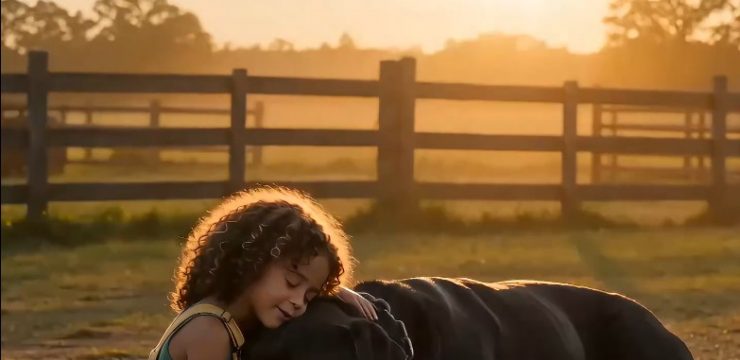
Lucy sank to the floor and wrapped both arms around his neck.
“Sir Max,” she whispered.
The dog closed his eyes.
Elias stopped a few feet away, afraid that if he touched her too quickly she might disappear like every dream he had woken from since the day she vanished.
Lucy looked up at him.
“I tried to come home,” she said.
His face crumpled.
“I know, baby.”
“I remembered the tree. I remembered Max. I found the cabin, but you weren’t outside. I got scared. I buried the lunchbox because I thought if they found me again, at least someone would know.”
Elias dropped to his knees.
“You came back.”
“I never stopped trying.”
He held out his arms.
This time, she crossed the distance.
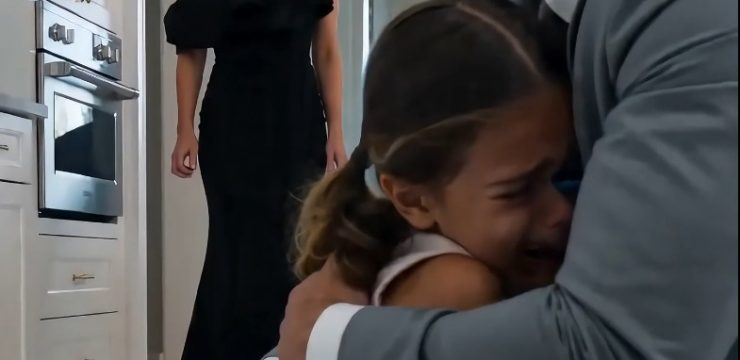
The first embrace was not neat or cinematic. It was shaking hands, broken breaths, whispered apologies neither one owed the other. It was a father holding the daughter the world had told him to mourn. It was a girl finally resting her head against the chest she had once believed she would never find again.
Mara arrived the next morning.
Agent Benton had called her.
She stepped out of a state police vehicle wearing a gray coat and a face hollowed by years of regret. For a moment, she and Elias only looked at each other across the gravel lot.
Then Lucy came out of the station.
Mara made one sound.
Not a word.
A mother’s sound.
Lucy hesitated, overwhelmed by a woman she remembered in pieces: perfume, lullabies, warm hands, crying behind a closed door.
Mara did not rush her.
She stood there with both hands open and tears running silently down her face.
“I’m sorry,” Mara said. “I’m so sorry.”
Lucy walked into her arms.
Elias turned away, not because he could not bear it, but because some grief deserved privacy even when it ended.
The trials took months.
Harlan tried to deny everything until his own records buried him. Vale tried to paint himself as a protector until the children he had renamed began telling the truth. Deputies resigned. Bank accounts were frozen. Land deals collapsed. Men who had shaken hands in daylight started accusing each other before cameras.
For Mason County, it was a scandal.
For Elias, it was background noise.
Justice mattered.
But Lucy mattered more.
She came home slowly.
At first, she slept with the lamp on. She startled at trucks on the dirt road. She walked to the cottonwood every morning with Max, standing beneath its branches until memory sorted itself into something she could survive.
Elias never pushed.
He learned her favorite tea. He fixed the porch swing. He listened when she wanted to talk and stayed nearby when she did not.
Mara returned too, not as if the old life could be stitched back together perfectly, but as someone willing to sit with what had been broken. She and Elias did not pretend nine years could vanish.
They simply agreed that Lucy would never again have to choose which parent believed her pain.
One evening, weeks after the first frost silvered the dry field, Elias found Lucy under the cottonwood.
Max lay at her feet.
The sun was sinking behind the cabin, turning the windows gold. For the first time in years, the place looked less like a monument to loss and more like a home waiting for voices.
Lucy held the old blue ribbon in her hands.
“I used to think this tree took me,” she said.
Elias sat beside her.
“And now?”
She looked down at Max.
“Now I think it kept the way back.”
Elias swallowed the ache in his throat.
Max lifted his head, thumped his tail once, and settled again.
The wind moved through the branches overhead.
No secrets fell from them this time.
No buried box.
No old lie.
Just leaves, light, and the quiet sound of a family learning how to breathe in the same place again.
Elias reached for Lucy’s hand.
She let him take it.
Across the field, the cabin door stood open.