Act I
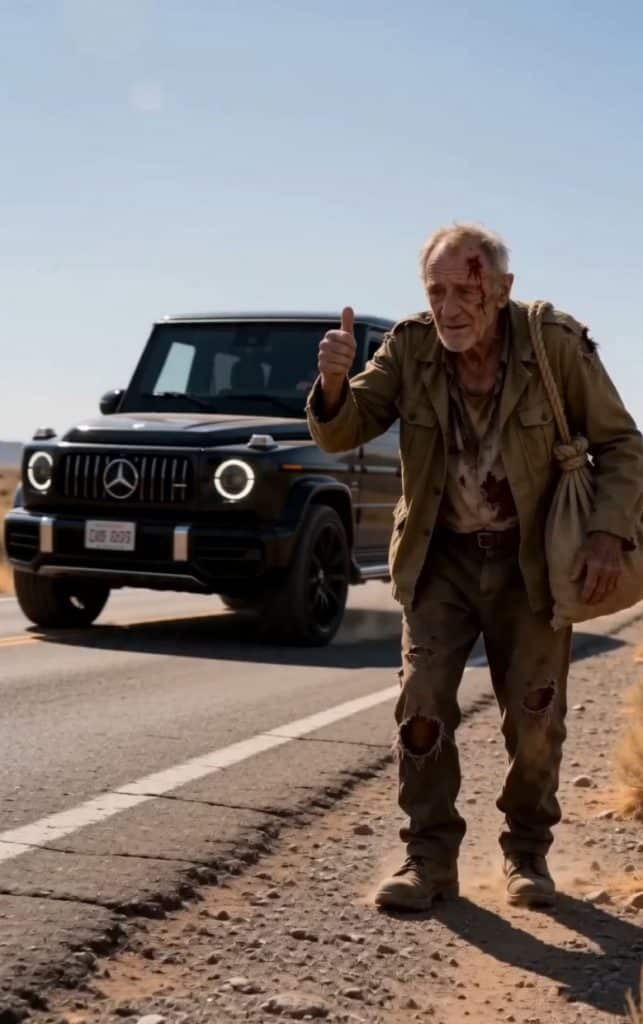
The black SUV slowed just long enough for cruelty to lean out the window.
The old man stood on the shoulder of the desert highway with one trembling thumb raised, his boots sinking slightly into the dust at the edge of the cracked asphalt. Heat shimmered around him. Blood marked his forehead in a thin red line, already drying beneath the grit on his face. His olive field jacket hung in shreds over a tattered shirt, and a heavy burlap sack sagged from one hand as if it carried the last weight he owned.
For one bright second, hope crossed his face.
Then the passenger in the white V-neck laughed.
“Look at this trash!” he shouted, pointing through the open window. “Keep walking, bum!”
The driver grinned behind his sunglasses and hit the gas.
The luxury SUV roared away, tires spitting gravel, leaving behind a wall of golden dust so thick the old man disappeared inside it. He coughed once, staggered back, and nearly fell.
But he did not curse them.
He only stood there in the heat, one hand tightening around the knotted sack.
The desert stretched silent around him.
No stores. No shade. No houses. Only the endless California high desert, dry sagebrush, and a highway that looked like it had been drawn straight across the earth by someone who had no intention of stopping.
Minutes passed.
Then another engine came humming gently down the road.
Not modern. Not loud.
A pristine red 1954 Chevrolet Bel Air rolled through the heat waves like a memory from a kinder decade. Its chrome flashed in the sun. Its whitewall tires crunched softly over the shoulder as it slowed beside the old man.
The driver was a teenage boy with dark eyes and a beige linen shirt, both hands still carefully on the wheel.
He leaned across the bench seat and opened the heavy passenger door from the inside.
“Please, sir,” the boy said, his voice calm and sincere, “let me take you where you need to go.”
The old man stared at him.
The boy saw the injury on his forehead and immediately reached for a clean cloth tucked near the dashboard.
“You’re hurt,” he said. “I have water too.”
For the first time all morning, the old man’s expression broke.
Not fully.
Just enough to show the exhaustion underneath.
He climbed in slowly, keeping the burlap sack pressed against his lap as though it were alive.
The boy did not ask what was inside.
He only turned the car back onto the highway.
Behind them, the black SUV was gone.
Ahead of them, the desert waited.
And the old man, who had been watching the world all day, had finally found someone who did not look away.
Act II
The boy’s name was Leo Marquez, and the car was the only inheritance his father had left him.
His father, Daniel, had been a mechanic with permanently bruised knuckles and a laugh that could fill a garage. He bought the red Bel Air before Leo was born, swearing he would restore it “when life slowed down.”
Life never did.
There were bills, hospital visits, late shifts, broken appliances, and a mortgage that seemed to grow teeth every winter. Daniel worked under other men’s cars by day and under his own by night, teaching Leo the difference between patience and stubbornness.
“Machines tell the truth,” he used to say. “People hide, engines don’t.”
When Daniel got sick, the Bel Air became their last project together.
Leo was fourteen then. He learned to sand rust from the fenders, polish chrome, rebuild the carburetor, and listen for the soft cough in the engine before it warmed. His father’s hands shook near the end, so Leo became the hands. Daniel became the voice.
Two years later, the car was finished.
Daniel died six weeks after that.
Since then, Leo drove it like a promise.
He never sped. Never let anyone eat in it. Never turned the key without touching two fingers to the dashboard, right above the small scratch his father had refused to buff out because “not every scar needs fixing.”
That morning, Leo had been driving back from Ridgecrest with an envelope in the glove compartment.
A rejection.
He had applied for a scholarship at a technical school in Los Angeles, hoping to study automotive engineering. The letter was kind, polished, and final. Impressive candidate. Limited funding. Try again next year.
Next year felt like another country.
His mother was already working double shifts at a clinic. Their roof needed repair. The garage behind their house, Daniel’s old garage, was two missed payments from being sold. Leo had not told her yet, but he had begun considering selling the Bel Air.
The thought made him feel like a traitor.
That was the mood he was in when he saw the old man.
At first, Leo thought he was seeing a mirage: a figure hunched at the roadside, jacket torn, forehead marked, a thumb raised against the enormous empty sky.
Then the black SUV stopped.
Leo was too far back to hear every word, but he saw the passenger point. He saw the laugh. He saw the dust cloud swallow the old man as the SUV sped away.
His hands tightened around the wheel.
His father’s voice came back to him, not as a memory but as a rule.
If a man is standing alone in the heat, you stop.
So Leo stopped.
Now the old man sat beside him, silent, the burlap sack resting across his knees.
Leo offered him water.
The old man took it with both hands.
“Thank you,” he said.
His voice was rough, like gravel pressed under a tire.
“What happened to you?” Leo asked gently. “Did someone hurt you?”
The old man touched the cut at his forehead.
“Not badly.”
“That doesn’t answer the question.”
A faint smile appeared beneath the grime.
“No,” he said. “It doesn’t.”
Leo glanced at him, then back at the road.
“My mom says I ask too many questions.”
“Your mother sounds wise.”
“She says that too.”
The old man gave a dry, quiet laugh.
For several miles, they drove without speaking. The Bel Air’s engine purred beneath them. Heat rippled over the asphalt. Far ahead, mountains sat purple against the horizon.
Finally, the old man nodded toward a turnout ahead.
“There,” he said. “The lookout.”
Leo slowed.
The turnout overlooked a vast valley streaked with dry washes and gold light. The sun had begun to lower, softening the desert into something almost holy. Leo parked near the edge and hurried around to help the old man out.
The old man moved carefully, still clutching the sack.
“I hope this spot is alright, sir,” Leo said. “Stay safe.”
He bowed his head slightly and turned to leave.
The old man caught his wrist.
His grip was weak, but his eyes were suddenly sharp.
“Stop,” he said.
Leo froze.
The old man’s voice lowered.
“I have a gift for your heart, son.”
Then he set the burlap sack in the dirt and began untying the knot.
Act III
Leo did not move.
The old man worked the twine slowly, his fingers rough and scarred, the knot resisting him like it had been tied for years. A dry wind moved across the turnout, carrying the smell of sagebrush and hot stone.
“Sir,” Leo said carefully, “you don’t have to give me anything.”
The old man looked up.
“That is why I can.”
Leo swallowed.
The sack loosened.
A strange golden light reflected upward from within it, catching the underside of the old man’s chin and flashing across Leo’s face. It was not the soft glow of sunset. It was sharper. Denser.
Leo leaned forward.
His mouth opened.
Inside the sack were gold bars.
Not movie gold stacked in neat rows, but old stamped bars wrapped in oilcloth, scratched and heavy, their surfaces dulled by age but still bright enough to throw fire into the air. Beside them lay a leather case, a bundle of papers sealed in plastic, and an old photograph.
Leo stumbled back.
“No,” he whispered.
The old man watched him calmly.
Leo shook his head hard, tears rising before he understood why.
“No, sir. I can’t. I can’t take that.”
The old man sat on a flat stone and rested one hand on the open sack.
“My name is Elias Whitcomb,” he said.
Leo knew the name.
Everyone in the desert towns knew it.
Whitcomb. Like Whitcomb Mines. Whitcomb Motors. Whitcomb Canyon Road. Whitcomb Technical Grants, the foundation his school counselor had told him to apply to before funding “ran dry.”
Leo stared at the old man.
“You’re dead.”
Elias smiled faintly.
“Legally inconvenient, but no.”
Leo backed away another step.
The old man reached into the leather case and withdrew a folded newspaper clipping. It showed a younger version of him standing beside a line of classic cars and a woman in a white hat. The headline called him a desert magnate, a recluse, a philanthropist, a tyrant, depending on which paragraph a reader believed.
“My nephews have been telling people I am dying for fifteen years,” Elias said. “They prefer the world prepared for my absence.”
Leo looked toward the empty highway.
“The SUV.”
“My sister’s grandsons,” Elias said. “Brandon and Cole. Rich enough to be bored. Poor enough in soul to laugh at a bleeding man.”
Leo looked back at the sack.
“This was a test?”
“Not at first.”
The old man’s face hardened, and for a moment the frail hitchhiker disappeared. In his place sat a man who had built roads, fought bankers, buried friends, and survived too long to be easily fooled.
“I came out here this morning to visit my wife’s marker at the canyon overlook,” Elias said. “My driver was supposed to wait. Instead, my nephews arrived. They wanted signatures. Transfers. Authority. They said I was too old to manage what remained of my estate.”
Leo’s stomach tightened.
“What did they do?”
“Took my phone. Took my driver. Left me on the shoulder after I refused to sign.” He touched his forehead. “The cut came when I slipped near the guardrail. They thought a few hours in the heat would teach me humility.”
Leo’s face went pale with anger.
“They left you out here?”
“Yes.”
“Then we need to call the police.”
Elias nodded toward the leather case.
“We will.”
Leo blinked.
Elias lifted the old photograph.
“First, I needed to know something.”
The picture showed three men in front of a garage. One was Elias, much younger. One was a smiling man with bruised knuckles and kind eyes.
Leo’s breath caught.
His father.
Daniel Marquez.
“How do you have that?” Leo whispered.
Elias looked at the photograph with deep sadness.
“Because your father saved my life long before you saved what was left of it.”
Act IV
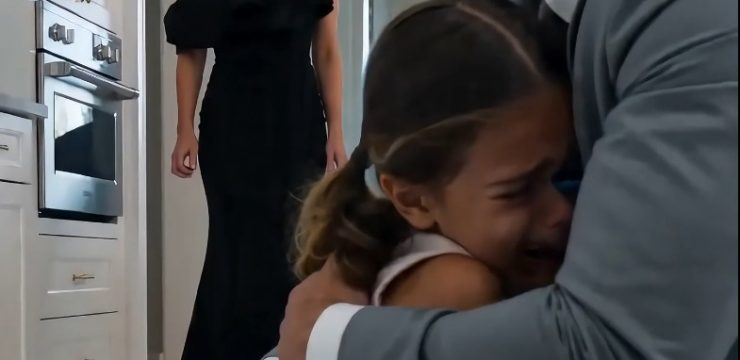
Leo took the photograph with trembling hands.
His father stood beside a younger Elias, both of them covered in grease, smiling in front of a half-rebuilt engine. Behind them, painted crookedly across a garage wall, were the words Marquez & Son Auto Repair.
But Leo had never seen the photo.
His father had never mentioned Elias Whitcomb.
“Your dad was the best mechanic I ever knew,” Elias said. “And the most stubborn man I ever hired.”
“You hired him?”
“I tried. He refused me three times. Said he’d rather own a small honest garage than become a rich man’s pet mechanic.”
A laugh broke from Leo’s mouth, then vanished into tears.
“That sounds like him.”
Elias nodded.
“Years ago, I wrecked a car on this road. Bad night. Bad weather. No one stopped. Your father did. Pulled me out, kept me talking, fixed what he could, and refused a reward.”
Leo looked at the photograph again.
“He never told us.”
“He said kindness counted less if you kept receipts.”
Leo closed his eyes.
That sounded like him too.
Elias reached into the plastic bundle and pulled out a document.
“After that night, I created a private scholarship fund for mechanics’ children. Your father never applied. Too proud. But he did ask me for one favor when he got sick.”
Leo went still.
“What favor?”
“To watch you from a distance. Not interfere. Not buy your life. Just make sure if the world ever tried to crush the good out of you, someone would be close enough to notice.”
Leo could not speak.
Elias handed him the document.
“This morning, before my nephews found me, I was coming to sign the final papers restoring the Whitcomb Technical Grants. Full funding. Ten years. Priority for students from working families.”
Leo’s eyes moved across the page.
His name was there.
Leonardo Daniel Marquez.
Full scholarship.
Housing stipend.
Tool allowance.
Apprenticeship placement.
His knees nearly gave out.
“I didn’t get it,” he said. “They rejected me.”
“My nephews froze the foundation accounts two months ago,” Elias said. “They wanted the money moved into private holdings before my death. Which, as I mentioned, they keep finding premature.”
Leo looked at the sack.
“And the gold?”
Elias touched one bar with two fingers.
“My father pulled it out of the first mine he ever owned. I kept it because men in suits can make numbers disappear, but gold stays heavy. I carried it today because I no longer trusted my own house.”
A low rumble rose from the highway.
Both of them turned.
The black SUV appeared around the curve, moving slowly now.
Leo’s body tensed.
Elias sighed.
“They finally realized I might still be inconvenient.”
The SUV pulled into the turnout.
Brandon, the driver in the black T-shirt, stepped out first. Cole, the passenger in white, followed, still wearing his sunglasses even though the sun was almost gone.
“Well,” Cole called. “Look who found a chauffeur.”
His smirk faded when he saw the open sack.
Brandon’s face changed completely.
“Uncle Elias,” he said, suddenly gentle. “We were worried.”
Leo almost laughed at the lie.
Elias did not move.
“You left me on the road.”
Cole rolled his eyes.
“You were being dramatic.”
“You took my phone.”
“You were confused.”
“You mocked a stranger for needing help.”
Cole glanced at Leo.
“Oh, come on. This kid?”
Leo stepped forward.
“He has a name.”
Cole smiled.
“Of course he does.”
Elias looked at Leo, then at the two young men.
“This is the part I feared,” he said.
Brandon frowned.
“What part?”
“The part where I learn whether blood means anything without character.”
Brandon’s eyes went to the documents.
“Uncle, let’s get you home. We can discuss this privately.”
“No.”
“Elias—”
“I said no.”
The old man’s voice cracked like a door slamming shut.
For the first time, the young men looked afraid.
Elias pulled a small recorder from inside the leather case and held it up.
“I have your conversation from this morning. The pressure. The threats. The transfer papers. I also have witnesses now.”
Brandon’s face drained.
Cole stepped forward.
“You old—”
Leo moved between them.
He was only a teenager. No weapon. No plan. Just his father’s car behind him and a moral line in the dirt.
“Don’t,” Leo said.
Cole stared at him.
Then red and blue lights flashed across the turnout.
A sheriff’s cruiser rolled in behind the SUV.
Then another.
Elias smiled faintly.
“I may be old,” he said, “but I know how to activate an emergency beacon.”
The sheriff stepped out, one hand resting calmly near his belt.
“Mr. Whitcomb,” he said. “We got your signal.”
Cole lowered his sunglasses.
Brandon looked at the sack, the documents, the police, the boy, the old man.
And finally understood that the person they had abandoned on the road had never been powerless.
He had been watching.
Act V
The desert sunset turned the whole turnout gold.
Not the greedy shine inside the burlap sack. A softer gold. The kind that touched rock, dust, steel, and skin without asking who deserved it.
Brandon and Cole were taken aside first.
Their voices rose, then lowered, then disappeared into the flat official tone men use when they realize charm has stopped working. The sheriff collected statements. A deputy photographed the documents. Elias refused an ambulance until Leo threatened to drive him to the hospital himself.
That made the old man laugh.
“You’re Daniel’s boy,” he said. “No doubt.”
Leo sat on the hood of the Bel Air, still holding the photograph of his father.
The scholarship papers lay beside him.
He kept looking at his name, expecting it to vanish.
Elias came to stand near him, now with a clean bandage pressed lightly to his forehead.
“You are frightened of the gift,” the old man said.
Leo nodded.
“It’s too much.”
“Yes.”
“I don’t know what to do with too much.”
“Then start with what you know.”
Leo looked at him.
Elias nodded toward the red car.
“Your father built that with you.”
“We built it together.”
“Then drive forward. Study. Learn. Come back if you wish. Build something honest. Help someone when it costs you time. Feed someone when it costs you money. Stop when everyone else drives past.”
Leo wiped his face quickly.
“My dad would’ve liked you.”
“He pretended not to.”
Leo smiled through tears.
For a while, they watched deputies load the burlap sack into evidence custody, not because Elias had lost it, but because he wanted everything documented before his nephews could claim he had imagined the day.
The gold was not the true gift.
Leo understood that slowly.
The gold was proof. Weight. Leverage against men who had hidden behind accounts and signatures.
The real gift was the paper in his hands.
And the photograph.
And the knowledge that his father’s kindness had outlived him.
A week later, the story spread across the desert towns.
Not the full story. Those never travel clean.
Some said a billionaire had disguised himself as a beggar to test strangers. Some said a teenager had saved him from heatstroke. Some said two rich heirs lost everything because they laughed at the wrong old man.
The truth was more complicated.
Elias did not disguise himself as poor.
Life had stripped him down that day. His own blood had left him injured and stranded. But some quiet part of him, the part that had spent years wondering what would happen to his fortune after he died, had watched every passing car with a question.
Who stops when there is nothing to gain?
The rude duo did not.
Leo did.
The legal consequences came quickly. Brandon and Cole were removed from all estate authority. Investigations opened into frozen foundation accounts and attempted coercion. Their luxury SUV, briefly famous because half the county saw it on the news, became a symbol of something they would never escape.
But Elias did not spend much time speaking about them.
He spent his energy elsewhere.
The Whitcomb Technical Grants reopened before fall.
The first award was given in Daniel Marquez’s name.
Leo tried to refuse the ceremony.
His mother made him wear a clean shirt and go.
Elias arrived in a simple gray suit, leaning on a cane he clearly resented. When he stepped up to the microphone, the small auditorium fell silent.
“Years ago,” he said, “a mechanic stopped for me on a road where better-dressed men drove by. He would not let me repay him. That annoyed me for decades.”
Laughter moved through the room.
Elias looked at Leo.
“His son has inherited the same problem.”
More laughter, gentler this time.
“So we are not repaying them,” Elias continued. “We are continuing them.”
Leo’s mother began to cry into a tissue.
Leo stared at his shoes.
Behind him, projected on a screen, was the old photograph: Daniel Marquez and Elias Whitcomb standing in front of the garage, young and alive in a way photographs make almost cruel.
After the ceremony, Elias handed Leo a small box.
Leo gave him a warning look.
“No more gold.”
“No gold,” Elias promised.
Inside was a hood ornament.
Original Chevrolet. Restored. Perfectly polished.
Leo touched it with reverence.
“My dad searched for one of these for years.”
“I know,” Elias said. “He beat me in a poker game for it and then refused to take it because he said I looked too sad.”
Leo laughed, then cried before he could stop himself.
Elias placed a hand on his shoulder.
“Grief is just love with nowhere obvious to go,” the old man said. “So put it into the work.”
Leo did.
He went to Los Angeles. He studied engines, design, restoration, and the future of clean transportation. He called his mother every night. He called Elias every Sunday, though Elias pretended the calls were a nuisance.
Every summer, Leo came home and worked in the old garage.
Not because he had to.
Because the place smelled like oil, dust, and his father’s hands.
Three years later, the Marquez Garage reopened as a training shop for teenagers who could not afford fancy programs but knew how to learn with their sleeves rolled up. The sign above the door was new, but Leo kept the old scratch in the workbench, the one his father had made while dropping a wrench and swearing loudly enough for the neighbors to hear.
Elias attended the opening in a wheelchair, complaining about the ramp even though he had paid for it.
The red Bel Air was parked out front.
On its dashboard sat the restored hood ornament, shining beneath the California sun.
A boy from the first training class asked Leo if the car was worth a lot.
Leo looked at it for a long moment.
“Yes,” he said. “But not in a way you can sell.”
Elias heard him and smiled.
Later that evening, when the crowd thinned, Leo drove Elias back to the same desert lookout.
The road was quiet. The sky burned orange and violet. Sagebrush bent in the wind. The valley below looked endless, but no longer empty.
Leo parked near the edge.
For a while, neither of them spoke.
Then Elias said, “Do you ever think about that day?”
Leo leaned against the car.
“Every time someone needs a ride.”
The old man nodded.
“And do you stop?”
Leo looked at him.
“You know I do.”
Elias’s eyes shone, though he blamed the wind.
The burlap sack was long gone by then, locked away in court records and family legend. The gold had been moved into the foundation. Brandon and Cole had become names people spoke with lowered voices and raised eyebrows.
But the real treasure had never stayed in the sack.
It had moved.
Into a scholarship.
Into a garage.
Into a boy who became a man without letting the world make him hard.
And into the memory of one hot afternoon when cruelty drove away laughing, kindness pulled over in a red car, and an old man opened a bag full of gold only to reveal something far heavier.
The proof that a good heart, tested in dust and heat, could change the direction of an entire life.