Act I
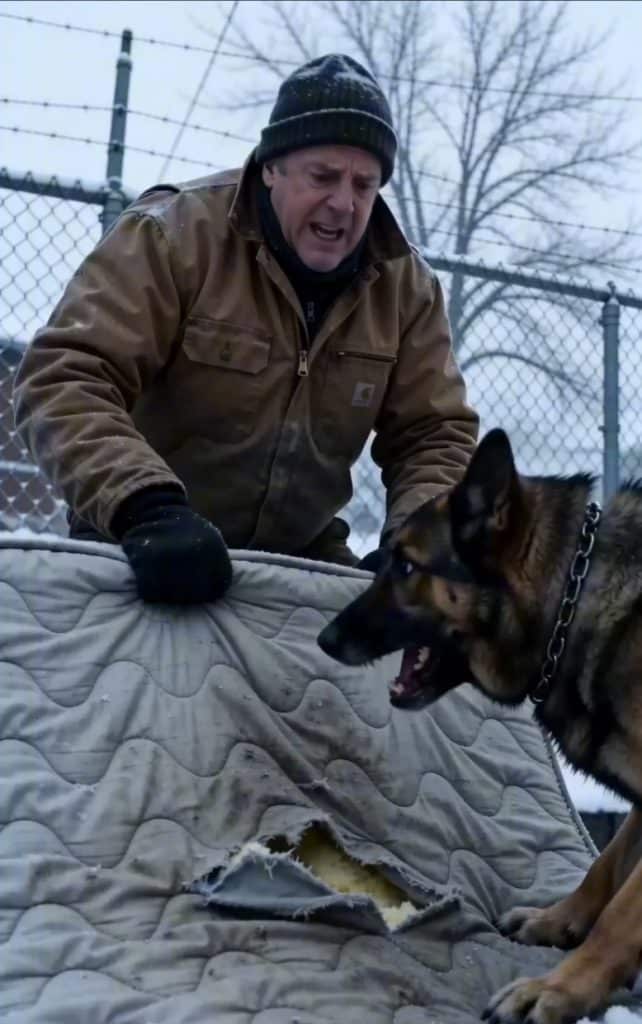
Arthur Keene was halfway through dragging the mattress across the snow when Kaiser lost his mind.
The old thing was filthy, ripped along one side, and frozen stiff from lying all night beside the alley fence. Arthur had found it dumped behind the rental property at dawn, half-buried under fresh powder, surrounded by soda cans, wet cardboard, and a cracked plastic milk crate.
He hated illegal dumping.
He hated winter.
Most of all, he hated being cold before coffee.
“Come on,” he grunted, gripping the top edge with both gloved hands. “It’s just trash.”
Kaiser slammed both front paws onto the mattress.
The German Shepherd pinned it hard against the snow, teeth bared, hackles raised. His chain collar rattled as he leaned his full weight forward, barking so loudly the sound bounced off the garage doors and rattled the chain-link fence.
Arthur yanked again.
The mattress did not move.
“Kaiser!” he snapped. “I’m tossing it. Let go!”
The dog looked up at him once.
Not angry.
Pleading.
Then he dropped his head and buried his snout into a small tear near the middle of the mattress.
Arthur froze.
Kaiser bit down on the yellow foam and jerked violently. Chunks flew into the air. Gray fabric shredded beneath his teeth. Snowflakes thickened around them, catching in the dog’s wet fur as he tore at the mattress like he was trying to get to something alive.
“Hey!” Arthur shouted. “Stop that!”
Kaiser did not stop.
He growled through his teeth and ripped the hole wider.
Arthur stood there, breath smoking in the air, irritation giving way to something colder. Kaiser was trained. Stubborn, yes. Protective, absolutely. But he did not attack garbage.
Not like this.
The dog backed away suddenly.
Four paws spread wide.
Head low.
Eyes fixed on the black space inside the torn mattress.
A distant siren wailed somewhere beyond the frozen trees.
Arthur let go of the mattress. It fell flat into the snow with a dull slap.
“What the hell did you find?” he whispered.
He stepped closer.
Kaiser barked once, deep and warning.
Arthur crouched over the opening.
At first, all he saw was darkness between layers of foam and fabric. Then he saw plastic tubing. A strip of silver tape. A narrow hollow space carved inside the mattress where no hollow space should have been.
Then something inside moved.
Arthur’s heart stopped.
He reached in with one shaking hand and pulled away a loose flap of fabric.
Two eyes looked back at him.
A little girl was curled inside the mattress, wrapped in a thin blanket, her lips pale from the cold, her fingers clenched around a cracked red crayon.
She was alive.
Barely.
Arthur stumbled backward, one hand flying to his mouth.
“Oh… my God,” he breathed. “No.”
Kaiser stopped barking.
The dog lowered his head and whined.
The child blinked slowly, as if the gray winter sky hurt her eyes.
Then Arthur saw the necklace around her throat.
A tiny brass key on a string.
He knew that key.
He had carved her initials into it six winters ago, back when she was small enough to fall asleep on his chest while his daughter laughed from the kitchen.
L.K.
Lila Keene.
His granddaughter.
The child everyone said was dead.
The mattress had not been dumped by accident.
It had been delivered to the one man who would recognize what was buried inside.
Act II
Six years earlier, Arthur had been told to mourn quietly.
He did not.
His daughter, Hannah Keene, had vanished during a February storm with her two-year-old daughter, Lila. Their car was found abandoned near an overpass outside town. The official report said Hannah had been overwhelmed, unstable, possibly fleeing custody problems no one could prove existed.
Arthur never believed it.
Hannah was not unstable.
She was scared.
There was a difference.
She had worked as a case reviewer for a private family-placement contractor called North Star Homes, a clean little company with blue brochures, smiling children on its website, and donors who wore expensive coats at charity dinners.
A month before she vanished, Hannah came to Arthur’s house after midnight.
Kaiser was with her then, younger and leaner, a working dog she had adopted after he washed out of police training for being “too attached.” Hannah loved that about him.
“He notices what people try to hide,” she told Arthur.
That night, she looked exhausted. Her hands shook around the mug of coffee he gave her.
“Dad,” she said, “if something happens to me, don’t trust anyone who says I ran.”
Arthur remembered laughing because the alternative was fear.
“Don’t talk like that.”
“I found records,” she whispered. “Children moved under new names. Files sealed before hearings. Payments disguised as donations. It’s not just bad paperwork.”
Arthur had stared at her.
“Go to the police.”
“I tried.”
The way she said it made his skin go cold.
“Then go higher.”
“I am. Tomorrow.”
But tomorrow never came.
By morning, Hannah and Lila were gone.
Kaiser was found three days later near a drainage ditch, limping through snow with his collar broken and Hannah’s scarf tangled around his neck. The dog refused to leave Arthur’s porch after that.
So Arthur kept him.
Or maybe Kaiser kept Arthur.
The town moved on faster than Arthur could understand. Hannah’s name became uncomfortable. Lila’s photograph came down from grocery store windows. North Star Homes released a statement about “tragic family instability” and donated money to a children’s winter coat drive.
Arthur broke a man’s nose in a bar for repeating that phrase.
After that, people called him bitter.
He became the old man with the dog.
The one who fixed rental boilers, shoveled alleys, repaired gutters, and picked up trash tenants dumped behind buildings. He kept a framed photo of Hannah and Lila in his kitchen, but he stopped inviting people inside because they always looked at it with pity.
Kaiser never did.
Every year, on the day Hannah vanished, the dog became restless. He paced by the back door. He sniffed the air. He stared toward the north side of town, where North Star Homes had once operated out of a renovated brick schoolhouse.
Arthur told himself it was memory.
Dogs grieved too.
But that morning, standing in the snow behind the rental property with his missing granddaughter hidden inside a mattress, Arthur understood.
Kaiser had not been grieving.
He had been waiting.
The ambulance arrived first.
Arthur wrapped Lila in his own coat and held her against his chest while paramedics worked around him. She was conscious but weak, her eyes drifting toward Kaiser every few seconds as if he were the only real thing left in the world.
“What’s her name?” one paramedic asked.
Arthur could barely speak.
“Lila,” he said. “Her name is Lila.”
The paramedic looked at him sharply.
“Are you family?”
Arthur looked down at the child.
Six years had changed her face. Her cheeks were thinner. Her hair was darker. But the small crease between her brows when she tried not to cry was Hannah’s.
“I’m her grandfather.”
Lila’s fingers moved against his coat.
Her voice was almost nothing.
“Kaiser,” she whispered.
The dog pressed his nose gently to her hand.
Arthur broke then.
Not loudly. Not dramatically.
Just one sharp breath that folded him inward.
Because Lila had remembered the dog.
Somewhere in whatever darkness had taken her, she had kept that name.
And if she remembered Kaiser, she might remember who took her.
Act III
The hospital put Lila in a warm room with soft lights and a guard outside the door.
Arthur did not leave.
Neither did Kaiser.
A nurse tried once to move the dog to the hallway. Lila woke from a shallow sleep and made a small frightened sound. Kaiser stood, placed himself between the bed and the door, and stared at the nurse until she wisely decided hospital policy had room for mercy.
Arthur sat beside the bed, hands clasped, watching his granddaughter breathe.
He had imagined finding her a thousand times.
In those imaginings, she ran into his arms. She knew him. She called him Grandpa. The music swelled, the nightmare ended, and grief returned everything it had stolen.
Reality was quieter.
Lila was eight now. She remembered pieces. A dog. A blue kitchen. A woman singing while brushing her hair. Snow outside a window. A man’s voice telling her never to say her old name.
She did not remember Arthur clearly.
That hurt.
But it was a living hurt.
Arthur could survive that.
A detective arrived that evening. Not local police. State bureau. A woman named Mara Ellison with silver-streaked hair, careful eyes, and the tired posture of someone who had seen too many families destroyed by polite criminals.
She placed a sealed evidence bag on the table.
“We found this inside the mattress lining,” she said.
Arthur looked at it.
A flash drive.
A folded birth certificate.
And a laminated card with North Star Homes printed across the top.
His hands curled into fists.
“I told them,” he said. “Six years ago, I told everyone.”
Detective Ellison did not offer him the insult of surprise.
“I know.”
Arthur stared at her.
She lowered her voice.
“Your daughter contacted my office the day before she disappeared. Her call was logged, then somehow misfiled. I reopened it last year after two more children vanished under sealed placement orders.”
Arthur felt the room tilt.
“Two more?”
Ellison’s face hardened.
“At least.”
Lila stirred in the bed.
Kaiser lifted his head.
Arthur forced himself still.
“Who put her in that mattress?”
“We’re working on that.”
“That means you don’t know.”
“It means I won’t lie to you.”
Arthur looked toward the window. Snow tapped softly against the glass.
Ellison continued.
“The mattress came from a house on Camden Street. A couple named Peter and Elise Ward rented it for three months under false documents. They disappeared last night.”
Arthur knew Camden Street.
Three blocks from his rental alley.
Close enough for Kaiser to smell what no human could.
“Why bring her here?” Arthur asked.
Ellison hesitated.
“I don’t think they meant to. The alley behind your building is used by a private waste hauler. Bulky items get picked up before dawn and taken to an industrial transfer yard. Someone likely planned to move her without anyone checking the inside.”
Arthur’s face drained of color.
“If I had tossed it onto the truck—”
“You didn’t.”
“No,” he said, looking at Kaiser. “He didn’t let me.”
The detective nodded once.
Then Lila opened her eyes.
She looked at Arthur, then at the evidence bag, then at Kaiser.
“The lady said he would find me,” she whispered.
Arthur leaned forward.
“What lady, sweetheart?”
Lila’s fingers tightened around the blanket.
“The lady with my eyes.”
Arthur could not breathe.
Hannah.
Lila’s lower lip trembled.
“She told me if I got scared, remember Kaiser. She said Kaiser always finds family.”
Arthur gripped the edge of the bed.
Detective Ellison went still.
“Lila,” she said gently, “when did you see that lady?”
The child’s eyes filled.
“In the basement house.”
Arthur stood so fast the chair hit the wall.
Because for six years, he had buried two people in his heart.
Now one had come back alive.
And the other might still be waiting in the dark.
Act IV
The basement house was not on any official North Star property list.
Kaiser found it anyway.
Two nights after Lila was rescued, Detective Ellison brought Arthur to Camden Street under strict instructions not to interfere. Arthur agreed with his mouth and ignored it in his heart.
Kaiser sat in the back of the unmarked vehicle, body tense, nose working against the cold air leaking through the window.
The Ward house looked ordinary.
That was the worst part.
Pale siding. Dead wreath on the front door. A child’s plastic sled leaning against the garage. Nothing monstrous ever arrives wearing its own name.
Inside, investigators found empty rooms, wiped counters, and closets cleared in a hurry.
Kaiser ignored all of it.
He went straight to the basement door.
Then he began to growl.
Arthur’s blood turned cold.
The basement was unfinished, concrete-walled, and colder than the rest of the house. There were storage shelves, paint cans, broken furniture, and three old mattresses leaning against the far wall.
Kaiser lunged toward them.
An officer grabbed his collar.
Arthur snapped, “Let him work.”
For once, no one argued.
Kaiser sniffed each mattress, then stopped at the last one.
He pawed at the seam.
Inside the fabric, investigators found a phone wrapped in plastic.
The battery was nearly dead.
Detective Ellison turned it on.
The screen lit with one unsent video.
Hannah Keene appeared on it.
Arthur made a sound like someone had struck him.
His daughter looked older, thinner, but alive in the recording. Her face was bruised by exhaustion, not violence. Her hair had been cut short. She sat in dim light, speaking quickly.
“My name is Hannah Keene,” she said. “North Star did not place children. It sold access to them through sealed courts and private guardianships. Judge Ralston signed the orders. County Director Vale erased the files. Peter and Elise Ward transported the children under foster credentials.”
Arthur covered his mouth.
Hannah looked off-camera, listening.
Then back.
“If Lila sees this someday, baby, I never left you. I never stopped looking. Kaiser knows your scent. If Dad has him, trust the dog.”
The video ended.
No goodbye.
No explanation of where she was now.
Just proof.
Enough proof to make powerful people afraid.
Detective Ellison’s team moved fast after that.
Warrants hit three addresses before sunrise. Bank accounts were frozen. A county office was sealed. Judge Ralston was pulled from a charity breakfast while cameras caught him pretending not to understand why state agents were reading him his rights.
Peter and Elise Ward were found at a motel outside the state line.
They had cash, false passports, and a list of names.
Hannah’s name was on it.
Not under deceased.
Under transfer pending.
Arthur saw that phrase and nearly tore the paper in half.
“What does it mean?” he demanded.
Ellison looked grim.
“It means they moved her recently.”
“Where?”
“We’re finding out.”
But Kaiser already knew.
At the motel, while agents searched the Wards’ car, the dog pulled Arthur toward a service road behind the building. He sniffed the snow, circled once, and barked toward the woods beyond the highway.
Ellison followed his gaze.
“There’s an old maintenance facility back there.”
Arthur was already moving.
The building sat half a mile from the motel, hidden behind pines and a rusted chain gate. It had once belonged to the highway department. Now it looked abandoned.
It was not.
There was heat coming from the vents.
Light beneath one door.
And when Kaiser reached the entrance, he began scratching like he had at the mattress.
This time, Arthur did not tell him to stop.
Agents forced the door open.
Inside, in a small office with boarded windows, they found Hannah Keene sitting on a cot beneath a wool blanket, alive, weak, and staring at the door as if she had been waiting through six winters for that exact sound.
Kaiser reached her first.
The German Shepherd pressed his head into her lap.
Hannah’s hands shook as they sank into his fur.
“Kaiser,” she whispered.
Arthur stood in the doorway, unable to move.
His daughter looked up.
For a second, neither of them spoke.
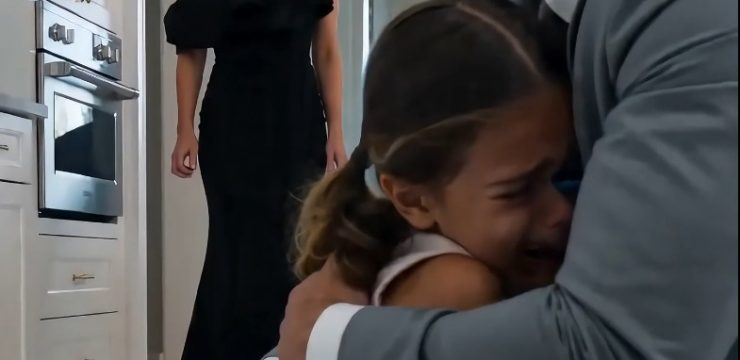
Then Hannah’s face crumpled.
“Dad?”
Arthur crossed the room and fell to his knees.
He held her like the years were something he could break with his arms.
And outside, snow kept falling on a world that had finally run out of places to hide the truth.
Act V
The town wanted a clean ending.
It did not get one.
Clean endings are for stories where the harm is small enough to sweep into a final sentence. What happened in Arthur’s town had roots. It had offices. It had signatures, sealed hearings, quiet payments, and smiling people who knew exactly which words made cruelty sound official.
The investigation lasted months.
North Star Homes collapsed first. Then the county director resigned. Then the judge’s private emails surfaced. Then families began coming forward, some furious, some ashamed, some holding photographs of children they had been told they could never see again.
There were trials.
There were hearings.
There were apologies that sounded polished and apologies that sounded like they hurt.
Arthur attended only the ones Hannah asked him to attend. He had spent six years shouting at doors that would not open. Now that they were open, he cared less about watching powerful people fall than he expected.
He cared about breakfast.
About Lila learning where the mugs were kept.
About Hannah sleeping through a whole night without waking at every car door outside.
About Kaiser finally resting his head on the kitchen rug instead of pacing from window to window.
The house changed slowly.
Arthur took down nothing. The old photographs stayed. The missing posters stayed too, folded in a box but not thrown away. Lila asked to see them once, and Arthur showed her carefully.
“That was me?” she asked.
“That was you.”
“Did you look for me?”
Arthur’s eyes burned.
“Every day.”
She studied him, still unsure how to fit him into the map of her life.
Then she reached for his hand.
“I think Kaiser looked too.”
Arthur laughed through the ache in his throat.
“Kaiser did most of the work.”
Hannah recovered in pieces.
Some days she was almost herself, sharp and stubborn, arguing with doctors and correcting legal statements with a pen in her hand. Other days, she sat by the window with a blanket over her knees, watching snow melt from the roofline.
Arthur learned not to push.
Love, he discovered, was not dragging someone out of the past before they were ready.
Sometimes it was sitting beside them until the room felt safe enough to breathe in.
One afternoon, when winter had loosened its grip and the alley behind the rental property had turned to gray slush, Arthur returned there with Kaiser.
The trash pile was gone.
The fence had been repaired.
The mattress had been taken as evidence, leaving only a shallow rectangle in his memory where it had lain in the snow.
Arthur stood in that spot for a long time.
He remembered his own voice.
It’s just trash.
The shame of it still struck deep.
Not because he could have known.
Because he had spent years living in a town that treated certain people, certain families, certain children, like things that could be misplaced, renamed, sealed away, or tossed out of sight.
Kaiser sniffed the ground, then sat beside him.
“I know,” Arthur said quietly. “You were right.”
The dog looked up, solemn and unimpressed.
That spring, Arthur built a new fence around the backyard.
Not to keep the world out.
To let Lila feel safe inside it.
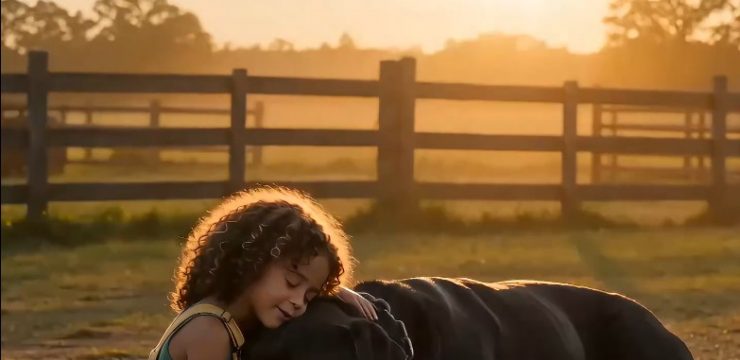
She planted marigolds near the steps because Hannah said her mother had loved them. Arthur made raised garden beds from cedar. Kaiser dug exactly one unauthorized hole and looked deeply offended when everyone laughed.
On the first warm evening of May, they ate dinner outside.
Nothing special.
Soup. Bread. Store-bought pie.
But Lila sat between Hannah and Arthur with Kaiser’s head resting on her shoe, and the sound of her laughter moved through the yard like something returning to its rightful place.
Hannah looked at Arthur across the table.
“I thought I’d never come home,” she said.
Arthur swallowed.
“I should have found you sooner.”
She shook her head.
“You kept him.”
Kaiser lifted one ear at the mention of himself.
Hannah smiled faintly.
“You kept the one soul who still knew the way.”
Arthur looked down at the dog.
The same dog who had barked at a filthy mattress in the snow until a stubborn old man finally listened. The same dog who had turned trash into evidence, silence into testimony, and an alley into the beginning of a rescue.
Lila leaned against Arthur’s arm.
“Grandpa?”
The word still caught him off guard every time.
“Yes, sweetheart?”
“Can Kaiser sleep in my room tonight?”
Arthur pretended to consider it.
Kaiser was already standing.
Hannah laughed softly.
“I think he answered.”
The dog followed Lila toward the house, tail low but wagging, as if escorting royalty.
Arthur watched them go.
The backyard grew quiet after that, but not empty. For the first time in years, silence did not feel like something hiding.
It felt like peace.
And in the corner of the yard, where winter shadows had once stretched like bars across the snow, marigolds opened their bright orange faces to the sun.