Act I
The little girl’s scream did not belong in a room that clean.
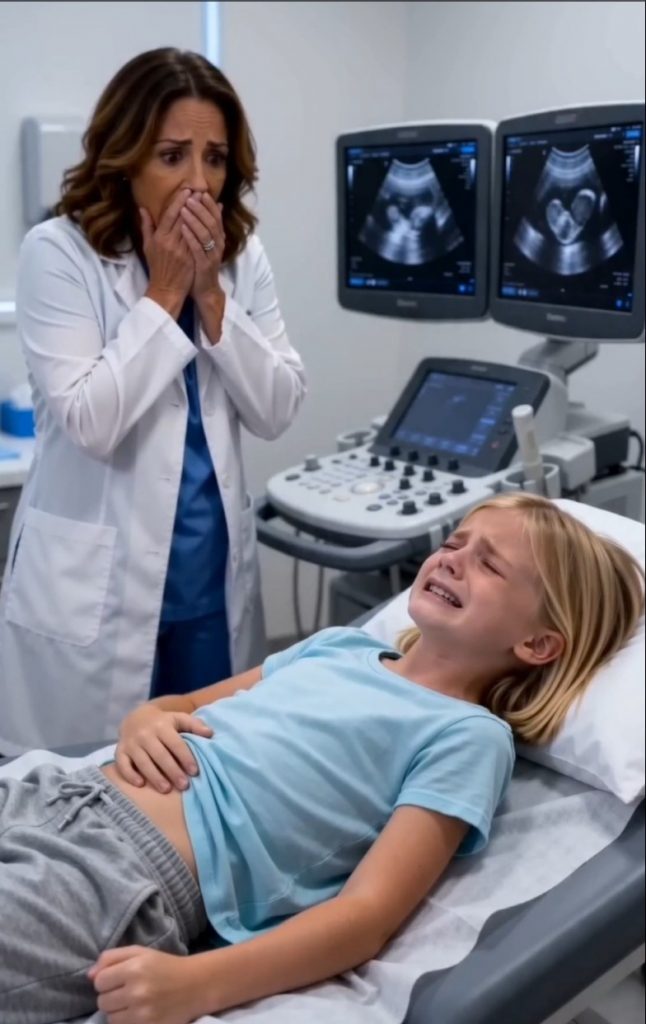
Everything around her was white, polished, and controlled. The walls. The cabinets. The paper sheet stretched over the exam table. Even the ultrasound machine hummed with a steady calm, as if pain were something that could be measured without changing the air.
But Sophie Vale was twisting on the table, one hand pressed hard against her lower stomach, her small fingers curled into the fabric of her blue shirt.
“It hurts!” she cried. “It really hurts my stomach. It hurts so much!”
Dr. Claire Hensley stood beside the ultrasound monitor with both hands over her mouth.
She had been a pediatric physician for twenty years. She had seen frightened children, worried parents, rare conditions, strange scans, and emergencies that made nurses move faster without being told.
But she had never seen anything like this.
On the black-and-white screen, beneath the grainy waves of tissue and shadow, was a shape that did not belong in a child’s body.
It was not a tumor.
Not fluid.
Not anything natural.
It was smooth, dense, and strangely precise, with edges too clean for biology.
Claire lowered her hands slowly.
“Sophie,” she said, forcing her voice to stay gentle, “I need to look one more time, sweetheart.”
The girl sobbed and nodded.
Claire warmed more gel between her fingers and placed the probe carefully against the child’s abdomen. Sophie cried harder, but she held still as best she could.
On the monitor, the shape appeared again.
Clearer this time.
A small capsule.
Black. Polished. Sealed.
Claire felt the room tilt.
Behind her, a woman in a camel-colored coat stood near the door, arms crossed, lips pressed thin. Mrs. Vale had introduced herself as Sophie’s guardian. She had not comforted the child once.
“She’s dramatic,” Mrs. Vale said. “She gets attention this way.”
Claire did not look at her.
“No child fakes that kind of pain.”
Mrs. Vale’s expression hardened.
“I’m paying privately. I would appreciate discretion.”
That word landed badly.
Discretion.
People used it when they wanted silence to sound expensive.
Sophie tossed her head, tears soaking into her blonde hair.
“Please,” she begged. “Make it stop. It hurts so bad.”
Claire stared at the screen again.
The capsule sat in a dangerous place, lodged where it could cause serious harm if ignored. It had to be removed. Immediately.
But the question was not only what it was.
The question was why a terrified eight-year-old girl had something hidden inside her that looked less like an accident and more like evidence.
Claire stepped back from the machine.
Her chin trembled before she could stop it.
“Oh my God,” she whispered.
Mrs. Vale moved toward the table.
“We’re leaving.”
Claire turned so fast the woman stopped.
“No,” she said. “You’re not.”
For the first time, Mrs. Vale looked afraid.
And that was when Sophie opened her eyes, saw the silver ring on Claire’s left hand, and whispered a sentence that froze the doctor’s blood.
“The nurse said my real mommy had a moon on her ring.”
Act II
Claire had not taken off that ring in eight years.
It was silver, simple, and worn smooth at the edges from the nervous habit of twisting it around her finger. Inside the band, hidden against her skin, was a tiny crescent moon engraved beside a date.
Nora’s date.
Her daughter’s date.
The baby Claire had been told died three hours after birth.
Back then, Claire had not been Dr. Hensley to anyone. She had been a new mother in a private clinic room, exhausted, half-conscious, and reaching for a child she had barely been allowed to hold.
Her husband had been deployed overseas. Her parents were dead. She had no one in the room except doctors, nurses, and a senior obstetrician named Dr. Malcolm Sloane.
Sloane had been kind in the way powerful men are kind when they know kindness will help them end a conversation.
“There was nothing we could do,” he told her.
Claire remembered the cold weight of those words.
She remembered asking to see her baby.
She remembered being told it would be better not to.
For months afterward, grief swallowed her life.
But grief has instincts too.
It notices missing details.
No footprints. No proper bracelet. No clear final report. A death certificate signed too quickly by a doctor who would not meet her eyes afterward.
Claire asked questions until the clinic board warned her to stop.
Then the records disappeared in a “system migration.”
Then Dr. Sloane left the clinic, only to reappear years later as the director of the private pediatric center where Claire now worked.
He always smiled when he saw her.
That was what she hated most.
The smile.
Like he knew exactly which part of her life had been buried and exactly how deep.
Now an eight-year-old girl lay on Claire’s exam table, crying in pain, speaking of a ring with a moon inside it.
Claire’s mouth went dry.
“What nurse?” she asked softly.
Sophie looked toward Mrs. Vale and shrank.
“I don’t know.”
Mrs. Vale’s voice sharpened.
“She makes up stories.”
Claire pressed the emergency call button on the wall.
“Not today.”
Within seconds, two nurses entered. Claire kept her body between Mrs. Vale and the child.
“I need pediatric surgery on standby,” she said. “And security at this door.”
Mrs. Vale stared at her.
“You have no right.”
“I have a child in acute distress and an unexplained foreign object visible on imaging.” Claire’s voice stayed level. “That gives me every right.”
The woman’s face changed.
The mask of cold wealth slipped just enough for Claire to glimpse panic underneath.
“You don’t know who you’re interfering with.”
Claire looked at Sophie, pale and shaking on the table.
“Yes,” she said. “I think I do.”
As nurses prepared to move Sophie, the girl grabbed Claire’s sleeve.
Tiny fingers. Desperate grip.
“She told me not to let them take the black thing,” Sophie whispered. “She said it had my name.”
Claire bent closer.
“Who said that?”
Sophie’s lips trembled.
“The nurse from the basement.”
The floor seemed to fall away beneath Claire.
Because eight years ago, during the week after her daughter’s supposed death, one nurse had tried to call her.
Miriam Reyes.
She left one message.
Dr. Hensley, there’s something wrong with the baby records. Please don’t trust—
The message ended there.
By morning, Miriam had resigned.
By noon, no one at the clinic admitted she had ever worked there.
Claire had spent eight years thinking Miriam was another ghost attached to her grief.
Now a child in pain had spoken her back into the room.
And the capsule in Sophie’s body was no longer just a medical emergency.
It was a message that had survived inside a child because every other hiding place had failed.
Act III
The procedure took less than an hour.
Claire was not allowed to perform it herself. She was too emotionally involved, and she knew it. So she stood outside the operating suite with her hands clasped so tightly her knuckles ached, listening to the careful movement of trained people trying to save a frightened child from whatever adults had done around her.
Mrs. Vale had vanished before security could question her.
That told Claire more than any argument could have.
Hospital administration called twice. Dr. Sloane called three times. Claire did not answer until a nurse brought Sophie safely into recovery and placed a sealed evidence container in Claire’s hand.
Inside was the capsule.
Small. Black. Polished.
The same shape she had seen on the screen.
A detective named Aaron Pike arrived twenty minutes later, along with a child protection officer. Claire insisted they open the capsule in front of witnesses.
The first item inside was a flash drive.
The second was a tiny folded paper.
The third was a hospital ID bracelet, yellowed with age but still readable.
Baby Girl Hensley.
Claire stopped breathing.
Detective Pike looked at her.
“Doctor?”
She could not speak.
The room went too bright, too silent, too impossible.
With trembling hands, the child protection officer unfolded the paper. The handwriting was cramped and faded, but legible.
Dr. Claire Hensley’s daughter did not die. She was taken through the private placement file under the name Sophie Vale. I kept proof as long as I could. If this child reaches a doctor, protect her from Sloane.
Signed,
Miriam Reyes, RN
Claire turned toward the recovery room window.
Sophie slept under a pale blanket, one hand resting near her face, blonde hair spread over the pillow.
For eight years, Claire had imagined her daughter as a baby.
Frozen in time.
A child she could mourn but never know.
Now the child was alive, older, wounded by secrets, and sleeping fifteen feet away.
Detective Pike inserted the flash drive into an isolated forensic laptop.
File after file appeared.
Birth records.
Payment transfers.
Adoption documents marked confidential.
Photographs of infants.
Names changed.
Parents told their babies died.
Children moved through private guardianships to wealthy families who wanted clean paperwork and no questions.
At the center of it all was Dr. Malcolm Sloane.
Claire gripped the back of a chair.
Pike’s face darkened as he scrolled.
“This is bigger than one child.”
Claire looked at Sophie.
“No,” she said quietly. “It started with one child. That’s how they got away with it.”
A nurse entered the room, nervous.
“Dr. Hensley,” she said, “Dr. Sloane is here.”
Claire turned.
Through the glass door at the far end of the hall, Sloane walked toward them in a charcoal suit beneath his white coat. His silver hair was perfectly combed. His expression was calm.
Too calm.
The same smile appeared when he saw Claire.
“Claire,” he said warmly. “I heard there was a misunderstanding with a patient.”
Detective Pike closed the laptop.
Sloane’s eyes flicked to the evidence container.
The smile faded.
Only slightly.
But Claire saw the truth in that tiny change.
He knew exactly what had been found.
And he had come to take control before the little girl woke up.
Act IV
Dr. Sloane had built his career on rooms going quiet when he entered them.
This room did not.
Detective Pike stepped between him and the evidence table.
“Dr. Sloane, I need you to remain where you are.”
Sloane laughed softly.
“I’m the director of this facility.”
“And I’m the detective holding a flash drive with your name on it.”
The hallway changed.
Nurses slowed. A security guard shifted closer. Somewhere behind Claire, a monitor beeped in steady rhythm, reminding everyone that the child at the center of this was not an idea, not a file, not a scandal.
She was alive.
Sloane looked at Claire.
“You’re grieving again,” he said quietly. “I understand how this must feel, but you have to be careful. Pain can make people see patterns that aren’t there.”
For a moment, she was back in that clinic room eight years ago.
Weak. Heartbroken. Being told what reality was by the man who had stolen it from her.
Then Sophie stirred behind the glass.
Claire looked at the little girl.
And grief became steel.
“You told me my daughter died.”
Sloane’s face remained composed.
“She did.”
Claire lifted the hospital bracelet from the evidence container.
“Then why was her bracelet inside Sophie Vale?”
No answer.
Not fast enough.
Not clean enough.
Pike noticed.
Claire took one step closer.
“Miriam Reyes tried to warn me.”
Sloane’s eyes hardened at the nurse’s name.
“Miriam was unstable.”
“No,” Claire said. “She was brave.”
Behind them, Sophie’s small voice came from the recovery room.
“Dr. Claire?”
Everyone turned.
The girl was awake.
Pale. Frightened. But awake.
Claire went to her immediately.
Sophie’s eyes moved from Claire to Sloane, and terror flashed across her face.
“That’s him,” she whispered.
Sloane’s mask broke.
Just for a second.
But the room saw it.
Detective Pike moved.
“Dr. Sloane, you’ll need to come with me.”
Sloane stepped back.
“This is outrageous.”
Sophie began to cry, not loudly, but with the exhausted fear of a child who had learned adults could decide what happened to her body, her name, and her life.
Claire took her hand.
“No one is taking you anywhere,” she said.
Sophie looked at her ring.
“The moon,” she whispered.
Claire twisted the band off her finger and placed it gently in Sophie’s palm. Inside, the engraved crescent caught the hospital light.
Sophie stared at it.
Then she touched the hospital bracelet in the evidence box.
“My old nurse said I had another name.”
Claire’s throat closed.
“Yes.”
“What was it?”
Claire could barely make the word.
“Nora.”
Sophie was quiet for a long time.
Then she asked the question that broke everyone in the room.
“Did you want me?”
Claire sat on the edge of the bed and pressed the girl’s hand between both of hers.
“Every day,” she said. “Every single day.”
Sophie’s face crumpled.
Claire did not pull her into an embrace too quickly. She did not claim a right the child had not yet given. She simply stayed close, steady and open, while Sophie cried.
Then, slowly, the little girl leaned toward her.
Claire wrapped her arms around her daughter for the first time since the night she was born.
Outside the recovery room, Sloane was led down the hall.
This time, no one stepped aside for him.
Act V
The DNA test came back two days later.
Claire already knew.
But knowing with the heart and holding proof in your hand are different kinds of miracles.
The report confirmed what the bracelet, the capsule, and Sophie’s memories had already revealed.
Sophie Vale was Nora Hensley.
Claire’s daughter.
Alive.
The media learned about the case within a week, though Claire fought to keep Nora’s face and details private. The headlines focused on the scandal: stolen infants, private guardianships, forged death records, wealthy families, medical corruption, and a respected doctor whose career collapsed under the weight of documents he thought would never surface.
Claire cared about the investigation.
But she cared more about breakfast.
About finding out Nora hated oatmeal but loved strawberries.
About learning that she slept with the light on.
About sitting beside her during therapy sessions while Nora drew houses with locked doors at first, then windows, then gardens.
Mrs. Vale was arrested three states away with a false passport and a bag of cash. She claimed she had only followed instructions. Sloane claimed he had helped children find “better lives.”
The jury did not admire his phrasing.
Miriam Reyes was found living under another name in a coastal town, frail and frightened but alive. She had spent years hiding after smuggling proof out of Sloane’s clinic piece by piece.
When Claire visited her, Miriam cried before saying hello.
“I tried to save her,” she said.
Claire took her hand.
“You did.”
Miriam shook her head.
“Not soon enough.”
Claire looked through the window where Nora sat in the garden with a social worker, carefully drawing a crescent moon in blue pencil.
“Soon enough for her to come home.”
Home was not simple.
Claire did not pretend it was.
Nora did not wake up one morning and become the baby Claire had lost. She was eight years old, with memories Claire had not been part of, fears Claire could not erase, and a name she was not ready to let go of all at once.
So they made room for both.
Sophie for the girl who survived.
Nora for the child who had been stolen.
At bedtime, Claire asked which name felt right that night.
Sometimes Nora answered, “Sophie.”
Sometimes she whispered, “Nora.”
Sometimes she said, “Both.”
Claire always said, “Okay.”
One evening, months after the hospital room, Nora found the old silver ring on Claire’s dresser.
Claire had stopped wearing it on her finger and placed it on a chain instead. She said it belonged to both of them now.
Nora held it up to the light.
“Did you really wear it the whole time?”
“Yes.”
“Even when you thought I was gone?”
Claire nodded.
Nora turned the ring between her fingers.
“Why?”
Claire sat beside her.
“Because loving you didn’t stop just because someone lied to me.”
Nora thought about that.
Then she leaned against Claire’s shoulder.
It was small. Quiet. Not the dramatic embrace people imagine when they hear the word reunion.
But Claire had learned that the deepest healing often arrived softly.
No cameras.
No speeches.
Just a child choosing, for one moment, not to pull away.
The pediatric center changed after Sloane.
Its private wing was closed. Records were audited. Families were contacted. Some received answers they had been begging for across years of closed doors and polite lies.
Not every ending was happy.
Claire knew that.
But truth, even painful truth, was still a door.
And a door was better than a wall.
On Nora’s ninth birthday, Claire baked a lopsided cake with too much frosting. Miriam came. Detective Pike stopped by with a card. The nurses who had protected Nora that day sent a blue sweater embroidered with a tiny crescent moon near the cuff.
Nora opened it and smiled.
A real smile.
Claire had to look away for a second.
Later, after the candles were blown out and the dishes sat unwashed in the sink, Nora climbed onto the couch beside Claire with a sketchbook.
She had drawn a hospital room.
An ultrasound machine.
A little girl on a table.
A doctor standing beside her.
But in the drawing, the doctor was not covering her mouth in horror. She was reaching out her hand.
Underneath, Nora had written:
This is when she found me.
Claire touched the page carefully.
“Is that how it felt?”
Nora rested her head against her mother’s arm.
“At first it hurt,” she said. “Then you stayed.”
Claire closed her eyes.
Outside, evening settled over the windows. The house was quiet, but not empty. The silence held no secrets now.
The scan had shown a dark shape where no dark shape should have been.
The world had called it an abnormal mass.
But it had been more than that.
It was a message.
A key.
A buried truth.
And because one doctor refused to look away from a child’s pain, the secret hidden for eight years finally came into the light.