Act I
The cake was the only bright thing in the room.
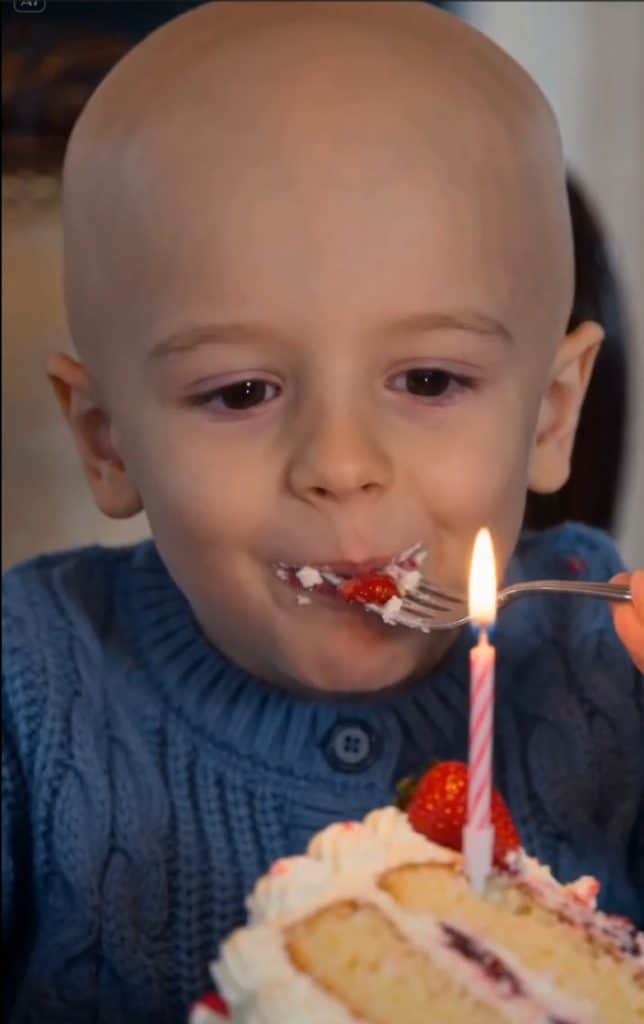
It sat on a porcelain plate at the edge of the grand mahogany table, small and imperfect, with strawberry cream leaning softly between pale layers and one thin candle trembling in the chandelier light.
Leo leaned toward it with both hands curled in excitement.
Elena held the silver fork carefully, smiling through tears as she guided one bite toward his mouth.
“Here you go,” she whispered. “This is sweet… just for you. Don’t worry, eat slowly.”
Leo took the bite and closed his eyes.
For one second, the mansion disappeared from his face.
The baldness from treatment, the blue sweater too large around his thin wrists, the quiet rooms where everyone spoke in careful voices, the months of being told no, not now, maybe later—gone.
He giggled with cake crumbs on his lip.
Elena laughed too, but her laugh broke at the end. Tears slipped down her cheeks as she dabbed gently at his mouth with a linen napkin.
She did not notice the man in the doorway.
Arthur Blackwood stood frozen beneath the archway, his charcoal suit perfect, his navy tie straight, his face suddenly drained of color.
No one ate in the formal dining room anymore.
Not since Leo’s diagnosis.
Not since Arthur had ordered every part of the house to become controlled, sterile, silent, safe.
And yet there was his son, sitting beneath the crystal chandelier, eating cake with a maid.
Arthur stepped forward.
His shoes struck the marble threshold with a sound sharp enough to make Elena turn.
The fork stopped in midair.
Leo’s smile faded.
Arthur looked at the cake. The candle. The tears on Elena’s face.
Then his eyes locked on her.
“What is going on here?”
His voice filled the room like a door slamming.
Elena stood so quickly the chair scraped behind her. Her black maid’s uniform was neat, her white lace apron pressed, her hair pinned into a dark bun. But her hands were shaking.
Leo reached for the plate.
“Papa,” he said softly. “It’s my birthday cake.”
Arthur’s face tightened.
“There was to be no cake.”
Elena swallowed.
“Sir, I only gave him a small piece. I checked with—”
“You checked with whom?” Arthur cut in. “You are not his nurse. You are not his doctor. You are staff.”
The word struck harder than he intended.
Elena lowered her eyes.
Leo’s small hand moved protectively over the cake plate.
“She made it for me,” he whispered. “Please don’t be mad.”
Arthur stared at his son.
The candle flame flickered between them.
And then Elena said the one sentence that made the whole room stop breathing.
“Your wife asked me to.”
Act II
Arthur did not move.
For years, his wife’s name had been a wound no one in the mansion touched.
Isabel Blackwood had once made the house loud.
She opened curtains Arthur preferred drawn. She filled antique bowls with oranges because she said rich rooms were often starved of color. She danced barefoot in the dining room when no guests were present and insisted that every birthday deserved one real candle, even if the cake came from a grocery store.
Then she died when Leo was two.
After that, Arthur closed the house slowly, room by room.
The music stopped first.
Then the visitors.
Then the family photographs.
Then the kitchen smells.
He told himself it was grief. Then responsibility. Then protection.
When Leo became ill, Arthur became even stricter. Every meal was planned. Every visitor screened. Every surface polished. Every laugh treated as if it might break something.
The mansion became a beautiful waiting room.
Doctors came and went. Specialists called from other cities. Nurses moved softly through halls. Staff lowered their voices. Leo learned to ask permission before wanting anything.
Cake became impossible.
Parties became impossible.
Joy became something Arthur postponed until survival was guaranteed.
But children do not live on guarantees.
They live on moments.
Elena had arrived three months earlier as a temporary maid hired through an agency. She was quiet, efficient, and nearly invisible. She polished silver, changed linens, folded blankets in Leo’s room, and never spoke unless spoken to.
But Leo noticed her.
He noticed everyone adults overlooked.
He asked why she hummed in the pantry. She said it helped the work move faster. He asked why she wore pearl earrings if she was a maid. She said someone she loved had given them to her. He asked if she knew how to make cake.
Elena went still.
Then she said, “I know one recipe.”
Leo smiled.
“My mama used to like cake.”
Elena had turned away before he could see her cry.
Because she knew.
She knew the recipe.
She knew the song Isabel used to hum while frosting the layers.
She knew the reason Isabel always put strawberries in the cream, even in winter, even when they cost too much.
Elena knew because Isabel Blackwood had not only been Arthur’s wife.
She had been Elena’s older sister.
But Arthur did not know that.
Or if he once did, grief had buried the memory under lawyers, staff lists, and years of distance.
Elena had been nineteen when Isabel married into the Blackwood family. Too young, too outspoken, too poor for the room. Arthur’s mother had despised her. The household had treated her like an embarrassment Isabel refused to hide.
After Isabel died, Elena tried to see Leo.
Her letters went unanswered.
Her calls were blocked.
A family attorney told her Arthur wanted no contact with Isabel’s relatives and warned her not to upset a grieving widower. Elena was young enough then to believe people with polished desks were telling the truth.
Years passed.
Then she saw Leo’s face in a charity newsletter.
Blackwood Foundation Announces Pediatric Research Initiative After Heir’s Diagnosis.
The boy had Isabel’s eyes.
Elena applied to the household agency the next week under her full name, Elena Marquez. Not Elena Rivers, her maiden name. Not Aunt Elena. Not family.
Just staff.
She told herself she only wanted to see him once.
Then once became one week.
One week became three months.
And on the morning of Leo’s seventh birthday, she found him sitting alone in the breakfast room, staring at a calendar he had marked with a blue crayon.
“Papa says we’ll celebrate when I’m better,” he said.
Elena had smiled until she reached the pantry.
Then she cried into a dish towel.
By noon, she had called Leo’s nurse, checked what was allowed, and baked the smallest strawberry cream cake the mansion had ever seen.
Not to defy Arthur.
To keep a promise Isabel had written years before.
Now Arthur stood across from her, his face turning cold.
“My wife,” he said, “has been dead for five years.”
Elena lifted her tearful eyes.
“I know.”
Arthur’s jaw tightened.
“How?”
Elena reached into the pocket of her apron.
Her hand trembled as she removed a small folded envelope, yellowed at the edges, sealed once and opened many times.
Arthur saw the handwriting before he saw the name.
Isabel.
And suddenly, the dining room felt too small for the truth coming toward him.
Act III
Arthur took the envelope as if it might burn him.
The paper had softened from years of being unfolded and refolded. Across the front, in Isabel’s looping hand, were three words.
For Leo’s seventh.
Arthur’s breath caught.
He had never seen it.
Elena spoke quietly.
“She gave it to me before the last surgery. She said if anything happened, I should make him her birthday cake when he turned seven. One candle. Strawberry cream. No big party unless he wanted one.”
Leo looked between them.
“Did Mama write that?”
Arthur could not answer.
His fingers shook as he pulled out the letter.
My sweet Leo,
If you are reading this, then you are seven, which means you are already far taller, smarter, and louder than I can imagine from here.
I hope someone made you cake.
Your father may try to protect you by making the world quiet. Forgive him, but do not let him turn your life into a museum. He loves deeply and fears even deeper.
Your Aunt Elena knows the recipe.
She knows the song too.
If she is there, ask her to sing it badly. She always sings it badly.
Arthur stopped reading.
The words blurred.
Aunt Elena.
He looked up.
Elena stood motionless, tears flowing freely now.
Leo whispered, “You’re my aunt?”
Elena’s face crumpled.
“Yes, sweetheart.”
Arthur turned the page with numb fingers.
There was more.
Arthur,
If this letter finds you, then it means I am asking something of you from a place where I cannot argue with you properly, which is terribly unfair because you know I always won arguments by the third cup of tea.
Do not shut my family out.
Whatever your mother says, whatever the lawyers advise, whatever grief convinces you is easier, Leo will need people who loved me before I belonged to the Blackwood name.
Elena is young. She will make mistakes. But she loves fiercely, and she will love our son without wanting anything from him.
Please let her.
Arthur sank into the chair opposite Leo.
Not sat.
Sank.
As if the bones had gone out of him.
He heard his mother’s voice from five years earlier.
Isabel’s family will complicate everything.
They’ll want access.
They’ll want money.
You need order now, Arthur. Not sentiment.
He remembered signing documents. Delegating calls. Telling the attorney to “handle outside contact” while he stood in the nursery holding a sleeping two-year-old who still smelled like baby soap and hospital corridors.
He had thought he was protecting Leo.
Maybe that was the most dangerous lie grief had offered him.
Elena reached for the back of Leo’s chair, not touching him until he leaned toward her first.
“I wrote to you,” she said softly. “So many times.”
Arthur looked up.
“I never saw them.”
“I know that now.”
The bitterness in her voice was gentle, which made it worse.
Leo touched the letter.
“Papa, was I not supposed to know Aunt Elena?”
Arthur closed his eyes.
There was no answer that did not condemn him.
Before he could speak, another voice entered from the hallway.
“Mr. Blackwood?”
It was Mrs. Calder, the house manager, stiff-backed and pale, standing just beyond the doorway.
In her hand was a silver tray.
On it lay a stack of old unopened envelopes.
Act IV
Arthur stood slowly.
Mrs. Calder had run the mansion since before Isabel’s death. She knew every schedule, every key, every rule. She had served Arthur’s mother first, then Arthur, then the grief that filled the house after Isabel was gone.
“What are those?” Arthur asked.
Mrs. Calder’s mouth tightened.
“Old correspondence, sir.”
Elena went still.
Arthur stepped toward the tray.
The top envelope was addressed in Elena’s handwriting.
Mr. Arthur Blackwood
Regarding Leo and Isabel’s final request
Unopened.
The next one was the same.
And the next.
Some had been returned. Some never sent forward. Some marked reviewed. Some stamped by the attorney’s office Arthur had trusted without question.
Arthur’s face darkened.
“Where did you get these?”
Mrs. Calder looked at Elena with open resentment.
“I kept what I was instructed to keep.”
“By whom?”
For the first time, Mrs. Calder did not answer immediately.
That silence was enough.
Arthur’s mother had died two years earlier, but her control remained in drawers, policies, staff habits, and fear dressed as tradition.
Mrs. Calder lifted her chin.
“Mrs. Blackwood Senior believed it was best. The family was vulnerable. People come out of nowhere when there is wealth involved.”
Elena flinched.
Arthur’s voice dropped.
“She was not out of nowhere. She was my wife’s sister.”
Mrs. Calder’s eyes hardened.
“She was a girl from a family that never understood this house.”
“No,” Elena said suddenly.
Everyone turned.
For three months, she had been quiet in that uniform. Silent in corridors. Invisible beside the silver. But now her voice shook with years of swallowed humiliation.
“We understood your house,” she said. “We understood it perfectly. It was the place where Isabel learned to whisper when she was sad because grief was considered untidy. It was the place where people called love inappropriate if it came without inheritance papers. It was the place that buried her letters before her son could ever hear her voice.”
Mrs. Calder’s cheeks flushed.
Arthur looked at the cake.
The candle had nearly burned down.
Leo was watching him with wide, frightened eyes.
Not frightened of Elena.
Of him.
That realization cut deeper than any accusation.
Arthur crossed to the cake, leaned forward, and gently blew out the candle before the wax touched the frosting.
Leo whispered, “Am I in trouble?”
Arthur turned toward him.
“No.”
His voice broke on the word.
“No, son. You are not in trouble.”
Leo’s lower lip trembled.
“Is Aunt Elena?”
Arthur looked at Elena.
The maid’s uniform suddenly seemed obscene.
A costume the house had forced onto family because no one in power had cared enough to look closely.
“No,” Arthur said. “She is not.”
Mrs. Calder stiffened.
“Sir, with respect, the household cannot function if staff members violate boundaries.”
Arthur turned toward her.
“The boundary was a lie.”
The room went utterly still.
Mrs. Calder’s face drained.
Arthur lifted the stack of letters from the tray.
“You are relieved of duty pending review. Any attorney, manager, or staff member involved in suppressing family correspondence will answer for it.”
Mrs. Calder’s lips parted.
“But sir—”
“Leave.”
The single word carried years of grief, guilt, and authority.
Mrs. Calder left the dining room without another sound.
Elena stood beside Leo, crying silently.
Arthur looked at her, then at his son.
For a moment, all his wealth, all his control, all his rules meant nothing.
He had been master of a house that had kept a child safe from germs and danger and almost completely starved him of family.
Then Leo reached for the cake again.
“Can I have another bite?” he asked.
Arthur looked at Elena.
This time, he did not command.
He asked.
“Is it alright?”
Elena wiped her tears.
“Yes,” she said. “One more small bite.”
And when she lifted the fork, Arthur heard a song under her breath.
A terrible, off-key little birthday song.
Just as Isabel had promised.
Act V
Arthur did not sleep that night.
After Leo was tucked into bed, after Elena sat beside him and told him stories about his mother as a girl, after the mansion settled into its usual expensive silence, Arthur went to the nursery Isabel had designed and opened every locked drawer.
He found more evidence of absence.
Photographs removed from albums because they showed Elena beside Isabel.
Returned holiday cards.
A small box of gifts Elena had mailed for Leo’s third and fourth birthdays.
A knitted blue scarf.
A wooden train.
A children’s book with an inscription inside.
For my nephew, Leo. Your mother loved stories. I hope you do too.
Aunt Elena
Arthur sat on the floor holding the book until dawn.
By morning, the house began to change.
Not loudly.
Great houses resist change because so much of their power comes from pretending nothing is wrong. But Arthur had spent too long mistaking order for love.
He started with the dining room.
The gold-trimmed plates stayed. The crystal stayed. The mahogany table stayed.
But the silence did not.
Leo ate breakfast there the next day, still in his blue sweater, wrapped in a blanket, sitting between his father and Elena. The rest of the cake was placed in the center of the table, not hidden, not apologized for.
Arthur asked Elena to sit.
She hesitated.
“Sir, I’m still in uniform.”
Arthur looked pained.
“Please don’t call me sir.”
She looked down at her hands.
“I don’t know what else to call you.”
That was fair.
Forgiveness, Arthur understood now, would not arrive because he felt sorry. Regret was not repair. Shame was not restoration.
“Arthur,” he said. “When you’re ready.”
Elena sat.
Leo smiled around his spoon.
“My aunt sings bad,” he announced.
For the first time in years, Arthur laughed in that room.
The sound startled him.
It startled Elena too.
Then she laughed softly, and Leo joined, and for a few seconds the dining room belonged not to chandeliers or portraits or old rules, but to the living.
The review of the household was brutal.
Arthur found that his mother’s influence had lasted beyond her death in ways both subtle and cruel. Staff had been trained to protect the Blackwood image above the Blackwood child. Lawyers had treated Isabel’s wishes as sentimental complications. Mrs. Calder had not acted alone, though she had acted willingly.
Arthur dismissed more than one person.
He wrote letters he should have written years earlier.
He met Isabel’s relatives.
Some wanted nothing from him.
Some wanted to know why he had waited until the damage was done.
He had no answer that improved the truth.
So he stopped trying to improve it.
“I failed,” he said.
Sometimes that was all honesty could offer.
Elena stayed at the mansion, but not as a maid.
At first, she stayed only for Leo. She moved into a guest room near his suite, keeping her pearl earrings on the bedside table and her old uniform folded in a drawer she refused to throw away.
“Why keep it?” Arthur asked once.
Elena looked at the black fabric and white lace.
“Because I need to remember what this house can do to people when everyone agrees to look away.”
Arthur nodded.
He had no right to argue.
Leo grew stronger slowly.
There were difficult days. Quiet days. Days when cake was impossible and stories were enough. Days when Arthur sat beside his son’s bed listening to Elena tell Isabel stories he had never known.
Isabel stealing peaches from a neighbor’s tree.
Isabel cutting her own bangs at thirteen and blaming the dog.
Isabel burning three cakes before inventing the strawberry cream recipe because she refused to let failure have the last word.
Leo loved those stories.
Arthur needed them.
They returned Isabel to the house not as a portrait, not as a grief, but as a person.
One afternoon, months later, Leo asked to celebrate his birthday again.
“But your birthday passed,” Arthur said.
Leo shrugged.
“I was tired that day. I want a loud one now.”
So they threw one.
Not a society event.
No trustees. No donors. No reporters. No formal seating plan.
Just family, nurses, a few staff members who had stayed kind, children from Leo’s treatment group, and one slightly lopsided strawberry cream cake baked by Elena while Leo supervised from a stool.
Arthur lit the candle himself.
His hand shook.
Leo noticed.
“Papa?”
Arthur smiled.
“I’m alright.”
Elena stood on Leo’s other side.
The chandelier light caught her pearl earrings.
For one breath, Arthur saw Isabel between them. Not as a ghost. Not as pain. As presence. As memory finally allowed to breathe.
Leo closed his eyes and made a wish.
Then he blew out the candle.
Everyone clapped.
Elena sang badly.
Leo laughed so hard he leaned into Arthur’s side.
That laugh became the new center of the house.
Years later, people would still talk about the day Arthur Blackwood caught a maid feeding cake to his sick son in the forbidden dining room.
Some would say he discovered a family secret.
Some would say he fired the house manager.
Some would say the maid turned out to be the boy’s aunt.
All of that was true.
But Arthur remembered the smaller thing.
The fork suspended in Elena’s trembling hand.
The tears on her face.
The way Leo’s eyes closed with happiness over one bite of cake.
Arthur had believed fatherhood meant keeping danger away at any cost.
That day taught him the cost could become its own danger.
A child did not need a perfect house.
He needed warmth.
He needed stories.
He needed people who remembered the recipes of the dead and loved him enough to bring sweetness into rooms ruled by fear.
And sometimes, saving a child did not look like another locked door, another rule, another command.
Sometimes it looked like a woman in a maid’s uniform, crying under a chandelier, feeding a lonely boy cake because his mother had asked her to keep joy alive.