Act I
Max was supposed to attack.
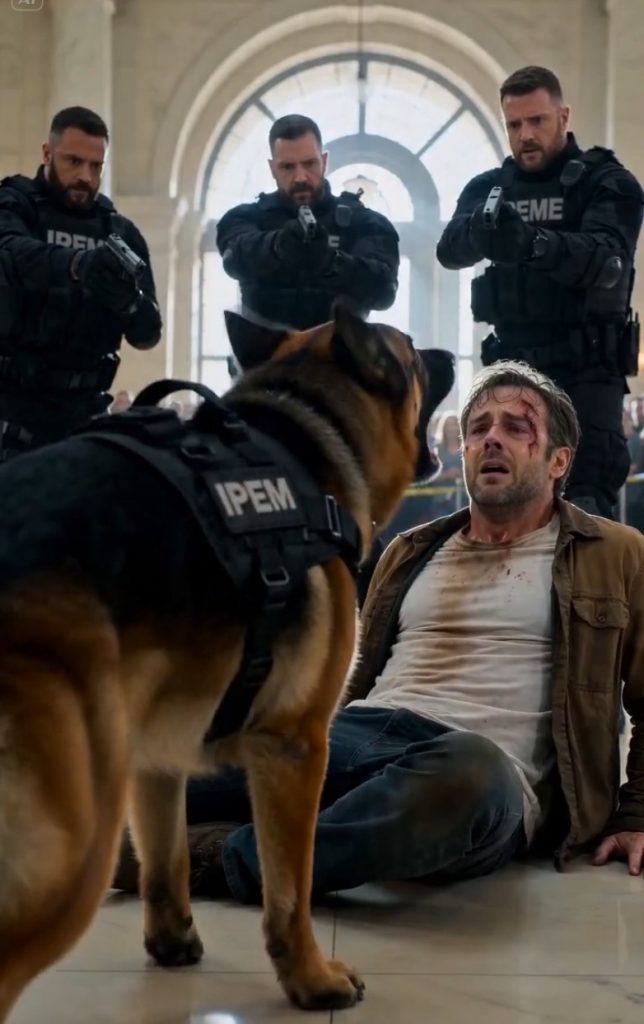
That was what everyone in the municipal hall expected when the German Shepherd lunged forward, teeth bared, tactical harness tight across his powerful chest. His bark cracked through the vaulted lobby, echoing off marble floors and arched windows until the crowd behind the security line went silent.
In the center of the hall, Elias Reed sat on the cold floor with both palms pressed behind him.
He did not run.
He did not raise his hands too quickly.
He only stared at the dog.
Three IPEM tactical officers stood in a half circle behind him, handguns drawn, black vests marked in white block letters. Their commander had shouted the warning twice already.
“Subject is noncompliant. K9 ready.”
Elias’s brown field jacket was torn at the sleeve. His white shirt was dirty from whatever chase had brought him here. A scrape marked his forehead, and another cut crossed his cheek, but he barely seemed aware of them.
His eyes were locked on Max.
The dog barked again, lunging so hard his handler braced with both hands on the leash.
“Max!” the officer commanded. “Hold!”
Max froze.
Not because of the order.
Because he had smelled something.
His ears rose. His mouth closed. His whole body changed in one impossible second, aggression melting into confusion, then into something so painfully human that even the officers felt it.
The echo of his last bark faded through the hall.
Max took one step forward.
Then another.
A low whimper rose from his chest.
Elias’s face broke.
“Oh… my gosh,” he whispered.
The words were barely audible, but Max heard them.
The dog’s eyes softened. Moisture gathered near the dark fur beneath them. He tilted his head exactly the way he had done years ago when waiting for a command only one man used to give.
Elias trembled.
“Hey, little wolf.”
That was all it took.
Max tore free from his handler and surged forward.
The officers tightened their aim, but the dog did not attack. He crashed into Elias’s lap, buried his head into the man’s shoulder, and whined like something inside him had been waiting too long to breathe.
Elias wrapped both arms around him and folded into the dog’s fur.
His shoulders shook.
The crowd stared.
The officers lowered their weapons by inches, confused and shaken by a reunion that made no sense.
Because according to IPEM’s own records, Elias Reed had been dead for four years.
And Max had just recognized the man everyone was ordered to fear.
Act II
Before Elias became a fugitive, he was the best K9 trainer IPEM ever had.
Interagency Protection and Emergency Management was the kind of unit that appeared when cities broke. Bomb threats. Disaster evacuations. Missing persons. Hostage standoffs. Anything too complicated for one department and too public to mishandle.
Elias believed in the work.
He believed in the dogs more.
Max had come to him as a restless young Shepherd with too much drive and not enough trust. Other trainers called him difficult. Elias called him unfinished.
“He doesn’t disobey,” Elias told them. “He questions bad commands.”
That made people laugh.
It stopped being funny later.
Elias trained Max with patience, not force. He taught him search patterns in empty train stations, scent work in collapsed buildings, controlled restraint in crowded spaces. But he also taught him something no manual mentioned.
Recognition.
Max learned voices. Heartbeats. Fear. Lies.
He could tell the difference between a dangerous man and a terrified one faster than most officers could unholster a weapon.
For six years, Elias and Max were inseparable.
Then Elias found the ledger.
It was hidden inside an emergency procurement file after a flood response on the north side of the city. At first, it looked like boring corruption: inflated equipment costs, fake vendors, missing funds.
Then he kept reading.
The money led to private security contractors. The contractors led to sealed transport manifests. The manifests led to names of people who had vanished after being taken into “protective custody” during crises.
Witnesses.
Whistleblowers.
Immigrants without family nearby.
People easy to misplace when sirens were loud and records moved fast.
Elias brought the files to his supervisor, Deputy Director Marcus Vale.
Vale listened calmly.
Too calmly.
“You’ve misunderstood what you found,” he said.
Elias had known that tone. It was the voice powerful men used when they were deciding whether you were still useful.
That night, Elias copied everything he could. Before he could reach federal investigators, his vehicle was rammed off a service road outside the city. When he woke, the files were gone, his badge was gone, and the news was calling him a corrupt agent who had murdered two informants and fled.
IPEM issued a statement.
Elias Reed died in a warehouse fire while resisting arrest.
No body was shown.
No funeral was open to the public.
Max was removed from the K9 unit for “behavioral instability” after he refused to obey the handler who took him from Elias’s apartment. For weeks, he would not work. He searched every room he entered. He slept facing doors. He growled at Deputy Director Vale whenever the man came near.
So they retrained him.
Or tried to.
They gave him new commands, new handlers, new routines. But they could not erase the first person who had taught him what safety smelled like.
Elias survived because one paramedic at the warehouse fire recognized that the “dead fugitive” had a pulse and chose conscience over orders.
For four years, Elias lived under borrowed names, moving from shelter work to warehouse jobs to night buses across state lines. He collected fragments of proof. Old invoices. Hidden recordings. Testimony from people Vale thought too scared to speak.
Then he learned Vale would be appointed national director of IPEM in a public ceremony at the grand municipal hall.
Every important camera would be there.
Every official would be watching.
So Elias came home.
Not to clear his name quietly.
To make the truth impossible to bury.
But Vale saw him enter before the ceremony began.
Within minutes, the building was locked down.
The public was pushed behind barriers.
A warning went over police radio.
Armed suspect. Former IPEM operative. Dangerous. Do not approach.
Elias had no weapon.
Only a data drive sewn into the lining of his field jacket and the terrible hope that someone, somewhere, would let him speak before they silenced him forever.
Then they brought in the K9 unit.
They brought in Max.
And the lie made its first mistake.
Act III
“Get the dog off him!”
Deputy Director Vale’s voice cut through the hall from near the west staircase.
Max did not move.
He stayed pressed against Elias, body half across his lap, rumbling softly whenever an officer stepped too close. Not attacking. Guarding.
Elias lifted one hand slowly.
“Don’t shoot,” he said. “Please. He’s not a threat.”
One of the tactical officers, Lieutenant Mara Santos, lowered her weapon first.
She had seen K9s miss commands before. She had seen dogs hesitate under stress. But this was not hesitation.
This was recognition.
“Who are you?” she asked.
Elias looked up.
“You already know who they told you I am.”
Vale strode closer, surrounded by two security aides.
“This man is a trained manipulator,” he said. “He is exploiting the animal’s confusion.”
Max turned his head toward Vale and growled.
The crowd heard it.
Phones rose higher.
Vale noticed and lowered his voice.
“Lieutenant, remove the dog and secure the suspect.”
Elias laughed once, weakly.
“Still using that word.”
Vale’s face hardened.
Elias looked at Santos.
“My name is Elias Reed. I trained Max from eleven months old. His first search command was ‘find home.’ His release word was never in the file because I never trusted Vale with it.”
Santos stared at him.
“What was it?”
Vale snapped, “Do not entertain this.”
Elias looked down at Max.
His voice softened.
“Moonlight.”
Max immediately shifted back, sat at Elias’s left side, and placed one paw over the man’s knee.
A murmur rolled through the hall.
Santos’s face changed.
That was not luck.
That was history.
Elias reached slowly toward his jacket.
Weapons rose again.
He stopped.
“There’s a drive in the inner lining,” he said. “Left side. You take it. Not him.”
Santos hesitated, then nodded to one officer.
The officer stepped forward carefully while Max watched every movement. He opened the torn lining and pulled out a small black drive sealed in plastic.
Vale’s expression sharpened.
“Evidence must go through proper chain of command.”
Elias looked at him.
“You mean your command.”
Santos closed her fist around the drive.
Vale’s calm slipped.
“Lieutenant, hand it over.”
She did not.
For the first time, the power in the hall shifted.
Not dramatically. Not loudly. Just enough for every person there to feel that an order was no longer the same as truth.
Santos turned to a junior officer.
“Get me an independent terminal. Now.”
Vale stepped closer.
“This is insubordination.”
“No,” she said. “This is verification.”
The crowd behind the barrier began whispering.
Elias kept one hand on Max’s neck. The dog leaned into him, still trembling, still unwilling to believe the person he had mourned was solid beneath his fur.
A technician brought a secured laptop from the press station.
Santos inserted the drive.
Files opened.
Video.
Audio.
Payment ledgers.
Transport records.
Names.
At the top of the first folder was a title that made Santos go still.
MERIDIAN EMERGENCY CUSTODY PROGRAM.
Vale turned to leave.
Max barked.
One sharp sound.
Every officer looked up.
Santos drew her sidearm again, but this time she did not aim at Elias.
“Deputy Director Vale,” she said, “do not move.”
And in the center of the hall, still seated on marble, Elias Reed closed his eyes as if hearing his own name return from the dead.
Act IV
The ceremony never happened.
Instead of applause for Marcus Vale, the grand hall filled with the sound of federal agents arriving through the east entrance.
Vale tried to speak to them like a man used to being obeyed.
It did not work.
The drive Elias carried was only the first piece. Once Santos refused to surrender it, other people inside IPEM began moving. Quietly at first. Then all at once.
An analyst released archived dispatch logs.
A retired officer sent encrypted emails to investigators.
A clerk in procurement unlocked records she had been told to delete years earlier but had copied instead because Elias Reed had once helped find her missing son during a flood evacuation and she never believed he was a murderer.
The truth did not arrive like lightning.
It arrived like doors opening down a long hallway.
Vale’s emergency custody program had been created under the language of public safety. Temporary relocation. Witness security. Crisis stabilization.
Beautiful phrases.
Ugly purpose.
People who threatened powerful contracts were moved, hidden, discredited, or declared unreachable. Some were released months later too frightened to speak. Some never returned to public life at all.
Elias had found the pattern.
So Vale made him part of it.
The warehouse fire that supposedly killed Elias had been staged to erase him and destroy the documents he carried. The charges against him were built from forged reports and testimony paid for through shell accounts.
But Vale had not counted on Elias surviving.
He had not counted on Max remembering.
And he had definitely not counted on the reunion being recorded by two hundred phones beneath the arched windows of the municipal hall.
By evening, Vale was in custody.
By midnight, Elias was in a hospital room under federal protection, with Max lying on the floor beside his bed and refusing to leave.
A nurse tried to move the dog once.
Max opened one eye.
The nurse reconsidered.
Santos came in after dawn.
She had removed her tactical helmet. Without it, she looked younger, more tired, and deeply ashamed.
“I was five seconds from giving the order,” she said.
Elias looked at her.
“But you didn’t.”
“Because of him.”
Max’s tail moved once against the floor.
Elias touched the dog’s head.
“He always questioned bad commands.”
Santos swallowed.
“We all should have.”
Elias had no easy answer for that.
Four years of being hunted had burned away his interest in speeches. He wanted clean clothes. Sleep. A door that locked from the inside. He wanted to stop hearing boots in every hallway.
But he also wanted his name back.
Not for pride.
For the people who had believed the lie and died under it. For the families told their loved ones had run away. For the officers who had tried to speak and been crushed under official language.
And maybe, a little, for the dog who had mourned him without understanding why the world had stopped smelling like home.
Two days later, federal investigators showed Elias the footage from the hall.
He watched only once.
Max barking.
Max stopping.
Max crying.
Max running into him.
Elias turned away before the video ended.
Santos asked if he was all right.
“No,” he said.
It was the most honest answer he had given in years.
Act V
The city tried to turn Elias Reed into a hero.
He hated that.
Hero was too clean a word. It left out hunger, fear, bad motel rooms, fake names, and the nights he almost walked into a police station just to be done running. It left out the people who did not survive long enough to be vindicated.
It also left out Max.
So Elias refused every interview that did not begin with the dog.
“Max saved my life,” he said the first time cameras caught him leaving the courthouse. “Again.”
The word again made reporters shout questions.
Elias kept walking.
Vale’s trial took months.
The evidence was overwhelming, but powerful men rarely fall without dragging half a city’s secrets into daylight. Officials resigned. Contractors vanished behind lawyers. Families filed claims. IPEM was torn apart, audited, rebuilt, and forced to answer for every name Meridian had hidden.
Elias testified for three days.
On the first day, he wore a navy suit borrowed from a federal victim advocate because he owned nothing formal anymore. On the second, he brought Max.
The courtroom changed when the dog entered.
Not because anyone thought he understood law.
Because everyone remembered the video.
The moment a trained K9 refused to attack the man the system called dangerous.
The moment instinct defeated a lie dressed as protocol.
When Vale’s attorney suggested Elias had manipulated Max’s behavior, Elias looked at the jury and shook his head.
“You can train a dog to follow a command,” he said. “You can’t train grief into him four years later.”
Max lay beside him, head on his paws.
The jury understood.
The verdict did not repair everything.
But it broke enough.
Guilty on conspiracy. Guilty on obstruction. Guilty on unlawful detention. Guilty on falsified federal records.
When Vale was led away, he did not look at Elias.
He looked at Max.
The dog did not bark.
He did not need to.
After the trial, IPEM offered Elias reinstatement.
He declined.
Then they offered Max a formal retirement with honors.
Elias accepted on one condition.
“No ceremony with speeches,” he said. “He hates speeches.”
That was not true.
Max loved attention.
Elias simply did not trust ceremonies.
So they held it quietly in the municipal hall where everything had happened. No press line. No podium. Just Santos, a few federal investigators, families of victims, and the rebuilt K9 unit standing beneath the same arched windows.
The marble floor had been polished since that day, but Elias could still find the place where he had sat with guns behind him and Max in front of him.
He stood there now in a dark coat, one hand resting on the Shepherd’s harness.
Santos approached with a small leather collar tag.
MAX REED
SERVICE RETIRED
LOYAL BEYOND COMMAND
Elias read it twice.
His throat tightened.
Max sat patiently, as if he had always known paperwork would eventually catch up with the truth.
Santos fastened the tag to his collar.
Then she looked at Elias.
“I’m sorry,” she said.
He knew she meant more than the guns.
More than that day.
She meant the whole machine that had turned him into a target and called it duty.
Elias nodded.
“I know.”
It was not forgiveness.
Not yet.
But it was a door left unlocked.
Months later, Elias moved into a small house at the edge of the city, near a park with enough trees for Max to inspect every morning. He slept badly at first. Max did too. Some nights the dog woke from dreams and searched the hallway until Elias called his name.
“I’m here, little wolf.”
Max would pad into the bedroom, sigh like an old soldier, and drop beside the bed.
One autumn afternoon, Elias returned to the municipal hall alone.
Not for court.
Not for testimony.
For himself.
The building was busy again. People crossed the marble floor with coffee cups and briefcases. Sunlight poured through the high windows. No one stopped to stare at the place where a dead man had come back because a dog refused to forget him.
Elias stood near the center and listened.
No barking.
No shouted orders.
No weapons drawn.
Just footsteps, echoes, life continuing.
Max leaned against his leg.
Elias smiled faintly.
“You remember?”
The dog looked up at him.
Of course he did.
Elias crouched and wrapped one arm around Max’s neck, not as desperately as he had that day, but with the same gratitude.
For years, Elias thought survival meant staying hidden.
Max had taught him something else.
Sometimes survival was being recognized.
Being seen past the blood, the lies, the dirt, the orders shouted by men who needed you erased.
Sometimes salvation came on four paws across a marble floor, refusing every command except love.
Elias stood, and Max stood with him.
Together, they walked toward the doors.
This time, no one aimed a weapon.
This time, no one shouted stop.
And when they stepped into the light outside, Max moved first.
Elias followed him home.