Act I
The restroom smelled of bleach, old tile, and fear.
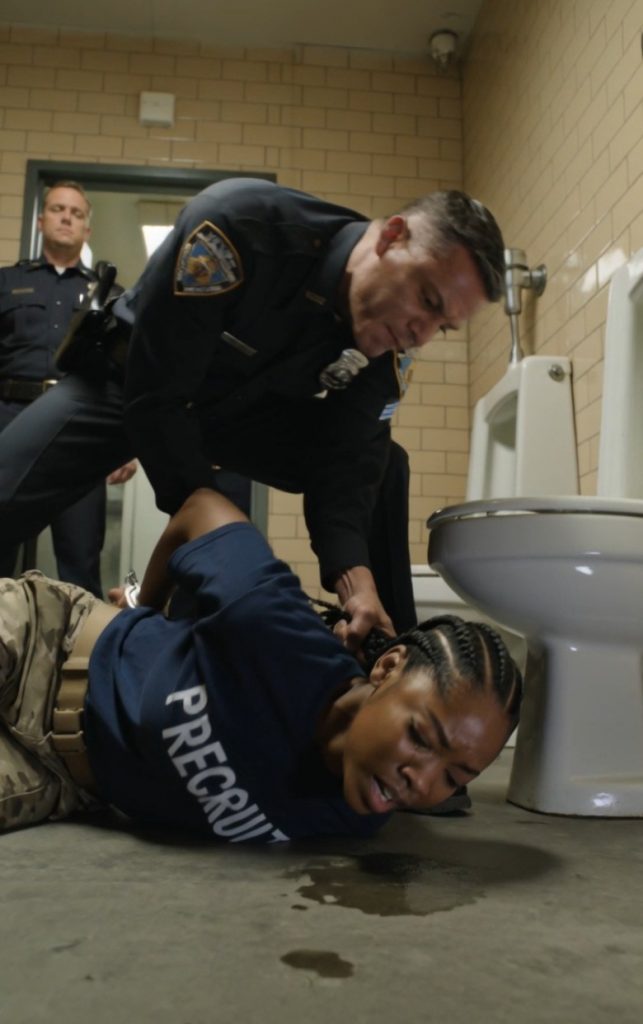
Maya Reed was bent forward under the harsh yellow light, her wrists locked behind her with black zip-ties, her breath coming in sharp, broken pulls. The beige subway tiles around her were stained from years of neglect. A row of white urinals stood along one wall. The concrete floor beneath her boots was damp and cold.
Sgt. Vance had one hand twisted in her braids.
Not enough to tear.
Enough to control.
Enough to remind her that in that room, with two uniformed officers standing silent in the doorway, he believed she had no power at all.
“No!” Maya gasped. “No!”
Vance leaned close to her ear. He was broad, salt-and-pepper hair cut short, navy uniform crisp enough to look honorable from a distance. His silver name tag read VANCE.
Up close, he looked like rage wearing a badge.
“I’m impressed,” he whispered. “You think you’re special?”
Maya squeezed her eyes shut.
She had trained for pain. For exhaustion. For the academy instructors yelling in her face. For pepper spray, stress drills, mock arrests, and the thousand small humiliations recruits endured because the department called them discipline.
But this was not discipline.
This was punishment.
Vance shoved her lower, his voice rising until it bounced off the tile.
“This is what happens when you forget your place. You will keep silent.”
The officers at the door did not move.
Officer Keane looked at the floor.
Officer Brooks stared straight ahead, jaw tight, pretending not to see the tears running down Maya’s face.
Their silence filled the room more heavily than Vance’s shouting.
Maya’s breathing slowed.
Not because she was calm.
Because something inside her had gone still.
She opened her eyes and stared at the wet concrete beneath her. One tear fell from her cheek and broke against the floor. Then another.
Vance thought he was breaking her.
He did not know the thing he had actually done.
He had finally said the words out loud.
You will keep silent.
Maya lifted her head as much as his grip allowed. Her eyes found the cracked mirror above the sink. In it, she could see part of the doorway behind him. Two officers. One flickering light. One truth that had nowhere left to hide.
Then, from the hallway, came the sound of approaching footsteps.
Not hurried.
Not uncertain.
Heavy. Official. Coming straight toward them.
Vance froze.
The officers in the doorway turned.
And Maya, still bound, still shaking, understood with a fierce, terrible clarity that the door was about to open on more than a restroom.
It was about to open on years of buried fear.
Act II
Maya Reed had wanted to be a police officer before she understood what a badge could protect and what it could hide.
Her mother, Denise Reed, had worn one for twenty-three years.
Captain Reed was the kind of woman other officers described as difficult when what they really meant was honest. She corrected reports no one wanted corrected. She walked recruits through dangerous calls twice if she thought the academy had failed to prepare them. She brought extra socks to winter shifts because she said cold feet made people careless.
At home, she was softer.
She braided Maya’s hair before school, hummed old soul songs while cooking, and kept her polished badge in a drawer beside church gloves and birthday candles.
“When you wear authority,” Denise used to say, “you better remember it belongs to the people who trust you with it.”
Maya believed that.
Then her mother’s career ended.
Officially, Captain Reed retired early for health reasons.
Unofficially, she had been pushed out after filing complaints against a training unit led by Sgt. Vance. Recruits were being injured, intimidated, and pressured to falsify reports. Those who complained were labeled weak. Those who stayed quiet were promoted faster.
Denise had evidence.
Then the evidence disappeared.
Statements vanished from internal files. Medical reports were rewritten. A recruit who had agreed to testify suddenly changed his story. Vance called Denise unstable, emotional, obsessed with undermining the department.
The word spread quietly.
Unstable.
Maya watched people stop calling. Stop visiting. Stop meeting Denise’s eyes at grocery stores.
Her mother never got her name back.
She died four years later with a cardboard box of old case files under her bed and one note taped inside the lid.
If silence protects the powerful, it is not peace. It is permission.
Maya found the note at nineteen.
By twenty-four, she entered the academy.
Everyone told her not to.
Her aunt called it self-destruction. Her friends said the department did not deserve her. Her pastor said forgiveness did not require walking back into the building that hurt her family.
Maya agreed.
Then she went anyway.
Not because she wanted revenge.
Because her mother had loved the job before the job betrayed her.
For the first few weeks, Maya kept her head down. She ran harder than anyone, studied longer, answered only when asked. Vance noticed her on day three.
“Reed,” he said, reading her name tag. “Any relation?”
Maya held his gaze.
“Yes, Sergeant.”
His smile was small.
“I thought so.”
After that, the drills changed.
Her gear went missing. Her reports came back with red marks for mistakes no one else was penalized for. Vance called her “legacy” in front of the class, as if her mother’s ruined career were a stain she had inherited.
Then Luis Moreno got hurt during a night exercise.
Not badly enough to make the news. Badly enough that he limped for days and lied about why.
Maya saw the truth in his face.
Fear.
The same fear she had seen in old recruits who visited her mother late at night, speaking in the kitchen with their voices low.
Maya began documenting everything.
Dates. Times. Names. Vance’s comments. The way reports changed after submission. The officers who turned away. The recruits who stopped objecting. She copied public records, matched them with her mother’s old files, and sent everything to the state oversight office through an attorney her mother had trusted.
She did not tell anyone.
Except Luis.
He warned her.
“He’ll find out.”
“He already knows what he is,” Maya said. “He just doesn’t know someone else does too.”
That morning, Vance called her into the precinct basement for “corrective training.”
There was no training.
Only him.
Keane.
Brooks.
And the restroom where he thought there were no cameras.
But Maya had filed her report the night before.
And somewhere beyond the tile, beyond the door, beyond the men who thought their silence was safe, someone had finally read it.
Act III
The restroom door swung open.
A woman in a dark suit stood outside.
She was in her fifties, with close-cropped gray hair and a face that did not waste expression. Behind her stood the chief of police, two state investigators, and an internal affairs captain carrying a folder thick enough to change careers.
Sgt. Vance released Maya’s braids as if her hair had burned him.
“Deputy Commissioner Hale,” he said, instantly changing his voice. “This is not what it looks like.”
The woman looked at Maya.
Bound wrists.
Tear-streaked face.
Recruit shirt twisted at one shoulder.
Then she looked at Vance.
“It rarely is, Sergeant.”
Chief Langford stepped into the room, his expression tight with a shame that seemed too late to be useful.
“Cut her loose.”
Officer Brooks moved first.
His hands shook as he took out a pocket blade and sliced through the zip-ties. Maya’s arms came free, stiff and aching. She brought them slowly in front of her, wrists marked from pressure, fingers trembling.
Nobody touched her without asking.
That mattered.
Deputy Commissioner Hale removed her coat and draped it gently over Maya’s shoulders.
“Maya Reed?”
Maya nodded.
Hale’s voice softened.
“I’m Nora Hale. I received your submission last night.”
Vance’s eyes flashed toward Maya.
There it was.
The realization.
Not that she had spoken.
That she had spoken before he could frighten her into denying herself.
He straightened, trying to recover command.
“Commissioner, this recruit has a long history of insubordination. Her mother had the same problem. She is using an old family grievance to—”
“Enough,” Hale said.
One word.
It cut clean through him.
Internal Affairs Captain Mercer opened the folder.
“Sergeant Vance, you are being relieved of duty pending investigation into misconduct, retaliation, falsification of training records, and assaultive conduct against recruits under your supervision.”
Vance’s face reddened.
“Based on her word?”
Captain Mercer looked toward the hallway.
“Based on a great deal more than that.”
Officer Keane swallowed hard.
Brooks stepped forward, eyes wet now.
“I gave a statement.”
Vance turned on him.
“You what?”
Brooks looked at Maya, then at the floor.
“I should have stopped it sooner.”
“Yes,” Maya said.
The simple word struck him harder than anger.
Brooks nodded, accepting it.
“I sent the text to Captain Mercer when Vance brought her down here,” he said. “And my body camera was still running in the hall. Audio picked up everything from the doorway.”
Vance took a step back.
His eyes moved from Brooks to Keane.
Keane looked away.
The room that had made Maya powerless minutes earlier now turned on the man who thought he owned it.
But Maya did not feel victorious.
She felt cold.
Hale noticed.
“We can leave,” she said quietly. “You don’t have to stand here.”
Maya looked at Vance.
For years, he had lived in her house without ever entering it. He sat in her mother’s silences. In the cardboard box under the bed. In the way Denise Reed’s name was spoken softly, like a warning.
Now he stood in front of her, smaller than the shadow he had cast.
Maya’s voice shook, but it did not break.
“My mother told the truth about you.”
Vance’s jaw tightened.
“She was a bitter woman.”
Maya took one step forward.
“No,” she said. “She was early.”
No one spoke.
Hale’s face changed slightly.
Not a smile.
Recognition.
Then Maya looked at the chief.
“And you all were late.”
Act IV
They took Vance out through the back corridor.
Not in handcuffs at first. The department still had procedures, still had lawyers, still had men who would use the word alleged as if Maya’s bound wrists had been theoretical.
But he was escorted.
That was enough for the moment.
Maya sat in a quiet interview room upstairs with a blanket around her shoulders and a cup of water she could barely hold. Deputy Commissioner Hale sat across from her, not too close. Captain Mercer stood near the wall. Chief Langford remained outside the room until Maya agreed to let him enter.
When he did, he looked older than he had an hour before.
“Maya,” he said, “I’m sorry.”
She stared at him.
The apology fell between them, heavy and insufficient.
“My mother came to this department,” Maya said. “She filed reports. She named names. Did you apologize to her too?”
Langford’s face tightened.
“I was a lieutenant then.”
“You were an officer.”
He lowered his gaze.
That answer was the first honest thing he offered.
Hale opened Maya’s submitted packet.
“Your mother’s files match several missing internal documents. Some were removed from department archives. Some were altered. We also have three former recruits willing to give statements now that your report has reopened the matter.”
Maya closed her eyes.
Former recruits.
People her mother had tried to protect.
People Maya had never met but had carried like invisible witnesses.
Captain Mercer spoke gently.
“Luis Moreno is safe. He’s with his family. He confirmed your account of the night exercise.”
Maya nodded.
Good.
She could breathe a little easier after that.
Then Hale placed one final envelope on the table.
It was old, cream-colored, and sealed in plastic.
Maya recognized her mother’s handwriting.
Her chest tightened.
“What is that?”
“Your attorney sent it with your packet,” Hale said. “She said your mother instructed her to hold it until someone reopened the Vance file successfully.”
Maya stared at the envelope.
Her name was written across the front.
Maya Simone Reed.
She touched it but did not open it right away.
For a moment, she was eight years old again, sitting on the kitchen counter while her mother braided her hair, complaining that the parts were too tight. She could hear Denise laughing. Could smell coconut oil and coffee.
Then she opened the letter.
My Maya,
If you are reading this, it means you did what I could not finish, though I pray you did not have to pay too much of yourself to do it.
I need you to remember something. The goal was never to destroy one man. Men like Vance survive because rooms protect them. Files protect them. Silence protects them. Fear protects them.
Do not spend your life becoming the opposite of him. Become the opposite of the room.
Be the one who sees. The one who speaks. The one who opens the door.
And if anyone tells you that you forgot your place, remember this:
Your place is wherever truth needs a witness.
Love,
Mom
Maya’s hands shook so hard the page fluttered.
She pressed the letter against her chest and finally let herself cry.
Not the helpless tears of the restroom.
Not the stunned tears of someone cornered.
These came from somewhere deeper.
From grief.
From relief.
From the impossible ache of being proud and furious at the same time.
Chief Langford looked away.
Hale did not.
She sat with Maya in silence, letting the moment belong to the woman who had earned it.
By nightfall, Vance was suspended. By morning, the state had seized training records from the academy. Within a week, the story reached the press. The department tried to call it an isolated incident.
Maya corrected that at the first public hearing.
“It was not isolated,” she said into the microphone. “It was insulated.”
The room went silent.
This time, silence did not protect Vance.
It listened to her.
Act V
The investigation took eleven months.
That was what people never understood about justice.
It rarely arrived like thunder. It arrived in paperwork, delays, hearings, denials, statements, old emails, missing signatures, recovered footage, people changing their stories and then changing them again when evidence made courage easier.
Vance fought everything.
He called Maya unstable. Then ambitious. Then vindictive. Then confused by stress. Each word was older than him and uglier than he knew.
But this time, the words did not work.
Too many people had spoken.
Luis testified.
So did Brooks.
Keane admitted he had stayed silent because he feared losing his pension, and the admission cost him anyway. Former recruits came forward from other classes. One woman arrived with a scar across her career, not her skin, and said Vance had taught her to distrust every badge in the building.
Captain Denise Reed’s files were restored to the record.
Her early retirement was formally reviewed.
Then corrected.
Not enough.
Never enough.
But her name was no longer whispered as a cautionary tale.
At the memorial wall inside the precinct, someone added a small framed photograph of her in uniform. Maya stood in front of it the day it went up, wearing civilian clothes, her braids falling over her shoulders.
Chief Langford approached carefully.
“I should have fought harder for her.”
Maya did not look away from the photo.
“Yes.”
He nodded.
No defense.
No excuse.
That, at least, was progress.
Maya returned to training after six weeks.
People were surprised.
Some thought she would leave. Some wanted her to, because her presence made the department uncomfortable. Others treated her like glass, which annoyed her almost as much as being treated like a threat.
Deputy Commissioner Hale called her one afternoon.
“You do not owe this institution your healing,” she said.
Maya looked through the academy window at a new class of recruits running drills in the rain.
“I know.”
“Then why stay?”
Maya touched the letter folded inside her jacket pocket.
“Because my mother loved what this job was supposed to be. I want to see if that version can still breathe.”
Hale was quiet for a moment.
“Then make them earn you.”
Maya did.
She graduated the following spring.
Not at the top of the class.
That surprised people too.
She had missed weeks. She had gone to hearings. She had done therapy twice a week and learned that surviving humiliation did not mean pretending it had not marked her.
But when her name was called, the room stood.
Her aunt cried openly. Luis shouted the loudest. Brooks, now reassigned and under review but allowed to attend as a witness, stood at the back with his hands folded, eyes full of regret.
Maya crossed the stage in her dress uniform.
Deputy Commissioner Hale pinned the badge.
For one second, Maya could not breathe.
Then Hale leaned close and whispered, “Captain Reed would be proud.”
Maya smiled through tears.
“I know.”
The restroom was renovated that summer.
New lights. New tile. New sinks. Fresh paint.
But Maya asked for one thing to remain.
Not the old fixtures. Not the grime. Not the cracked mirror.
Just the doorway.
Above it, the department installed a small plaque, plain metal, easy to miss unless someone stopped to read.
No authority is above accountability. No silence is neutral.
Some officers hated it.
Maya considered that useful.
Years later, rookies would hear versions of the story.
They would hear about Sgt. Vance, the recruit, the investigation, the fall of a training unit that had called abuse tradition. Some versions made Maya sound fearless. She corrected those when she could.
“I was terrified,” she would say. “Fear doesn’t mean you failed. It means you understood the cost and still told the truth.”
When she became a field training officer, she carried two things in her locker.
Her badge.
And her mother’s letter.
On hard days, she read the last line.
Your place is wherever truth needs a witness.
She thought of that restroom then.
The yellow light.
The damp concrete.
The officers in the doorway.
Vance’s voice telling her to stay silent.
And the moment her eyes lifted, not because she had power yet, but because she remembered she had a name before he tried to reduce her to fear.
The world would call it the day Maya Reed exposed Sgt. Vance.
But Maya knew better.
Her mother had started it.
Luis had strengthened it.
Brooks had finally opened his mouth.
Hale had opened the door.
And Maya, bound and shaking in a room designed to make her feel alone, had made a vow she kept for the rest of her life.
She would never again confuse silence with survival.
And she would never let a badge become a weapon in a room where no one was willing to look.