Act I
The passport caught fire before Maya Brooks understood what was happening.
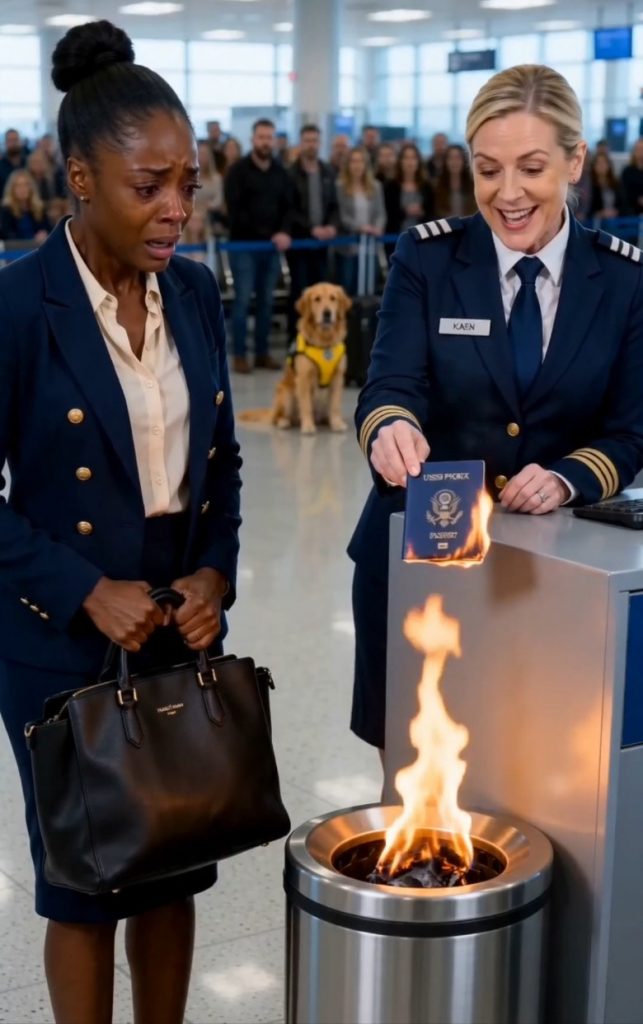
One second, it was in Officer Karen Mills’s hand, blue cover folded open beneath the harsh airport lights. The next, a strip of orange flame climbed the edge of the page and curled inward, blackening the gold seal like it was nothing more than trash.
Maya stood frozen on the other side of the stainless steel bin.
Her black leather tote hung from her hand. Her navy blazer was buttoned neatly over a cream blouse. She had dressed carefully that morning because her mother always said airports were places where people judged you before you reached the counter.
Now everyone was judging.
Passengers in the waiting area leaned forward. A man lowered his newspaper. A woman with a Golden Retriever service dog pulled the dog closer, her face going pale.
Officer Karen smiled.
“Oh, look at that,” she said, holding the burning passport over the trash can. “It’s burning.”
Maya’s breath vanished.
“That’s my passport,” she whispered.
Karen laughed.
Not nervously.
Not like someone who had made a mistake.
She laughed like this was the point.
“People like you shouldn’t be traveling,” Karen said, loud enough for the people behind the barrier to hear. “Hahaha!”
The flames reflected in her eyes.
Maya shifted her tote onto her elbow, then lifted both hands to cover her mouth. Her body shook once, violently, as smoke curled up from the bin and the familiar blue booklet collapsed into ash.
Her passport had taken eight weeks, two interviews, and every document her mother had saved in a shoebox under the bed.
Birth certificate.
Naturalization records.
Her father’s name corrected after years of clerical mistakes.
Proof, proof, and more proof.
Because Maya had learned early that certain people were allowed to simply be American, while others were expected to carry evidence.
And now the evidence was burning in front of her.
“What is she doing?” Maya sobbed.
Karen tossed the passport fully into the trash can, clapped her hands together, and did a tiny mocking dance as the last corner disappeared into the smoke.
Maya stared at the bin.
“Oh my God,” she cried. “What are you doing?!”
Passengers began to murmur louder.
Someone said, “Did she just burn that woman’s passport?”
Someone else shouted, “Call a supervisor!”
Karen turned toward the crowd with a glare that had clearly worked on people before.
“This is a security matter,” she snapped. “Everyone stay back.”
Then she looked at Maya again.
“You’re not going anywhere today.”
Maya’s knees nearly gave out.
She was supposed to be on a flight to Washington in ninety minutes. She was supposed to testify before a federal civil rights panel about discriminatory airport seizures, unlawful document holds, and travelers who had vanished into “secondary screening” rooms for hours without explanation.
In her tote were sworn statements from fourteen passengers.
Three named Officer Karen Mills.
Karen had not known that.
But she had just given Maya the fifteenth statement in front of an entire terminal.
And someone in the waiting area was already recording.
Act II
Maya did not become a civil rights lawyer because she liked courtrooms.
She became one because of a night at an airport when she was sixteen years old.
Her mother, Elaine Brooks, had been flying home from a nursing conference in Atlanta. She had called Maya from security, voice tight but calm in the way adults sound when they are trying not to scare their children.
“They’re saying my documents don’t match,” Elaine said.
“But they do,” Maya replied. “You checked everything.”
“I know, baby.”
Then a woman’s voice snapped in the background.
Ma’am, put the phone away.
The line went dead.
Elaine missed her flight. She spent six hours in a holding room without her medication. By the time she was released, shaken and humiliated, no one apologized. Her documents were returned bent, smudged, and missing one page.
The official report called it a routine verification delay.
Elaine called it what it was.
A warning.
For months afterward, she kept copies of everything. She taught Maya how to scan records, how to ask for badge numbers, how to write down exact times.
“People who abuse power count on confusion,” Elaine said. “Don’t give them any.”
Maya never forgot.
Years later, when Elaine died from a stroke far too young, Maya found the airport report tucked inside the shoebox of documents. On the final page, in her mother’s handwriting, was one sentence.
One day, make them answer.
So Maya did.
She studied law. She worked legal aid cases. She represented travelers who were told their documents were suspicious because their names sounded foreign, their addresses looked poor, their accents were too strong, or their skin made officers suddenly “need to verify.”
Most cases went nowhere.
Airports were designed to make people feel powerless. Everyone was tired. Everyone was rushing. Everyone feared missing flights, losing visas, angering the wrong person behind a counter.
Then Maya found a pattern at Northgate International.
Same terminal.
Same security contractor.
Same officer.
Karen Mills.
Some travelers said Karen confiscated documents and returned them damaged. Some said she laughed when they cried. One elderly man said she threatened to tear up his boarding pass unless he apologized for “wasting American time.”
No one believed him.
Not enough.
That was why Maya was flying to Washington.
Not for herself.
For all of them.
And tucked inside her passport, behind the first blank visa page, had been a small photo of her mother in her nurse’s uniform.
The photo burned too.
That was the part Maya could not say aloud as she stood at the security counter, watching smoke rise from the bin.
Karen had not only destroyed a document.
She had burned the last picture Maya carried everywhere.
The officer did not know that.
She only knew Maya looked devastated.
And she liked it.
“Now,” Karen said, still grinning, “do you want to calm down, or should I call airport police and tell them you became aggressive?”
Maya’s hands dropped from her face.
Something inside her steadied.
Not healed.
Not calm.
Steadied.
Behind the barrier, the Golden Retriever service dog suddenly stood.
His handler, an elderly man in a charcoal coat, rose with him. He had been sitting quietly near the terminal seats, watching the scene with the stillness of someone who had learned patience in rooms where every word mattered.
He stepped forward, one hand on the dog’s harness.
“Officer Mills,” he said, “I would advise you to stop speaking.”
Karen turned.
“And you are?”
The man looked at the smoking trash can.
Then at Maya.
Then back at Karen.
“Retired Judge Samuel Whitaker,” he said. “Chair of the panel Ms. Brooks is scheduled to testify before tomorrow morning.”
Karen’s smile vanished.
And the entire terminal seemed to inhale at once.
Act III
Karen recovered quickly.
Cruel people often do. They spend their lives practicing new masks.
“This woman presented suspicious documentation,” she said, straightening her uniform jacket. “I followed security protocol.”
Judge Whitaker looked at the trash can.
“Security protocol involves open flame now?”
A few passengers murmured.
Karen’s cheeks flushed.
“She became argumentative.”
Maya stared at her.
“I asked why you were taking my passport.”
Karen pointed at her. “See? Hostile tone.”
Judge Whitaker’s Golden Retriever stood calmly at his side, yellow vest bright beneath the terminal lights. The dog’s quiet presence made Karen’s agitation look even worse.
The judge turned to the passengers.
“Did anyone record what happened?”
Half a dozen phones lifted.
Karen’s eyes widened.
A young mother near the barrier said, “I got all of it.”
A college student added, “Me too. She said, ‘People like you shouldn’t be traveling.’”
Karen’s mouth tightened.
“That was taken out of context.”
Maya almost laughed.
The sentence had no safe context.
Airport police arrived first. Then a security supervisor. Then the terminal manager, sweating through his suit jacket as he hurried across the gray floor.
Karen immediately stepped toward him.
“Mr. Lawson, this passenger attempted to pass fraudulent identification.”
Maya reached into her tote with trembling hands.
An officer tensed.
Judge Whitaker said, “She is retrieving documents.”
Maya pulled out a folder.
Then another.
Copies of her passport.
Copies of her birth certificate.
Her bar identification.
Her hearing notice.
Her federal witness confirmation letter.
And the affidavits.
Fourteen of them.
She placed the folder on the workstation desk beside Karen’s badge.
The supervisor opened it.
His expression changed on the first page.
Then again on the second.
By the fourth, he stopped pretending this was a misunderstanding.
Karen saw the names.
Her own appeared three times before page ten.
“You came here to set me up,” she hissed.
Maya’s voice shook, but it did not break.
“No. I came here to board a plane.”
Judge Whitaker stepped closer.
“And testify about patterns of misconduct.”
Karen looked around.
The passengers were no longer just spectators. They were witnesses now, and that made the room dangerous for her.
She tried one more lie.
“She handed me the passport already damaged.”
The young mother with the phone stepped forward.
“No, she didn’t.”
The college student said, “You took it from her.”
An older man in a business suit said, “You lit it.”
Then the quiet woman with the service dog finally spoke.
Her voice was soft, but it carried.
“You were laughing while she cried.”
Karen flinched as if the truth had touched her skin.
Airport police asked her to step away from the counter.
She refused.
Then they asked again.
Differently.
This time, she moved.
But as one officer reached for the smoking trash bin, Karen lunged toward it.
Maya saw why before anyone else did.
Inside the bin, half-burned beneath the passport ash, was not just Maya’s document.
There were other papers.
Pieces of boarding passes.
A torn green card photocopy.
A folded complaint form with scorch marks along one edge.
Karen had not started today.
Today was simply the first time someone made her stop before the ashes were emptied.
Act IV
The terminal was shut down for forty-three minutes.
That was all it took for Karen Mills’s little kingdom to collapse.
Maintenance workers sealed the trash can as evidence. Airport police pulled security footage. Passengers gave statements. The supervisor made calls that began politely and ended with his face turning the color of old paper.
Maya sat in a private waiting room with a cup of water she had not touched.
Her hands still smelled faintly of smoke.
Judge Whitaker sat across from her, the Golden Retriever resting at his feet. The dog’s name was Henry, and every few minutes he lifted his head to check on Maya as if she were the one he had been assigned to protect.
“I missed my flight,” Maya said.
“We’ll fix that,” the judge replied.
She shook her head.
“You can’t fix the passport.”
“No,” he said. “But we can fix what happens next.”
Maya looked down at her empty hands.
“My mother’s picture was inside.”
The judge’s face softened.
For a moment, he stopped being a federal panel chair and became simply an old man who understood that grief sometimes hides inside small paper things.
“I’m sorry,” he said.
Maya closed her eyes.
She had heard apologies all her life.
Most were useless.
This one, at least, did not ask her to stop being angry.
A knock came at the door.
The terminal manager entered with two federal officers and a woman from the State Department’s regional passport office who looked like she had been pulled from a meeting and had decided fury was more efficient than makeup.
“Ms. Brooks,” the woman said, “we’re issuing you an emergency replacement tonight.”
Maya looked up.
“Tonight?”
“Yes.”
The terminal manager cleared his throat.
“And Northgate International will be covering all costs associated with the replacement, rebooking, lodging if needed, and any legal exposure resulting from this incident.”
The judge raised an eyebrow.
The manager swallowed.
“And we are cooperating fully with the investigation.”
Maya knew the language.
Cooperating fully meant terrified.
Federal officers had already found seven prior complaints against Karen. Three had been marked “resolved” without the passengers being contacted. Two contained missing video files. One involved Elaine Brooks.
Maya’s mother.
When the officer told her that, Maya felt the room go silent around her.
“Elaine Brooks filed a complaint here eleven years ago,” he said gently. “Officer Mills was listed in the report.”
Maya stared at him.
Karen had humiliated her mother.
Then, more than a decade later, she had burned her daughter’s passport at the same counter.
Not coincidence.
Culture.
A place where cruelty had been protected long enough to become habit.
Maya stood.
“I want to see her.”
The federal officer hesitated.
Judge Whitaker said nothing.
He only watched.
Maya repeated, “I want to see Officer Mills.”
They brought Karen past the waiting room ten minutes later.
She was no longer smiling.
Her tie was crooked. Her badge had been removed. Her hands were not cuffed yet, but two officers walked close enough that everyone understood the difference was temporary.
Maya stepped into the doorway.
Karen saw her and looked away.
“No,” Maya said.
Karen froze.
“Look at me.”
Slowly, Karen turned.
Maya’s voice was quiet.
“You burned my passport. You burned my mother’s picture. But you also burned your last hiding place.”
Karen’s lips pressed together.
No apology came.
Maya had not expected one.
Some people are not sorry when they are exposed.
They are only offended the world stopped cooperating.
The officers led Karen away.
Behind Maya, Judge Whitaker rose.
“You still want to testify tomorrow?”
Maya looked through the glass wall of the waiting room at the terminal beyond: the passengers, the counter, the stainless steel bin now sealed in an evidence bag.
Her eyes burned.
“Yes,” she said. “Now more than ever.”
Act V
Maya testified the next morning in the same navy blazer.
She had not slept much.
Her emergency passport sat on the table in front of her, crisp and new, but it felt heavier than the old one. Not because of the paper. Because of what it now represented.
The panel room was full.
Officials. Attorneys. journalists. Travelers who had filed complaints and never been called back. Judge Whitaker sat at the center, Henry asleep beneath the table with his yellow vest folded beside him.
Maya began with the facts.
Dates. Names. Procedures. Missing footage. Damaged documents. Passengers threatened into silence.
Then she stopped.
And told them about her mother.
Elaine Brooks, nurse, citizen, traveler, woman who kept copies of everything because the world kept asking her to prove she belonged.
Maya told them about the airport call when she was sixteen. The dead phone line. The complaint that disappeared. The shoebox under the bed. The note her mother left behind.
One day, make them answer.
Her voice shook when she said it.
But it held.
Then she told them about the passport burning.
Not as an isolated act of one cruel officer, but as the visible flame from a much older fire.
“A system does not become abusive only when someone records it,” Maya said. “The recording only makes the rest of you responsible for knowing.”
No one spoke.
Judge Whitaker looked down for a moment, then back up.
“Ms. Brooks,” he said, “your mother would be proud.”
Maya swallowed hard.
“Thank you.”
The fallout came fast.
Karen Mills was fired, then charged after investigators found evidence of document destruction, intimidation, and falsified reports. Her supervisor resigned. Northgate’s security contractor lost its federal review status. Every complaint from the past fifteen years was reopened by an independent office.
Some travelers received apologies.
Some received settlements.
Some received something more important: confirmation that they had not imagined the cruelty.
Maya knew that mattered.
There is a special kind of harm in being abused by authority and then told your memory is the problem.
Months later, Maya returned to Northgate International.
Not because she wanted to.
Because she refused to let the last image of that terminal be smoke.
This time, she arrived with a new passport, a new tote, and a small laminated copy of her mother’s photo tucked safely inside her wallet.
The security counter had changed.
New staff.
Visible complaint monitors.
Body cameras.
A sign explaining travelers’ document rights in six languages.
The stainless steel trash can was gone.
Maya noticed that first.
At the far end of the terminal, Judge Whitaker sat waiting for his own flight, Henry beside him. When he saw Maya, he lifted a hand.
She walked over.
“You flying today?” he asked.
“Yes.”
“Business or revenge?”
Maya smiled faintly.
“Conference.”
“Good. Revenge has terrible legroom.”
She laughed.
It surprised her.
Not because the joke was good, though it was.
Because the sound came easily.
Henry stood and gently pressed his head against her knee. Maya stroked his soft golden fur.
“Thank you,” she told him.
The dog accepted this with professional dignity.
When Maya’s boarding group was called, she walked toward the gate without rushing. The airport still smelled the same: coffee, floor cleaner, jet fuel, too many people carrying too many private worries.
But she felt different inside it.
Not safe exactly.
Safety was not something she trusted quickly.
But present.
Seen.
Unmoved.
At the jet bridge, she paused and opened her wallet.
Her mother’s photo looked back at her.
Elaine in her nurse’s uniform, smiling like she already knew her daughter would become difficult in all the right ways.
Maya touched the edge of the picture.
“They answered,” she whispered.
Then she placed the wallet back in her bag, handed over her passport, and watched the gate agent scan it without suspicion, without contempt, without making her feel like her citizenship was a favor.
“Have a good flight, Ms. Brooks,” the agent said.
Maya took the passport back.
“I will.”
Outside the window, morning light spread across the runway.
And this time, when Maya walked onto the plane, nothing burned behind her.