Act I
The morgue was too cold for surprise.
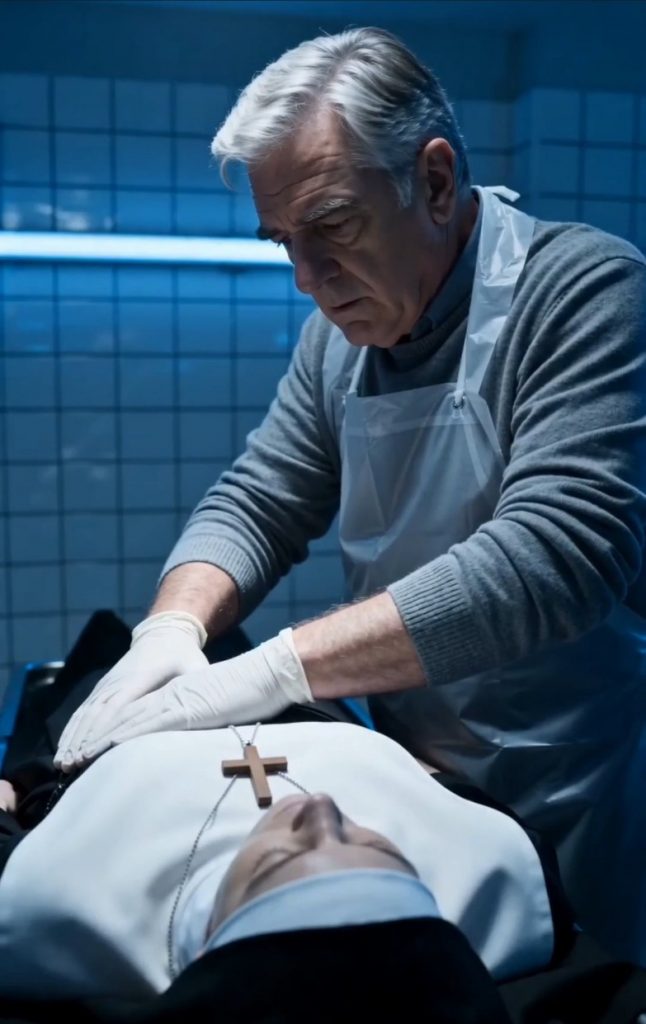
Dr. Samuel Cross had worked there long enough to believe that nothing behind those white-tiled walls could still shock him. The room was all steel, fluorescent light, and silence. A stainless sink gleamed under the blue bar of light on the wall. Cabinet doors reflected thin strips of his white apron as he moved beside the metal gurney.
The young nun lay motionless beneath his gloved hands.
Her habit was black and white, neat despite the storm that had brought her in. A small wooden cross rested on her chest. Her face was pale, peaceful in a way that made Samuel uncomfortable.
Peace could be a mask.
The report said she had been found on a roadside outside St. Agnes Home for Children after a late-night accident. No identification beyond the habit. No purse. No phone. No witnesses willing to speak.
The sheriff had called it tragic.
Samuel called it unfinished.
He pressed carefully along her abdomen, checking for anything unusual. His fingers paused.
There was something beneath the layers.
Not bone. Not swelling.
A shape.
Flat. Firm. Hidden deliberately.
Samuel’s brow furrowed. He found the edge of the habit near her waist and began unfastening the black fabric. The rustle sounded too loud in the sterile room.
Layer by layer, he pulled the cloth aside.
Then he froze.
Taped beneath the nun’s clothing was a waterproof packet, thick and rectangular. Through the translucent wrapping, Samuel saw photographs, hospital bracelets, a small flash drive, and a folded page marked with one word in red ink.
MERCY.
His daughter’s name.
The air left his lungs.
“Oh… my God.”
He stumbled back from the gurney, both gloved hands raised as if the packet had reached for him.
“What is this?” he whispered.
The morgue light flickered.
Then the nun’s fingers moved.
Not much.
Just enough.
Samuel’s heart slammed against his ribs.
He leaned closer, hand shaking as he pressed two fingers gently to her throat.
A pulse.
Faint. Slow. Real.
The woman on his table was not dead.
And whatever she had carried into the morgue had been meant for him.
Act II
Samuel Cross had not said his daughter’s name out loud in twelve years.
Mercy.
It was too soft a name for what had happened to her.
She had been six months old when she vanished from the church nursery during a winter charity dinner. Samuel had been younger then, still married, still able to believe that institutions meant safety if they had enough crosses on the walls and enough donors in the photographs.
His wife, Anna, had stepped away for less than five minutes.
When she returned, the crib was empty.
No broken window. No alarm. No suspicious car caught on camera. Just a white blanket, a missing baby, and a room full of people who suddenly remembered nothing clearly.
The police searched.
The newspapers came.
The church offered prayers.
St. Agnes Home for Children, which ran the nursery that evening, expressed sorrow in a letter so carefully written that Samuel had wanted to tear it apart with his bare hands.
The official theory shifted every few months.
A stranger.
A grieving mother.
A paperwork error.
Then, eventually, silence.
Anna broke first. Not loudly. Quietly. She stopped sleeping, then stopped eating, then stopped looking at Samuel because his face reminded her of the child they could not find.
Their marriage ended in the slowest way possible.
No screaming. No dramatic final scene.
Just two people drowning in the same house and unable to save each other.
Samuel buried himself in work. The dead asked nothing of him. They did not lie. They did not look away. They did not tell him to move on.
Years later, he became county coroner.
People called him thorough. Cold. Difficult.
He accepted all three.
Because when a baby disappears from a church nursery and everyone survives the scandal except the family, a man learns that warmth is not the same as truth.
St. Agnes remained.
It grew richer, cleaner, more respected. Its director, Father Alden Pierce, became a celebrated figure in child welfare circles. Politicians visited. Donors smiled beside children in pressed clothes. The annual gala still filled the town’s largest ballroom.
Samuel never attended again.
But every few years, a file crossed his desk that carried the faint smell of the old wound.
A young mother who disappeared after giving birth.
An adoption record sealed too quickly.
A child transferred across state lines under emergency authority.
Nothing enough to prove.
Everything enough to keep him awake.
Then the nun arrived.
Her intake form listed her as Sister Catherine, approximately thirty-two, found near the old service road behind St. Agnes. The sheriff’s deputy said she had no signs of a struggle. The hospital said she was gone before arrival. The church asked for immediate release of the body for burial.
That last part made Samuel suspicious.
People who had nothing to hide rarely rushed the dead.
Now Sister Catherine lay breathing on his table with Mercy’s name hidden beneath her habit.
Samuel hit the emergency call button.
Then he grabbed the phone and called the one person he still trusted.
Detective Laura Vale answered on the second ring.
“Cross?”
“She’s alive,” Samuel said.
“Who?”
“The nun from St. Agnes.”
A pause.
Then Laura’s voice changed.
“What did you find?”
Samuel looked at the packet.
“My daughter’s name.”
Silence.
This time, Laura did not ask if he was sure.
She knew what that name cost him.
“I’m on my way,” she said.
Behind him, the young nun’s lips parted.
Samuel turned.
Her voice was barely a breath.
“Don’t… let them take me back.”
Then the hallway door handle began to turn.
Act III
Samuel moved before he thought.
He pulled the sheet higher over Sister Catherine, slid the packet into the cabinet beneath the sink, and stepped between the gurney and the door.
Two men entered.
One was Deputy Harlan, young and nervous, his uniform still wet from rain. The other was Father Alden Pierce.
Samuel had not seen him in person for years.
The priest was older now, with silver hair and a black coat tailored too well for humility. His face wore the same practiced grief Samuel remembered from Mercy’s disappearance. Soft eyes. Folded hands. A voice that made refusal feel rude.
“Dr. Cross,” Father Pierce said. “I came as soon as I heard. Such a terrible loss.”
Samuel did not move.
“The examination is not complete.”
Father Pierce glanced at the gurney.
“The sisters are devastated. We hoped to bring her home tonight.”
“Not possible.”
Deputy Harlan shifted. “Doc, sheriff said if there’s no issue—”
“There is an issue,” Samuel said.
Father Pierce’s eyes returned to him.
For one second, the softness disappeared.
“What issue?”
Samuel heard the faintest sound behind him.
A breath.
He stepped slightly to block the view.
“I need additional testing.”
Father Pierce smiled.
“Surely that can be handled after release. We have religious obligations.”
Samuel’s voice turned flat.
“And I have legal ones.”
The room chilled.
Deputy Harlan looked between them, sensing a fight he did not understand.
Father Pierce stepped closer.
“Samuel,” he said quietly. “I know this place carries difficult memories for you. Perhaps your judgment is affected.”
There it was.
The same old blade.
Grief as disqualification.
Pain as unreliability.
Samuel’s hands curled inside his gloves.
“My judgment is the only reason she’s still here.”
Father Pierce stared at him.
Still here.
The words landed.
His eyes flicked toward the body.
Too quickly.
Samuel saw it.
So did Sister Catherine.
Her hand, hidden beneath the sheet, moved just enough to brush Samuel’s wrist.
Father Pierce’s face hardened.
“Deputy, please wait outside.”
Harlan hesitated.
Samuel looked at him.
“Stay where you are.”
The young deputy froze.
The air in the room tightened.
Father Pierce’s voice dropped.
“You do not know what you’re interfering with.”
Samuel almost laughed.
For twelve years, he had known exactly that.
He just had not known the names.
The outer hallway suddenly filled with footsteps.
Detective Laura Vale pushed through the door, rain on her coat and two state investigators behind her.
Father Pierce’s expression shifted instantly back to sorrow.
“Detective,” he said. “This is a private matter.”
Laura looked at the gurney, then at Samuel.
“No,” she said. “It’s not.”
Samuel opened the cabinet and removed the hidden packet.
Father Pierce went pale.
At last, Sister Catherine opened her eyes.
And looked straight at the priest.
Act IV
Her real name was not Catherine.
It was Claire Donovan.
She had entered St. Agnes at nineteen, not because she wanted to disappear from the world, but because she wanted to serve the people the world forgot. Children without family. Mothers without money. Girls told their fear was shame.
For years, she believed in the work.
Then she began noticing things.
A baby transferred without a matching court order.
A mother told her child had been placed with relatives when no relatives existed.
Donation checks linked to private adoption attorneys.
Old files rewritten.
New files missing.
Claire asked questions carefully at first.
Then directly.
That was when doors began closing.
Father Pierce told her she was tired. Emotional. Overly attached. He suggested a retreat. Then reassignment. Then silence.
Claire did not stay silent.
She copied records at night and hid them wherever she could: under chapel floorboards, behind loose bricks, inside hymnals no one opened anymore.
Then she found Mercy Cross.
Not the child.
The file.
The name was handwritten at the top of a sealed transfer record from twelve years earlier. The baby had not vanished from the nursery because of a stranger. She had been moved through a private network under a false emergency placement, her identity changed before sunrise.
Samuel gripped the edge of the counter when Claire told him.
Laura stepped closer.
“Do you know where Mercy is now?”
Claire’s eyes filled with tears.
“I know where she was sent. The records stop after that, but the first placement is in the packet.”
Samuel looked down at the waterproof bundle.
For twelve years, he had imagined the truth as a locked room.
Now it was in his hands.
He was terrified to open it.
Claire’s voice weakened.
“I tried to bring everything to you. I knew they would watch police. I thought if I could reach the morgue records office, someone would listen. But they caught me near the service road.”
Father Pierce spoke sharply.
“This woman is confused.”
Claire turned her head toward him.
“No, Father. I was confused when I thought faith meant obeying men who used God as a locked door.”
The room went silent.
One of the state investigators stepped toward Father Pierce.
“Father Alden Pierce, we need you to remain here.”
He smiled faintly.
“On what grounds?”
Laura opened the packet.
Inside were names.
Not one.
Dozens.
Children moved.
Mothers silenced.
Donors protected.
Doctors paid.
Judges influenced.
And at the center of the oldest file was a photograph of a baby wrapped in a white blanket.
Mercy.
Samuel’s knees almost failed.
Laura caught his arm.
He barely felt it.
On the back of the photograph was a handwritten note.
Placement approved. Cross family not to be notified. Alden P.
Father Pierce’s face finally cracked.
Not with guilt.
With anger.
“You have no idea how many children we saved from impossible situations.”
Samuel looked at him.
“You stole them.”
“We placed them.”
“You erased them.”
Father Pierce said nothing.
Claire reached weakly for the wooden cross at her chest.
“I took vows to protect the vulnerable,” she whispered. “Not the reputation of men who preyed on desperation.”
The priest turned to her with cold fury.
“You have destroyed the work of a lifetime.”
“No,” Samuel said, voice shaking. “She exposed it.”
The investigator stepped behind Father Pierce.
This time, there was no sermon left to hide inside.
Act V
Claire survived.
The hospital listed her condition as serious but stable. Samuel visited once, standing awkwardly beside her bed with a cup of vending-machine tea he had forgotten to drink.
“You should hate me,” she said.
He looked at her, startled.
“For what?”
“For waiting so long.”
Samuel sat slowly.
For a moment, he was back in the morgue, seeing Mercy’s name through plastic, feeling twelve years of grief change shape in his hands.
“I spent twelve years not knowing where to look,” he said. “You pointed.”
Claire cried then.
Quietly.
Like someone who had carried too much evidence and not enough hope.
The investigation spread beyond the county within days.
St. Agnes closed its doors. Father Pierce was charged, along with attorneys, administrators, and medical staff who had helped turn vulnerable families into paperwork. Some records were incomplete. Some destroyed. Some names had been changed so many times that finding the truth became an act of excavation.
But Mercy’s first placement survived.
A family in Vermont.
Then a second transfer.
Then a new name.
Emma.
Samuel learned it from Detective Laura Vale in his kitchen at 2:13 in the morning.
His daughter was alive.
Fifteen years old.
Living with adoptive parents who had no idea their adoption had begun with a crime. That was the part Samuel had not expected to hurt.
They had not stolen her.
They had loved her.
The reunion did not happen like a movie.
There was no running across a field. No instant embrace. No swelling music capable of fixing stolen time.
Emma agreed to meet Samuel in a therapist’s office three months later.
She had Mercy’s eyes.
No, he corrected himself.
She had her own eyes.
Cautious. Intelligent. Angry.
She sat across from him in a green sweater, arms folded tight, while her adoptive mother cried silently beside her.
Samuel had prepared a speech.
He forgot all of it.
Finally, he said, “I’m sorry the truth found you like this.”
Emma studied him.
“You’re my biological father.”
“Yes.”
“You looked for me?”
“Every day.”
Her mouth trembled, but she did not cry.
“Then why did it take so long?”
The question entered him cleanly.
No cruelty.
Just the right of a child to ask why adults failed.
“Because people lied,” he said. “And because I trusted some institutions too much and myself too little.”
She looked down.
“I already have parents.”
“I know.”
“I don’t want to hurt them.”
Samuel’s eyes filled.
“Then don’t. Love is not a chair with only one seat.”
For the first time, Emma looked at him not as an intruder, but as a person.
Not family yet.
But not nothing.
That was enough for the first day.
Months became a fragile pattern.
Letters. Then phone calls. Then short visits. Emma wanted to know about Anna, her birth mother, who had moved away years earlier and returned when she learned Mercy had been found. That meeting was harder. Softer. Full of tears no one knew where to place.
They did not become whole.
They became connected.
There is a difference.
Samuel kept working as coroner, though the morgue changed for him forever. The white tiles, the blue light, the stainless steel sink—they no longer belonged only to endings.
They had become the place where a woman everyone thought was gone opened her eyes and returned the first piece of his daughter’s life.
Claire left the convent but not her faith.
She testified for two years.
Sometimes she shook on the stand. Sometimes her voice failed and the judge called a recess. But she always returned.
When asked why she hid the files beneath her habit, she answered simply.
“Because men searched my room. They searched my desk. They searched my bags. But they never imagined the truth would be carried on the body of a woman they thought they had already silenced.”
Samuel was in the courtroom that day.
Emma sat beside him.
Not touching.
Close enough.
Father Pierce never looked at Claire when the verdict was read.
He looked at Samuel.
As if Samuel had ruined him.
Samuel held his gaze without satisfaction.
The ruins had been built long before the morgue.
One year after the discovery, Samuel visited the old St. Agnes building. It had been emptied by then. The statues were covered. The nursery walls were bare. Sunlight fell through stained glass onto dust.
Claire met him in the chapel.
Together, they placed a small wooden box beneath the altar.
Inside were copies of names recovered from the records. Not all of them. Never enough. But many.
Mercy Cross was one.
Emma chose to write it herself.
Not because she wanted to stop being Emma.
Because she wanted the stolen name to exist somewhere it could not be erased again.
Samuel stood in the quiet chapel and thought of the first time he saw Claire on the gurney.
The pale face.
The wooden cross.
The hidden packet.
His own voice breaking.
What is this?
Now he knew.
It had been evidence.
It had been confession.
It had been a map.
It had been a key.
Most of all, it had been a refusal.
A refusal to let powerful men bury children under new names, mothers under shame, and truth under holy language.
Samuel walked out of the chapel into the afternoon light with Emma beside him.
She did not call him Dad.
Not then.
Maybe not ever.
But at the bottom of the steps, she slipped a folded paper into his hand.
He opened it after she left.
It was a drawing of three names connected by thin blue lines.
Mercy. Emma. Samuel.
Underneath, she had written:
I’m still figuring it out.
Samuel sat on the chapel steps and wept.
Not because everything had been restored.
It had not.
But because the dead silence of twelve years had finally been broken by a living girl with a pencil, a brave woman with a hidden packet, and a truth that refused to stay sealed beneath black cloth and fluorescent light.
The morgue had taught Samuel that every body carried a story.
That night, Claire Donovan taught him something more.
Some stories are not dead.
They are only waiting for someone brave enough to open the fabric and look.