Act I
The egg hit the floor first.
It landed sunny-side up against the sterile white tile, yellow center trembling beneath the fluorescent lights. The two slices of bread followed, skidding apart like scraps. Then the brown plastic tray clattered across the mess hall, loud enough to cut through every conversation before the laughter swallowed it whole.
The commander threw his head back and laughed.
It was not a small laugh. It was not private. It was a performance, deep and booming, designed to make every recruit in the room understand exactly what had just happened.
The woman stood perfectly still.
Her name tag read CARTER.
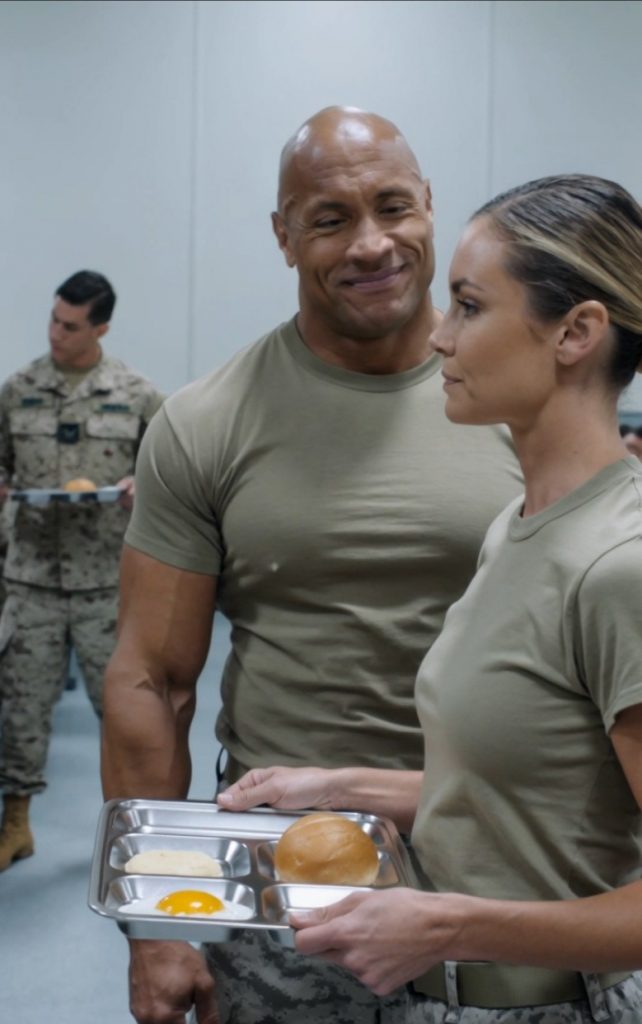
Her blonde hair was pulled into a tight bun. Her olive green shirt was tucked cleanly into her camouflage pants. Her arms stayed pinned at her sides, her posture rigid, her eyes fixed straight ahead as if the tray had never left her hands.
Around her, the male recruits erupted.
Some clapped. Some slapped the metal tables. A few stood on their stools and pumped their fists like they had just watched a championship play instead of a soldier’s breakfast being knocked onto the floor.
The commander turned slowly, feeding on it.
He was bald, massive, and built like a wall with boots. His olive shirt stretched tight across his chest, and his camouflage cargo pants were tucked into polished military footwear. He looked less like a man leading recruits and more like a man daring the room to disappoint him.
“You really think you belong here?” he had asked her seconds earlier.
She had not answered.
So he stepped closer, lowering his head until his mouth was inches from her face.
“This place isn’t for weak people like you.”
Still, she did not answer.
That was what made him angry.
He wanted fear. He wanted flinching. He wanted the small, visible crack that would prove his point to the room. Instead, she walked forward with the same steady pace, carrying the same meal every soldier had been given: two slices of bread and one fried egg on a white ceramic plate.
No extra portion. No special treatment. No excuse.
So he created one.
As she passed him, his arm swung upward, hard and sudden, striking the bottom of her tray.
The mess hall exploded.
But Carter did not look down.
She stared at a fixed point on the far wall, her face cold and unreadable, while the laughter rose behind her like a storm.
And somewhere above the mess hall doors, a small black camera blinked red.
Act II
The mess hall at Fort Arlen had always been ugly in the same way discipline was supposed to be ugly.
Plain white walls. Long metal tables. Stools bolted to the floor. Fluorescent lights bright enough to erase every shadow and every excuse. The food was simple, identical, and deliberately unremarkable.
Two slices of bread.
One fried egg.
A white plate.
No one could say they had been favored. No one could say they had been cheated. At least, that was the theory.
In practice, Fort Arlen had its own rules, and those rules were not written on any wall.
The men learned them fast. Laugh when Commander Harlan Briggs laughed. Stay quiet when he picked someone to break. Never protect the person at the center of the room, because tomorrow it might be you.
Briggs called it tradition.
The recruits called it survival.
He had been at Fort Arlen for eleven years, long enough for his temper to become part of the building. His voice carried through corridors. His boots could silence a barracks before he entered it. Men who feared him later bragged that he had made them stronger, because fear becomes easier to worship when you are too ashamed to admit it hurt.
The arrival of Private Carter unsettled him before she said a word.
She did not ask for attention. She did not complain. She ran the drills, cleaned her station, memorized protocol, and kept her face unreadable under pressure. She did not try to be one of the boys, and that alone made the boys suspicious.
Briggs hated it more than all of them.
He had spent years turning the mess hall into a stage. A recruit could fail on the obstacle course, fall behind on a march, or miss a command during inspection, but nothing entertained him like humiliation in front of breakfast.
That morning, Carter entered with her tray and took three steps before Briggs blocked her path.
The room knew the rhythm.
Forks slowed. Boots shifted under tables. The recruits closest to the aisle leaned slightly forward, hungry for the scene before they had finished eating.
Briggs looked down at her plate.
“Same meal as everybody else,” he said, loud enough for the room to hear. “Still carrying it like it’s too heavy.”
A few men laughed.
Carter’s expression did not move.
That was when Briggs leaned close and asked the question.
“You really think you belong here?”
The room waited.
She looked through him.
That silence made the commander’s smirk tighten. To everyone else, it looked like discipline. To Briggs, it felt like defiance.
So he escalated.
“This place isn’t for weak people like you,” he whispered, though the nearest table heard enough to grin.
Then she stepped forward.
For one brief second, she passed him cleanly. Her tray stayed level. Her shoulders stayed square. She did exactly what training demanded: move with purpose, ignore provocation, maintain control.
That was when Briggs knocked the tray from her hands.
The recruits cheered because they knew they were supposed to.
But not everyone in the room was cheering.
At the end of the third table, a young recruit named Ellis stared at the broken plate and forgot to laugh. He had seen Carter run the endurance route the day before after twisting her ankle on loose gravel. She finished without asking for a medic. She even helped another recruit carry his pack for the last half mile.
Ellis had wanted to say something then.
He had not.
Now, watching her stand alone while egg yolk spread across the floor, shame burned hotter in him than fear.
Across the mess hall, another man noticed the same thing. He was older than the recruits, sitting in a plain uniform without insignia visible from a distance. He had entered before breakfast, eaten quietly, and kept his head lowered over a cup of black coffee.
No one had paid attention to him.
That had been the point.
When Briggs laughed, the older man did not move. He only glanced toward the camera above the doors, then back to Carter.
Because the humiliation had not interrupted the inspection.
It had begun it.
Act III
Private Carter was not supposed to be at Fort Arlen.
Not as a recruit.
Not as a target.
And definitely not as the woman Briggs thought he could break before breakfast.
Her full name was Lieutenant Anna Carter, Military Standards and Conduct Division. Twenty-seven years old. Top of her officer training class. Former logistics commander attached to a disaster-response unit overseas. She had carried wounded civilians through floodwater, rebuilt supply lines under pressure, and once spent thirty-six hours coordinating evacuations with no sleep and no working radio after midnight.
But Briggs saw a blonde bun, a quiet face, and a name tag without rank.
So he saw weakness.
That was his first mistake.
His second was assuming Fort Arlen still belonged to him.
For six months, complaints had reached headquarters in fragments. A recruit resigning after “discipline problems.” A family writing that their son had changed after training and would not explain why. Medical forms with injuries described vaguely. Anonymous notes that used the same phrase again and again.
Organized bullying.
Not hard training. Not strict standards. Not the ordinary pressure of military life.
Bullying.
The kind that turned a unit into a pack and called cruelty loyalty.
Briggs had survived every inquiry because no one would speak on record. The recruits protected him out of fear. His assistants claimed ignorance. His mess hall cameras somehow failed during the worst incidents.
So headquarters sent someone he would underestimate.
Anna Carter arrived under a temporary administrative placement with a stripped-down file and a private order signed two levels above Briggs. Her job was simple on paper: observe the training environment, document misconduct, identify whether the culture at Fort Arlen had crossed from discipline into abuse.
In reality, it was a trap with a pulse.
She knew what he would do.
Not exactly. Not the tray. Not the egg on the floor. But she knew men like Briggs rarely hid themselves when they believed the room belonged to them.
The identical breakfast portions mattered.
Anna had noticed them immediately. Two slices of bread and one egg for every soldier in the mess hall. Briggs could not claim she had been given special treatment. He could not say he was correcting privilege. The tray in her hands was proof that she had been standing in the same line as everyone else.
And he still chose to single her out.
The older man at the third table knew it too.
Colonel Nathan Vale had arrived at Fort Arlen before sunrise in a plain utility uniform, his rank covered under a neutral field jacket. He had commanded training units before. He believed in pressure, exhaustion, discipline, and standards that did not bend for anyone.
But he had no patience for commanders who confused humiliation with leadership.
When Briggs knocked the tray down, Vale did not interrupt.
Not because he approved.
Because a room tells the truth only when it thinks truth has no witness.
Anna stood at attention while the laughter roared around her. She let the sound settle into the recording. She let the recruits clap. She let Briggs grin like a man who had just won something.
Then she finally moved.
Not to pick up the bread.
Not to wipe the egg from the floor.
She turned her head slightly toward Briggs.
“Permission to retrieve another meal, Commander?”
The question cut strangely through the noise.
Briggs stopped laughing.
He had expected tears. Anger. Maybe a trembling apology. Instead, she offered him regulation.
The recruits quieted by instinct.
Briggs leaned close again, but this time there was less certainty in his face.
“You don’t learn fast, do you?”
Anna’s eyes stayed forward.
“I learn from command climate, sir.”
It was a military phrase. Dry. Professional. Almost harmless.
Almost.
Colonel Vale set down his coffee.
And that was the moment Briggs began to lose the room.
Act IV
Briggs heard the chair scrape before he saw the man stand.
It was not loud, but every recruit in the mess hall seemed to feel it. The older man at the third table rose slowly, removed his field jacket, and revealed the rank on his chest.
Colonel.
The laughter died like someone had cut the power.
Briggs turned.
For the first time that morning, his face did not know what shape to take.
“Colonel Vale,” he said, forcing the name out as if respect had become difficult to swallow.
Vale walked into the aisle. He did not raise his voice. He did not need to. Authority, real authority, has a way of lowering the temperature in a room.
“Commander Briggs.”
The recruits sat frozen at the tables, hands in laps, mouths closed. A few stared at their plates. The men who had clapped hardest now looked as though they had never made a sound in their lives.
Vale stopped beside the fallen tray.
His eyes moved over the bread, the egg, the broken plate, then to Anna.
“Private Carter,” he said.
Anna remained still.
“Yes, sir.”
“Are you injured?”
“No, sir.”
“Were you carrying the standard meal issued to all recruits?”
“Yes, sir.”
Vale looked at Briggs.
The commander’s jaw flexed.
“Sir, this was a corrective exercise,” Briggs said quickly. “The recruit displayed an attitude problem.”
Vale’s expression did not change.
“Her attitude problem was walking with a tray?”
A few recruits lowered their eyes.
Briggs tried to recover.
“She’s been disruptive to unit cohesion.”
At that, Ellis looked up.
The words struck something in him. Carter had not disrupted anything. She had stayed quiet, followed orders, and worked harder than most of them. The only disruption was the way Briggs needed everyone to hate who he hated.
Vale noticed Ellis move.
“Recruit,” he said.
Ellis stiffened.
“Yes, sir.”
“Did Private Carter provoke the commander?”
The room held its breath.
Ellis looked at Briggs.
Briggs stared back with a warning sharp enough to cut.
Then Ellis looked at the egg on the floor.
“No, sir.”
A ripple moved through the mess hall.
Vale nodded once.
“Speak clearly.”
Ellis swallowed.
“No, sir. She asked no question. She made no comment. She was walking to her seat.”
Briggs turned red.
“Colonel, with respect—”
“You will be silent unless answering a direct question.”
Briggs went still.
The sentence did more than discipline him. It showed the room he could be disciplined.
That was when another recruit spoke.
“Sir,” he said, voice shaky, “Commander Briggs blocked her first.”
Then another.
“He leaned into her face, sir.”
Another.
“He said she didn’t belong.”
The truth did not roar at first. It came out in pieces, small and frightened, from men who had spent weeks learning silence. But once the first pieces landed, the room could no longer pretend the floor was clean.
Vale listened.
Anna did not turn around.
Her face stayed composed, but inside her chest something tightened and released. She had not needed them to defend her. She had needed them to remember they could still choose what kind of soldiers they became.
Vale lifted his gaze to the camera above the door.
“Recording active?”
A technician in the back doorway stepped forward.
“Yes, sir. Full audio and video since 0600.”
Briggs looked toward the camera.
That was the smallest he had looked all morning.
Vale faced him again.
“Commander Briggs, you are relieved of direct training authority pending formal review.”
The words hit the room harder than the tray had.
Briggs opened his mouth, then closed it.
For years, he had ruled by spectacle. Now he was losing by procedure, in the same mess hall where he had taught young men to laugh at weakness.
Vale turned to Anna.
“Lieutenant Carter.”
This time, the title was clear.
Several recruits stared.
Briggs went pale.
Anna pivoted with perfect precision and saluted.
“Yes, sir.”
The room understood all at once.
She had never been the weak link.
She had been the test.
Act V
No one ate for several minutes after that.
The mess hall, which had been loud with cruelty moments earlier, sat under a silence that felt heavier than shouting. Recruits stared at their identical plates as if seeing them for the first time. Two slices of bread. One egg. The same meal, the same uniform, the same oath waiting beyond training.
And yet one of them had been chosen for humiliation because Briggs needed someone beneath him.
Anna lowered her salute.
Colonel Vale gave a short nod.
“Lieutenant, continue.”
She looked at the floor.
The broken plate remained where it had fallen. The egg yolk had spread into a thin yellow streak across the white tile. The bread lay at the edge of a stool, stepped near but not on.
Anna bent down.
Not quickly. Not shamefully.
She picked up the tray first, then the bread, then the pieces of ceramic large enough to lift safely. Before she could reach the last piece, Ellis stepped out from his table.
“Permission to assist, sir?”
Vale looked at Anna.
Anna looked at Ellis.
For the first time that morning, her expression softened by the smallest degree.
“Granted.”
Ellis knelt and helped gather the mess.
Then another recruit stood.
Then another.
Soon half the table was on its feet, not cheering, not clapping, not performing, just quietly helping clean what they had helped make possible.
Briggs watched from the aisle, guarded now by two senior staff members who had appeared from the back of the hall. His huge frame still filled space, but it no longer controlled it. Without the laughter, he was just a man who had mistaken fear for respect.
Anna carried the broken plate to the disposal bin.
A mess worker, an older woman with tired eyes and a hairnet, handed her a clean cloth.
“Thank you,” Anna said.
The woman nodded toward Briggs without looking at him.
“Been waiting a long time for somebody to see.”
Anna held her gaze for a second.
“We saw.”
That afternoon, Fort Arlen changed in ways that did not look dramatic from the outside.
Orders were signed. Interviews began. Training staff were separated and questioned. Old camera failures were reviewed. Medical reports were pulled. Recruits who had been afraid to speak were given private rooms, clear protections, and officers who did not report to Briggs.
The story of the tray moved through the base faster than any official memo.
By nightfall, everyone knew Commander Briggs had been relieved.
By morning, everyone knew the woman he humiliated was not a helpless recruit.
But Anna did not let them turn her into a legend.
When a young soldier approached her outside the administration building and said, “Ma’am, you really showed him,” she corrected him.
“No,” she said. “He showed himself.”
That mattered.
Briggs had not fallen because Anna was secretly strong. She had always been strong. He had fallen because the room finally had to face what it had been rewarding.
A week later, the mess hall reopened under new supervision.
The walls were still white. The tables were still metal. The lights were still too bright. Breakfast was still simple enough to make no one feel special.
Two slices of bread.
One egg.
A white plate.
But the atmosphere had changed.
Recruits still joked. They still complained. They still groaned over early drills and bad coffee. But when one soldier dropped his tray by accident, no one laughed until he laughed first, and even then three others helped him clean it up.
Ellis noticed that.
Anna noticed too.
On her final morning at Fort Arlen, she entered the mess hall in full uniform with her real rank visible. The room stood automatically. Not out of fear. Not out of performance.
Out of respect.
Colonel Vale was waiting near the serving line.
“Report is going to headquarters,” he said.
Anna nodded.
“And Briggs?”
“Formal proceedings. He will not return to command recruits.”
She accepted that without visible satisfaction.
Justice in uniform rarely arrived like thunder. More often, it came as paperwork, testimony, signatures, and the slow removal of men who thought cruelty was a leadership style.
Anna took her tray from the line.
Two slices of bread.
One egg.
A white plate.
She carried it down the same aisle where Briggs had blocked her. Recruits watched, but no one snickered. No one leaned in with cruel anticipation. No one treated her presence like a joke.
When she reached the spot where the tray had fallen, she paused.
Only for a second.
Then she continued to an empty seat and sat down.
Ellis sat across from her, nervous but determined.
“Ma’am,” he said, “I should have spoken sooner.”
Anna looked at him over the rim of her coffee.
“Yes,” she said.
He lowered his eyes.
Then she added, “Next time, you will.”
Ellis nodded.
“Yes, ma’am.”
That was enough.
Outside, morning light spilled across the training yard. Boots struck pavement in organized rhythm. Commands echoed in the distance. Fort Arlen was still hard, still demanding, still built to strip away excuses.
But something poisonous had been pulled out by the root.
Not everything.
Never everything at once.
But enough for the young men in that mess hall to understand the difference between strength and cruelty. Enough for them to remember the sight of a soldier standing motionless while the whole room laughed, refusing to surrender her dignity to the floor.
Years later, some of those recruits would tell the story differently.
They would say the commander knocked her tray away, and she did not even blink.
They would say the room went silent when her rank was revealed.
They would say that was the day Fort Arlen changed.
But Anna knew the real moment had come earlier.
Before the colonel stood.
Before the camera was mentioned.
Before the truth found its voice.
It came in the seconds after the plate shattered, when laughter filled the mess hall and everyone expected her to break.
She stood straight.
She looked forward.
And she let them learn that dignity is not something another person can knock out of your hands.