Act I
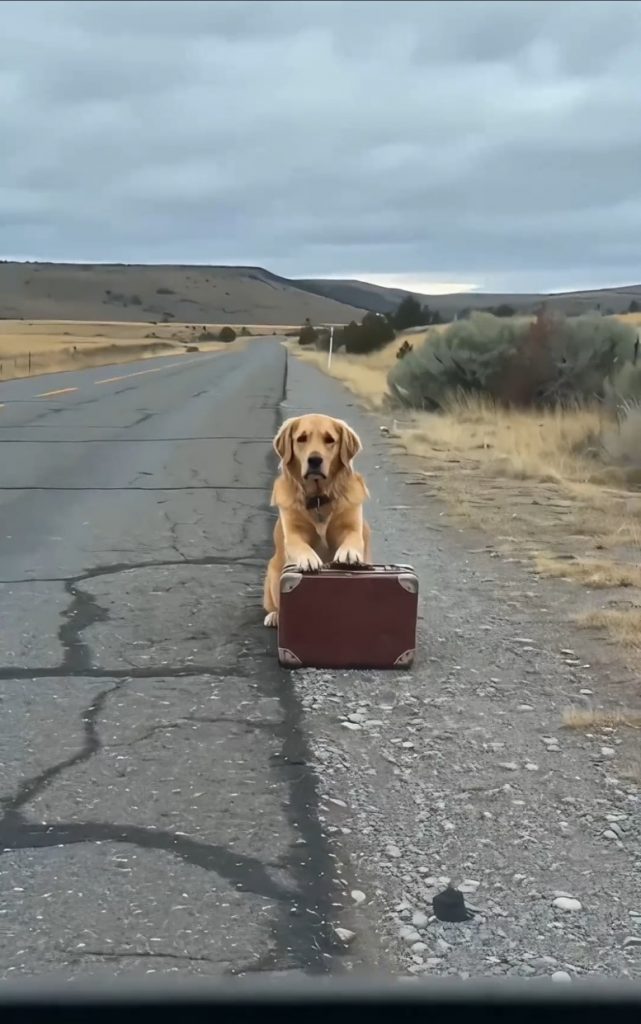
The dog was sitting on the shoulder like he had been told not to move.
That was what made Jack Mercer slow down.
Not the suitcase.
Not at first.
Just the dog.
A golden retriever, dusty and exhausted, hunched beside a worn burgundy suitcase on the gravel shoulder of a lonely desert road. The sky above him was heavy with gray clouds, and the dry yellow grass bent in the wind around scattered rocks and leafless trees.
There were no houses nearby.
No parked car.
No person walking away in the distance.
Just the dog, the suitcase, and two empty lanes stretching through nowhere.
Jack eased his truck toward the shoulder, one hand still on the wheel. Through the passenger window, he watched the dog lower his head and press both paws over the suitcase as if protecting it from the whole world.
“What are you doing out here, buddy?” Jack whispered.
The dog looked up.
His eyes were dark, wet, and human with desperation.
Jack killed the engine.
The wind filled the silence.
When he stepped out, the dog did not run. He stayed crouched over the suitcase, ribs showing faintly beneath dusty golden fur, panting hard through an open mouth.
Jack approached slowly.
“It’s okay,” he said. “I’m not going to hurt you.”
The dog whimpered once, then lowered his muzzle to the suitcase latch.
Jack froze.
The animal bit gently at the metal hardware, tugging, scraping, pulling the suitcase an inch across the gravel. Not away from Jack.
Toward him.
The suitcase was old. Burgundy leather, scuffed beige corners, dirt across the seams. It looked heavy. Abandoned. Wrong.
Jack knelt.
The dog stepped back just enough to let him touch the handle, then immediately pressed his paw onto the suitcase again as if warning him not to ignore it.
The tag on the dog’s collar was scratched almost unreadable.
BAXTER.
Beneath the name was a phone number.
And beneath the number, carved into the metal by hand, were three words.
DON’T TRUST DAVID.
Jack’s throat tightened.
He looked at the dog.
“Who’s David?”
Baxter whined and tugged the suitcase latch again.
Jack opened it.
Inside were a child’s yellow sweater, a woman’s wallet, a cracked phone wrapped in a scarf, and a folded note sealed in a plastic bag.
The note had only one sentence.
If Baxter brings you this, my daughter and I are not safe.
Act II
Before that road, before the suitcase, before the dog became a messenger no one expected, there was a woman named Lena Hart.
She lived in a white house at the edge of Silver Creek with a wraparound porch, a rose garden, and a husband everyone in town admired.
David Hart owned the largest construction company in the county. He sponsored youth baseball, shook hands at church fundraisers, donated to the sheriff’s campaign, and smiled in photographs like a man with nothing to hide.
Lena knew better.
So did Baxter.
The dog had been her daughter’s tenth birthday gift. Emma picked him from a shelter because he was “the saddest one,” and Lena had laughed because that was exactly the kind of child Emma was.
Tender.
Stubborn.
Unable to walk past anything hurting.
Baxter became Emma’s shadow. He waited outside her bedroom in the morning, followed her to the bus stop, and slept with his head on her backpack as if guarding her homework from unseen enemies.
At first, David tolerated him.
Then Baxter began to growl.
Not at strangers.
At David.
Always when David’s voice changed.
Always when Lena went quiet.
Always when Emma stood too still.
Small towns are good at admiring men in public and not asking what they sound like at home.
Lena tried leaving once.
David found her before sunset.
After that, he took her car keys. Then her bank card. Then her phone “for her own good.” He told people she was anxious, unstable, overwhelmed by motherhood.
He said it lovingly.
That was what made people believe him.
But Lena had been preparing.
Quietly.
She copied documents. Bank transfers. Photos of bruised doors and broken locks. Emails proving David had been moving company money into hidden accounts under Emma’s name. A recording of him telling Lena that no court would believe her because everyone already thought he was the reasonable one.
She packed the burgundy suitcase in secret.
Not with clothes.
With proof.
She hid it beneath loose boards in the pantry and trained Baxter with a simple command.
Find the red.
At night, when David was away, she would make Baxter drag the suitcase from behind the pantry wall to the kitchen. Emma would clap silently, and Lena would give him pieces of chicken.
It had seemed almost ridiculous at the time.
A desperate woman teaching a dog to retrieve evidence.
Then David announced he was filing for full custody.
He said Lena needed treatment.
He said Emma deserved stability.
He said it all in a lawyer’s office while smiling at the secretary.
That night, Lena packed the suitcase for real.
By dawn, she and Emma were gone.
Baxter sat in the back seat with his head on Emma’s lap.
For thirty miles, Lena believed they might make it.
Then David’s truck appeared behind them.
Act III
Jack called 911 from the roadside with the note in his hand and Baxter pacing circles beside him.
The cracked phone inside the suitcase had just enough battery to turn on. No signal, but the voice memo app was open. One recording waited at the top.
Jack hesitated before pressing play.
Then Lena Hart’s voice filled the empty road.
“My name is Lena Hart. If this suitcase has been found, David is probably telling people I ran away or hurt my daughter. I didn’t. I’m trying to leave him.”
Baxter stopped pacing.
He stared at the phone.
Lena’s voice shook but did not break.
“He has friends in the sheriff’s office. Do not give this to Deputy Crane. Do not let them take Emma back to Silver Creek. The documents in this suitcase prove financial fraud, coercive control, and threats against us.”
Jack looked up at the gray sky.
A truck moved slowly in the distance, too far to identify.
Lena continued.
“If Baxter is with the suitcase, follow him. He knows where we went.”
Jack stared at the dog.
Baxter had already turned toward a narrow dirt track almost hidden behind scrub grass.
The dispatcher’s voice came through Jack’s phone.
“Sir, stay where you are. Deputies are being sent to your location.”
Jack gripped the phone tighter.
“What deputies?”
There was a pause.
“Silver Creek County.”
Jack looked down at the note again.
Do not give this to Deputy Crane.
His heart began to pound.
“Send state police,” Jack said. “And medical. I’m not leaving.”
The dispatcher started to answer, but Baxter barked once.
Sharp.
Commanding.
Then he grabbed the suitcase handle and pulled toward the dirt track.
Jack looked at the empty road.
Then at the dog.
“Alright,” he whispered. “Show me.”
He dragged the suitcase with one hand and followed Baxter off the shoulder.
The dog moved fast despite his exhaustion, cutting through dry grass, around rocks, toward a line of leafless trees half a mile from the road. Jack stumbled after him, breath hard, phone in his pocket still connected to 911.
The dirt track led to an abandoned pump station, a low concrete building with a rusted metal door and broken windows.
Baxter ran to the door and scratched hard.
Jack heard something inside.
Not a machine.
Not wind.
A child crying.
He dropped the suitcase.
“Emma?”
The crying stopped.
A tiny voice answered from behind the door.
“Baxter?”
The dog barked and pressed his whole body against the metal.
Jack looked around, found a rusted pipe near the wall, and forced the door open.
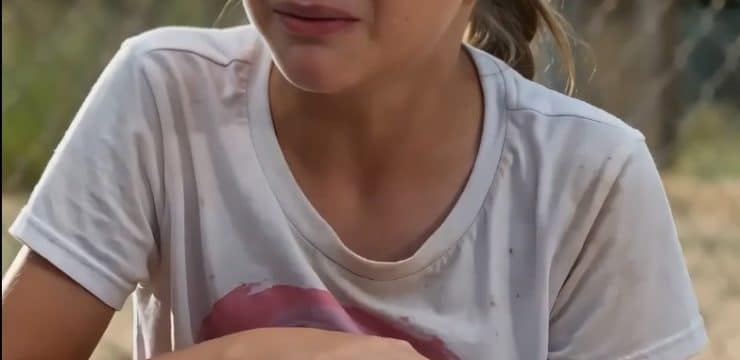
Inside, behind old equipment and a stack of rotting boards, sat a little girl with tangled brown hair, a swollen cheek, and her arms wrapped around a woman lying weakly beside her.
Emma Hart looked up at Jack with eyes too tired for a child.
“Did Baxter bring help?” she whispered.
Baxter shoved past Jack and ran to her.
The girl wrapped both arms around the dog’s neck and broke apart.
Act IV
Lena was alive.
Barely conscious, dehydrated, and hurt from the crash that had forced her car off an old service road. She had managed to get Emma and Baxter out, but she could not walk far. So she did the only thing left.
She tied the suitcase handle to Baxter’s collar, gave him the command, and pointed toward the highway.
Find the red.
The dog had dragged it until the strap broke.
Then he guarded it on the roadside until someone stopped.
Jack stayed with them until the first sirens approached.
But when the patrol car appeared, Emma grabbed his sleeve.
“No,” she whispered. “That’s him.”
The cruiser stopped near the field.
A deputy stepped out.
Tall, broad, mirrored sunglasses, one hand already on his belt.
Deputy Crane.
Jack felt his stomach drop.
Baxter growled.
The deputy’s face changed when he saw the dog, the suitcase, and Jack standing in front of the pump station door.
“Well,” Crane called, “looks like you found them.”
Jack did not answer.
His phone was still connected to 911 in his pocket.
The dispatcher could hear everything.
Crane walked closer.
“Sir, I’ll take it from here.”
Jack stepped in front of the door.
“No.”
Crane’s smile thinned.
“You don’t want to interfere with an investigation.”
“State police are coming.”
That was when Crane stopped smiling completely.
Behind Jack, Lena stirred.
Her voice was faint but clear.
“Don’t give him the suitcase.”
Crane’s hand twitched.
Baxter lunged forward with a bark so fierce Crane stepped back.
Then the distant sound of heavier sirens rose from the road.
Not one car.
Several.
Crane looked toward the highway.
For the first time, fear crossed his face.
State troopers arrived within minutes. So did an ambulance. Crane tried to explain. Then tried to leave. Then tried to claim he was following protocol.
But the dispatcher had recorded him demanding control of the scene.
The suitcase held more.
Payments from David Hart’s company to Deputy Crane. False incident reports. A draft petition claiming Lena was mentally unstable. A private custody plan prepared before she even left. Messages between David and Crane discussing roadblocks, missing-person statements, and how to make Lena look like she had abandoned Emma.
David was arrested that night at his home.
He was wearing a pressed shirt and telling neighbors he was praying for his missing wife and daughter when state police pulled into the driveway.
The neighbors watched in silence as the man they admired was led away.
Some looked shocked.
Some looked ashamed.
A few looked like they had known enough to ask questions and had chosen not to.
Act V
Baxter slept for eighteen hours after the rescue.
Not peacefully at first.
His paws twitched. His body jerked. Every time someone walked past the hospital room door, he lifted his head and looked for Emma.
The nurses eventually stopped trying to remove him.
One of them brought a blanket and said hospital policy could argue with her after the dog woke up.
Lena recovered slowly.
Emma stayed close.
Baxter stayed closer.
When Lena opened her eyes fully two days later, Emma was asleep in the chair beside her bed, and Baxter lay on the floor with his head on the burgundy suitcase.
Lena began to cry.
Jack was standing near the window with a paper cup of coffee gone cold in his hand.
“You saved us,” Lena whispered.
He shook his head.
“No, ma’am.”
He looked at Baxter.
“He did.”
The case became bigger than anyone expected.
David’s construction company was investigated. Deputy Crane was suspended, then charged. Other reports surfaced from women who said they had tried to leave powerful men in the county and somehow found themselves disbelieved, delayed, or turned around at the door.
The suitcase became evidence.
The red suitcase.
The one everyone later called strange, lucky, impossible.
Lena called it prepared.
At trial, David’s attorney tried to paint her as unstable. He spoke about anxiety. Stress. A mother’s poor judgment. He suggested she had endangered Emma by fleeing into the desert.
Then prosecutors played Lena’s recording.
They showed the documents.
They called Jack.
They called the dispatcher.
And finally, they showed the jury a photo taken on the roadside: Baxter sitting with both paws on the burgundy suitcase, dusty and exhausted, refusing to leave the proof behind.
No one in the jury box looked away.
David was convicted.
So was Crane.
Lena did not smile at the verdict. Emma did not cheer. Baxter slept through most of it beneath the courtroom bench, waking only when Emma shifted her foot.
Justice did not feel like victory.
It felt like breathing without permission.
Months later, Lena moved with Emma to a small town near the coast where nobody knew David’s name before they knew hers. She found a little blue house with a fenced yard, wind chimes, and a kitchen window facing the morning sun.
The suitcase came with them.
Emma wanted to throw it away at first.
Then she changed her mind.
They placed it in the hallway closet, empty now except for Baxter’s old broken strap and the metal tag Lena had scratched by hand.
DON’T TRUST DAVID.
One afternoon, Emma took the tag and turned it over.
“Can we change it?” she asked.
Lena looked up from the table.
“To what?”
Emma thought for a moment.
Then she said, “Trust Baxter.”
So they did.
Jack visited once that summer.
He brought Baxter a new collar, dark leather with brass hardware and a bright round tag.
BAXTER HART
VERY GOOD BOY
Emma read it aloud and declared it “almost right.”
Jack looked offended.
“Almost?”
She took the tag to the kitchen drawer, found a marker, and added one word on the back.
HERO.
That evening, they walked Baxter along the beach.
The dog ran ahead, barking at gulls with the same voice that had once saved their lives beside an empty road. Emma laughed until she had to sit down in the sand. Lena watched her daughter and cried quietly, not from fear this time, but from the strange pain of seeing joy return to a child who had learned too early how to hide.
Jack stood beside her.
“You okay?” he asked.
Lena wiped her face.
“No.”
Then she smiled.
“But I think someday I might be.”
Baxter came trotting back, tongue out, tail high, sand stuck to his nose.
He dropped at Emma’s feet and rolled onto his back like a ridiculous king.
Emma leaned over him.
“You found the right person,” she whispered.
Baxter thumped his tail.
Maybe he understood.
Maybe he didn’t.
But Lena believed he understood enough.
He had understood the suitcase mattered.
He had understood the road meant help.
He had understood that staying still could be as brave as running, and running could be as loyal as refusing to leave.
Years later, people would still tell the story of the dog by the red suitcase.
Some versions made it sound magical.
A mysterious dog.
A lonely road.
A suitcase full of secrets.
But Lena knew the truth was not magic.
It was training.
Courage.
Preparation.
Love.
It was a woman hiding evidence because the world had taught her not to expect belief.
It was a child trusting a dog when adults failed.
It was a stranger stopping on a road where most people would have kept driving.
And it was Baxter, dusty and trembling under a gray desert sky, guarding the only thing that could bring his family home.