Act I
The old man looked like the kind of person the city had trained people not to see.
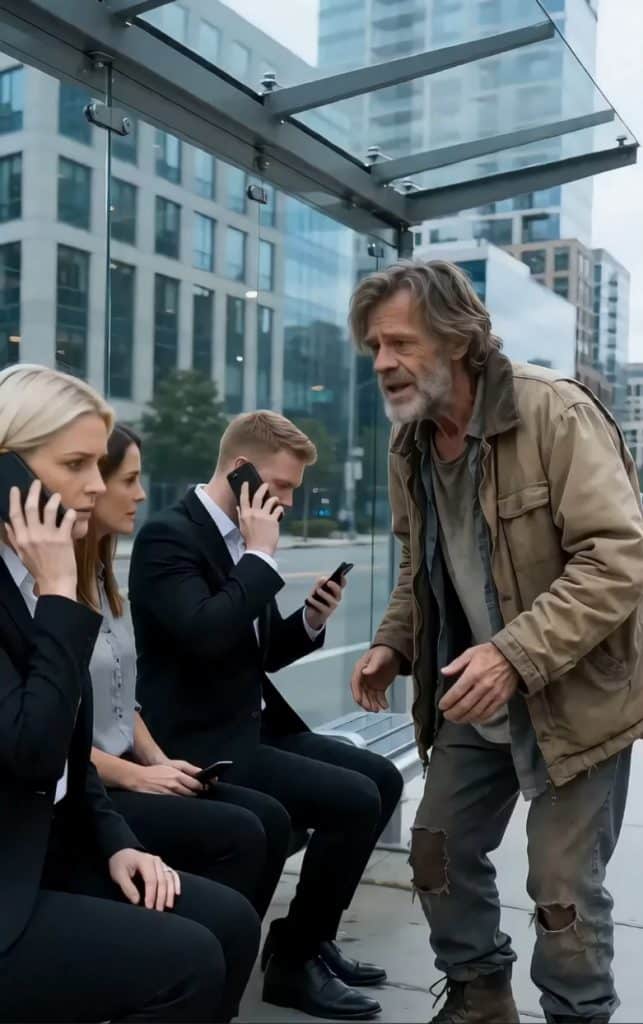
He stood beneath the glass bus shelter in a worn tan jacket, his gray-brown hair tangled from the wind, his beard rough, his boots dusty against the clean concrete sidewalk. Behind him, downtown traffic slid past in polished streams of black cars and tinted windows.
Everyone else at the stop looked like they belonged there.
The young man in the black suit had a phone pressed to his ear. The blonde woman sat stiffly on the silver bench in tailored black, expensive and guarded. A brunette woman in a soft gray blouse sat farther down, hands folded over her phone, watching quietly.
The older man stepped toward the suited man first.
“Excuse me,” he said, voice gritty but hopeful. “Can I borrow your phone for one call?”
The suited man looked at him as if a stain had started speaking.
“Get away from me.”
He turned his shoulder and continued his call.
The old man swallowed the humiliation like he had practiced it.
Then he turned toward the blonde woman.
“Can I use yours?”
She shot up from the bench, heels clicking against the pavement.
“Don’t touch me!”
He had not touched her.
His hands were open. Empty. Almost apologetic.
The shelter went quiet except for the passing traffic and the faint hum of the city. The old man stepped back, embarrassment tightening his face.
That was when the brunette woman stood slightly from the bench and extended her phone.
“Take this phone,” she said softly.
The man looked at her as if she had handed him water in a desert.
“Thank you.”
He took it carefully, stepped away toward the glass panel, and turned his back for privacy. His posture changed the moment the phone touched his ear. The hunched uncertainty vanished. His voice dropped low, serious, controlled.
The woman watched, puzzled.
A minute later, he returned the phone.
“God bless you,” he said.
She smiled modestly, expecting nothing more.
Then a black luxury vehicle stopped outside the shelter.
The blonde woman—the same one who had recoiled from him moments earlier—walked toward the car, received a heavy black bag from someone inside, and carried it back to the old man with the stiff precision of an employee.
The brunette’s smile faded.
The old man accepted the bag, turned toward her, and held it out with both hands.
“You were the only one who saw me as a human,” he said. “I have a gift for you.”
And as she took the heavy bag, every person at the bus stop realized the old man had never been asking for help because he was powerless.
He had been looking for the one person who still had a heart.
Act II
Her name was Claire Bennett, and kindness had cost her before.
That was why she almost did not offer the phone.
She had learned caution the hard way. A purse stolen in college after helping a stranger. A boyfriend who used her sympathy like a key. A supervisor who praised her “generous spirit” while handing her everyone else’s unpaid emotional labor.
By thirty-nine, Claire had become careful.
Not cold.
Careful.
She worked as a claims coordinator for a private health insurance company two blocks away, where she spent her days reading files about people whose lives had been reduced to codes, denials, pending reviews, and polite letters that carried devastating news in soft language.
She hated the job.
She needed the paycheck.
Her younger brother, Miles, lived in assisted care after a construction accident left him unable to work. Their mother had died the previous winter. Rent was rising. Medical bills never stopped arriving. Claire had become the kind of woman who kept two grocery lists: what she needed and what she could afford.
Still, when the older man asked for a phone, she saw her father.
Not in his face.
In his exhaustion.
Her father had been a machinist with cracked hands and pride too large for his paycheck. After the factory closed, he wore the same stunned look for months, as if the world had taken not only his income but his right to stand upright.
People treated him differently after that.
Clerks became impatient.
Bankers smiled less.
Neighbors stopped asking advice.
Claire remembered standing beside him at a pharmacy once while a cashier spoke slowly, loudly, as if poverty had made him stupid.
Her father never complained.
That hurt the most.
So when the suited man snapped at the old stranger and the blonde woman jumped up like he was contagious, something inside Claire refused to stay seated.
It was not bravery.
It was memory.
She gave him her phone.
The man’s hand shook when he took it, but his eyes were clear. That was the first thing she noticed. Not lost. Not confused. Tired, yes. Worn down, yes. But sharp beneath the ruin.
Then he stepped away and made the call.
Claire could not hear the words clearly. Only the tone.
Low.
Commanding.
Like a man used to being obeyed but choosing not to show it until necessary.
The blonde woman, who had acted horrified by him seconds earlier, watched him with a strange tension in her jaw.
Not disgust now.
Recognition.
That was when Claire began to wonder what she had stepped into.
When the black car arrived, she knew.
This had never been an ordinary bus stop encounter.
It was a test.
And everyone except her had failed.
Act III
The old man’s name was Arthur Vale.
Claire did not learn that until he sat down beside her, the black bag resting between them like a secret with handles.
The suited man had ended his call by then. He stood a few feet away, pretending not to listen while listening with his whole body. The blonde woman remained standing near Arthur’s shoulder, silent and formal.
“My name is Arthur,” the old man said.
Claire nodded slowly.
“Claire.”
“I know.”
Her blood went cold.
Arthur saw the fear in her face and lifted one hand gently.
“I’m sorry. That sounded worse than I meant it. I know because my office has a file with your name on it.”
“My name?” she asked.
“Yes.”
The bag suddenly felt heavier in her lap.
Arthur looked through the glass shelter toward the towers rising over the street.
“I own Meridian Life Group.”
Claire stopped breathing.
Meridian Life.
Her employer.
The insurance company where she had worked for seven years. The company whose executives appeared in annual videos talking about compassion while pressuring staff to close claims faster. The company whose logo was printed on the badge inside Claire’s purse.
The suited man at the shelter turned pale.
Arthur noticed.
“So does he,” Arthur said softly.
The suited man stepped forward. “Mr. Vale, I didn’t recognize you.”
Arthur looked at him with devastating calm.
“That was the point, Daniel.”
The man’s face collapsed.
Claire stared at them both.
The blonde woman finally spoke.
“Mr. Vale requested a private assessment of field culture before the acquisition announcement.”
Arthur’s eyes stayed on Claire.
“My board believes Meridian needs restructuring. Numbers told me one story. People told me another. I wanted to know what kind of company we had become when nobody thought power was watching.”
Claire’s throat tightened.
The suited man—Daniel—was Daniel Price, a regional director she had only seen in email chains. He had once denied emergency leave for a woman on Claire’s team whose husband had suffered a stroke.
“Please,” Daniel said. “This is being taken out of context.”
Arthur raised an eyebrow.
“You refused a basic human request in public with a phone already in your hand.”
Daniel flushed.
The blonde woman looked away.
Arthur turned back to Claire.
“You helped when there was no reward.”
Claire’s fingers tightened around the bag handles.
“I just lent you a phone.”
“No,” Arthur said. “You did what our company claims to do in every advertisement. You treated a person in distress like a person.”
He nodded toward the bag.
“Open it.”
Claire hesitated.
The whole bus shelter seemed to lean toward her.
She unzipped the black bag.
Inside was not cash.
It was worse.
Papers.
Files.
A termination list.
Her name was on it.
Act IV
Claire pulled out the top folder with trembling hands.
BENNETT, CLAIRE M.
POSITION ELIMINATION — POST-MERGER REDUNDANCY.
Her vision blurred.
She flipped the page.
There were dozens of names. People from claims. Customer support. Appeals. Nurses who reviewed cases. Older employees. Single parents. People with medical accommodations.
Every name had been marked for elimination.
At the bottom was Daniel Price’s signature.
Arthur’s face darkened as he watched her read.
“That list was delivered to me yesterday,” he said. “Daniel recommended cuts to improve quarterly performance before the acquisition.”
Daniel stepped closer.
“It was a proposal. Every merger has redundancies.”
Claire lifted her head.
“My brother’s care is on my employee insurance.”
Daniel said nothing.
“My job pays for his housing.”
Still nothing.
Her voice shook now.
“How many of us were supposed to find out after the deal closed?”
Arthur looked at Daniel.
“Yes,” he said. “How many?”
Daniel’s professional mask cracked.
“You asked us to identify efficiencies.”
“I asked you to identify waste,” Arthur said. “You identified people.”
The blonde woman’s face changed then. The hardness faded, replaced by something almost ashamed. Claire understood suddenly that the woman was not simply cruel. She worked in Arthur’s office. She had known the test was happening. But even she had flinched from him when he looked poor.
Arthur reached into the bag and removed another folder.
“This,” he said, handing it to Claire, “is the revised plan I approved five minutes ago on your phone.”
Claire stared at him.
He continued.
“Daniel Price is terminated effective immediately. His severance will be redirected into an emergency employee assistance fund. The layoff list is suspended pending individual review. Your department will be audited for wrongful denials, claim manipulation, and retaliation.”
Daniel’s mouth opened.
Arthur cut him off.
“And Claire Bennett is being offered the position of Director of Patient Advocacy, if she wants it.”
Claire’s heart slammed once.
Then again.
“I’m sorry?”
Arthur smiled faintly.
“It comes with authority, staff, salary adjustment, and direct reporting access to my office.”
The city noise seemed far away now.
Claire looked at the bag. The papers. The man beside her in the torn jacket. The director who had dismissed him. The blonde woman who could no longer meet her eyes.
“Why me?” Claire whispered.
Arthur’s gaze softened.
“Because I read your appeal notes.”
Claire froze.
“You read those?”
“All of them.” His voice grew quieter. “You wrote the truth inside a system designed to bury it. You flagged cases that deserved review. You stayed late to help people who would never know your name. And today, when you thought I was nobody, you still handed me your phone.”
Claire’s eyes filled.
For years, she had believed her small acts had vanished into corporate machinery.
But someone had seen them.
Arthur stood.
The bus arrived behind them with a sigh of brakes.
No one moved to board.
Daniel looked around as if waiting for the world to return to normal.
It did not.
Arthur turned to the blonde woman.
“Call legal. Have security collect Mr. Price’s access card.”
Then he looked at Claire.
“You don’t have to answer today.”
Claire looked down at her name on the termination list.
Then at the revised offer.
Her voice was soft, but steady.
“Yes, I do.”
Act V
Claire did not become powerful overnight.
That was not how real reversals worked.
There was paperwork. Meetings. Suspicion. People who smiled while hoping she would fail. Executives who called her “inspiring” in public and “dangerous” behind closed doors. Departments that resented every question she asked because questions slowed profits.
But Claire had spent seven years reading the language of denial.
She knew where cruelty hid.
In passive verbs.
In missing attachments.
In “policy limitations.”
In “insufficient documentation.”
In “regret to inform you.”
She built the advocacy office slowly. Carefully. With people who had not forgotten what it felt like to answer desperate calls from strangers and have no power to help them.
She hired nurses back.
She restored appeals that had been closed too quickly.
She forced executives to listen to recorded calls from families they had previously reduced to file numbers.
Some quit.
Claire considered that a good sign.
Arthur Vale kept his promise. He stayed involved, though he never again appeared in the office wearing the tan jacket. He did, however, keep it hanging behind his door.
A reminder, he told her.
Not for him.
For anyone who came in too impressed with themselves.
Daniel Price sued and lost. The suited man from the bus stop became a cautionary story whispered in management training. The blonde woman, whose name was Rebecca, requested a transfer into Claire’s office six months later.
Claire almost said no.
Then Rebecca said, “I failed that day too.”
Claire studied her.
“Yes,” she said.
“I know.” Rebecca swallowed. “I don’t want to be that person again.”
Claire let her work there.
Not because shame erased harm.
Because change had to be more than punishment, or every lesson would end at humiliation.
A year after the bus stop, Meridian launched the Bennett Patient Advocacy Fund.
Claire hated the name.
Arthur insisted.
The fund helped employees and clients facing medical crises before bureaucracy pushed them into disaster. Miles was never told his sister’s kindness had helped protect his housing, but he knew something had changed. Claire visited more. Smiled more. Slept more.
One evening, after a long day of hearings, Claire returned to the same bus shelter.
The glass panels reflected the city lights. The silver bench was cold beneath her hand. Cars moved past in soft streaks of black and white.
For a moment, she saw it all again.
Arthur in the worn jacket.
Daniel turning away.
Rebecca recoiling.
Her own hand extending the phone.
Such a small gesture.
Almost nothing.
And yet her whole life had opened from it.
Arthur joined her a few minutes later, this time in a proper coat but the same weathered eyes.
“I thought I’d find you here,” he said.
Claire smiled faintly.
“Do you test everyone at bus stops, or was I special?”
He chuckled.
“You were special.”
Then he grew serious.
“I was not only testing kindness that day.”
Claire looked at him.
Arthur’s gaze moved toward the street.
“My son died after an insurance denial delayed treatment. Years ago. Different company. Same language. Same cowardice behind policy. I bought Meridian because I was angry.”
Claire said nothing.
He looked back at her.
“You reminded me anger cannot run a humane company. People can.”
For once, Claire had no answer.
The bus arrived, doors opening with a soft hiss.
Neither of them got on.
They stood beneath the glass canopy while the city moved around them, full of strangers carrying private emergencies no one else could see.
Claire thought of her father at the pharmacy.
Miles in his care room.
The old jacket.
The black bag.
The moment a man everyone ignored handed her the evidence of a life about to collapse, and then the chance to rebuild it differently.
“What was really in the bag?” Arthur asked.
Claire looked at him, confused.
“You know what was in it.”
He shook his head.
“No. Not the papers.”
She understood then.
The real gift had not been the promotion.
Not the salary.
Not the title.
It was proof.
Proof that being decent when no one important is watching still matters.
Proof that systems are made of choices.
Proof that sometimes the person who looks powerless is the one holding the door to your future.
Claire looked down the street as the bus pulled away.
Then she smiled.
“A mirror,” she said.
Arthur nodded.
“Yes.”
And in the reflection of the glass shelter, Claire saw not the tired woman who had once believed kindness was too small to survive the city.
She saw someone still holding out a phone.
Still choosing.
Still human.