Act I
The chair scraped across the courtroom floor like a warning.
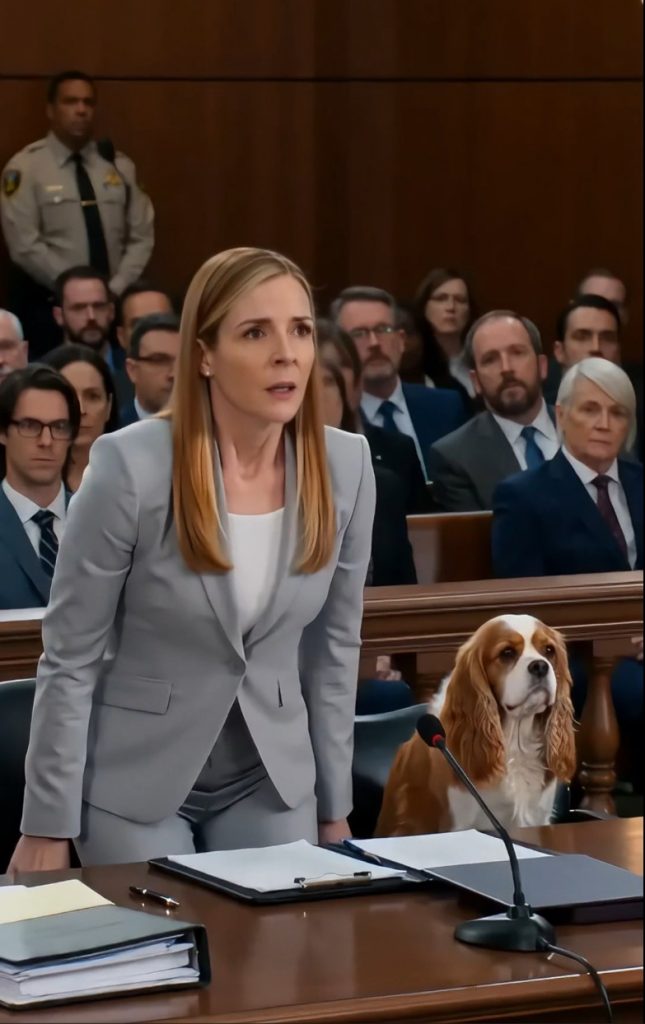
Every head turned as Evelyn Hart rose from the defense table. Her gray suit was pressed, her hair neatly brushed over one shoulder, her face pale but steady beneath the warm courtroom lights.
Beside her, sitting upright on a leather chair as if he understood the gravity of the room, was a small Cavalier King Charles Spaniel.
His name was Oliver.
He had soft chestnut ears, a white blaze down his face, and dark glossy eyes that followed Evelyn’s every movement. He did not bark. He did not tremble. He simply sat there, quiet and watchful, as if the entire courtroom had been waiting for him without knowing it.
The gallery murmured.
A woman accused of murder was strange enough.
A dog sitting beside her at counsel table was something else entirely.
Judge Mallory leaned forward from the bench, black robe falling heavily around his shoulders. “Mrs. Hart, this court has already heard your statement.”
Evelyn looked up at him.
“I understand, Your Honor.”
Her voice was clear.
Not loud.
Clear.
The prosecutor gave a sharp little smile from the opposite table. He had been waiting for her to crack all morning. Waiting for grief, panic, hysteria, anything he could turn into a closing argument.
But Evelyn did not crack.
She rested one hand lightly on Oliver’s back.
Then she said the sentence that stopped the courtroom cold.
“I am not guilty, and my dog will prove it.”
Someone in the gallery gasped.
The judge’s eyes widened. His mouth opened slightly, but for a moment, no words came out.
Oliver lifted his head.
He looked toward the witness box.
Then toward the prosecutor’s table.
Then, with slow certainty, he turned his gaze toward the third row of the public gallery, where a man in a navy suit suddenly stopped breathing normally.
Evelyn saw it.
So did her attorney.
And for the first time since the trial began, the real killer understood that the smallest witness in the room had never forgotten him.
Act II
Six months earlier, Evelyn Hart had been known for two things.
Her husband’s money.
And her dog.
Nathan Hart was a celebrated pharmaceutical executive, a man whose name appeared on hospital wings, charity gala banners, and the business pages of every major paper in the state. He was charming in public, generous with cameras nearby, and careful enough with words that even his enemies admired his discipline.
Evelyn had been his second wife.
That detail followed her everywhere.
At charity dinners, women smiled at her diamonds and whispered about the age gap. At board functions, men called her “Nathan’s lovely wife” in a tone that made her feel like furniture in a beautiful room. When she left her career as a pediatric therapist to care for Nathan after his heart condition worsened, people called her devoted.
After his death, they called her ambitious.
The night Nathan died, there had been a storm.
Evelyn remembered the rain hitting the windows of their house, the hallway lights flickering, Oliver pacing at the study door. Nathan had been working late with his private financial advisor, Daniel Cross, a smooth, handsome man with perfect cufflinks and eyes that rarely matched his smile.
Evelyn had disliked Daniel from the beginning.
Not because he was rude.
Because he was too polite.
He watched people the way accountants watched numbers, calculating weaknesses, locating leverage. He called Nathan “my friend” too often. He once handed Evelyn a glass of wine at a dinner party and said, “You must feel very lucky.”
She had set it down untouched.
Oliver had disliked him too.
That mattered to Evelyn.
Oliver was not just a pet. He had been trained after Nathan’s diagnosis as a medical alert dog, small enough to sit quietly in offices and boardrooms, sensitive enough to recognize changes in Nathan’s breathing, scent, and stress before people noticed them.
He woke Nathan during episodes.
He pawed at Evelyn when Nathan needed help.
He was gentle with everyone.
Everyone except Daniel Cross.
Whenever Daniel entered the house, Oliver went still.
No barking. No growling.
Just stillness.
The kind of stillness that made Evelyn look twice.
On the night of the storm, Nathan argued with Daniel in the study. Evelyn heard only pieces through the door.
Missing transfers.
Board review.
No more delays.
Then Daniel left.
Ten minutes later, Oliver began pawing frantically at the study door.
Evelyn opened it and found Nathan collapsed beside his desk.
She called 911. She performed CPR until the paramedics arrived. She answered every question. She handed over every medication bottle. She told the detectives Daniel had been there.
But Daniel had an alibi by morning.
Security cameras showed him leaving at 9:14 p.m. The medical examiner placed Nathan’s death later. The housekeeper claimed Evelyn and Nathan had argued earlier that day. A bottle of Nathan’s medication had Evelyn’s fingerprints on it, which meant nothing because she handled his medication every week.
Then came the will.
Nathan had changed it one month earlier.
Evelyn inherited more than anyone expected.
And grief became motive.
The headlines arrived before the indictment.
Socialite Wife Charged in Husband’s Death.
Widow Claims Innocence.
Medical Alert Dog Present During Death.
Present.
That was the word that haunted Evelyn.
Oliver had been present.
Oliver had seen Daniel.
Oliver had smelled whatever changed in that room before Nathan died.
But dogs could not testify.
At least, that was what the prosecutor kept saying.
Then Evelyn’s attorney, Mara Voss, found the old training file.
And everything changed.
Act III
Oliver had been trained with a scent archive.
That was what the prosecutor had dismissed as “pet-owner sentiment” until Mara Voss placed the certification documents on the defense table and asked the court for permission to demonstrate.
Medical alert training did not rely on magic.
It relied on scent, repetition, and recognition. Nathan’s trainers had used gauze samples, clothing, medication containers, and breath samples collected during medical events. Oliver could identify certain stress-related changes in Nathan’s body chemistry, but he was also trained to recognize Nathan’s medication scent and respond when something was wrong.
That was important.
Because Nathan had not died from forgetting his medicine.
He had died after taking a capsule that had been altered.
The prosecution said Evelyn had done it.
Mara said the evidence had been arranged.
For weeks, the trial had gone badly.
The prosecutor built a clean, cruel story. Evelyn wanted Nathan’s fortune. Evelyn controlled the medication. Evelyn was tired of being a caregiver. Evelyn found him quickly because she knew when he would collapse.
The jury listened.
Evelyn sat still through all of it.
Only Oliver seemed to sense each blow as it landed. Sometimes he would rest his chin on her knee. Sometimes he would stare across the courtroom at Daniel Cross, who sat in the third row every day as Nathan’s “grieving friend and advisor.”
Daniel never missed a session.
That, too, mattered.
Men who want justice attend trials.
Men who want to monitor damage attend every minute.
Mara discovered the first crack in Daniel’s alibi two nights before Evelyn’s statement.
The security camera outside the Hart estate showed Daniel leaving at 9:14 p.m. But the driveway camera did not show his car passing the gate until 9:41. For twenty-seven minutes, he had been somewhere on the property.
Daniel said he had taken a phone call in his car.
Cell records said otherwise.
Then Mara found the second crack.
Nathan’s study had a side door leading to the garden.
It did not have a camera.
But it did have a dog door.
Not for Oliver. For an old golden retriever Nathan owned years earlier. The flap had been sealed but never removed, hidden behind a decorative panel from inside the study.
When investigators searched the room again, they found scratches on the exterior panel.
Fresh ones.
Someone had opened the garden side after the first police search.
Someone had been looking for something.
Mara believed Daniel had returned through the garden door after pretending to leave. He had swapped the medication, waited long enough for Nathan to take it, then slipped out before Evelyn found him.
But belief was not proof.
Then Oliver gave them proof in the strangest way.
During a pretrial meeting at Mara’s office, she placed several sealed evidence bags on the table: Nathan’s medication bottle, Evelyn’s coat, Daniel’s business card, and a small leather glove found in the garden bed weeks after the death.
Oliver ignored everything.
Until he reached the glove.
He froze.
Then he pawed the floor twice and sat.
That was his trained alert.
Mara sent the glove for independent testing.
It contained trace residue from Nathan’s altered medication.
And inside the cuff, barely visible beneath the lining, was one reddish-brown hair.
Not human.
Dog hair.
Oliver’s hair.
The glove had touched Oliver that night.
Or Oliver had brushed against the person wearing it.
That still was not enough.
Not until Mara remembered the dog’s courtroom behavior.
Every day, Oliver watched Daniel.
Not the prosecutor.
Not the judge.
Daniel.
So Mara asked for one final demonstration.
The judge nearly denied it.
Then Evelyn stood and said, “I am not guilty, and my dog will prove it.”
Now the entire courtroom watched the little spaniel on the chair.
And Daniel Cross watched him too.
Sweat gathered at his temple.
Act IV
Mara walked to the center of the courtroom with the judge’s permission.
“This is not a trick,” she said. “This is not testimony from an animal. This is a trained behavioral response supported by physical evidence.”
The prosecutor stood. “Objection. This is theatrical.”
Judge Mallory’s eyes remained on Oliver. “Overruled for now. Proceed carefully, Ms. Voss.”
Mara nodded.
On the table were four identical sealed scent containers, prepared under supervision that morning. One held Evelyn’s glove. One held Nathan’s clean handkerchief. One held the leather glove found in the garden. One held an unrelated leather item from evidence storage.
Oliver was lifted down from the chair.
Evelyn did not move, though every part of her wanted to reach for him.
The courtroom seemed to hold its breath.
Oliver sniffed the first container.
Nothing.
The second.
Nothing.
The third.
He stopped.
His long ears fell forward as he lowered his head. His body went still. Then he pawed the floor twice and sat.
Exactly as trained.
A murmur broke through the gallery.
The prosecutor’s jaw tightened. “A dog sitting is not evidence of murder.”
“No,” Mara said. “But residue is. And so is the next exhibit.”
She turned toward Daniel Cross.
“Mr. Cross, would you please stand?”
Daniel gave a short laugh. “I’m not on the witness stand.”
“No,” Mara said. “But you are under subpoena for rebuttal.”
The judge looked sharply at Daniel. “Stand, Mr. Cross.”
Slowly, Daniel rose.
For the first time since the trial began, he looked less like a grieving friend and more like a man measuring exits.
Oliver turned toward him immediately.
Not barking.
Not lunging.
Just staring.
Mara held up a second leather glove in a clear evidence bag.
“This was recovered this morning from a storage unit rented under one of Mr. Cross’s shell companies.”
The courtroom erupted.
The judge struck his gavel once. “Order.”
Mara’s voice stayed steady.
“It matches the glove found in the Hart garden. Testing shows the same medication residue. Financial records also show Mr. Cross had been diverting funds from Nathan Hart’s foundation for eight months. Nathan discovered the transfers the night he died.”
Daniel’s face drained of color.
The prosecutor looked stunned, then angry, then afraid of what this meant for his case.
Mara placed the sealed glove near Oliver.
The dog sniffed.
Then pawed twice.
Sat.
And looked at Daniel.
Evelyn closed her eyes.
Not because it was over.
Because the truth had finally stood up in a language no one could bully.
Daniel tried one last escape.
“This is absurd,” he said. “She trained the dog to react to me.”
Evelyn spoke before Mara could stop her.
“No,” she said softly. “You trained him yourself.”
Daniel froze.
The whole room turned.
Evelyn’s eyes locked onto him. “You gave Oliver treats every time you came to the house because you wanted him to stop alerting around you. You wore gloves so he wouldn’t smell the chemicals from Nathan’s medication. You thought he was just a dog.”
Oliver’s gaze never left Daniel.
Evelyn’s voice broke for the first time.
“But he was Nathan’s dog. And Nathan trusted him more than he trusted you.”
Daniel’s mouth opened.
No answer came.
Then a woman in the back row stood.
Nathan’s former assistant, pale and shaking.
“I have emails,” she said. “Mr. Cross made me delete invoices. I was afraid to say anything. But I have copies.”
The judge leaned forward, shocked breath audible in the silent room.
And just like that, the case against Evelyn Hart began to collapse.
Act V
The jury never reached a verdict.
They did not need to.
By the end of that week, the state moved to dismiss the charges against Evelyn pending further investigation. The prosecutor did not meet her eyes when he made the motion.
Evelyn did not celebrate.
Wrongful accusation does not leave the body just because a judge says the words.
She sat at the defense table with one hand buried in Oliver’s fur and listened as the courtroom that had nearly condemned her rearranged itself around the truth.
Daniel Cross was taken into custody two days later.
The investigation into his accounts exposed a pattern far larger than Nathan’s death. Stolen foundation funds. Forged approvals. Hidden offshore transfers. A plan to frame Evelyn that depended on everyone believing the simplest story.
The young wife.
The fortune.
The medication.
The grief that looked too calm.
That was all he needed.
Almost.
He had not accounted for Oliver.
At a later hearing, Nathan’s assistant testified. So did the forensic accountant. So did the technician who recovered deleted files from Daniel’s laptop. The gloves became evidence. The residue became evidence. The security gap became evidence.
Oliver did not testify, of course.
People repeated that often, as if it made them feel smarter.
But everyone in that courtroom knew the truth.
Oliver had remembered what people missed.
He had remembered the scent of danger.
He had remembered the man who came back through the garden door.
He had remembered Nathan.
Months later, Evelyn returned to the Hart estate for the final time.
The house had grown unbearable after Nathan’s death. Too many rooms. Too many flowers sent by people who now felt guilty for believing the worst of her. Too many portraits of a life that had been admired from the outside and poisoned from within by a man Nathan had trusted.
Evelyn walked into the study with Oliver at her heels.
The room was clean now. Too clean. The desk polished. The shelves restored. The garden door repaired. No sign remained of the night everything changed, which somehow made it harder.
On Nathan’s desk sat a framed photograph.
Nathan smiling in the garden with Oliver in his lap, both of them looking slightly ridiculous and perfectly happy.
Evelyn picked it up.
For the first time in months, she allowed herself to remember her husband before the trial, before the cameras, before strangers debated whether she had loved him enough to be innocent.
Nathan had been flawed.
Proud.
Difficult.
Kind in quiet ways that never made speeches.
He had trusted the wrong man.
But he had trusted the right dog.
Oliver placed one paw against Evelyn’s shoe.
She looked down.
His eyes were softer now. Still watchful, but no longer carrying the same heavy tension. He had done what he had been trained to do. More than that, he had done what love had taught him to do.
Stay.
Notice.
Remember.
Evelyn knelt and wrapped her arms around him.
“Good boy,” she whispered.
Oliver leaned into her chest.
After the estate was sold, Evelyn moved into a smaller house near a park. No gates. No marble foyer. No rooms designed to impress people who never stayed long enough to know the truth.
She went back to work slowly, counseling children who had learned too early that adults could rewrite reality and call it protection. She never used her own story in sessions. She did not need to.
She understood what it meant to be unheard.
Oliver came with her sometimes, sitting quietly beside the couch, letting small hands stroke his ears when words became too hard.
The courtroom video still surfaced online now and then.
Evelyn hated watching it.
The gray suit. The tense face. The judge’s stunned expression. The little dog sitting beside her while the whole room decided whether innocence could arrive on four paws.
People called it dramatic.
Miraculous.
Unbelievable.
Evelyn knew better.
It had been none of those things.
It had been patience.
Training.
Evidence.
A woman refusing to confess to a lie.
And a dog who understood that the dead cannot speak, so the living must pay attention to what remains.
On the anniversary of Nathan’s death, Evelyn visited his grave with Oliver.
She placed white flowers near the stone and stood beneath a pale morning sky while Oliver sat at her feet.
For a long time, she said nothing.
Then she looked down at him and smiled sadly.
“You proved it,” she said.
Oliver looked up, ears lifting slightly in the breeze.
Behind them, the world moved on. Cars passed beyond the cemetery wall. Leaves shifted across the grass. Somewhere, a church bell rang the hour.
Evelyn touched Nathan’s name on the stone, then turned to leave.
Oliver walked beside her, small and steady, his shadow close to hers on the path.
In court, they had laughed at the idea that a dog could prove a woman innocent.
But the truth had never needed to bark.
It only needed one honest creature to remember what everyone else was willing to ignore.