Act I
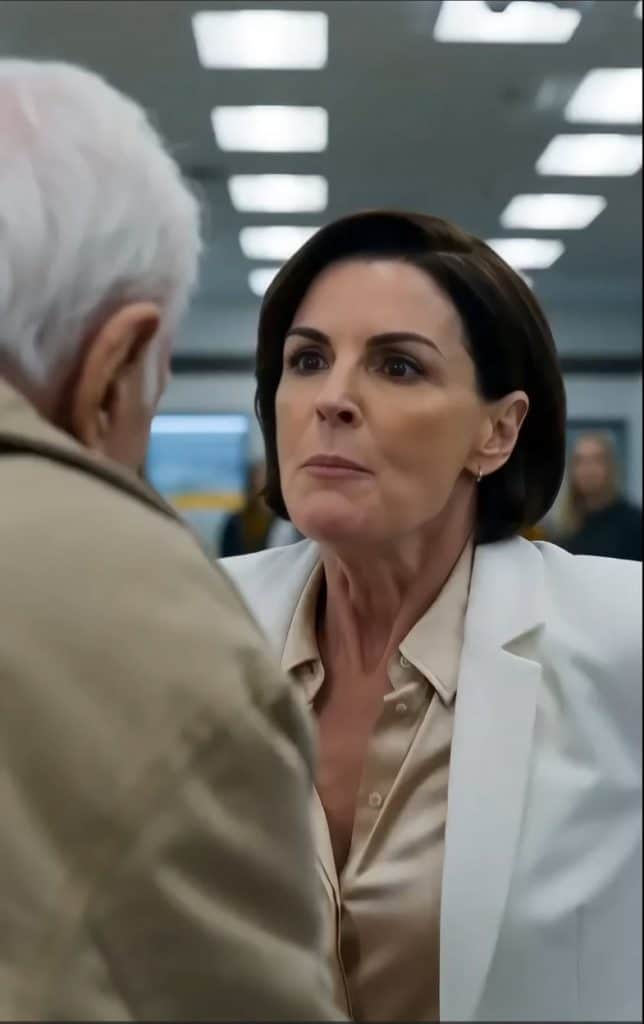
The woman in the white blazer did not wait for the old man to move.
She leaned into him first.
The supermarket deli was bright, cold, and ordinary in the way public places are ordinary before they become unforgettable. Fluorescent lights shone over glass cases filled with sliced meats and prepared food. Employees in white coats stood behind the counter. Shoppers paused with baskets in their hands, half-listening, half-pretending not to.
The elderly man stood near the display case in a worn tan jacket, his shoulders rounded, one hand resting lightly on the metal edge for balance.
He was not blocking the whole aisle.
He was simply slow.
That was enough for the woman.
“Move, old man!” she snapped. “You’re in everybody’s way!”
Several people turned.
The old man flinched, his pale face tightening with embarrassment. He tried to step aside, but his foot caught slightly against the base of the display case. His hand searched for balance.
The woman’s face twisted with impatience.
“Oh, for God’s sake.”
Her arm shot forward.
It was not a dramatic shove. Not the kind that looks violent from across a room. It was worse because it was casual, entitled, almost thoughtless.
Just enough force to make a frail man lose balance.
His shoulder struck the edge of the deli case. Metal scraped against the floor. Then he went down with a heavy, stunned sound that silenced the whole section.
A blonde woman nearby gasped and covered her mouth.
Behind the counter, one of the deli workers dropped a roll of paper. It bounced once and rolled beneath the glass case.
For a moment, nobody moved.
The old man lay partly against the counter, his tan jacket twisted beneath him, his white hair stark under the fluorescent lights. His breath came in a low groan.
The woman in the white blazer looked down at him.
Not horrified.
Annoyed.
“That’s what happens when people don’t watch where they’re going,” she muttered.
Then footsteps came fast from the aisle.
A man in a black jacket moved through the crowd with controlled urgency. He dropped beside the elderly man, one hand hovering near his shoulder, the other bracing the floor.
“Dad?”
The word changed the room.
The old man’s eyes fluttered.
“I’m alright, Michael,” he whispered, though he clearly was not.
Michael looked up slowly.
The woman in the white blazer took one step back.
His eyes were cold, furious, and terrifyingly steady.
“You have no idea who you just touched,” he said.
The woman’s lips parted.
And behind her, the supermarket manager went completely pale.
Act II
The old man’s name was Harold Bennett.
Most people in the store did not know that.
That was strange, because his name was on every receipt.
Bennett Family Market had started forty-two years earlier with one narrow butcher shop, a secondhand meat slicer, and Harold sleeping in the storeroom because he could not afford both rent and inventory.
He had built the business slowly.
One counter.
Then one store.
Then six.
Then twenty-two across the state.
But he never let the company become faceless. That was his rule. Every employee got paid training. Every store donated unsold food before closing. Every manager knew that elderly customers, disabled customers, tired parents, and confused shoppers were not obstacles to profit.
They were the reason the doors opened.
Harold used to stand behind the deli counter himself and say, “A store tells you who it is by how it treats the slowest person in line.”
His son Michael had grown up hearing that sentence.
He had also grown up watching people take advantage of Harold’s decency.
Board members wanted faster expansion. Investors wanted fewer staff. Consultants wanted self-checkout lines, smaller benefits, shorter breaks, cheaper ingredients, and polite phrases for ugly decisions.
Harold resisted for as long as he could.
Then his health began failing.
After a mild stroke, he stepped down publicly and let Michael run daily operations. But Harold still visited stores quietly. He would arrive without announcement, buy soup, talk to employees, inspect restrooms, watch how customers were treated when no one important was supposed to be watching.
He called it “walking the truth.”
Michael called it risky.
“You’re not twenty-five anymore,” he told him.
Harold always smiled.
“No. That’s why people show me who they are.”
The woman in the white blazer was named Patricia Vale.
She had married into wealth, positioned herself on charity boards, and recently joined the company’s advisory committee through her brother, a private equity partner trying to purchase Bennett Family Market.
Patricia did not think of herself as cruel.
Cruel people rarely do.
She thought of herself as efficient.
Clean.
Selective.
She disliked disorder, slowness, coupons, food stamps, crying children, elderly people counting change, and anyone who made public spaces feel less polished. To her, the grocery chain was not a community institution.
It was an asset.
She had toured three stores that week and sent notes afterward.
Too many non-purchasing elderly lingerers.
Deli line inefficient due to over-accommodation.
Staff overly familiar with lower-value customers.
Michael had read the memo at midnight and nearly thrown his laptop across the room.
Harold asked to visit the flagship store the next morning.
Michael said no.
Harold went anyway.
He wore his oldest jacket because he was stubborn, and because he had a theory.
“If a person needs to see my suit before showing respect,” Harold said, “then I have learned what I came to learn.”
Michael followed him from a distance.
He was still two aisles away when Patricia shoved his father to the floor.
And the whole company’s future changed beside the deli case.
Act III
Patricia tried to recover quickly.
People like her always did.
She straightened her white blazer, lifted her chin, and forced her face back into its polished shape.
“I didn’t touch him,” she said.
The blonde woman nearby turned sharply.
“Yes, you did.”
Patricia glared at her.
“I beg your pardon?”
The blonde woman’s voice shook, but she did not look away. “You shoved him.”
A deli employee stepped out from behind the counter.
“I saw it too.”
Then another voice came from the crowd.
“So did I.”
Michael helped Harold sit upright carefully. The old man waved off the panic with one trembling hand, but his face was pale and damp with pain.
“Call an ambulance,” Michael said.
The manager rushed forward.
“Mr. Bennett, I’m so sorry. I didn’t realize—”
Harold looked up.
The manager stopped speaking.
Because the apology had already failed.
It had begun with the name.
Mr. Bennett.
Not sir.
Not are you hurt?
Not we’re here.
Only the sudden terror of realizing the fallen man had power.
Patricia heard it too.
Her eyes moved from Harold to Michael.
“Bennett?” she whispered.
Michael stood.
“Yes.”
The color drained from her face.
Harold slowly reached for the edge of the counter, but Michael steadied him.
The old man’s voice was quiet.
“Don’t help me stand just yet.”
Michael looked down.
Harold’s eyes were fixed on Patricia.
“I want to hear what she says when she understands.”
The silence that followed was brutal.
Patricia’s mouth opened, then closed.
Her arrogance had not vanished because she felt remorse. It had vanished because consequences had entered the aisle.
“I didn’t know who he was,” she said.
Michael’s expression hardened.
“That is not a defense.”
Patricia looked around, searching for someone powerful enough to rescue her from the room’s judgment. She found only shoppers, employees, and one elderly man on the floor who had spent his life building the place she wanted to gut.
Then Harold spoke again.
“You thought I was nobody.”
Patricia swallowed.
“I was startled. He was blocking—”
“I was choosing soup.”
No one laughed.
The words were too sad.
An ambulance siren sounded faintly in the distance.
Michael turned to the manager.
“Where is the security footage?”
The manager stiffened.
“Office system. Camera three should cover this counter.”
“Lock it.”
Patricia’s eyes widened.
“That’s unnecessary.”
Michael looked at her.
“My father was pushed to the floor in his own store. Everything after that is necessary.”
Behind the counter, one of the younger employees began crying quietly.
Harold noticed.
Even from the floor.
“What’s your name?” he asked.
The employee wiped her face with her sleeve.
“Lena.”
“Lena,” Harold said gently, “did anyone tell staff to ignore complaints during today’s visit?”
The manager closed his eyes.
Patricia went still.
And Michael understood this was not one ugly moment.
It was a symptom.
Act IV
The ambulance arrived through the automatic doors with two paramedics and a stretcher.
Harold tried to argue, of course.
“I don’t need all this fuss.”
Michael leaned close.
“You fell next to a metal deli case. You’re getting checked.”
Harold sighed.
“You sound like your mother.”
“Good.”
That nearly made the old man smile.
As the paramedics examined him, Michael took statements.
Not officially. Not dramatically. He simply listened.
The deli workers spoke first.
Patricia had entered the store earlier that morning with two regional staff members and a clipboard. She had criticized the counter layout, complained about seniors asking too many questions, and told the manager that “soft service culture” was dragging down store value.
One employee said Patricia had pointed at Harold before the shove and muttered, “This is exactly what I mean.”
The manager did not deny it.
He looked sick.
“I thought she was part of the acquisition team,” he said. “I didn’t want trouble.”
Michael stared at him.
“So you let her create it.”
The manager lowered his eyes.
Patricia heard enough.
“This is absurd,” she snapped. “You’re all acting like I attacked him. He fell.”
The blonde woman stepped forward again.
Her name was Elise Turner. She was a nurse on her lunch break, still wearing her hospital badge under her coat.
“He fell because you put your hands on him,” she said.
Patricia’s face tightened.
“You people are exaggerating.”
Harold, now seated on the stretcher, looked at her for a long moment.
Then he asked, “Which people?”
The question landed hard.
Patricia’s lips pressed together.
Michael took a slow breath.
“I want her removed from the property.”
Patricia’s head snapped toward him.
“You can’t do that.”
“I can.”
“My brother is negotiating with your board.”
“Not anymore.”
That was the first true crack.
Patricia looked less like a woman embarrassed in public and more like someone watching a building collapse around her.
Michael pulled out his phone and called the board chair on speaker.
No theatrics.
No shouting.
Just one sentence.
“The acquisition talks are over. I’ll send the footage.”
Patricia lunged verbally then, the way people do when power slips.
“You’re making a mistake,” she hissed. “Your father’s little family-market fantasy is outdated. These stores are bleeding money because he insists on running them like charity kitchens.”
Harold’s face changed.
Not anger.
Disappointment.
That was worse.
Michael’s voice went flat.
“You pushed an old man because he slowed down your day. You don’t get to lecture us on value.”
The store had gone silent all the way to the produce section.
Customers stood at the ends of aisles. Cashiers leaned from their stations. Deli workers stood shoulder to shoulder behind the glass.
Everyone listening.
Harold looked at them.
Then at his son.
“Michael.”
His voice was weak but steady.
“Don’t just cancel the sale.”
Michael crouched beside him.
“What do you want?”
Harold’s eyes moved to the workers.
“Ask them what we stopped noticing.”
Act V
The video went public before midnight.
Not because Michael leaked it.
Because someone in the deli line had recorded the aftermath, including Patricia’s words, Harold on the floor, and the moment everyone learned who he was.
By morning, the internet had turned Patricia Vale into a symbol.
But Harold hated that part.
“People love a villain they can point at,” he told Michael from his hospital bed. “It keeps them from asking where they were standing when she did it.”
The doctors said Harold was bruised and shaken, but nothing was broken.
Michael suspected otherwise.
Something had broken.
Not bone.
Trust.
For two weeks, he visited every Bennett Market location with no cameras and no executives announced in advance. He spoke to cashiers, deli workers, stock clerks, janitors, drivers, and department managers.
He asked one question.
“What have we stopped noticing?”
The answers filled three notebooks.
Breaks skipped because schedules were too thin.
Elderly regulars rushed because lines were monitored.
Employees afraid to help confused customers because speed metrics mattered more than service.
Managers pressured by acquisition rumors.
Customers treated differently depending on how expensive they looked.
By the third notebook, Michael understood his father had been right.
Patricia did not create the rot.
She exposed it.
The company changed slowly, then publicly.
The acquisition was canceled. The advisory committee was dissolved. Store managers were retrained. Staffing was increased at deli and pharmacy counters. A customer care policy was created specifically for elderly and disabled shoppers, with actual labor hours attached instead of motivational posters.
Michael named it the Bennett Standard.
Harold objected.
“Sounds pompous.”
Michael smiled.
“You built it.”
“No,” Harold said. “The employees did. I just listened when I was smart enough.”
Patricia issued a public apology drafted by someone expensive.
It was smooth.
Regretful.
Empty.
Harold did not respond.
Elise Turner, the nurse who spoke up, received a handwritten note from him and a year of free groceries, which she tried to refuse and failed. Lena, the crying deli worker, was promoted after Michael learned she had been keeping a private list of customer complaints management ignored.
As for the store manager, he was not fired immediately.
Harold insisted on speaking to him first.
“You froze,” Harold said.
The manager’s eyes filled.
“Yes, sir.”
“You were afraid of the wrong person.”
“Yes, sir.”
“Don’t do it again.”
He did not.
Months later, Harold returned to the same deli counter.
This time, he wore the same tan jacket.
Michael hated that jacket by then.
Harold refused to throw it away.
The employees saw him enter and stiffened at first, then relaxed when he lifted both hands.
“No inspection,” he said. “I came for soup.”
Lena laughed from behind the counter.
“Chicken noodle?”
“Always.”
An elderly woman stood ahead of him, counting change slowly from a small coin purse. The line behind her waited.
No sighs.
No mutters.
No one rushed her.
When she came up short, the cashier quietly said, “You’re covered today.”
Harold looked toward Michael.
Michael pretended not to see his father’s eyes shine.
Near the deli case, a small plaque had been installed on the wall.
A store tells you who it is by how it treats the slowest person in line.
Some customers walked past without reading it.
Some paused.
A few took photos.
Harold simply touched the edge of the plaque once, then stepped aside for the next customer.
The supermarket remained bright, cold, and ordinary.
That was the point.
Kindness did not need violins.
Dignity did not need chandeliers.
Most tests of character happened under fluorescent lights, beside deli counters, in the small impatient moments where one human being decided whether another was in the way.
Patricia had looked at Harold Bennett and seen an obstacle.
The store had learned to see him as a warning.
But Harold hoped they would see something more useful.
A reminder.
That nobody becomes worthless because they move slowly.
That power is not proven by how loudly you can humiliate someone.
And that sometimes the person you shove aside is the very person who built the ground you are standing on.