Act I
The coffee cup exploded against the mahogany table.
White ceramic shattered across the polished wood, sharp pieces skidding between legal folders, tablets, and trembling hands. Dark coffee splashed outward in a violent arc, spreading across the glossy surface like a stain the room could no longer hide.
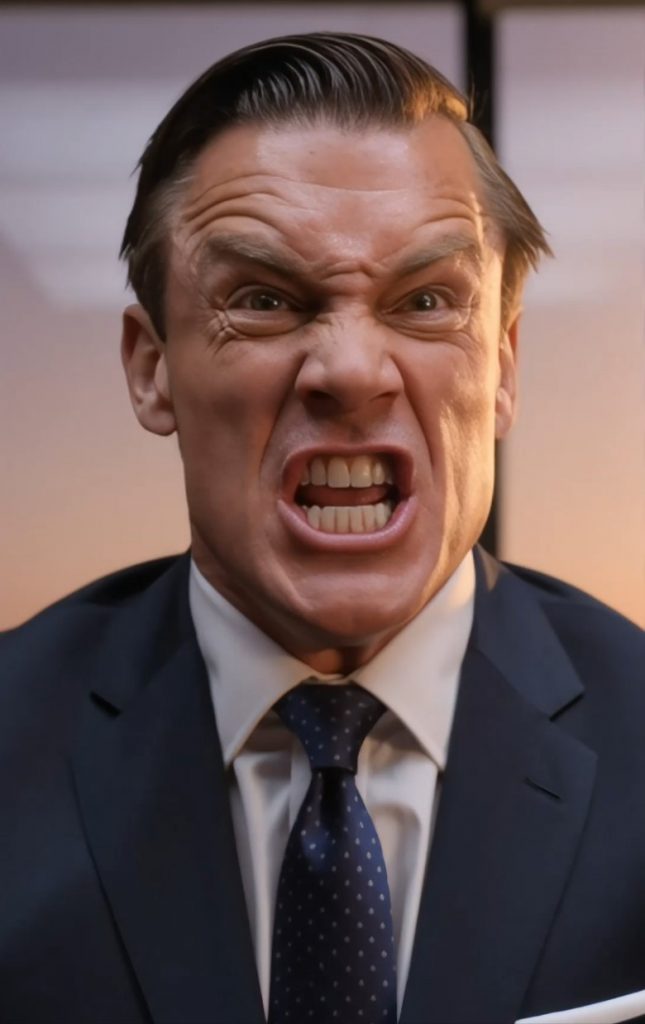
At the head of the conference table, Richard Vale was breathing like he had just finished a fight.
His navy suit was perfect. His tie was silk. His hair was slicked back without a strand out of place.
But his face ruined the image.
Red. Sweating. Twisted with rage.
“You’re fired!” he screamed. “Get out!”
The executives seated down the table did not move.
They had seen Richard humiliate assistants, crush managers, make interns cry in glass hallways, and fire people with a smile during holiday weeks. But this was different.
This time, his target was the janitor.
The man stood beside a cleaning cart near the far wall, wearing a gray short-sleeved work shirt with a red name patch that read DAVID. He was older, maybe late fifties, with weathered skin, cropped gray-brown hair, and a quiet, steady face that seemed carved from years of hard work and patience.
He did not flinch when the cup shattered.
He did not step back.
He only looked at the broken porcelain, then at the coffee spreading across the table, and finally back at Richard.
That calm made Richard angrier.
“Did you not hear me?” Richard roared, pointing toward the door. “Get out of my building now!”
One executive lowered her eyes.
Another shifted uncomfortably in his chair.
The city outside the floor-to-ceiling windows glowed orange and purple under the sunset. Forty-seven floors below, traffic crawled through the streets like nothing extraordinary was happening above it.
Inside the boardroom, nobody dared breathe too loudly.
David tilted his head slightly.
A faint smirk touched one corner of his mouth.
Not mocking.
Not frightened.
Knowing.
Richard saw it and stepped around the table, his shoes crunching close to a porcelain shard.
“You think this is funny?”
David’s eyes stayed calm.
“No,” he said softly. “I think it’s overdue.”
The room changed.
Richard blinked.
The executives looked up.
David reached into the pocket of his gray work shirt and pulled out a small black access card.
It was not a janitor’s badge.
It was a master keycard.
And printed beneath the company logo were three words that made Richard Vale stop breathing.
Chairman Emeritus Access.
Act II
Before the skyscraper bore Richard Vale’s name on the lobby directory, it belonged to another man.
David Mercer.
Thirty-one years earlier, David had started Mercer Global Logistics with two trucks, one warehouse lease, and a folding table he used as a desk. He built the company before it had investors, before it had glass elevators, before executives started saying words like “optimization” and “human capital” because saying “people” made layoffs harder to swallow.
David was not soft.
Nobody who built a company from debt and sleep deprivation could afford to be soft.
But he had rules.
Drivers were paid for every hour they worked. Warehouse staff got health insurance before the first executive bonus was ever approved. No manager was allowed to scream at employees, not because David cared about politeness, but because he believed fear made people stupid and stupid people made dangerous decisions.
For twenty years, that worked.
Mercer Global grew. The trucks multiplied. The warehouses spread across the country. The boardroom moved from a rented office above a tire shop into a skyscraper with a skyline view.
Then David’s wife got sick.
Cancer has a way of shrinking empires to hospital rooms.
David stepped back. First for six months. Then a year. Then permanently, or so everyone thought. His wife died quietly one October morning, and the man who had once shaken hands with senators stopped answering invitations.
The board appointed a new CEO.
Richard Vale.
At first, Richard seemed like the perfect successor. Polished. Educated. Relentlessly ambitious. He spoke beautifully to investors and ruthlessly to anyone without power. Profits rose. Stockholders applauded. The board called him efficient.
The employees called him something else.
Not in emails.
Not where anyone could trace it.
But in break rooms, loading docks, elevator corners, and late-night texts, Richard Vale became the man who made the building colder.
He cut veteran drivers right before pension milestones.
He outsourced safety inspections.
He denied injury claims.
He forced department heads to sign nondisclosure agreements after “internal restructuring incidents.”
Worst of all, he created a culture where humiliation flowed downward like spilled coffee.
David heard rumors.
At first, he ignored them.
That was his mistake.
Grief had made him tired. Age had made other people assume he was finished. Richard sent quarterly reports full of polished numbers and charitable language. The board saw growth.
David saw only what they handed him.
Then came the letter.
No return address.
No signature.
Just a single sheet of paper mailed to the old farmhouse where David had lived since his wife’s death.
Mr. Mercer,
You built this company to feed families. He is using it to break them.
Come see what happens when they think you are nobody.
Inside the envelope was a gray janitor’s shirt.
Name patch already sewn on.
DAVID.
For the first time in years, David felt something sharper than grief.
He came back not through the executive entrance, not with lawyers, not with press.
He came through the service elevator at dawn with a cleaning cart and a fake contractor assignment.
For three weeks, he cleaned his own building.
And what he saw made him wish he had returned sooner.
Act III
The boardroom confrontation had not been an accident.
Richard did not know that.
He believed David had interrupted the meeting by mistake. A careless old janitor rolling a cart too close to a confidential executive session. A disposable employee entering a room where men like Richard decided which other people’s lives could be trimmed.
The truth was uglier.
David had been invited in by the CFO.
Her name was Elaine Porter, and she had worked for Mercer Global since the folding-table days. She had watched Richard’s rise with the frozen smile of a woman collecting evidence in silence.
For months, Elaine had been building a file.
Fraudulent safety reports.
Illegal retaliation.
Executive bonuses tied to denied worker claims.
A hidden fund used to pay off harassment complaints.
And one more thing.
Richard had been preparing to force a buyout of David’s remaining founder shares by arguing that the old man was mentally unfit to remain involved.
He had even drafted the statement.
The founder is no longer capable of understanding the company’s modern obligations.
David had read it while wearing rubber gloves in the executive washroom.
That almost made him laugh.
Now, in the boardroom, Richard stared at the access card in David’s hand.
“What is this?” he demanded.
David slid it across the table.
The card stopped beside the broken coffee cup.
Elaine stood slowly from her seat.
Her voice was quiet but clear.
“It’s real, Richard.”
Richard turned toward her.
“What did you do?”
Elaine did not blink.
“What you should have been afraid of from the beginning. I called the man who owns more of this company than you ever will.”
The executives shifted as if the chairs had become traps.
Richard looked back at David.
For the first time, his anger had to share space with fear.
David took one step closer to the table. His cleaning cart remained behind him, spray bottles and cloths lined up neatly under the sunset glow.
“I spent three weeks in this building,” David said. “I cleaned conference rooms after layoffs. I emptied trash cans full of shredded complaints. I watched a security guard help an injured warehouse clerk limp out the side entrance because your managers didn’t want investors seeing an ambulance.”
Richard’s face hardened.
“You have no proof.”
David looked at the coffee spreading over the wood.
“No?”
Elaine opened the dark folder in front of her.
Inside were printed emails, signed affidavits, security stills, audit reports, and transcripts. She placed the first stack onto the table, carefully avoiding the coffee.
Then another.
Then another.
The pile grew.
Richard’s mouth tightened.
David’s voice remained calm.
“You told a driver named Marcus Hill that if he reported brake failures, he’d never work in logistics again.”
One executive looked down.
“You fired a payroll supervisor after she refused to alter overtime records.”
Another executive closed his eyes.
“You cut medical coverage for thirty-two injured employees while approving your own retention bonus.”
Richard slammed his palm on the table.
“This is a setup.”
David nodded once.
“Yes.”
The room froze.
David’s smirk returned, faint and devastating.
“But not by me.”
He looked toward the glass wall beside the door.
On the other side stood three people Richard had not noticed.
A federal investigator.
The company’s outside counsel.
And Marcus Hill, the driver Richard thought had been too afraid to speak.
Act IV
Richard tried to stand taller.
Men like him often do that when the floor begins to vanish.
“This meeting is adjourned,” he said.
“No,” Elaine replied. “It isn’t.”
“I am the CEO.”
David finally stepped to the head of the table.
He did not raise his voice.
He did not need to.
“You were.”
The silence after that word was so complete that everyone heard a drop of coffee fall from the edge of the table onto the carpet.
Richard laughed once, sharp and desperate.
“You can’t remove me in a boardroom stunt.”
David looked at the directors.
“Vote.”
No one moved.
Richard turned on them.
“Don’t be ridiculous. You all approved the restructuring.”
Elaine’s face went pale.
One of the older board members whispered, “We approved budget targets. Not crimes.”
Richard pointed at him.
“You knew enough.”
That was the moment he made it worse.
The investigator by the door wrote something down.
David watched Richard realize what he had said.
A confession does not always sound like guilt.
Sometimes it sounds like accusation.
One by one, the board members voted.
Suspension pending investigation.
Immediate removal from operational authority.
Restricted access.
Full forensic audit.
With each raised hand, Richard’s face lost another layer of certainty.
When Elaine raised hers last, he stared at her like betrayal was something only others were capable of committing.
“You owe your career to me,” he said.
Elaine’s voice trembled for the first time.
“No. I owe my silence to fear. I’m done paying it.”
The door opened.
Security entered, but not for David.
Richard looked at the guards as if they were props that had forgotten their script.
“You can’t be serious.”
David reached down and picked up one shard of the broken cup from the table. He held it carefully between two fingers.
“My wife used to say a man tells you who he is by how he treats people who can’t help him.”
He placed the shard back onto the table.
“I should have come back before you taught my company to fear its own shadow.”
Richard’s eyes flashed.
“Your company?” he spat. “This place was dying when I took over. I made it valuable.”
David looked around the room.
At the executives who had stayed quiet too long.
At Elaine, who had finally stopped.
At the investigators waiting.
At the sunset burning behind the glass.
Then his eyes returned to Richard.
“No,” David said. “You made it profitable. There’s a difference.”
The guards stepped closer.
Richard’s hands curled into fists.
For one terrible second, it looked as if he might lunge.
But power had already left him.
All he could do was straighten his tie with shaking fingers and walk out past the cleaning cart.
As he reached the door, David spoke one last time.
“Leave the badge.”
Richard stopped.
The access badge clipped to his jacket gleamed under the boardroom lights.
Slowly, with every person in the room watching, he removed it and dropped it on the table.
It landed beside the broken cup.
Act V
The story reached the employees before it reached the press.
That mattered more to David.
By midnight, warehouse workers were texting one another that Richard was gone. By morning, drivers were posting photos of coffee-stained boardroom tables and asking whether it was true that the old janitor was actually Mercer.
The company released a formal statement.
Employees wrote a better one.
He came back with a mop and took out the trash.
David hated the joke.
Secretly, he also loved it.
The weeks that followed were brutal.
Not glamorous.
Not cinematic.
Real repair rarely is.
There were audits, lawsuits, settlement negotiations, angry investors, regulatory interviews, and department heads suddenly claiming they had always been uncomfortable with Richard’s leadership. David listened to each of them with the same expression he had worn in the janitor’s shirt.
Calm.
Unimpressed.
Some were fired.
Some cooperated.
Some cried.
He did not enjoy any of it.
That surprised people.
They expected revenge to look satisfying on him. It did not. Revenge was too small for what had been broken.
Accountability was heavier.
Marcus Hill returned to the building three weeks later with a cane and a folder of medical records. David met him in the lobby, not upstairs.
“I should have known,” David said.
Marcus looked at him for a long moment.
“Yes,” he said.
No forgiveness offered.
None demanded.
David nodded.
“You’re right.”
That answer did more than any polished apology could have.
The company created a worker protection office with direct board oversight. Elaine became interim CEO. Safety claims were reopened. Retaliation settlements were reviewed. The executive bonus pool was frozen and redirected into medical and pension restitution.
Investors complained.
David let them.
One director warned him that the stock might fall.
David looked out the window at the trucks moving below.
“If the price of honesty is a bad quarter,” he said, “we can survive one honest bad quarter.”
Six months later, the boardroom table was replaced.
Elaine argued it was unnecessary.
David insisted.
Not because the old one was damaged.
Because everyone kept looking at the spot where the cup had shattered.
On the day the new table arrived, David walked into the boardroom wearing a suit for the first time since his return. Dark gray. Plain tie. No pocket square. He still looked more like himself in the janitor’s shirt.
The red name patch had been framed and placed on a shelf in the room.
DAVID.
Not as a joke.
As a warning.
At the first meeting after the restructuring, a young assistant entered nervously with coffee. Her hands shook slightly as she placed cups before the directors.
David noticed.
So did Elaine.
The assistant nearly dropped one cup near David’s hand.
“I’m sorry,” she whispered.
The room tensed out of old habit.
David picked up the cup before it could tip.
Then he smiled gently.
“It’s just coffee.”
The assistant blinked, surprised.
He looked around the table.
“Let’s make sure everyone remembers that.”
No one missed the meaning.
Months passed.
The company did not become perfect. No company does. There were still arguments, budget fights, bad managers, exhaustion, human mistakes wrapped in corporate language.
But something had shifted.
People spoke sooner.
Managers listened faster.
The building felt less like a machine and more like a place where people might survive a bad day without being destroyed by it.
On the anniversary of Richard’s removal, David came to the skyscraper before dawn.
Not through the executive entrance.
Through the service elevator.
He wore the gray janitor’s shirt again.
The night cleaning crew stared when they saw him.
One woman laughed softly and shook her head.
“You lost, Mr. Mercer?”
David picked up a cloth from the cart.
“No,” he said. “Just checking what we still miss from up there.”
He spent two hours with them.
Not performing humility for cameras.
There were no cameras.
He cleaned glass doors, pushed carts, listened to complaints about broken supply closets and inconsistent overtime approvals. He wrote everything down.
At sunrise, he rode up to the boardroom alone.
The city outside was just beginning to glow. No orange and purple drama this time. Only pale gold light spreading over rooftops, bridges, warehouses, streets, and trucks already moving.
David stood at the head of the table.
For a moment, he could still see Richard there, red-faced and screaming.
You’re fired. Get out.
He could still hear the cup shatter.
But the room no longer belonged to that sound.
It belonged to what came after.
The silence when fear ended.
The vote.
The badge hitting the table.
The first apology that did not ask to be forgiven.
David touched the framed name patch on the shelf.
His wife’s voice came back to him then, soft and amused.
A man tells you who he is by how he treats people who can’t help him.
He looked down at the city.
Then at the cleaning cart reflected faintly in the boardroom glass behind him.
The truth was, the cart had helped him more than any executive title ever had.
It had shown him the company from the height most people were forced to live at.
Eye level with spills.
With stains.
With the mess powerful men left behind for someone else to clean.
David smiled faintly.
This time, there was no secret in it.
Only a promise.
No one in his building would ever again be invisible just because their name was stitched on a work shirt instead of engraved on a door.