Act I
The first thing Stacy heard was the sound of heels.
Sharp. Measured. Expensive.
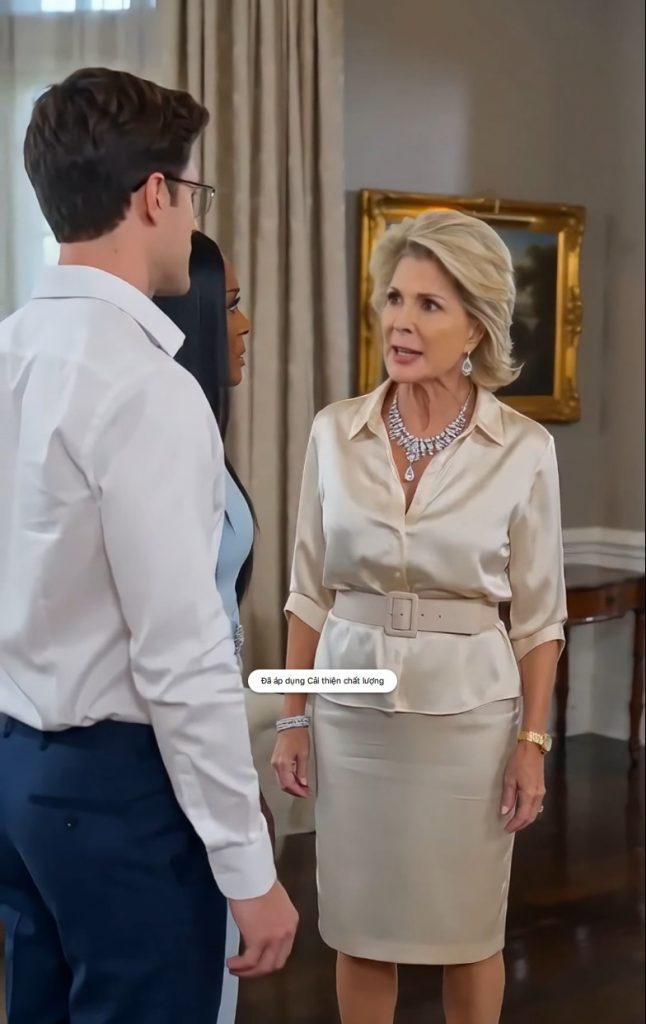
They struck the polished hardwood floor like a warning, echoing beneath the high ceiling of the Whitmore estate as sunlight poured through the beige curtains and turned the room golden.
Stacy stood beside Daniel in a pale blue dress she had chosen after three nervous changes that morning. She had wanted to look elegant, respectful, worthy of the woman who had raised the man she loved.
Then Evelyn Whitmore walked in.
She did not smile.
Her eyes moved from Stacy’s hair to her dress, from her hands to her shoes, and settled there with the slow cruelty of someone deciding how low another person belonged.
A diamond necklace glittered at her throat. Her cream silk blouse looked untouched by real life. Even the tilt of her chin seemed inherited from generations of people who had never been told no.
Then she laughed once.
Not warmly.
Not accidentally.
“I thought I was meeting your fiancée today,” Evelyn said, her voice slicing through the room, “not the maid.”
For one second, no one moved.
The insult hung between the gold-framed paintings and the cream sofa, uglier than anything that belonged in that beautiful house.
Stacy felt the words land before she fully understood them. Her breath caught. Her face stayed still because she had learned, long ago, that dignity was sometimes the only thing people could not take from you.
But her eyes betrayed her.
Daniel felt her body stiffen beside him.
He had warned Stacy that his mother could be cold. He had told her Evelyn cared too much about old names, old money, and old rules no decent person should still worship.
But he had not expected this.
Not before hello.
Not before Stacy had even spoken.
Daniel’s arm tightened gently around her waist. Then he turned toward his mother.
“Her name is Stacy,” he said, calm enough to make the room quieter. “And she is my fiancée.”
Evelyn’s face changed.
The polished smile cracked first. Then her eyes widened, as if Daniel had admitted to burning down the estate instead of choosing a woman to marry.
“What?” she gasped. “Oh, please tell me you’re joking.”
Stacy looked down.
Daniel did not.
For years, he had watched Evelyn destroy people with perfect posture. Servants. Assistants. Relatives without enough money. Women who entered rooms too confidently. Men who failed to flatter her quickly enough.
But this was different.
This was Stacy.
And Daniel had not brought her there only to be introduced.
He had brought her there because he was done letting his mother hide behind silk, diamonds, and lies.
“I’m not joking,” Daniel said.
Then he reached into his pocket.
Evelyn’s gaze dropped to his hand as he pulled out a small white card, folded once down the center.
Stacy looked at it too, confused.
Daniel held it out.
“And before you say another word,” he said, “look at these DNA test results.”
The room froze.
Evelyn’s face went pale beneath her makeup.
Because before Stacy understood what the paper meant, Evelyn already did.
And that was when Stacy realized this meeting had never been about an engagement.
Act II
Three months earlier, Stacy Brooks had almost refused Daniel’s proposal.
Not because she did not love him.
She loved him in the quiet ways that mattered. In the way she remembered how he took his coffee when he was too tired to ask. In the way he never made her explain why certain jokes hurt. In the way he listened when she spoke about things most people only pretended to hear.
But love did not erase fear.
Especially not the kind of fear that came from growing up with people constantly reminding you where you did and did not belong.
Stacy had been raised by her grandmother in a small brick house on the edge of Baltimore. There were no chandeliers, no grand staircases, no portraits of dead ancestors staring down from gilded frames.
There was one hallway lined with photographs. One kitchen table with scratches from old homework and birthday cakes. One woman who worked double shifts and still found time to braid Stacy’s hair before school.
Her grandmother, Ruth Brooks, had never been rich.
But she had been proud.
“You don’t bow your head just because someone else was born standing on a higher floor,” Ruth used to say.
Stacy carried those words with her.
Through scholarship interviews where people looked surprised by her test scores. Through college rooms where classmates assumed she was there on charity. Through charity galas where donors praised her ambition with the same tone they used for rescue animals.
By the time she met Daniel Whitmore, Stacy had built a life from discipline and restraint.
She worked in nonprofit legal advocacy, helping families untangle housing fraud and inheritance disputes. She wore clean lines, spoke carefully, and kept her private pain behind a locked door.
Daniel found her at a public records office on a rainy Thursday.
He was there searching for documents tied to one of the Whitmore Foundation’s old land donations. Stacy was there helping a widow prove her home had been taken through a forged signature.
Daniel noticed her arguing with a clerk twice her age without raising her voice once.
She noticed him because he was the only man in a tailored coat who stepped aside when an elderly woman needed a chair.
Their first conversation lasted seven minutes.
Their second lasted two hours.
By the third, Daniel had stopped pretending he only wanted her opinion on paperwork.
But Daniel came with a name.
Whitmore.
Old buildings carried that name. Hospital wings. Museum plaques. Scholarship funds. The kind of name that opened doors before he touched the handle.
Stacy knew what names like that did to women like her.
They welcomed you in public, then questioned you in private.
Daniel swore he was not like them.
Stacy believed him.
But Evelyn was different.
Evelyn Whitmore had married into the family twenty-eight years earlier, when Daniel was seven. His birth mother had died young, and Evelyn arrived wrapped in beauty, ambition, and sympathy.
Society loved her.
She became the perfect second wife. The perfect hostess. The perfect stepmother in photographs.
But Daniel remembered the truth behind the photographs.
Evelyn had never hit him. Never shouted where others could hear. She was too controlled for that.
Her cruelty was quieter.
She corrected his grief. She replaced his mother’s portraits. She told him tears made men weak, then praised him in public for becoming “so wonderfully composed.”
By the time Daniel was grown, he had learned that Evelyn’s love was always attached to performance.
Smile correctly.
Date correctly.
Marry correctly.
Protect the family image.
For years, he played along just enough to survive her.
Then he met Stacy.
And for the first time, Daniel did not want to survive Evelyn.
He wanted to confront her.
Still, Stacy begged him not to turn their engagement into a war.
“She’s your mother,” Stacy said the night before the visit.
Daniel looked at her for a long moment.
“No,” he said softly. “She’s the woman who raised me.”
Stacy did not understand the difference then.
She would soon.
Because Daniel had been keeping something from her too.
Not a betrayal.
A truth he was terrified would break her heart.
It had started with Stacy’s locket.
A small oval thing on a thin gold chain, worn smooth at the edges. Inside was half of a photograph: a young woman’s hand holding a newborn wrapped in a white hospital blanket.
No face.
No name.
Only a date written on the back.
Daniel had seen that date once before.
In a sealed Whitmore family file Evelyn had tried to destroy.
At first, he told himself it was coincidence.
Then he saw the birthmark on Stacy’s left wrist, shaped like a small crescent moon.
And suddenly, memories he had buried began crawling back into the light.
A locked nursery in the east wing.
A housekeeper dismissed without reference.
A summer when Evelyn disappeared for six weeks and returned thinner, colder, and furious whenever anyone mentioned children.
Daniel did not want to believe it.
So he investigated quietly.
He found an old nurse living in Delaware. A closed maternity clinic. A forged adoption transfer. A payment made from Evelyn’s private account to a woman named Ruth Brooks.
Stacy’s grandmother.
Then came the DNA test.
Daniel had held the results in his hand for two days before asking Stacy to come with him to the estate.
He told himself he would explain everything before they walked through the door.
But then Stacy smiled at him in the car, nervous and hopeful, and said, “Maybe she’ll surprise us.”
Daniel looked through the windshield at the house that had swallowed half his childhood.
“She will,” he said.
He just did not tell Stacy how.
Act III
Evelyn did not take the paper at first.
She stared at it as if Daniel had offered her something poisonous.
“Daniel,” she said slowly, “whatever this is, put it away.”
Her voice had changed.
The mockery was gone. So was the disbelief. What remained was fear dressed as authority.
Daniel did not lower his hand.
“Read it.”
Stacy looked between them.
“What is going on?” she whispered.
Daniel’s jaw tightened.
He had imagined this moment a hundred times, and every version ended with Stacy hating him for not telling her sooner.
But Evelyn had forced his hand the moment she called Stacy a maid.
The moment she tried to make Stacy feel small inside a house built on secrets.
Evelyn finally snatched the paper.
Her diamonds trembled against her blouse as she unfolded it. Her eyes moved across the words once.
Then again.
Her lips parted.
“No,” she breathed.
Stacy’s heart began to pound.
Daniel turned to her then, and the anger in his face softened into something almost unbearable.
“Stacy,” he said, “I need you to hear me before she twists this.”
Evelyn looked up sharply.
“Don’t you dare.”
Daniel ignored her.
“The test confirms a maternal match,” he said. “Not between you and me. Between you and Evelyn.”
Stacy did not understand.
Not at first.
The words sounded too strange to enter her body.
Maternal match.
Evelyn.
Her.
She looked at the older woman in the cream silk blouse, at the perfect hair, the diamond necklace, the mouth that had just called her a maid.
Then she laughed once.
A small, broken sound.
“No,” Stacy said. “That’s not possible.”
Evelyn folded the paper too quickly.
“It’s contaminated,” she snapped. “These companies make mistakes all the time.”
“This wasn’t from a website,” Daniel said. “It was court-admissible testing through a private lab. Chain of custody verified.”
Evelyn’s eyes flashed.
“You had no right.”
“I had every right after I found the adoption transfer you forged.”
The room seemed to tilt.
Stacy stepped back from Daniel’s arm.
“Adoption?” she said.
Daniel’s face tightened with pain.
He reached into his pocket again and pulled out another folded document.
Not a test result this time.
A copy of a birth record.
The paper was old, the ink faded, but the name at the bottom was clear.
Female infant. Born to Evelyn Rose Hart.
Stacy stared at the date.
It was the same date engraved inside her locket.
Her grandmother had always said Stacy’s mother was a young woman who loved her but could not keep her. Ruth never gave a name. Whenever Stacy asked, her grandmother’s face would close like a door in winter.
“She wanted you safe,” Ruth would say.
Stacy had built dozens of stories around that sentence.
Maybe her mother was poor. Maybe she was sick. Maybe she had been alone.
Never once had Stacy imagined this.
A woman in diamonds.
A woman in a mansion.
A woman who could insult her own child without recognizing the face she had abandoned.
Evelyn regained herself with frightening speed.
“She is not my daughter,” she said.
The words came out clean and cold.
Stacy flinched as if struck.
Daniel took one step forward.
“Careful.”
Evelyn laughed, but there was panic underneath it.
“You think you can walk into my house with some paper and rewrite my life?”
“No,” Daniel said. “You already rewrote it. I’m correcting the record.”
Evelyn looked at Stacy then, really looked at her, and something flickered across her face.
Recognition.
Not love.
Not regret.
Recognition.
It passed quickly, but Stacy saw it.
And that hurt more than the insult.
Because Evelyn had not failed to know her.
She had chosen not to.
Stacy’s voice came out barely above a whisper.
“You knew.”
Evelyn said nothing.
Stacy stepped closer.
“You knew the second you saw me.”
Evelyn’s mouth tightened.
The silence answered for her.
Then Daniel revealed the final piece.
“Your grandmother didn’t buy that locket,” he said gently. “Evelyn did. The nurse kept a record of it. She left it with you the day she signed you away.”
Stacy touched the chain at her throat.
The room blurred.
Her whole life had been built around half a photograph and a woman who never came back.
Now that woman stood in front of her, dressed like royalty, looking more offended by exposure than ashamed of abandonment.
Evelyn’s voice dropped.
“You don’t know what my life was then.”
Stacy looked at her.
“No,” she said. “I know what mine was.”
And for the first time since entering the estate, Evelyn had no insult ready.
Act IV
The confrontation did not stay private for long.
It could have.
Daniel would have allowed that, for Stacy’s sake.
But Evelyn made the mistake she had made her entire life.
She reached for control.
Within minutes, she called Howard Vance, the Whitmore family attorney, and demanded he come immediately. Then she called her sister, Celeste, who lived two estates away and fed on scandal the way other people lived on oxygen.
By sunset, the living room was no longer just a room.
It was a courtroom without a judge.
Howard arrived with a leather folder and the nervous expression of a man who knew old money always came with old crimes. Celeste arrived in pearls, pretending concern while her eyes devoured every detail.
Stacy sat on the cream sofa, hands folded, back straight.
She had stopped crying before anyone else entered.
That frightened Evelyn most.
Tears she could dismiss. Anger she could call hysteria. But Stacy’s composure gave her nothing to attack.
Daniel stood beside the fireplace, the DNA report and birth record laid on the coffee table like evidence.
Evelyn remained standing.
She always stood when she wanted others to feel beneath her.
“This is absurd,” she announced. “A desperate young woman finds a wealthy family, gets close to my son, and suddenly produces documents claiming blood relation. How convenient.”
Daniel’s eyes hardened.
“Enough.”
But Stacy raised one hand slightly.
“No,” she said. “Let her finish.”
Evelyn looked pleased for half a second, mistaking dignity for weakness.
“She came here wearing a pretty dress and a tragic little story,” Evelyn continued. “I have seen women like her before. They know exactly which men to choose.”
The room went still.
Daniel moved, but Stacy stood first.
Slowly.
She did not raise her voice.
“You’re right about one thing,” Stacy said. “I did come here with a story.”
She removed the locket from her neck and opened it.
Then she placed it on the table beside the test.
“My grandmother told me my mother was young, scared, and alone. So I spent most of my life forgiving a woman I had never met.”
Evelyn looked away.
Stacy kept going.
“I forgave her when I had birthdays without her. I forgave her when teachers asked for family medical history and I had nothing to write down. I forgave her when I wondered if I looked like someone who had chosen not to keep me.”
Her voice trembled once, but did not break.
“But I never imagined I was forgiving a woman who could look me in the face and call me a maid.”
Celeste’s expression shifted.
Even Howard looked down.
Evelyn’s face tightened with rage.
“You have no idea what I sacrificed.”
Stacy nodded slowly.
“You sacrificed me.”
The words landed harder than a shout.
Evelyn’s hand flew to her necklace.
“I was eighteen,” she said. “My father would have disowned me. Charles Whitmore would never have married me. I had one chance to escape the life I was born into.”
Daniel stared at her.
“So you bought another one with your child?”
Evelyn turned on him.
“Don’t you judge me. You have lived under this roof because of the choices I made.”
“No,” Daniel said. “I lived under this roof because my father loved my mother before you erased every trace of her.”
For the first time, Celeste spoke.
“Evelyn.”
It was only one word, but it carried years.
Evelyn’s eyes snapped toward her sister.
“Don’t.”
Celeste swallowed.
But Daniel had already noticed.
“What do you know?” he asked.
Celeste’s fingers tightened around her purse.
Evelyn’s voice became dangerous.
“Celeste.”
The older sister looked at Stacy, and whatever she saw there broke through decades of fear.
“She didn’t just give you away,” Celeste said quietly. “She made sure no one could find you.”
Stacy went still.
Evelyn’s face drained.
Celeste continued.
“Ruth Brooks wasn’t randomly chosen. She was a nurse’s aide at the clinic. She wanted to report the illegal transfer, but Evelyn paid the director to threaten her license. Ruth took you because she was afraid no one else would protect you.”
Stacy’s hand covered her mouth.
Daniel’s voice turned cold.
“And the trust?”
Howard looked up too quickly.
There it was.
The second secret.
Evelyn closed her eyes.
Daniel walked to the sideboard and lifted a folder he had brought in with his coat.
“My father amended the Whitmore family trust before he died,” he said. “I found the draft in his private archive. Any biological child legally connected to Evelyn before her marriage had to be disclosed because it affected the foundation’s inheritance structure.”
Howard took the document with shaking hands.
He read the first page.
Then the second.
His expression changed.
Evelyn whispered, “That was never executed.”
Daniel looked at Howard.
“Was it?”
Howard did not answer immediately.
That was answer enough.
Celeste sat down.
Stacy could barely breathe.
Daniel turned back to Evelyn.
“You hid Stacy because if my father knew she existed, he would have required a full disclosure. He would have provided for her. Maybe even brought her here.”
Evelyn’s mask shattered.
“He would have pitied her,” she snapped. “He would have made me parade my shame through every room of this house.”
Stacy looked at the paintings, the curtains, the sunlight on the floor.
This house had been protected from her existence.
Not because she was unwanted by everyone.
Because she was inconvenient to one woman’s ambition.
Howard finally spoke.
“There may be legal exposure,” he said carefully. “If these records are authentic, and if funds were concealed—”
“They are authentic,” Daniel said.
Evelyn stared at him with pure hatred.
“You would destroy your own family for her?”
Daniel walked to Stacy’s side and took her hand.
“No,” he said. “I’m done letting you decide who counts as family.”
The silence that followed was enormous.
And this time, Evelyn was the one standing alone.
Act V
By morning, the story had already begun leaving the estate.
Not through gossip columns.
Not through Celeste.
Through lawyers.
Daniel filed the documents with the probate court. Howard, suddenly eager to protect himself, confirmed the existence of the amended trust records. The retired nurse in Delaware signed an affidavit. The old clinic director, long disgraced and living quietly, admitted enough to make denial useless.
Evelyn Whitmore did not go to prison.
Life was not that neat.
But she lost the thing she loved most.
Control.
The Whitmore Foundation board removed her from its leadership pending investigation. Her access to several family accounts was frozen. Invitations stopped coming, not all at once, but steadily enough for her to feel each absence.
Women who had once admired her table settings began whispering about forged records.
Men who had kissed her hand at galas suddenly found other rooms to stand in.
Evelyn had spent decades building a life where reputation mattered more than truth.
Then truth arrived wearing a blue dress.
Stacy did not move into the estate.
Reporters expected her to. Celeste expected it. Even Daniel offered, gently, to let her claim whatever space had once been denied to her.
But Stacy walked through the east wing only once.
The locked nursery was still there, though it had been turned into storage. Dust covered old furniture beneath white sheets. A faded patch on the wall showed where a crib mobile had once hung.
Stacy stood in the doorway for a long time.
Daniel waited behind her.
He did not touch her until she reached back for his hand.
“She never prepared this for me,” Stacy said.
“No,” Daniel replied.
Stacy nodded.
Then she closed the door.
Some rooms did not need to be reclaimed.
Some only needed to be seen for what they were.
Weeks later, Ruth Brooks came to the estate.
She arrived in her Sunday coat, gripping her purse like she was prepared to fight every chandelier in the house.
When Stacy met her at the door, Ruth’s face crumpled.
“I should have told you,” she whispered.
Stacy held her grandmother before the apology could finish.
“You kept me safe,” she said. “That’s what matters.”
Ruth cried then, not loudly, not dramatically, but with the exhaustion of a woman who had carried another woman’s secret for too many years.
Daniel watched from the hallway and finally understood something.
Blood could reveal truth.
But love was proven by who stayed.
The wedding happened six months later.
Not in the Whitmore estate.
Stacy refused.
She and Daniel married in the garden behind Ruth’s small brick house, beneath strings of warm lights and a sky that threatened rain but never delivered it.
There were no society photographers.
No gold-framed ancestors.
No cold marble floors.
Just folding chairs, music, flowers, and people who loved them without needing them to perform.
Celeste came.
Howard did not.
Evelyn was invited.
Stacy had written the invitation herself.
Daniel had asked if she was sure.
Stacy said yes, not because Evelyn deserved a place there, but because Stacy refused to let bitterness make decisions for her.
Evelyn arrived late.
She wore navy instead of cream. No diamonds. Just pearl earrings and a face that looked older than anyone remembered.
When she saw Stacy in her wedding dress, something passed over her features that might have been grief.
Or envy.
Or the first honest feeling she had allowed herself in years.
After the ceremony, Evelyn approached Stacy near the old oak tree.
Daniel saw her coming and started to step forward.
Stacy touched his arm.
“It’s okay.”
Evelyn stopped an arm’s length away.
For once, she did not look Stacy up and down.
She looked only at her face.
“You look like my mother,” Evelyn said.
Stacy did not know what to do with that.
So she said nothing.
Evelyn’s mouth trembled.
“I was cruel to you.”
Stacy waited.
“I was cruel before I knew,” Evelyn added.
Stacy’s expression changed.
Evelyn heard the mistake as soon as she made it.
Before I knew.
As if cruelty needed confirmation of blood before it became wrong.
Stacy looked toward the garden, where Ruth was laughing with Daniel’s friends, where children chased each other between chairs, where love had made a mansion unnecessary.
Then she looked back at Evelyn.
“You were cruel because you thought I was beneath you,” Stacy said. “Finding out I came from you doesn’t make that worse. It only makes it harder for you to hide from.”
Evelyn’s eyes filled.
“I don’t know how to be your mother.”
Stacy’s voice softened, but only a little.
“I stopped needing one a long time ago.”
The words hurt Evelyn.
They were meant to.
But they were not revenge.
They were a boundary.
Stacy reached for the locket at her throat. Inside it, the half photograph remained. Not because she needed the mystery anymore, but because it reminded her of the girl she had been and the woman who had survived becoming.
“My grandmother raised me,” Stacy said. “Daniel chose me. I know who my family is.”
Evelyn nodded once, as if accepting a sentence she had earned.
Then Stacy did something no one expected.
She opened her hand.
Not for an embrace.
For a chance.
“You can start with honesty,” she said.
Evelyn looked at her hand for a long time.
Then she took it.
Across the garden, Ruth watched carefully, her face unreadable. Daniel stood beside her, tense until Stacy turned and smiled at him.
Not a perfect smile.
Not a healed one.
But real.
Years later, people would still talk about the day Evelyn Whitmore mistook her own daughter for a servant in the middle of her grand living room.
They would talk about the DNA test.
The scandal.
The lost inheritance.
The fall of a woman who believed money could polish cruelty into class.
But Stacy remembered something else.
She remembered the sound of heels on hardwood.
The insult.
The silence after.
And Daniel’s hand steady at her side.
Because that was the day she learned the truth was not always gentle when it arrived.
Sometimes it entered like a storm.
Sometimes it tore portraits from the walls.
Sometimes it exposed every lie a family had mistaken for tradition.
But if you were brave enough to stand there while everything false collapsed, truth could also clear a path.
And on the other side of that path, Stacy Brooks did not find the mother she had imagined.
She found something better.
She found herself.