Act I
The first scream came before anyone understood what they were seeing.
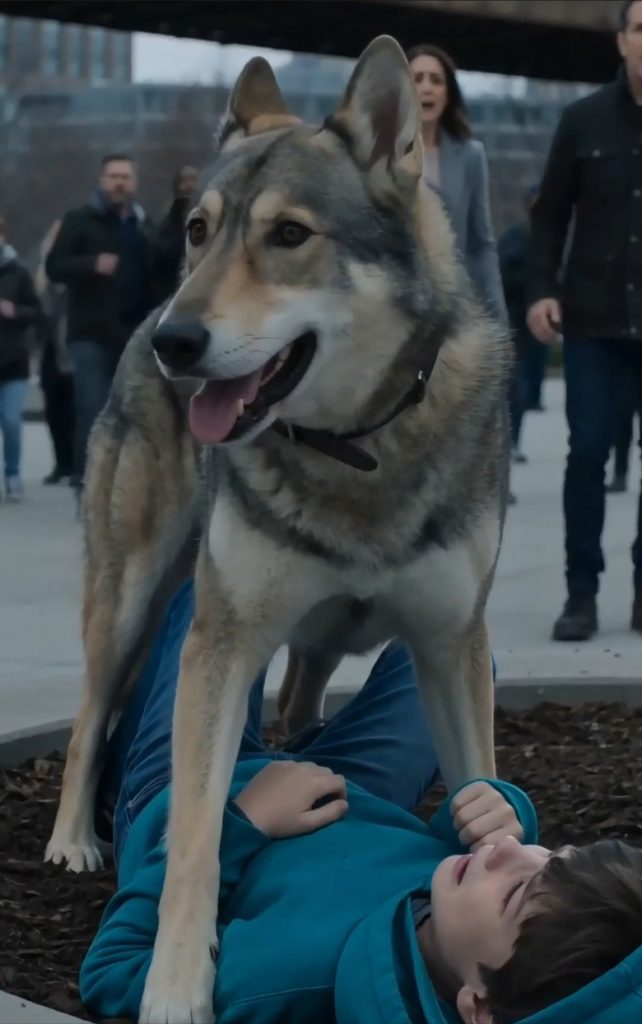
A gray-tan wolf dog launched over the concrete edge of the planter like something wild breaking out of the city itself. Its paws struck the mulch with a heavy, brutal thud, and the boy in the teal hoodie went down beneath it, small arms flying up as his back hit the dark soil.
For one suspended second, the whole plaza froze.
Then the woman started running.
“Noah!”
Her voice tore across the open square, sharp enough to make strangers turn. She was in a gray blazer, hair whipping behind her, heels striking the concrete as she sprinted toward the planter. Her face had already collapsed into terror. The kind of terror that comes when a parent sees danger moving faster than they can.
The boy lay on his back, trembling, eyes squeezed shut. The dog stood over him with its front paws planted on either side of his body, its black leather collar tight against a thick neck. It was enormous. Too large, too still, too focused.
People backed away.
A woman near the fountain covered her mouth. A man with a paper coffee cup dropped it without noticing. Someone whispered, “Don’t move. Don’t scare it.”
But Noah was already crying.
The dog’s head turned slowly, ears pricked. Its lips pulled back just enough to reveal the warning of teeth, not an attack, but a line no one dared cross. A low growl rolled from its chest, deep and steady, vibrating through the planter.
The woman stopped three steps away.
Her body wanted to keep going. Her hands reached toward her son. But the dog shifted its weight, and she froze, breath breaking in her throat.
“Please,” she whispered. “Please get off him.”
Noah opened one eye. A huge paw rested inches from his cheek. Dirt clung to his hoodie. His hands clutched the fabric at his chest, too afraid to push, too afraid to breathe loudly.
The dog did not bite.
It did not lunge.
It only stood there, locking the boy in place as if the entire world depended on him not moving.
Then the animal lifted its head.
Its muzzle rose toward the steel bridge overhead, and a sound came out of it that made every person in the plaza go silent.
It was not a bark.
It was a warning.
And somewhere above them, the metal answered.
Act II
The sound began as a groan.
At first, people mistook it for traffic, a truck grinding over the elevated road beyond the buildings. But the man in the black work jacket heard something else in it. He had spent half his life around steel, bolts, load points, stress fractures, and the ugly music of things about to fail.
His name was Daniel Cross, and he stopped so suddenly in the middle of the plaza that the crowd moved around him like water around a stone.
He looked up.
The elevated walkway stretched across the square like a dark rib cage. It had always been there, part of the city’s daily background, ignored by office workers and dog walkers and children with backpacks. People crossed under it every morning without thinking about the thousands of pounds suspended above their heads.
But Daniel saw the vibration.
A tiny shudder ran through one of the lower support panels. Then another. A strip of metal near the maintenance track trembled against its bolts.
His stomach turned cold.
“No,” he breathed.
Across the plaza, Elise Carter was still facing the dog, hands shaking, eyes locked on her son. To her, there was only one danger. The animal. The teeth. The massive paws beside Noah’s face.
She did not see the seam opening above them.
She did not know that three years earlier, her husband had stood in this same plaza with a folder of photographs under his arm and a warning no one wanted to hear.
Thomas Carter had been a structural engineer. Quiet, careful, stubborn in the way honest people become stubborn when powerful people tell them to look away. He had worked on the inspection team for the elevated walkway during its renovation, and he had come home for weeks smelling like rain, dust, and metal.
Elise remembered him sitting at their kitchen table long after Noah had gone to bed, staring at printed photos spread beside his coffee mug.
“Something’s wrong with the load brackets,” he had told her.
She had laughed at first, softly, because Thomas always made problems sound like puzzles. But then she saw his face.
He was afraid.
Not for himself. For everyone else.
Two months later, Thomas was dead.
The official report called it an accident. A fall at an off-site storage yard. A tragic mistake in bad weather. Elise had been left with a seven-year-old son, a box of her husband’s work files she had never been allowed to fully see, and a city that moved on too quickly.
Only one thing from Thomas’s old life remained close to Noah.
The dog.
Atlas had once been part of a private search-and-rescue program Thomas helped fund after a building collapse years before. He was trained to detect distress, movement under rubble, panic in tight spaces, and unstable ground. After Thomas died, Atlas disappeared from the program records. Elise had assumed the animal had been reassigned.
But Noah never forgot him.
He used to press his little face against the fence at the training yard and whisper, “Hi, Atlas,” while the enormous dog lowered its head like a gentle horse.
That was before grief made everything vanish.
Before Elise sold the house.
Before every trace of Thomas Carter’s warning seemed to sink beneath paperwork, silence, and money.
Now Atlas was back.
And he was standing over Thomas Carter’s son like a living wall.
Daniel Cross saw the dog raise its head again. He saw the animal’s body lock, not toward the mother, not toward the crowd, but toward the steel.
Then came the second groan.
This time, people heard it.
A long metallic strain rolled over the plaza. Coffee cups rattled on a nearby kiosk counter. Pigeons burst from the edge of a roof. The woman near the fountain lowered her hand from her mouth and looked up.
Daniel’s face changed.
He was no longer confused.
He was horrified.
Because he knew that sound.
He had heard it once before, years ago, in a recording Thomas Carter had sent him the night before he died.
Act III
“Everybody back!” Daniel shouted.
No one moved at first.
Fear does that. It pins people harder than any animal could. They stared at the dog, the boy, the mother, the bridge, each person waiting for someone else to decide what was real.
Daniel ran toward the planter.
Elise turned on him with wild eyes. “Help him!”
“I am,” Daniel said. “Do not move him.”
Her face twisted. “That dog is on my son!”
Daniel looked past her, up at the underside of the walkway. The trembling seam had widened. One rust-dark bolt was no longer seated flush. Another panel shifted with a dull, sickening knock.
“That dog is keeping him out of the fall line,” Daniel said.
Elise stared at him.
The words made no sense. They were too strange, too impossible, too far away from the sight of her child crying in the dirt.
Atlas growled again, but not at Daniel. His gaze never left the metal above.
Then Daniel saw the collar.
Black leather. Scratched buckle. Brass plate half-hidden under thick fur.
He stepped closer, slow enough not to challenge the animal, and read the worn engraving.
ATLAS — CARTER FIELD UNIT.
Daniel went pale.
Elise saw it.
“What?” she demanded. “What is it?”
Daniel swallowed. His voice came out smaller than before.
“That was Thomas’s dog.”
The plaza seemed to tilt under Elise’s feet.
For three years, she had trained herself not to react when strangers said her husband’s name. She had learned to hold grief like a glass of water filled to the rim. Not spilling. Not shaking. Not in public.
But hearing his name now, beside her son, beneath that bridge, with that dog standing guard, broke something open inside her.
“No,” she whispered. “No, that’s not possible.”
Daniel did not answer immediately.
Because the truth was worse.
He had known Thomas. Not well enough to be a friend, but well enough to owe him a debt. Thomas had sent him inspection photos. Audio recordings. A memo marked urgent. Daniel had been a junior contractor then, desperate to keep his job, with a sick mother and bills stacked on his counter.
When the redevelopment company buried Thomas’s report, Daniel stayed quiet.
When the city issued its clean inspection notice, Daniel signed a minor compliance statement he should have questioned.
When Thomas died, Daniel told himself silence was not the same as guilt.
But for three years, he had kept one file hidden.
A file Thomas had sent him.
A file he had never opened in full because some truths do not knock politely. They wait. They rot. They return when the steel begins to shake.
Atlas took one step sideways, pressing his body more firmly over Noah.
The boy sobbed harder.
“Mom,” he whimpered.
Elise nearly broke. “Baby, don’t move. I’m right here.”
Above them, a grinding crack split the air.
This time, panic exploded.
People screamed and scattered. A man grabbed his daughter by the arm and ran. Two office workers ducked beneath a concrete awning. Someone yelled to call emergency services. Phones came out, hands shaking as they recorded what no one yet understood.
Daniel climbed onto the edge of the planter.
Atlas snapped his head toward him and growled.
Daniel froze with both palms up.
“I know,” he said, voice trembling. “I know. I’m sorry.”
The dog stared at him.
For one impossible second, Daniel felt judged by an animal.
Then Atlas looked back up.
Daniel followed his gaze and saw exactly where the danger would land.
A rectangular service panel, long and heavy, had torn loose from one side of the elevated structure. It was still attached by one strained bracket, swinging a few inches with each vibration.
And beneath it, just beyond the planter, was the patch of concrete where Noah had been standing seconds earlier.
Where Atlas had knocked him down.
Where Elise would have reached if she had run in without stopping.
The dog had not attacked the boy.
It had saved him.
But the bracket above them was still failing.
Act IV
Daniel jumped down from the planter and turned toward the crowd.
“Clear the center!” he shouted. “Now! Move back to the buildings!”
This time, people listened.
Terror finally found direction. The plaza split open as strangers ran, stumbled, pulled each other away. A man in a navy coat helped the woman near the fountain to her feet. Someone dragged a stroller behind a column. The scream of the city sharpened into sirens far away.
Elise did not move.
Her son was still in the planter.
Daniel grabbed her arm. “You need to step back.”
“I’m not leaving him.”
“You’ll both die if that panel drops while you’re reaching for him.”
She slapped his hand away, not hard, but with the fury of a mother whose world had narrowed to ten feet of dirt and a crying child.
“Then get him out.”
Daniel looked at Atlas.
The dog had lowered his body now, almost covering Noah. His growl had become quieter, focused, controlled. He was not holding the boy down anymore out of aggression. He was bracing him.
Daniel saw the angle. Saw the panel. Saw the planter wall.
If Noah stayed flat, the concrete rim might shield him from the worst of the impact.
If anyone lifted him too soon, they would bring him straight into danger.
So Daniel made the hardest decision of his life.
“Not yet,” he said.
Elise’s face drained of color.
“What do you mean, not yet?”
Daniel pulled his phone from his pocket with shaking hands. He opened the emergency folder he had copied years ago and never deleted. Thomas Carter’s photographs filled the screen. Close-ups of brackets. Corrosion hidden under fresh paint. Notes in precise handwriting.
Then one image stopped him.
The exact panel above them.
Marked in red.
FAILURE RISK UNDER VIBRATION. PUBLIC PLAZA BELOW. IMMEDIATE CLOSURE RECOMMENDED.
Daniel turned the phone toward Elise.
Her eyes moved across the screen, and all the anger in her face changed shape. It did not disappear. It became something heavier.
Recognition.
Betrayal.
Three years of being told her husband had been careless, paranoid, exhausted. Three years of sympathy that felt rehearsed. Three years of official letters that said nothing in beautiful language.
“My husband wrote this,” she said.
Daniel nodded.
“And you had it?”
The question struck harder than shouting would have.
Daniel could barely meet her eyes. “Yes.”
Atlas barked once.
A short, violent command.
Daniel looked up.
The bracket snapped.
The sound was not loud at first. Just a clean metallic crack, like a lock breaking in an empty room. Then the panel dropped six inches, caught on a cable, swung, and slammed against the underside of the walkway.
The boom shook the plaza.
Elise screamed Noah’s name.
Atlas threw his full weight across the boy, pinning him flat as fragments of paint and dust rained into the planter. The heavy panel swung outward, missed the planter by inches, and crashed down onto the concrete where Noah had been standing before the dog shoved him.
The impact split the paving stone.
Silence followed.
Not peaceful silence. Shocked silence. The kind that arrives when everyone realizes how close they came to witnessing something unthinkable.
Elise was on her knees.
Daniel was breathing like he had run miles.
Atlas stayed still for one more second, ears forward, body tense.
Then he slowly stepped back.
Noah curled onto his side, crying but alive.
Elise climbed into the planter so fast she nearly fell. She gathered him into her arms, pressing his face against her shoulder, rocking once, twice, whispering his name like a prayer she had almost lost.
Atlas stood beside them, panting.
The crowd stared.
The animal they had feared now looked exhausted.
Noah lifted his trembling hand from his mother’s coat. His eyes were red, his voice small.
“Mom,” he whispered, “it’s Atlas.”
Elise looked at the dog.
The dog looked back.
And on his collar, beneath the dirt and scratches, Thomas Carter’s name caught the gray light.
Act V
By evening, the plaza was sealed behind yellow barriers.
Engineers in hard hats moved under floodlights. Police officers spoke to witnesses. Emergency crews photographed the fallen panel, the broken bracket, the cracked concrete. News vans lined the curb as the city tried to find language careful enough to make negligence sound accidental.
But this time, there were too many cameras.
Too many witnesses.
Too much proof lying in the middle of the plaza.
Daniel gave his statement before anyone asked him to.
He handed over Thomas Carter’s file. The photos. The memos. The audio recording of the same metallic strain Thomas had captured years earlier. He told the investigators about the pressure from the redevelopment company, the dismissed warnings, the altered inspection language, and his own silence.
He did not ask for forgiveness.
Elise would not have given it to him then.
She sat inside an ambulance with Noah wrapped in a thermal blanket, one arm around him, the other hand buried in Atlas’s fur. The dog rested his head against the edge of the ambulance step as if he had done only what he was trained to do.
Noah’s fingers traced the brass plate on the collar.
“Dad gave him this?” he asked.
Elise’s throat tightened.
“Yes,” she said. “I think he did.”
Daniel approached slowly, stopping several feet away. His face looked older now, stripped of all excuses.
“Elise,” he said.
She did not look up.
“I’m sorry.”
For a long moment, the only sound was the distant grind of machinery and Noah’s uneven breathing.
Then she raised her eyes.
“You should have said something when my husband was alive.”
Daniel nodded.
“You should have said something when they called him reckless.”
“I know.”
“You should have said something when my son cried himself to sleep because people whispered that his father made one mistake.”
Daniel’s eyes filled, but he did not defend himself.
“I know,” he said again.
Elise looked back at Atlas.
The dog had closed his eyes under Noah’s hand.
“My husband spent his life trying to stop that bridge from hurting people,” she said quietly. “And after everyone ignored him, his dog finished the job.”
The next morning, Thomas Carter’s name was everywhere.
Not as a footnote. Not as an accident victim. Not as a troubled engineer whose concerns were exaggerated.
As the man who had warned them.
The city released a statement promising a full investigation. The redevelopment company’s executives denied wrongdoing until Daniel’s documents became public. Then the denials changed into resignations, resignations into subpoenas, and the quiet machinery that had buried Thomas’s truth began to turn against the people who built it.
For Elise, none of that brought Thomas back.
Justice never does.
But it changed the shape of the grief.
It gave Noah something different to carry. Not shame. Not confusion. Not the hollow ache of unanswered questions.
Truth.
A week later, Elise brought Noah back to the plaza.
The fallen panel was gone. The walkway was covered in scaffolding. Fresh barriers blocked the center, and flowers had appeared along one concrete planter, left by strangers who had watched a terrifying moment become a miracle.
Atlas walked beside them on a new leash.
People recognized him immediately.
Some stepped back out of habit. Others smiled with embarrassed tenderness, remembering how they had judged him when he stood over a crying boy in the dirt.
Noah did not care.
He knelt beside Atlas and wrapped both arms around his neck.
The dog lowered his head against the child’s shoulder, calm now beneath the same gray sky.
Elise stood behind them, holding the old brass collar tag in her palm. Thomas’s name was scratched but readable. Carter Field Unit. A piece of a life stolen, returned by the only witness who had never learned how to lie.
For the first time in three years, Elise looked up at the bridge and did not feel small beneath it.
She felt angry.
She felt broken.
But she also felt her husband there, not as a ghost, not as a wound, but as a truth that had finally reached daylight.
Noah looked back at her.
“Can Atlas come home with us?”
Elise watched the dog nudge her son’s hand, gentle as a promise.
Then she smiled through tears.
“He already did,” she said.