Act I
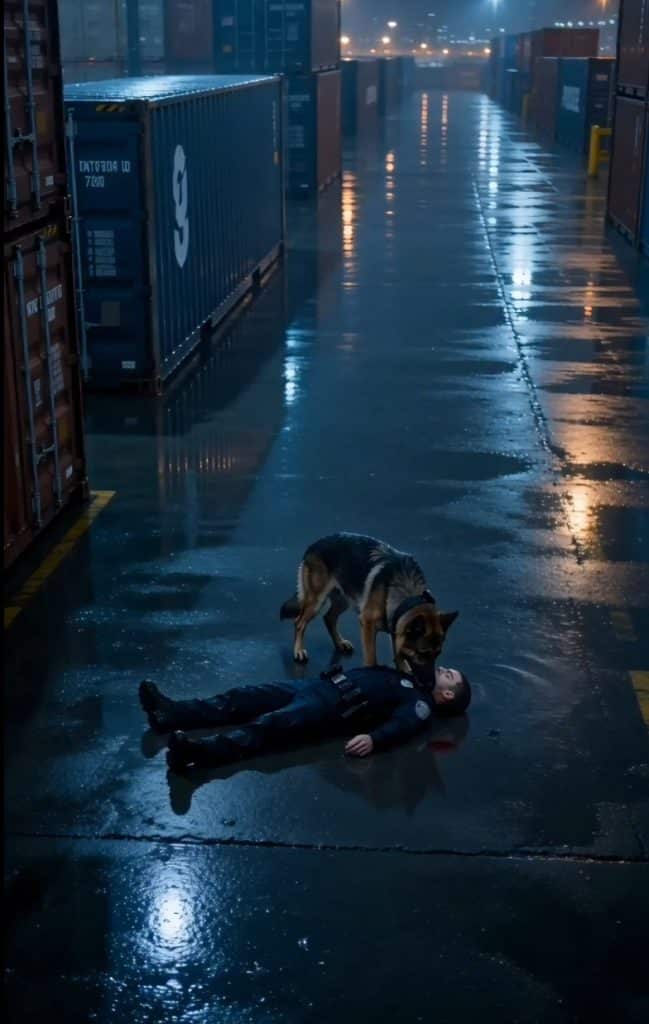
The shipping yard was empty except for the rain.
It fell hard over the stacked containers, over the cracked pavement, over the orange glow of a single streetlight trembling in the puddles. Beyond the fences, the city skyline glittered like another world, bright and careless, too far away to hear what had happened in the dark.
Officer Nathan Cole lay on his back beside container row 17.
His badge caught the streetlight whenever the rain shifted. His police patch was soaked. His face was pale beneath the cold water running down his temples, and his eyes stayed closed no matter how many times the German Shepherd nudged him.
The dog’s name was Rook.
He stood over Nathan with his black-and-tan coat matted against his body, tactical collar slick with rain, paws planted on either side of his partner like he had become a shield made of bone and loyalty.
Rook lowered his muzzle to Nathan’s chest.
Sniffed.
Waited.
Nothing.
He moved to Nathan’s shoulder, then to his neck, pressing his wet nose against the collar of the uniform as if there had to be a command hidden somewhere in the silence.
Still nothing.
A thin whimper slipped from Rook’s throat.
The sound barely survived the rain.
He nudged Nathan’s chin.
Once.
Twice.
Then he froze, staring at the face of the man who had fed him from his hand, slept on station floors beside him during double shifts, and once whispered into his fur after a funeral that he was the only partner who had never lied.
Nathan did not move.
Rook lifted his head and cried out.
It was not a bark at first. Not a warning. Not anger.
It was a mournful, breaking sound that rose into the wet night and vanished between the containers.
Then the dog turned toward the distant city lights.
He barked.
One sharp, echoing call.
The yard gave nothing back.
Rook barked again.
Louder this time.
His paws splashed as he turned in a circle, torn between the need to call for help and the fear of leaving Nathan even by a few steps. Finally, he dropped his head and returned to him, licking the rain from Nathan’s cheek with desperate gentleness.
As if love could wake him.
As if loyalty could pull breath back into a body.
When no answer came, Rook lowered himself onto the pavement and rested his head against Nathan’s chest.
His final whimper trembled through the rain.
But beneath that terrible stillness, something small was still fighting.
Act II
Six years earlier, Nathan Cole had refused to take the dog.
He had stood outside the K9 training facility with his arms crossed, jaw tight, pretending the limp in his left leg did not hurt as much as it did.
“I’m not ready for a partner,” he said.
Sergeant Alvarez had laughed once, not kindly but not cruelly either.
“No one’s asking if you’re ready. I’m asking if you’re done hiding behind paperwork.”
Nathan looked through the fence.
Inside the training yard, a young German Shepherd sat apart from the others. He was too alert to be relaxed, too quiet to be easy, too watchful to be ordinary. His ears followed every sound. His eyes tracked every person. He did not bark for attention.
He waited.
“That one bites?” Nathan asked.
“That one thinks,” Alvarez said. “Which is worse.”
Nathan should have walked away.
Instead, the dog stood, crossed the yard, and stopped directly in front of him. No excitement. No show. Just a steady look through the fence, like he had already made a decision Nathan had not caught up to yet.
“What’s his name?”
“Rook.”
Nathan frowned. “Like chess?”
“Like the piece that moves in straight lines,” Alvarez said. “No tricks. No hesitation. Once he’s committed, he doesn’t stop.”
Nathan looked back at the dog.
Rook looked back at him.
That was the beginning.
At first, Nathan trained him like a responsibility. Feedings. Commands. Tracking work. Vehicle searches. Night drills. Rain drills. Crowd drills. The dog learned fast, sometimes too fast, anticipating orders before Nathan gave them.
But somewhere between the long shifts and the quiet rides home, Rook stopped being an assignment.
He became the first living thing Nathan trusted after the warehouse shooting that had left his old partner gone and half the department whispering that Nathan had lost his nerve.
Rook never whispered.
Rook never asked why Nathan woke up sweating in the patrol SUV after too little sleep.
Rook never told him to move on.
He only nudged Nathan’s hand with his nose and waited until the man remembered where he was.
The other officers joked that Rook had trained Nathan better than Nathan had trained Rook.
Maybe they were right.
Together, they built a record no one could ignore. Missing children found. Weapons recovered. Elderly wanderers tracked home before winter nights turned cruel. Rook had once followed a scent through three blocks of flooded alleyways and stopped at a locked basement door where a frightened boy had been hiding for hours.
Nathan never took credit for those saves.
He always pointed down.
“Ask him,” he would say.
But lately, Nathan had changed.
He stayed late after shifts. Took calls outside. Locked files in the glove compartment instead of turning them in. Twice, Rook had watched him sit in the dark parking lot behind the precinct, staring at a photograph on his phone until the screen went black.
The photograph showed a shipping container.
Blue paint. White numbers. One corner marked with a red stripe.
Container 17-B.
Nathan had found it by accident during a routine dock sweep.
Or maybe not by accident.
His old partner, Officer Luke Mercer, had died near that same shipping yard years earlier. The report said he walked into an ambush during a stolen cargo investigation. The case closed quickly. Too quickly. Everyone called it tragic and moved on.
Nathan never did.
Then, two weeks before the rain-soaked night, an anonymous envelope arrived at his apartment.
Inside was a rusted key, a shipping manifest, and one sentence written on receipt paper.
Mercer didn’t die where they said he did.
Nathan told no one at first.
Except Rook.
He sat on the edge of his bed, holding the old key in his palm, while the dog rested his chin against Nathan’s knee.
“I know,” Nathan whispered. “Bad idea.”
Rook blinked.
Nathan almost smiled.
“Yeah,” he said. “We’re going anyway.”
The next night, Nathan filed a routine patrol route near the docks.
But he was not hunting stolen cargo.
He was hunting the truth.
Act III
The shipping yard looked abandoned when Nathan arrived.
Too abandoned.
No workers. No crane movement. No late truck traffic. Only rain starting to gather along the pavement and the slow groan of metal somewhere deep in the rows of containers.
Rook knew first.
His body went rigid before Nathan saw anything wrong.
“What is it?” Nathan whispered.
Rook’s nose lifted.
He pulled toward row 17.
The blue container sat exactly where the photograph said it would. White numbers. Red stripe. Rain sliding down its sides like sweat. Nathan reached into his pocket and closed his hand around the rusted key.
It fit.
Inside the container, there were no weapons.
No drugs.
No stolen electronics.
There were boxes of financial records sealed in plastic, old police evidence bags, and a small metal lockbox with Officer Luke Mercer’s badge number scratched into the lid.
Nathan’s breath caught.
Rook stood at the entrance, ears turning toward the darkness outside.
Nathan opened the lockbox.
Inside was a flash drive, a folded photograph, and a copy of an internal affairs complaint that had never been filed.
The names on it made the container feel suddenly airless.
Captain Harold Voss.
Detective Alan Pierce.
Dock supervisor Martin Vale.
And at the bottom, in Luke Mercer’s handwriting, one line underlined twice.
If anything happens to me, follow the dog.
Nathan stared at the sentence.
Luke had worked with a K9 before Rook. An older shepherd named Bishop. After Luke died, Bishop vanished from the report. Retired, they said. Transferred, maybe. No one seemed to know.
But Nathan remembered Bishop.
He remembered the dog howling outside the station garage the morning after Luke’s death while two senior officers forced him into a transport van.
Nathan looked at Rook.
“Your bloodline,” he whispered.
Rook’s head snapped toward the far end of the row.
A sound.
Not thunder.
A footstep in water.
Nathan reached for his radio.
Static.
He tried his phone.
No signal.
Then the yard lights died one by one, leaving only the orange streetlamp at the far end flickering through rain.
Nathan backed out of the container, one hand on Rook’s collar.
“Stay close.”
Rook did not need the command.
A voice came from the shadows.
“You should’ve left Mercer buried.”
Nathan turned.
Captain Voss stepped into the streetlight, rain running off his black coat. Behind him stood two men Nathan recognized from dock security, their faces hidden beneath hoods.
Nathan felt the world narrow.
“You killed Luke,” he said.
Voss looked almost disappointed.
“Luke got curious. So did you.”
Rook growled low.
Nathan’s hand tightened near his holster.
Voss sighed.
“Don’t make the dog pay for your conscience.”
That was the moment Nathan understood something worse than fear.
This was not only about Luke.
For years, the docks had been a private door for men who wore badges in daylight and sold protection in the dark. Evidence disappeared. Witnesses changed their stories. Cases collapsed. Anyone who got too close became careless, unstable, unlucky.
Luke had not been unlucky.
He had been betrayed.
Nathan moved first.
Not to attack.
To release Rook.
“Find help,” he said.
Rook refused.
“Rook. Go!”
The dog did not move.
The first impact threw Nathan sideways before he heard the sound that caused it. Pain flashed white through his shoulder and side, and he hit the pavement hard enough to knock the air from his lungs. His radio skidded into a puddle.
Rook lunged.
A shout split the rain.
Nathan tried to rise.
He could not.
Through the blur, he saw Rook drive one man back, heard boots splash, heard Voss cursing, heard metal slam against metal. Then something struck Rook’s collar, snapping the small body camera loose. It spun across the wet pavement, its red recording light still blinking.
Nathan saw it land beneath the container.
Still filming.
Voss did not.
Sirens did not come.
No headlights appeared.
The men fled only when a distant gate alarm began wailing from the other end of the yard, triggered by Rook during the struggle.
Nathan tried to speak.
Only a breath came out.
Rook returned to him, frantic, wet muzzle searching, paws splashing around his body.
Nathan wanted to say good boy.
He wanted to say run.
He wanted to say Luke was right.
Follow the dog.
But the rain filled his ears, and the night folded over him.
Act IV
Rook did what he had been trained to do.
And then he did what no training could teach.
He checked Nathan’s breathing. Nudged his chin. Pressed his nose to the pulse point at his neck. When Nathan did not respond, Rook lifted his head and called into the dark.
The first bark echoed between the containers.
No answer.
The second carried farther.
Still nothing.
But half a mile away, at the outer dock gate, a rookie officer named Elena Cruz heard it through the rain.
She had no reason to be there except guilt.
Nathan had asked her earlier that week to check an old dispatch log from Luke Mercer’s case. She had promised she would and then forgotten during a double shift. By the time she remembered, Nathan’s patrol car was already marked active near the docks.
Something about it bothered her.
So she drove by.
The gate was supposed to be locked and quiet.
Instead, the alarm light was blinking.
Then she heard the dog.
One bark.
A pause.
Another bark.
Cruz froze.
At the academy, K9 handlers had demonstrated distress patterns. Most officers forgot them. She had not. Her father had been a handler for sixteen years, and he taught her early that a working dog’s bark was not noise.
It was information.
Three more barks rang out.
Cruz grabbed her radio.
“Unit 23, possible officer down at Pier Yard East. I need backup and medical. Now.”
She did not wait for permission.
She ran.
The yard was a maze of steel and water. Rain blurred her flashlight. Containers rose like walls on both sides. She followed the barking until she saw the orange pool of streetlight ahead.
Then she saw Rook.
The dog stood over Nathan, soaked and shaking, teeth visible, body low in warning.
Cruz stopped instantly.
“Rook,” she said, voice steady despite the terror rising in her throat. “It’s Cruz. I’m here to help him.”
Rook growled.
Not because he did not know her.
Because Nathan was on the ground, and the whole world had become a threat.
Cruz lowered her weapon. Then she lowered herself to one knee in the rain.
“Rook,” she said again. “Guard.”
The dog’s ears shifted.
It was Nathan’s command.
Only handlers and close units used it.
Guard meant stay near. Protect. Let the right hands in.
Rook hesitated, then stepped back half a pace.
Cruz moved fast.
Nathan had a pulse.
Faint, but there.
“He’s alive,” she whispered.
Rook whimpered and pressed his nose to Nathan’s cheek.
Backup flooded the yard minutes later. Red and blue lights shattered across puddles. Paramedics dropped beside Nathan. Officers fanned between the containers. Rook refused to move until Cruz clipped a leash to his collar and walked beside the stretcher, her hand resting on his wet back.
As they lifted Nathan, Rook suddenly pulled hard toward container 17-B.
“Not now,” Cruz said.
Rook barked.
Sharp. Insistent.
Then he dragged her toward the container, stopping near its base, nose pressed beneath the metal edge.
Cruz crouched and shone her flashlight.
Something small blinked red in the shadows.
The collar camera.
Still recording.
She reached under and pulled it free.
On the cracked lens, rainwater ran like tears.
On the memory card was everything.
Voss stepping from the shadows.
The confession.
Nathan’s voice saying Luke’s name.
The attack.
The men fleeing.
And Rook coming back, again and again, refusing to leave his partner alone in the rain.
By dawn, Captain Voss was gone from his office.
By noon, he was in custody.
By nightfall, Luke Mercer’s case was reopened.
But Nathan Cole was still fighting behind hospital doors.
And Rook sat outside the ICU, staring at every person who passed as if one of them might finally tell him why his partner had not come back.
Act V
For three days, Rook barely slept.
The hospital staff tried everything. Blankets. Food. A quiet room. A temporary kennel behind the security desk.
He accepted water.
Nothing else.
Every time the ICU doors opened, he stood.
Every time they closed without Nathan, he lay back down with his head on his paws and his eyes fixed forward.
On the fourth morning, Elena Cruz arrived with Nathan’s old jacket.
It had been cleaned, but not completely. It still carried enough of him that Rook stood before she reached the waiting area. His tail moved once, cautiously, as if hope had become something dangerous.
Cruz knelt and let him smell the sleeve.
“He’s still here,” she whispered. “He’s trying.”
Rook pressed his nose into the jacket and closed his eyes.
Inside the ICU, Nathan woke just after sunrise.
He did not wake like men did in movies. No dramatic gasp. No sudden strength. Only a faint movement of his fingers and a cracked whisper that brought the nurse rushing to his side.
“Dog,” Nathan breathed.
The nurse leaned closer.
“What was that?”
Nathan’s lips barely moved.
“Where’s my dog?”
They made exceptions that day.
Hospitals rarely liked exceptions, but every person on that floor had already heard the story. The K9 in the rain. The officer found alive. The camera that exposed a captain. The old murder case pulled out of the dark because a dog refused to stop barking.
Cruz led Rook into the room slowly.
The German Shepherd stopped at the threshold.
For the first time since the shipping yard, he looked uncertain.
Nathan lay pale and weak beneath white blankets, tubes and monitors around him, his shoulder bandaged under the hospital gown. He looked smaller than Rook had ever seen him.
But his eyes were open.
“Hey, partner,” Nathan whispered.
Rook crossed the room in three careful steps.
No jumping.
No barking.
He placed his front paws beside the bed and lowered his head onto Nathan’s hand.
Nathan’s fingers moved weakly into the wet-black fur along his ears.
“I told you to run,” he said.
Rook gave one soft huff.
Nathan almost smiled.
“Yeah,” he whispered. “You never listened.”
Cruz turned away before anyone could see her cry.
Weeks later, the department held a ceremony for Luke Mercer.
Not in a conference room. Not behind a podium polished for cameras. They held it at the memorial wall, in the rain, because Nathan said Luke had waited long enough for the truth and deserved a sky honest enough to weep.
Luke’s sister stood beside Nathan as the corrected report was read aloud.
No more “ambush by unknown suspects.”
No more “case closed.”
This time, the words were plain.
Officer Luke Mercer had been murdered after uncovering corruption inside his own chain of command.
Captain Voss and the men who served him were charged. Records were seized. Other cases reopened. Families who had spent years being told to accept silence finally got phone calls that began with, “We found something.”
Nathan stood with one arm in a sling.
Rook sat pressed against his leg.
When Luke’s sister approached, she held out something wrapped in a small cloth.
“I was told this was lost,” she said.
Inside was Bishop’s old K9 tag.
Nathan stared at it.
The metal was scratched, weathered, and worn thin at the edge. Luke’s partner. Rook’s predecessor. The dog who had tried to lead them to the truth years before anyone was ready to follow.
Nathan knelt slowly, pain crossing his face.
He clipped Bishop’s tag onto Rook’s tactical collar beside his own.
Rook looked up at him.
“You finished it,” Nathan said.
The German Shepherd leaned into his hand.
That night, Nathan returned to the shipping yard for the first time.
Cruz went with him. So did Rook.
The rain had stopped, but the pavement still held old reflections beneath the orange light. Container row 17 stood quiet. The skyline glittered in the distance, not careless now, just far away.
Nathan stood over the place where he had fallen.
For a moment, he heard it all again.
Rain.
Barking.
The scrape of paws in water.
The sound of a loyal animal calling into an empty night and believing someone would answer.
Nathan looked down at Rook.
“I thought I was alone,” he said.
Rook’s ears lifted.
Nathan swallowed, his voice rough.
“I wasn’t.”
Cruz stood a few steps back, giving them the silence they had earned.
Rook moved closer and pressed his head against Nathan’s thigh.
Not dramatic.
Not loud.
Just there.
Exactly where he had always been.
Nathan rested his hand on the dog’s collar, fingers brushing over two tags now: Rook’s and Bishop’s, past and present, both carrying the weight of partners who had refused to abandon the truth.
In the distance, the city lights shimmered.
But this time, the yard did not feel empty.
Because the truth had been found.
The fallen had been named.
And the dog who once rested his head on his partner’s chest in the rain had done more than call for help.
He had carried two officers home.