Act I
The parking lot was almost empty when the German Shepherd started throwing himself against the blue sedan.
At first, it looked like madness.
A large black-and-tan dog leapt at the driver-side door, paws slamming against the hot metal, claws scraping down the glass. He barked so hard the sound bounced off the silent storefronts and rolled across the sun-blasted asphalt.
No owner called him back.
No leash trailed behind him.
No collar flashed at his neck.
Just a powerful stray dog, frantic under the cruel white glare of midday, biting at the silver door handle as if he understood exactly what it was supposed to do.
The handle snapped back with a sharp metallic thwack.
The dog dropped to the pavement, panting hard, then jumped again.
His paws struck the window.
His claws scraped.
His teeth caught the handle.
He pulled with his whole body.
Nothing.
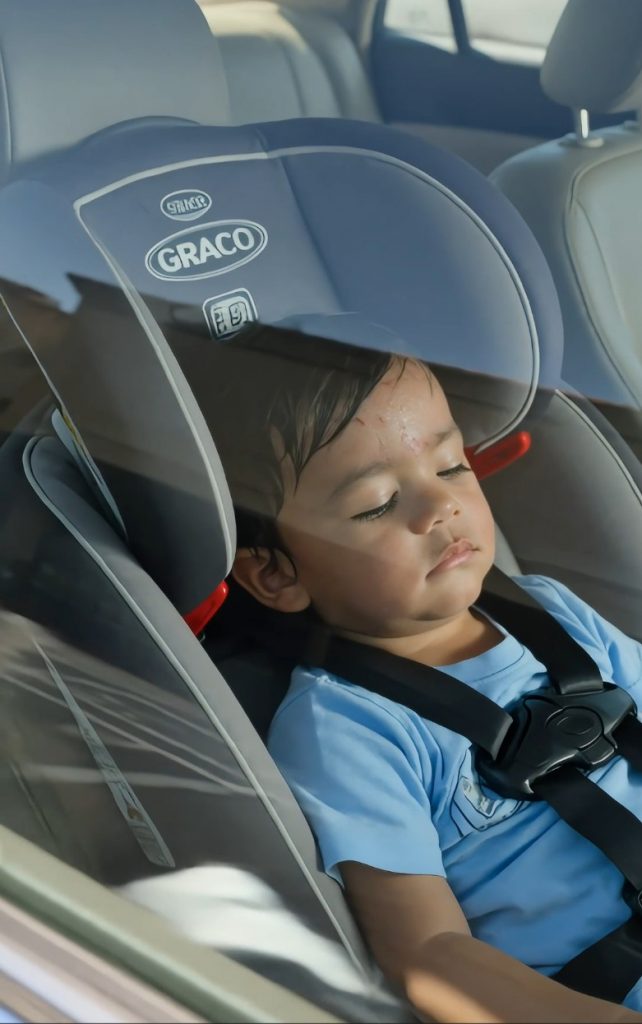
Inside the car, behind the sealed glass and the shimmering reflection of the sky, a toddler sat strapped into a gray child safety seat.
His light blue shirt clung to him.
His dark hair was damp.
His head leaned back at an angle no sleeping child would choose.
The dog barked again.
Louder.
Sharper.
A warning to anyone who could still hear it.
But the shopping center looked abandoned in the heat. The big store signs sat bright and ordinary above the empty spaces. A few cars waited far apart, their windows glaring like mirrors. Heat rose from the asphalt in waves that made the distance tremble.
The German Shepherd circled once, wild with urgency, then came back to the same door.
He did not waste time barking at the sky.
He did not run in circles.
He went for the handle.
Again.
And again.
His mouth clamped around the metal. His shoulders tightened. He yanked backward until his paws slipped on the paint and his body hit the side of the sedan with a dull thud.
Still locked.
The dog staggered, caught himself, and immediately jumped back up.
That was when Hannah Price saw him.
She had been walking out from the store with a receipt in one hand and her sunglasses pushed on top of her head. At first, she froze, afraid the dog might turn on her. He was huge, filthy around the paws, and moving with such violent desperation that every instinct told her to keep distance.
Then she saw where he was looking.
Not at her.
Not at the storefront.
At the back seat.
Hannah stepped closer, shading her eyes against the glare.
The dog barked at her once.
Then he turned and slammed both paws against the window.
Hannah’s stomach dropped.
“Oh my God,” she whispered.
Through the glass, between sunlight and reflection, she saw the child.
For one second, the whole world narrowed to that blue shirt and those motionless little hands.
Hannah screamed for help.
The German Shepherd barked with her.
And somewhere inside the locked car, the toddler did not move.
Act II
Before that day, nobody in the shopping center knew the dog’s name.
To them, he was only a problem that had appeared in the heat.
A stray near parked cars.
A big dog with no collar.
A liability.
That morning, a security guard had seen him trotting along the far edge of the lot, nose low, ears sharp, pausing beside vehicles as if searching for something. The guard had waved him away with a half-hearted shout, assuming he was chasing food wrappers or looking for shade.
The dog had ignored him.
He moved with purpose.
Past the cart return.
Past the white SUV.
Past the long strip of empty parking spaces where the heat shimmered so hard the pavement looked wet.
Then he stopped at the blue sedan.
Not because of food.
Not because of noise.
Because of something inside.
His name was Duke, though no one there knew it yet.
Six months earlier, Duke had belonged to a woman named Elena Marquez, a former emergency dispatcher who lived three towns over with her daughter and grandson. Duke had not been a service dog officially, not on paper, not with certificates or vests or polished obedience videos.
But he had been trained by necessity.
Elena had spent years listening to panic through phone lines. She knew the sound of danger arriving quietly. She knew emergencies rarely looked dramatic at first. Sometimes they looked like a missed breath. A stove left on. A child too silent in the next room.
So when her grandson Mateo was born, Elena taught Duke everything she could.
Not tricks.
Signals.
She taught him to bark if the baby stopped crying too suddenly. To nudge her hand if he heard choking. To lead someone to a closed door. To stay close when a child was alone.
Duke learned fast.
He learned the shape of fear in a human body.
He learned that small people needed big protection.
And he loved Mateo with the serious devotion only a dog can carry without ever asking whether he will be thanked.
But Elena died suddenly in early spring.
After the funeral, the family began to break in quiet, ordinary ways.
Her daughter, Marisol, was drowning in grief and bills. Her boyfriend, Trent, called Duke “too much dog” and complained that the German Shepherd watched him like a judge. He said the dog made the apartment feel crowded. He said a toddler did not need a hundred-pound shadow following him room to room.
Marisol refused to give him up.
Then one night Duke disappeared from the yard.
Trent said the gate must have blown open.
Marisol searched for weeks.
She put up flyers. Called shelters. Walked streets with Mateo on her hip, whispering Duke’s name until her voice gave out. But no one had seen him.
After a while, people told her to accept it.
Dogs wandered.
Things happened.
Life went on.
But Mateo did not understand life going on.
He would stand at the window with one hand pressed to the glass and say, “Duke home?”
Marisol would turn away so he would not see her cry.
What she did not know was that Duke had not wandered far because he wanted to leave.
He had been taken.
A neighbor later remembered seeing Trent drive away with the dog in the back of his truck. Another remembered hearing barking near the old service road behind the shopping center. But memories are slippery things when nobody knows yet that they matter.
By the time Duke made his way back toward familiar scents, weeks had passed.
He was thinner.
No collar.
Dust on his paws.
But he still knew what he had been trained to know.
A child alone was danger.
A child silent was worse.
So when Duke crossed that parking lot and caught the faintest trace of milk, sweat, fear, and a familiar blue blanket through the sealed car, he did not hesitate.
He went to work.
And the people who first saw him thought he was the emergency.
They were wrong.
He was the alarm.
Act III
Hannah dropped her shopping bag and ran toward the sedan.
The German Shepherd stayed at the door, barking, jumping, pulling, refusing to let the car disappear back into ordinary life. His paws slid down the glass, leaving streaks across the reflection.
“Help!” Hannah screamed. “There’s a child in here!”
A man near the storefront turned.
A cashier came running from inside.
The security guard hurried over, radio already in hand.
For a moment, everyone spoke at once.
“Whose car is this?”
“Call 911!”
“Is he breathing?”
“Get back from the dog!”
But Duke did not turn on anyone.
He planted himself beside the driver-side door, chest heaving, eyes locked on the toddler inside. When the security guard stepped toward the car, Duke moved aside just enough to let him look.
That was when the guard stopped treating him like a stray.
He saw the child.
His radio crackled in his hand.
The cashier began crying.
Hannah pressed both hands to the window, trying to see past the glare. “Baby, can you hear me?”
No response.
The toddler’s head remained tilted back against the seat.
The security guard repeated the address into his radio, his voice suddenly tight. Someone nearby was already on the phone with emergency services. Another person ran into the store shouting for a manager.
Duke barked once at the handle again.
The guard looked at him, then at the locked door.
“Smart dog,” he muttered, shaken.
Within minutes, the parking lot changed.
The emptiness broke open.
People came running from stores, from cars, from shaded corners where they had been hiding from the heat. A woman sobbed into her phone. A man shaded the window with his body, trying to block the sun. Someone shouted that the child’s lips looked wrong. Someone else told them not to crowd too close.
Hannah kept her voice steady because panic felt useless.
“Stay with us, sweetheart,” she said through the glass. “Help is coming.”
Duke whined.
Not barked.
Whined.
It was softer than the rest of the noise, and somehow worse.
Then the driver appeared.
Trent came out of the store with a drink in one hand and a plastic bag in the other. He stopped when he saw the crowd around his car.
For a second, confusion crossed his face.
Then irritation.
“What the hell is going on?”
Hannah turned so fast she almost stumbled. “Is this your car?”
Trent’s eyes flicked to the blue sedan, then to the people, then to Duke.
The dog went still.
Not calm.
Still.
His ears lowered by a fraction. His body stiffened. A low sound rose in his throat, not loud enough to be called an attack, but clear enough to make everyone step back.
Trent saw him and went pale.
“You,” he said.
Hannah heard it.
So did the security guard.
Duke knew him.
The toddler inside the car was not just any child.
He was Mateo.
And the man who had walked out of the store had left him there.
Act IV
The next few moments became the kind people would replay later in fragments.
The security guard ordering Trent to unlock the car.
Trent fumbling with the keys, hands suddenly clumsy.
Hannah standing so close she could feel heat coming off the door.
Duke barking again, once, sharply, as if the delay itself offended him.
When the locks clicked, the guard yanked the door open.
A wall of trapped heat rolled out.
Everyone recoiled.
Hannah covered her mouth.
The guard reached in carefully while another bystander shouted that emergency responders were almost there. The straps were released. The child was lifted into open air. His body was limp, his skin hot, his breathing shallow but there.
Alive.
Hannah began to cry.
Duke pushed forward, whining, trying to reach the toddler. The guard almost blocked him, then stopped himself.
“Let him,” Hannah said. “He knows the child.”
Duke lowered his head to Mateo’s small hand and touched it with his nose.
The toddler did not wake.
But his fingers twitched.
Duke froze as if that tiny movement had spoken.
Then he lay down beside him on the hot pavement, body curved protectively around the child while strangers used bags, shirts, and their own shadows to block the sun until the ambulance arrived.
Trent stood near the open door, talking too fast.
“I was only inside for a minute.”
No one believed him.
The receipt in his hand told a different story. The store cameras would tell more. The engine was off. The windows were closed. The parking space had no shade. The child had been strapped in the back seat long enough for silence to become danger.
The security guard took Trent’s keys.
Trent snapped, “You can’t do that.”
The guard looked at the toddler on the pavement.
“I just did.”
When police arrived, Trent tried to explain again.
He said he forgot.
Then he said he thought the errand would be quick.
Then he said Marisol usually handled the kid, as if the child were a bag someone else had failed to carry.
That was when Hannah heard another scream.
This one came from the far end of the lot.
A woman was running toward them, hair loose, face gray with terror.
“Mateo!”
Marisol nearly collapsed before she reached the ambulance. A paramedic caught her by the shoulders and guided her down beside her son. She touched his cheek, then pulled her hand back as if afraid he might break.
“I was at work,” she sobbed. “Trent said he was taking him to my sister. He said he was taking him to my sister.”
Duke lifted his head.
Marisol turned at the sound of his whine.
For one breath, she did not understand what she was seeing.
A German Shepherd with no collar. Dusty paws. Tired eyes. Lying beside her child like he had never left his post.
Then her face changed.
“Duke?”
The dog stood.
His whole body trembled.
Marisol reached for him with one hand while keeping the other on Mateo. Duke stepped into her touch and pressed his head against her shoulder.
The sound she made was not relief exactly.
It was grief, shock, gratitude, and the sudden unbearable return of something she had been told was gone forever.
“You came back,” she whispered.
Duke leaned harder into her.
Behind them, a police officer turned toward Trent.
“You know this dog?”
Trent looked away.
That was answer enough.
Act V
Mateo survived.
That was the sentence Marisol repeated to herself for days afterward, because everything else was too large to hold at once.
Mateo survived.
He spent one night in the hospital and another under observation. Nurses came and went. Doctors spoke carefully. Marisol sat beside the bed with one hand on her son’s leg and the other tangled in Duke’s fur.
Duke was allowed in after the story spread through the hospital.
No one had the heart to send him away.
Mateo woke near dawn, confused and weak, his little voice barely above a whisper.
“Duke home?”
Marisol covered her mouth.
Duke rose from the floor so quickly his paws slid.
He reached the bed and rested his muzzle beside Mateo’s hand. The toddler’s fingers opened and closed clumsily in his fur.
“Duke home,” Marisol said, crying so hard she could barely speak.
The investigation moved fast after that.
Security footage showed Trent parking the car, looking into the back seat, and walking away. It showed the minutes stretching. It showed Duke arriving, circling, reacting, trying the handle, refusing to leave. It showed Hannah running. It showed the crowd forming. It showed the difference between neglect and rescue with a clarity no excuse could soften.
Then another piece surfaced.
A neighbor came forward about the night Duke vanished.
Then another.
Then animal control scanned Duke and found his microchip still registered to Elena Marquez.
Marisol’s mother.
The woman who had trained him.
The woman who had once said, “That dog listens to what people miss.”
Trent denied taking Duke until the police found old messages on his phone arranging to dump “the dog problem” near an industrial road. By then, his lies had grown too tangled to save him.
Marisol did not attend the first hearing.
She stayed home with Mateo.
The blue sedan was gone. The apartment locks had been changed. Duke’s new collar sat around his neck, black leather with a brass tag that read simply:
DUKE MARQUEZ.
Underneath, in smaller letters, Marisol added the words her mother used to say whenever Duke barked at a closed door or stood between Mateo and a stranger.
Listen to him.
A week after the rescue, Hannah visited with a stuffed dog tucked under one arm and a nervous smile on her face. She stood in Marisol’s doorway, suddenly unsure of what to say to the woman whose life she had entered in the worst possible moment.
Marisol said it for her.
“Thank you.”
Hannah shook her head. “I almost walked away. I thought he was just attacking the car.”
“But you didn’t.”
Duke came to the door and sniffed Hannah’s hand.
She laughed softly through tears. “Hi, hero.”
Duke accepted the compliment with the dignity of a creature more interested in whether she carried snacks.
Mateo toddled in from the living room, slower than usual but smiling when he saw the stuffed dog. Duke immediately moved beside him, shoulder close to the child’s hip.
Always watching.
Always near.
Marisol saw it and felt the ache of her mother’s absence twist into something warmer.
Elena had not lived to see this.
But she had left behind the one guardian who knew what to do when love had no time to explain itself.
Months later, Marisol returned to the shopping center.
Not because she wanted to.
Because she needed the place to stop being a nightmare.
She parked far from the space where the blue sedan had been. Mateo sat safely beside her sister in the back seat, babbling to his toy dog. Duke sat upright in the cargo area, ears alert, eyes scanning the lot.
The asphalt still shimmered under the sun.
The storefronts still stood ordinary and bright.
People still pushed carts, checked phones, carried bags, hurried through errands that felt too small to matter until the day one of them became everything.
Marisol stepped out and stood for a moment in the heat.
She looked at the space where Duke had thrown himself again and again against a locked door, refusing to accept what no one else had noticed.
Her sister came around the car holding Mateo.
The little boy pointed toward Duke.
“Good boy,” he said.
Duke’s tail thumped once.
Marisol smiled, though her eyes filled.
“Yes,” she whispered. “The best boy.”
She lifted Mateo into her arms and held him close, breathing in the ordinary smell of sunscreen, crackers, and toddler shampoo.
Life after almost losing a child did not become simple.
Fear stayed.
It lived in the click of locks, in the silence after a nap, in every parking lot that looked too bright and too empty. But so did gratitude. So did anger. So did the fierce promise that no one would ever again make her doubt what she knew to be true.
Duke had not run away.
Duke had come back.
And when the world was too hot, too quiet, and too careless to notice a child fading behind glass, he had barked until silence broke.
That evening, at home, Mateo fell asleep on the living room rug with one hand resting on Duke’s paw.
Marisol stood in the hallway watching them.
The dog did not sleep.
His eyes were half-closed, but his ears remained alert. His body formed a golden-black wall beside the child, calm and immovable.
Marisol thought of her mother.
Of the missing flyers.
Of the parking lot.
Of the sharp metallic thwack of a handle refusing to open.
Then she looked at Duke and understood something that made her knees weaken all over again.
He had spent weeks trying to find his way home.
But on that terrible day, home had not been a house.
Home had been a child trapped in a locked car.
And Duke had found him.