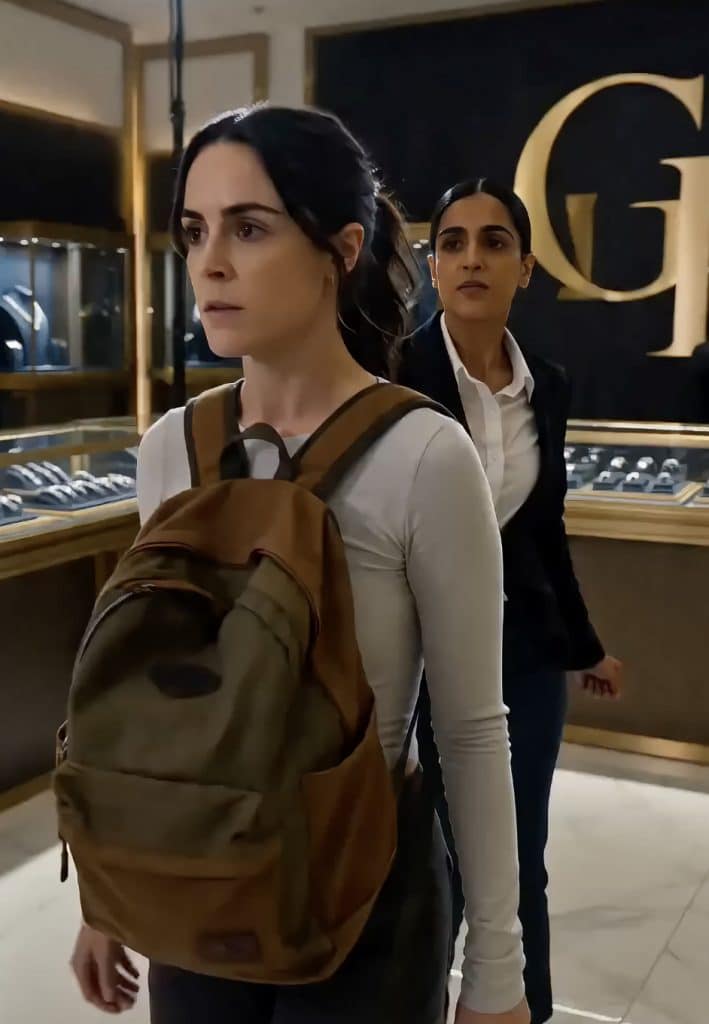
The story below is inspired by the jewelry-boutique scenario provided in the uploaded video analysis.
Act I
The accusation came so suddenly that nobody had time to question it.
One moment, the young woman was quietly walking through the luxury jewelry boutique, admiring the sparkling displays beneath warm golden lights.
The next, a store employee had her hands inside the woman’s backpack.
Customers turned.
Employees froze.
The woman barely had time to react.
The employee unzipped the backpack, reached inside, and triumphantly pulled out a diamond necklace.
Gasps spread across the showroom.
The necklace glittered beneath the lights.
The employee held it high like a trophy.
“You stole this, didn’t you?”
The accusation echoed across the marble floor.
The young woman’s face drained of color.
Shock.
Confusion.
Humiliation.
All at once.
She looked at the necklace.
Then at her backpack.
Then back at the employee.
For a moment, she couldn’t even speak.
Because she knew something wasn’t right.
She had never seen that necklace before.
Yet suddenly it was in her bag.
And everyone around her was already making up their minds.
The employee stepped closer.
Confident.
Aggressive.
Certain she had caught a thief.
What nobody knew was that she had just accused the wrong person.
Very, very wrong.
And within seconds, the entire situation would explode in a way nobody expected.
Act II
Her name was Emily Carter.
To strangers, she looked ordinary.
A ponytail.
Simple clothes.
Canvas backpack.
Nothing about her appearance attracted attention.
That was intentional.
For years, Emily had avoided standing out.
Not because she lacked confidence.
Because attention often brought trouble.
Growing up, she learned how quickly people judged appearances.
People assumed intelligence based on clothing.
Honesty based on income.
Worth based on status.
Her father hated that.
A former military instructor, he taught Emily a different philosophy.
Never announce your strength.
Let people reveal themselves first.
So she trained quietly.
Years of discipline.
Years of martial arts.
Years of self-control.
Judo.
Jiu-jitsu.
Defensive tactics.
Not because she enjoyed fighting.
Because she understood something important.
Panic creates mistakes.
Control creates options.
That lesson stayed with her long after she became an adult.
It was why she remained calm when the employee accused her.
It was why she carefully watched every movement.
And it was why she immediately noticed something nobody else did.
The employee wasn’t acting like someone who had discovered a crime.
She was acting like someone desperate to prove one.
The difference was subtle.
But Emily saw it.
And it made her suspicious.
Unfortunately, the employee wasn’t interested in answers.
She wanted a confrontation.
And she was about to get one.
Act III
The employee took another step forward.
Her face burned with self-righteous certainty.
Around them, staff members watched nervously.
Nobody intervened.
Nobody questioned how a store employee had searched a customer’s belongings without permission.
Nobody asked why the alleged evidence had appeared so conveniently.
They simply watched.
The employee reached toward Emily again.
That was her mistake.
Everything happened quickly.
A hand moved.
Emily reacted.
Instinct.
Training.
Years of repetition.
She intercepted the employee’s arm before it could grab her.
The employee tried to push forward.
Emily redirected the movement effortlessly.
Several employees gasped.
The confrontation escalated instantly.
The employee lunged again.
Emily remained calm.
Focused.
Controlled.
Within seconds, the employee found herself losing balance.
Losing control.
Losing the confidence she had displayed moments earlier.
Customers stepped back.
Nobody understood what they were seeing.
Only that the woman accused of theft suddenly looked far more composed than the person accusing her.
Then came the final mistake.
The employee charged recklessly.
Emily pivoted.
Turned.
And executed a flawless shoulder throw.
The employee’s feet left the ground.
For a brief moment, she was completely airborne.
Then she crashed onto the marble floor.
The diamond necklace flew from her hand and clattered across the showroom.
Silence followed.
Absolute silence.
Everyone stared.
The employee groaned on the floor.
Emily stood calmly above her.
Not triumphant.
Not angry.
Simply waiting.
And then a new voice broke the silence.
Act IV
“Stop!”
The store manager rushed from behind the counter.
Panic covered his face.
Not anger.
Panic.
That detail immediately caught everyone’s attention.
He wasn’t looking at Emily.
He wasn’t looking at the employee.
He was looking at another necklace in his hand.
An identical necklace.
The room froze.
The manager swallowed hard.
“It was never missing.”
Nobody moved.
Nobody spoke.
The words seemed impossible.
The manager lifted the second necklace.
“The necklace was inside the counter.”
A wave of confusion spread through the showroom.
The employee’s eyes widened.
The customers exchanged stunned glances.
The manager looked sick.
Because he already understood the implications.
If the original necklace had never been missing…
Then why was another one found inside Emily’s backpack?
The question hung heavily in the air.
Nobody wanted to answer it.
Especially the employee lying on the floor.
The manager turned toward her.
Slowly.
Carefully.
As though he were afraid of the truth.
Security footage would later reveal everything.
The employee had hidden a display necklace earlier that day.
She planned to “discover” it later.
Not because she believed Emily had stolen it.
Because she wanted recognition.
Praise.
A dramatic moment proving her vigilance.
Then panic took over when she realized the real necklace was still inside the counter.
By then, she had already planted the second necklace inside Emily’s open backpack.
What began as dishonesty became something much worse.
A false accusation.
A public humiliation.
And potentially a crime.
The employee finally understood the gravity of what she had done.
The color disappeared from her face.
But the worst part was still coming.
Act V
The boutique closed early that afternoon.
Statements were collected.
Security footage was reviewed.
Every minute of the incident was documented.
Every action.
Every lie.
Every decision.
The evidence left no room for debate.
The employee’s career ended that day.
But Emily wasn’t interested in celebrating.
As she sat with the store manager afterward, she asked a question that stayed with him for years.
“What would have happened if I couldn’t defend myself?”
The manager had no answer.
Because they both knew the truth.
Most people couldn’t.
Most innocent people don’t have years of martial arts training.
Most innocent people freeze when falsely accused.
Most innocent people would have been escorted out in disgrace.
Perhaps arrested.
Perhaps publicly shamed.
Perhaps forever carrying a stain they never deserved.
The realization haunted the manager.
And it transformed the store.
Policies changed immediately.
Employees were prohibited from searching personal belongings without proper authorization.
New customer-protection procedures were introduced.
Training emphasized respect before suspicion.
Evidence before accusation.
Facts before judgment.
Weeks later, Emily returned to the boutique.
The atmosphere felt completely different.
Customers were welcomed.
Employees were careful.
Professional.
Respectful.
As she prepared to leave, the manager personally thanked her.
Not for exposing an employee.
For exposing a weakness in the system.
Emily adjusted her backpack and smiled faintly.
Then she glanced toward the display cases.
Toward the diamonds.
Toward the luxury surrounding them.
And she said something the manager never forgot.
“The most valuable thing in this store was never the jewelry.”
The manager looked puzzled.
Emily pointed toward the entrance.
“Trust.”
Then she walked away.
Leaving behind a lesson worth more than every diamond in the building.
Because once trust is stolen, replacing it is far harder than replacing any necklace.
And sometimes the person accused of a crime is the only innocent person in the room.