Act I
The glass shattered before anyone understood why.
Orange juice splashed across the white marble floor, bright and violent against the polished stone. Shards scattered beneath the groom’s shoes. The string quartet faltered. A hundred wedding guests turned in their seats.
Nathaniel Carrington stood frozen in his black tuxedo, one hand still lifted where the glass had been.
The rim had been inches from his mouth.
He had not taken a sip.
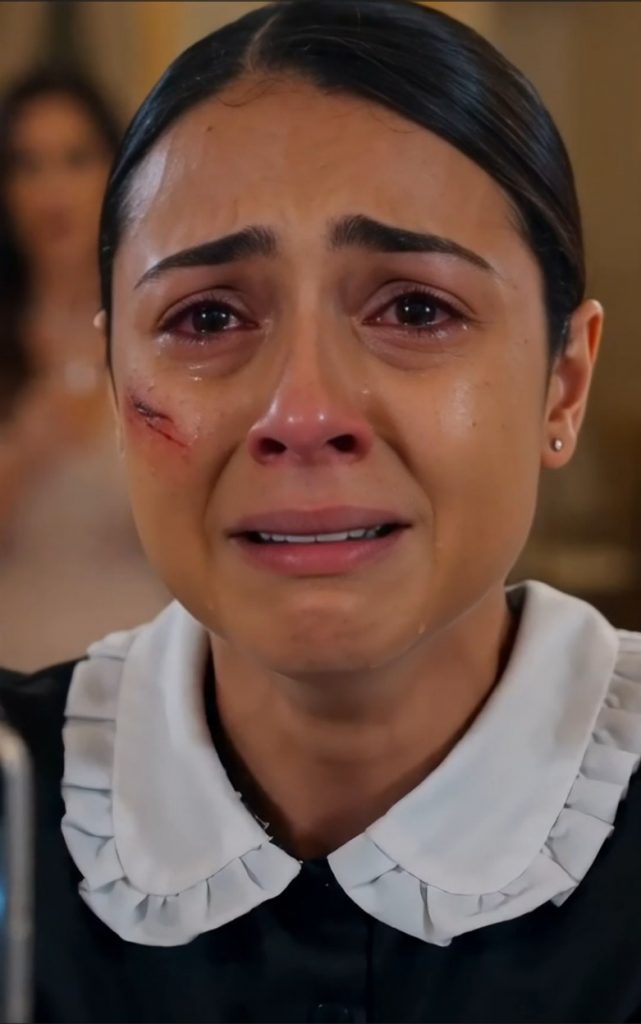
The maid who knocked it away stood beside him, breathing hard, her black service dress trembling around her knees. Her dark hair was pinned into a neat bun, but one strand had slipped loose against her cheek. She looked terrified.
Not guilty.
Terrified.
Then the bride came forward.
Vivienne Hale moved like a storm in lace. Her veil dragged behind her, pearl earrings swinging against her neck, her beautiful face twisted with rage.
Before the maid could speak, Vivienne slapped her.
The sound cracked through the ballroom.
“What kind of rudeness is this?!” she shouted.
The maid stumbled back, one hand rising to her reddened cheek. Gasps rippled through the guests. Candles flickered on the tables. Somewhere near the head table, Vivienne’s mother stood slowly, her expression turning cold.
Nathaniel looked from the shattered glass to the maid.
“Why did you do that?” he asked, shaken.
The maid’s eyes filled with tears.
Her name was Elena Cruz, though no one in the ballroom knew it. To them, she was only staff. A uniform. A pair of hands carrying trays beneath chandeliers.
Vivienne pointed toward the floor.
“Get her out,” she snapped. “Now.”
Elena reached into her apron pocket with trembling fingers.
“No,” she whispered. “Please. Look.”
She pulled out her phone.
On the screen was a video, shaky but clear.
A hand with long white-manicured nails hovered above a glass of orange juice. Two small white pills dropped in, disappeared beneath the surface, and the hand stirred the drink with a silver cocktail pick.
The ballroom went silent.
Nathaniel leaned closer.
Vivienne stopped breathing.
Elena looked at the groom through tears.
“I only wanted to save your life.”
And then Nathaniel saw the diamond ring on the hand in the video.
It was his bride’s.
Act II
Elena had not planned to be at that wedding.
She was supposed to be working the breakfast shift at a small hotel across town, refilling coffee for tourists who mispronounced the city and businessmen who never looked up from their phones.
But one of the catering girls got sick. The agency needed a replacement fast. The pay was triple the usual rate, and Elena’s younger brother’s tuition payment was due Monday.
So she said yes.
She did not know it was the Carrington-Hale wedding until the van pulled up outside the ballroom and she saw the press barricades, the floral arch, the black cars with tinted windows.
Everyone knew the Carrington name.
Nathaniel Carrington was not just rich. He was beloved in the way wealthy men sometimes become beloved when they use money to repair things other wealthy men break. He funded children’s hospitals. Built public libraries. Paid for legal clinics in neighborhoods his own board members refused to visit.
Vivienne Hale was different.
Her family had old money, sharper money. Her father made fortunes buying distressed companies and selling them in pieces. Her mother sat on museum boards and spoke of “legacy” as if it were something you could purchase by intimidating everyone in the room.
Their wedding had been called the event of the season.
Elena only cared about making it through the night without dropping anything.
Then she saw the orange juice.
Nathaniel was famous for not drinking alcohol. Years earlier, his younger brother had died in a drunk-driving crash, and Nathaniel had never touched champagne after the funeral. At the reception, while everyone toasted with crystal flutes, he drank orange juice from a slim glass.
Elena noticed because she was assigned to the service station behind the head table.
She also noticed Vivienne.
The bride kept glancing at Nathaniel’s glass.
Not lovingly.
Not casually.
Checking.
At first, Elena told herself she was imagining things. Rich people were strange at weddings. Brides became nervous. Families whispered. Mothers gave orders with smiles so tight they looked painful.
But when Vivienne stepped behind the floral partition near the service area, Elena saw her remove something from the tiny satin pouch hidden beneath her bouquet ribbon.
Two pills.
Elena froze.
The bride dropped them into the glass.
Then stirred.
Elena’s first instinct was not heroism. It was fear.
Who would believe her?
A maid. A replacement server. A woman whose name wasn’t even printed on the staffing sheet until an hour before the ceremony.
Vivienne Hale was standing under chandeliers in a custom lace gown while photographers waited to turn her smile into tomorrow’s front page.
Elena’s hand shook as she lifted her phone.
She recorded because proof was the only language the powerful could not easily erase.
Then a guest bumped into the service cart.
Vivienne looked up.
For one terrifying second, their eyes met.
Elena lowered the phone too late.
Vivienne’s expression did not change, but something in her face sharpened.
Then she picked up the glass and carried it toward Nathaniel.
Elena had one choice.
Speak and be stopped.
Or move.
So she ran.
And in front of two hundred guests, she slapped the glass from the groom’s hand before the poison could touch his lips.
Act III
For several seconds after the video played, no one moved.
Then the room erupted.
Guests stood. Chairs scraped. Someone screamed. The wedding planner began saying, “Please remain calm,” even though she looked seconds from fainting.
Nathaniel took Elena’s phone with both hands and replayed the video.
Once.
Twice.
His face lost all color.
Vivienne laughed.
It was a brittle, ugly sound.
“That could be anyone,” she said.
Elena looked at her. “It was you.”
Vivienne’s eyes flashed. “You filthy liar.”
Nathaniel turned slowly toward his bride.
“Vivienne,” he said. “Show me your hand.”
She drew back as if he had struck her.
“Are you serious?”
“Show me.”
Every eye in the ballroom dropped to her right hand.
The white manicure matched.
So did the diamond ring.
The same oval stone. The same halo setting. The same thin platinum band Nathaniel had placed on her finger in front of everyone less than two hours earlier.
Vivienne clenched her fist.
Her mother, Celeste Hale, stepped forward.
“This is absurd,” Celeste said. “You are humiliating my daughter on her wedding day because of a servant’s little video?”
Elena flinched at the word servant, but she did not lower her eyes.
Nathaniel looked at Celeste. “My drink was tampered with.”
Celeste’s face hardened. “Then call security and have the staff questioned.”
“That video shows Vivienne.”
“It shows a hand.”
Elena swallowed.
“There’s more.”
Vivienne’s head snapped toward her.
Elena tapped the phone again.
The video continued.
After stirring the drink, Vivienne whispered into her own reflection in the silver tray.
“Just enough to make him sign. Nothing more.”
Nathaniel stared.
“Sign what?” he asked.
Vivienne’s face emptied.
The question hung over the ballroom.
Then Nathaniel remembered the envelope.
Fifteen minutes before the toast, Vivienne’s father had taken him aside with a smile and a folder. He had said it was just a symbolic family trust document, something to formalize the merger of two charitable foundations after the wedding.
Nathaniel had laughed and said they could handle business after the honeymoon.
Vivienne had kissed his cheek.
“Please,” she had whispered. “For me?”
He had agreed to look at it later.
Later.
After the drink.
Nathaniel’s jaw tightened.
“Bring me the folder,” he said.
No one moved.
Vivienne’s father, Richard Hale, was no longer at the head table.
He was walking toward the ballroom doors.
Security stopped him before he reached them.
Act IV
The folder changed everything.
It was not a symbolic trust document.
It was a transfer of voting control.
Had Nathaniel signed it, the Hale family would have gained immediate influence over the Carrington Foundation’s investment board, donor access, and a restricted reserve fund meant for hospitals, shelters, and disaster relief programs.
Nathaniel read only the first page before his hands began to shake.
“You were going to drug me into signing this?”
Vivienne whispered, “It wasn’t supposed to hurt you.”
The sentence was so small, so desperate, that for one second it almost sounded human.
Then Nathaniel looked at Elena’s reddened cheek.
At the broken glass.
At the orange stain spreading over the marble.
“At what point,” he asked softly, “was I supposed to thank you?”
Vivienne’s eyes filled, but the tears looked angry.
“You don’t understand what my father would have done if this failed.”
Richard Hale shouted from near the doors, “Vivienne, stop talking.”
That was the first honest thing he had said all night.
The ballroom shifted again.
Now the bride looked less like a mastermind and more like a daughter raised inside a machine that turned fear into obedience. But fear did not make the glass safe. Fear did not erase the pills. Fear did not unstrike Elena’s face.
Nathaniel turned to security.
“Call the police.”
Celeste gasped. “You would destroy her?”
Nathaniel’s voice broke.
“She tried to destroy me.”
Elena stood alone near the head table, phone still in hand. Her cheek burned. Her chest hurt from holding back sobs. She had imagined many outcomes when she knocked that glass away.
Being believed had not been one of them.
A uniformed security guard approached her gently.
“Miss, we’ll need your statement.”
Elena nodded, but her eyes stayed on Nathaniel.
He looked back at her, and something in his expression changed from shock to gratitude so raw it was almost unbearable.
“I’m sorry,” he said.
Elena blinked. “For what?”
“For not asking before everyone else started accusing.”
That broke her more than the slap.
Because no one had ever apologized to her for being doubted.
The police arrived under chandeliers.
There was no dramatic chase. No screaming confession from the bride. Only officers moving through the golden ballroom, collecting the broken glass, the remaining orange juice, the phone, the folder, the silver stirrer, and every lie that had been polished enough to pass as ceremony.
Vivienne was escorted out still wearing her wedding gown.
Her veil trailed behind her over the marble.
For the first time all night, no one called her beautiful.
Act V
The newspapers called it the poisoned wedding.
Nathaniel hated that phrase.
It turned betrayal into spectacle. It made Elena into a headline and Vivienne into a villain in white lace, as if people could be understood fully from one frozen image.
The truth was uglier and more complicated.
The pills were sedatives, strong enough to impair judgment and dangerous in combination with Nathaniel’s heart medication. The intention, prosecutors argued, had not been public harm but private control.
Vivienne accepted a plea months later.
Her father fought harder.
Richard Hale denied everything until the financial trail surfaced: debts hidden beneath shell companies, pressure from investors, messages instructing Vivienne to “secure Nathaniel’s signature before the reception ends.”
Celeste claimed ignorance.
No one believed her fully, but belief and proof are different things.
Elena testified in a navy dress borrowed from her cousin.
She hated the courtroom almost as much as the ballroom. Too many eyes. Too much polished wood. Too many people deciding whether her truth sounded respectable enough.
But when she took the stand, Nathaniel sat in the front row.
Not beside her.
Not in a way that made the story romantic or strange.
Just present.
Visible.
A man alive because a young woman in a maid’s uniform had chosen action over safety.
The defense tried to make Elena look opportunistic.
They asked why she had been recording.
They asked whether she wanted money.
They asked whether she resented wealthy guests.
Elena answered quietly.
“I recorded because I knew no one would believe me without proof.”
The courtroom went silent.
That answer did more damage than anger ever could.
After the trial, Nathaniel established the Cruz Integrity Fund, named not for himself, but for Elena’s late mother, a hotel housekeeper who had raised three children and taught them never to confuse wealth with worth.
The fund provided legal support and emergency protection for service workers who reported abuse, corruption, or danger in private events and elite homes.
Elena objected to the name at first.
Nathaniel listened.
Then he said, “Your mother raised the woman who saved my life. I think her name belongs on the door.”
Elena cried in the parking lot where no cameras could see.
A year later, she no longer worked for the catering agency.
She ran operations for the fund, training staff to document safely, report quickly, and trust their instincts when something felt wrong beneath a beautiful surface.
She still kept the phone.
The original was locked in evidence for months, then returned to her after the case closed. Its screen was cracked from the chaos of that night, one corner dented from where she dropped it after the slap.
She never repaired it.
“It reminds me,” she told Nathaniel once.
“Of what?”
“That proof can be fragile and still hold.”
Nathaniel did not marry again quickly.
The gossip columns tried to push him into a redemption narrative, pairing him with actresses, heiresses, board members, anyone who looked good beside him in a photograph.
He ignored them.
For a long time, he focused on rebuilding what had almost been stolen. The foundation tightened its safeguards. Every major transfer required independent review. Every board member was investigated for conflicts of interest. Every trust document was rewritten so no one person’s signature, impaired or pressured, could endanger the entire mission.
He also called Elena every year on the date of the wedding.
Not to relive it.
To say thank you again.
On the third anniversary, the Carrington Foundation held a gala in the same ballroom.
Elena almost refused to attend.
The memory was too vivid.
The glass.
The slap.
The way every guest had looked at her like she was the stain on the marble instead of the person trying to stop one.
But Nathaniel asked once.
Only once.
So she went.
The ballroom looked different that night. Same chandeliers. Same marble. Same candles glittering in gold holders. But at the center of the room, there was no wedding cake, no lace veil, no hidden folder waiting to trap a man behind a smile.
There were service workers seated at tables with donors.
Nannies beside executives.
Drivers beside lawyers.
Housekeepers beside board members.
Not as decoration.
As guests.
Nathaniel took the stage near the spot where the glass had shattered years before.
He spoke about trust.
Not the legal kind first.
The human kind.
Then he asked Elena to stand.
She froze.
He had not warned her.
The room turned.
For one breath, she was back in the wedding reception, cheeks burning, phone shaking, waiting to be called a liar.
Then people began to applaud.
Not politely.
Fully.
Elena stood slowly.
Tears blurred the chandeliers into gold light.
Nathaniel looked at her from the stage.
“Some people think courage arrives loudly,” he said. “But sometimes it wears an apron, stands in the back of the room, sees what everyone else misses, and moves faster than fear.”
Elena pressed one hand to her mouth.
The applause rose higher.
This time, no one shoved her out.
No one slapped her.
No one called her rude for saving a life.
Years later, guests would still talk about the Carrington-Hale wedding as a scandal, a mystery, a near tragedy wrapped in white lace.
But Elena remembered it differently.
She remembered the exact second before she moved.
The rim of the glass near Nathaniel’s mouth.
The pills dissolving invisibly in the juice.
The knowledge that if she waited for permission, permission would come too late.
So she ran.
That was the truth beneath all the luxury, all the headlines, all the courtroom testimony.
One woman saw danger.
One man was about to drink.
And between them stood the smallest window of time.
Elena did not waste it.
Because sometimes a crash is not destruction.
Sometimes it is the sound of a life being saved before anyone else understands there was danger at all.