Act I
The hallway outside the bridal suite was too beautiful for the kind of secret it was holding.
White paneled doors. Gold-trimmed moldings. Tall windows throwing soft daylight across polished floors. Somewhere below, a string quartet was playing for two hundred guests who believed they had come to witness a perfect wedding.
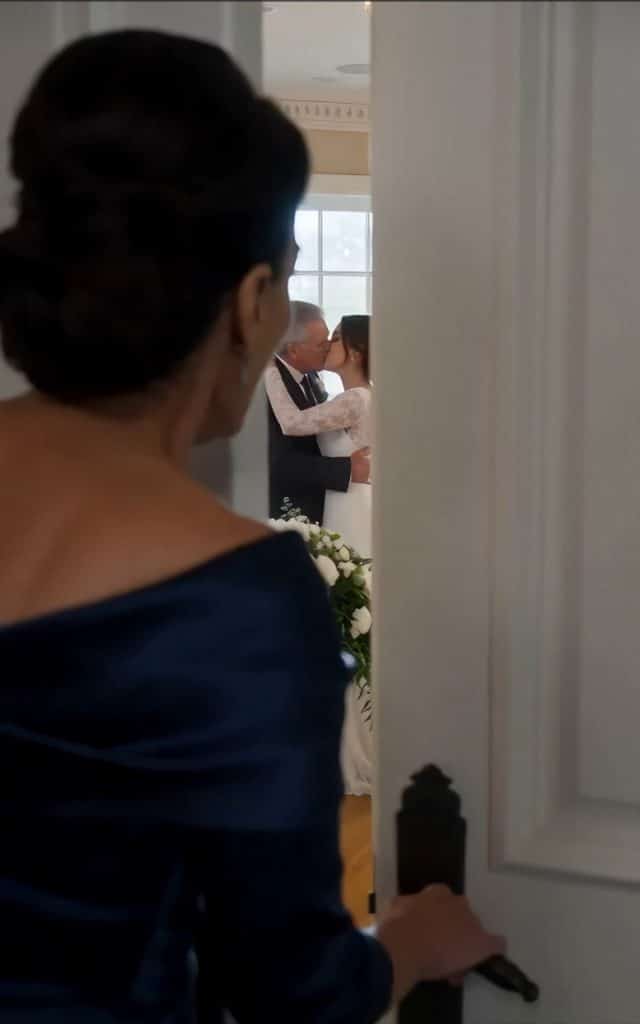
Margaret Vale stood outside the half-open door with her hand on the knob.
Her diamond ring caught the light as her fingers tightened.
At first, she thought she had misunderstood what she was seeing.
The bride’s white lace dress.
Her husband’s gray hair.
His hand at the bride’s waist.
The kiss.
Margaret’s breath vanished.
The room beyond the door was full of flowers, champagne glasses, and wedding-day sunlight. It should have looked innocent. Sacred, even.
Instead, it looked like the final insult in a marriage that had spent thirty years teaching Margaret how quietly betrayal could enter a home.
She pulled back from the crack in the door, both hands flying to her mouth.
“Oh my god,” she whispered.
Inside the room, her husband laughed softly.
Not nervously.
Not with shame.
With pleasure.
Margaret shut the door carefully, so carefully the latch barely clicked. Her body shook with the effort not to scream.
Then she turned.
Owen stood at the end of the hallway in his charcoal wedding suit, white rose pinned to his lapel. He looked impossibly calm, his dark eyes fixed on her as if he had been waiting for her to look exactly like this.
“Owen,” Margaret breathed.
He did not move.
She stepped toward him, her voice breaking into panic.
“Owen, your father is in there with your bride.”
For a second, the entire estate seemed to hold still.
The music downstairs faded behind the walls. The murmur of guests became distant. Somewhere, a bridesmaid laughed, unaware that the wedding had already begun to rot from the inside.
Owen’s expression did not change.
He looked at his mother with a calm so complete it frightened her more than rage would have.
“I know,” he said.
Margaret stared at him.
“You know?”
His eyes remained steady.
She grabbed his sleeve. “Then stop this now.”
Only then did Owen smile.
Not happily.
Not kindly.
The kind of smile a man gives when the trap has finally closed.
“Not yet,” he said.
Margaret’s hand dropped from his arm.
Behind her, the closed door hid her husband and the woman who was supposed to marry her son in less than twenty minutes.
In front of her stood Owen, still, polished, and terrifyingly composed.
And Margaret realized this was not the moment the betrayal had been discovered.
It was the moment she had been allowed to discover it.
Act II
The Vale wedding had been designed to look like a merger between love and royalty.
Owen Vale, heir to the Vale Foundation, was marrying Celeste Marlow, the daughter of a respected art dealer and a woman society magazines loved to describe as “effortlessly luminous.” The ceremony was being held at Whitestone Manor, the family estate where Owen had grown up beneath marble staircases, oil portraits, and rules no one admitted were rules.
The guest list included senators, donors, museum trustees, old-money widows, and people who still believed wealth was proof of character.
Margaret had planned every detail.
Not because she trusted the marriage.
Because she loved her son.
Owen had always been hard to read, even as a child. Quiet. Observant. Too intelligent for comfort. He noticed which servants were nervous, which adults were lying, which smiles lasted half a second too long.
His father, Richard Vale, called him cold.
Margaret called him careful.
She had learned the difference.
Richard had ruled the family with charm in public and cruelty in private. Never the messy kind that left easy evidence. His weapons were softer. Disappointment. Mockery. Financial control. A hand at the back of Margaret’s chair that looked affectionate but pressed too hard when she said the wrong thing.
For years, she stayed because leaving a man like Richard required more than courage.
It required proof.
Richard owned the lawyers. Richard owned the board. Richard owned the story people believed about him.
Then Celeste entered their lives.
She arrived at a charity auction on Owen’s arm, blonde, graceful, smiling with the careful warmth of someone who had studied how rich families breathe. Margaret tried to like her. She really did.
Celeste sent handwritten thank-you notes. Remembered birthdays. Complimented Margaret’s taste in flowers. Spoke softly about wanting a family after years of loneliness.
But Margaret saw the little things.
The way Celeste’s eyes moved toward Richard whenever Owen looked away.
The way Richard became younger in her presence, ridiculous and hungry for admiration.
The way Celeste never seemed surprised by anything inside the Vale estate, even rooms Owen claimed she had never visited.
Margaret told herself she was being paranoid.
Women married to men like Richard often learn to distrust their own instincts because men like Richard survive by convincing them instincts are hysteria.
Then, three weeks before the wedding, Margaret found a pearl earring under the desk in Richard’s private study.
Celeste wore pearls.
Margaret said nothing.
She watched.
Owen watched too.
That was the part she had not understood until now.
He had seen more than she had. Maybe from the beginning.
“Owen,” she whispered in the hallway, “how long?”
His smile disappeared.
“Long enough.”
“Why didn’t you tell me?”
His eyes softened for the first time.
“Because you would have tried to stop the wedding.”
“Of course I would have.”
“And then he would have called you unstable. He would have said grief over your marriage made you jealous of a younger woman. He would have buried you before you reached the truth.”
Margaret stepped back as if he had struck her.
Because he was right.
Richard would have done exactly that.
Owen glanced toward the closed door.
“Today he buries himself.”
The words chilled her.
Downstairs, the quartet changed songs.
Guests began taking their seats.
The wedding was still moving forward.
And Owen wanted it that way.
Act III
Owen led his mother into the small library across the hall.
It was one of the few rooms in Whitestone Manor not filled with wedding flowers. Dark shelves. Green velvet chairs. A chessboard untouched beside the window. Quiet enough for the truth to speak without being overheard.
Margaret closed the door behind them.
Her hands were still shaking.
“What have you done?”
Owen reached into the inside pocket of his suit jacket and removed a slim black drive.
“This started six months ago,” he said.
“Celeste?”
“No. Father.”
Margaret’s stomach tightened.
Owen placed the drive on the desk between them.
“Richard has been moving money out of the foundation for years. Donations meant for hospitals, scholarships, shelters. He used shell grants, fake consulting fees, and art purchases through Marlow galleries.”
Margaret whispered, “Celeste’s family.”
Owen nodded.
“Her father helped wash the money. Celeste helped secure access.”
Margaret reached for the chair behind her and sat down slowly.
The room seemed to tilt.
“The marriage,” she said.
“Was never about love.”
Owen’s jaw tightened.
“It was a contract. If I married her, her family gained permanent access to the foundation’s private endowment accounts. Father planned to force me out within a year and name himself acting chair again.”
Margaret stared at him.
“But why would he use your marriage?”
“Because the board trusts me. Because the public trusts the foundation when I’m standing beside it. Because nothing photographs better than a wedding.”
His voice stayed calm, but Margaret heard the wound beneath it.
Not heartbreak over Celeste.
Something deeper.
A son finally seeing the full shape of his father’s contempt.
“What about what I saw?” Margaret asked. “Was that part of the arrangement too?”
Owen looked toward the door.
“No. That was arrogance.”
Richard thought everyone in the estate belonged to him in some way. His wife. His son. The staff. The foundation. Even the bride.
Celeste thought betraying Owen with Richard made her powerful.
Neither understood Owen had stopped playing the role of fool weeks ago.
“How did you know they would be in that room?” Margaret asked.
“I didn’t know for sure.”
“But you let me walk past the door.”
Owen’s face tightened.
That was the first crack.
“I needed you to see it.”
Margaret stood.
“You used me.”
“I protected you.”
“No, Owen. You used me.”
The words landed hard between them.
For the first time, he looked away.
Margaret’s voice softened, but did not weaken.
“I am not angry because you planned against your father. God forgive me, I should have done it years ago. I am angry because you thought I could only be trusted with the truth once it was too late to choose what to do with it.”
Owen closed his eyes briefly.
When he opened them, he looked younger.
“I didn’t want him to hurt you again.”
“He already did.”
The silence that followed was full of thirty years.
Then Owen picked up the drive.
“The ceremony starts in ten minutes,” he said. “At the altar, Father will stand in the front row. Celeste will walk down the aisle. The board chair, Judge Ellis, and half the donors will be in the room.”
Margaret understood.
“You’re going to expose them during the wedding.”
“No,” Owen said. “I’m going to let them expose themselves.”
Before Margaret could ask what he meant, someone knocked on the library door.
Three quick taps.
Then a woman’s voice.
“Owen? It’s time.”
Celeste was outside.
Act IV
Margaret stopped breathing.
Owen slipped the drive back into his jacket and opened the door.
Celeste stood in the hallway in her lace wedding dress, veil pinned perfectly, lips flushed, eyes bright with a performance so flawless it would have fooled anyone who had not seen her seconds earlier in Richard’s arms.
“Owen,” she said softly. “Everyone’s waiting.”
Her gaze flicked to Margaret.
A tiny flash of alarm crossed her face.
Then it vanished.
“Margaret,” she said. “You look pale. Is everything all right?”
Margaret almost laughed.
Instead, she stepped forward and adjusted Celeste’s veil with trembling fingers.
“You look beautiful.”
Celeste smiled.
“Thank you.”
Margaret leaned closer, close enough that only the bride could hear.
“And careless.”
Celeste’s smile froze.
Owen watched silently.
From the far end of the hallway, Richard appeared, adjusting his cuff links. He looked completely composed. The perfect father of the groom. Silver-haired. Elegant. Untouchable.
His eyes met Margaret’s.
For one second, she saw the question there.
How much do you know?
She held his gaze.
Enough.
Richard smiled as if bored.
That was his mistake.
He still believed shame belonged to everyone else.
The ceremony began under a canopy of white roses in the grand ballroom. Guests turned as Celeste walked down the aisle. Cameras lifted. The quartet played softly. Richard sat in the front row beside Margaret, his hand resting near hers as if they were still a respectable couple.
Margaret did not move away.
Not yet.
Owen stood at the altar like a man carved from stone.
Celeste reached him and took his hands.
Hers were cold.
The officiant began speaking about love, fidelity, and sacred promises.
The irony was almost unbearable.
Then came the vows.
Celeste smiled up at Owen, eyes shining with practiced emotion.
“I promise to honor you,” she said. “To stand beside you. To be faithful in heart and life.”
A murmur of approval moved through the guests.
Owen nodded gently.
Then he lifted her hand and turned slightly, facing not only her, but the room.
“I prepared something too,” he said.
Celeste’s smile faltered.
Richard’s hand tightened on the arm of his chair.
A large screen behind the floral arch came alive.
Not with a slideshow.
With security footage.
The bridal suite.
The door cracked open.
Richard and Celeste in each other’s arms.
Gasps ripped through the ballroom.
Celeste stumbled back.
Richard stood so fast his chair struck the floor behind him.
“Owen!” he barked.
But the video continued only long enough to make denial impossible.
Then the image changed.
Bank transfers.
Foundation accounts.
Marlow gallery invoices.
Emails.
Richard’s name.
Celeste’s father’s name.
Celeste’s name.
Owen’s voice cut through the chaos, low and clear.
“This wedding was arranged to conceal theft from the Vale Foundation. Every document you are seeing has already been sent to the board, the attorney general’s office, and the press.”
Richard’s face drained.
Celeste whispered, “Owen, please.”
He looked at her.
There was no hatred in his face.
Only finality.
“You should have chosen someone easier to underestimate.”
Then Margaret stood.
The room turned toward her.
Richard’s expression shifted from rage to warning.
The old warning.
The one that had silenced her for decades.
This time, it failed.
Margaret removed her wedding ring and placed it on the seat beside him.
“I want it on record,” she said, voice trembling but clear, “that I will testify.”
Richard stared at her as if he had never seen her before.
Maybe he had not.
Act V
The wedding did not end with a kiss.
It ended with police cars outside Whitestone Manor and guests whispering into phones beneath chandeliers that had seen generations of family lies but never one this public.
Celeste did not faint.
Margaret noticed that.
She cried, yes. She pleaded. She reached for Owen twice and was stopped both times by her own father’s attorney pulling her back before she made things worse.
But she did not faint.
Women like Celeste survived by turning collapse into strategy, and she was already calculating what role would save her.
Victim.
Naive bride.
Manipulated daughter.
Owen let the investigators sort through that.
He had no interest in revenge beyond truth.
Richard was different.
He raged until no one listened. Threatened lawsuits. Called Owen ungrateful. Called Margaret unstable. Accused the board of betrayal, as if betrayal were something he had invented and therefore owned.
But the files were real.
The footage was real.
Margaret’s testimony was real.
And for the first time in his life, Richard Vale found himself in a room where charm had no market value.
In the weeks that followed, the Vale Foundation became headline news.
Funds recovered.
Executives removed.
Marlow Gallery investigated.
Donors furious.
Hospitals and scholarship programs that had quietly suffered under missing money were named publicly, and Owen made sure repayment began before the lawyers finished arguing over language.
The press wanted to make the story about the wedding scandal.
Owen refused.
Whenever cameras asked about Celeste, he spoke about stolen medical grants.
Whenever they asked about betrayal, he spoke about shelter funding.
Whenever they asked how he felt seeing his bride with his father, he said, “Less important than what they stole from people who needed help.”
Margaret watched those interviews from her new apartment.
Not the estate.
Never again.
For the first time in thirty years, she lived in rooms where no one monitored her tone.
She bought cheap flowers from a corner market because she liked them, not because they matched an event palette. She slept badly at first, then deeply. She learned how quiet peace could be when it was not waiting for footsteps outside the door.
Owen visited often.
At first, their conversations were awkward.
There was too much love between them to walk away, and too much hurt to pretend nothing had happened.
One evening, Margaret poured tea and said, “You became very good at secrets.”
Owen looked down.
“So did you.”
She could not argue.
They sat with that truth.
Then Owen said, “I thought if I controlled everything, no one could hurt you.”
Margaret smiled sadly.
“That is what your father thought too.”
He flinched.
She reached across the table and took his hand.
“The difference is, you are still capable of hearing that sentence and being ashamed.”
That was where healing began.
Not in grand apologies.
In honest ones.
A year later, the foundation reopened under a new charter. Public audits. Independent oversight. No family member with unchecked control. Margaret joined the ethics committee, not because Owen asked her to, but because she asked herself what kind of woman she wanted to be after spending too long surviving one man’s shadow.
At the first public gala after the scandal, she wore navy blue again.
Not the same gown.
Something simpler.
Owen stood beside her, no boutonniere, no bride, no performance.
When the guests began to applaud the foundation’s new free clinic program, Margaret looked at her son and saw not the calculating smile from the hallway, but the boy she had raised beneath all that marble and silence.
Careful.
Wounded.
Trying.
After the speeches, Owen stepped onto the balcony alone.
Margaret followed.
Below them, the estate gardens glowed under lanterns. Whitestone Manor had been sold to fund the programs Richard had robbed. This was the last event the family would ever host there.
Owen rested both hands on the stone railing.
“Do you ever miss it?” he asked.
“The house?”
“The life.”
Margaret looked back at the ballroom. At the glittering people, the polished floors, the beautiful rooms that had hidden so many ugly things.
“No,” she said.
Then, after a moment, “I miss who I might have been if I had left sooner.”
Owen closed his eyes.
“I’m sorry.”
“I know.”
This time, she believed him.
Inside, music began again.
Not wedding music.
Something brighter.
Margaret slipped her arm through her son’s.
“Come on,” she said. “Let’s go back in before someone thinks we’re being dramatic.”
For the first time in a long time, Owen laughed.
The sound was small, surprised, almost rusty.
But real.
And Margaret understood then that the hallway had not been the beginning of the ruin.
It had been the end of the performance.
A door cracked open.
A secret seen.
A son saying “not yet” because he had waited for the exact moment truth could do what silence never had.
Destroy the lie.
Save the people it had fed on.
And finally, finally, set them free.