Act I
Max hit the sandpit like a missile.
One second, Noah was crouched beside a blue plastic shovel, drawing crooked roads in the sand with one small hand. The next, a brindle-and-white dog came flying across the grass, low to the ground, muscles tight, eyes locked forward.
“Noah!” his mother screamed.
Max slammed into the boy’s side and knocked him down.
Sand burst into the air. Noah cried out, confused and terrified, his little arms folding over his chest as he rolled onto his back. His mother, Lena Ortiz, sprinted toward him in teal medical scrubs, heart in her throat, certain she had just watched a dog attack her child.
“Max!” a man shouted from the lawn. “Max, come back!”
The dog’s owner, Ryan Cole, ran toward the sandpit with one hand raised, but he stopped before getting too close. His face had gone pale under his dark baseball cap.
Because Max was not looking at Noah anymore.
He was staring at the man in the black hoodie standing only a few feet from the sandpit.
The man was broad-shouldered, bearded, and tense, with his hood pulled low despite the bright sun. His hands hovered near his sides. His jaw was clenched. He looked less shocked than furious.
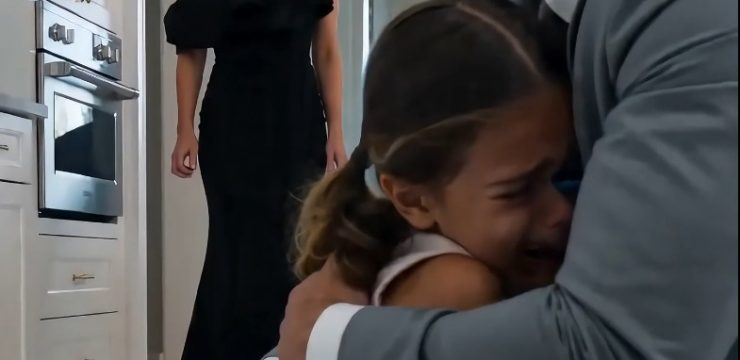
Lena dropped to her knees and pulled Noah into her arms.
“My baby, my baby,” she gasped, checking his face, his arms, his legs. “Are you hurt?”
Noah sobbed against her chest.
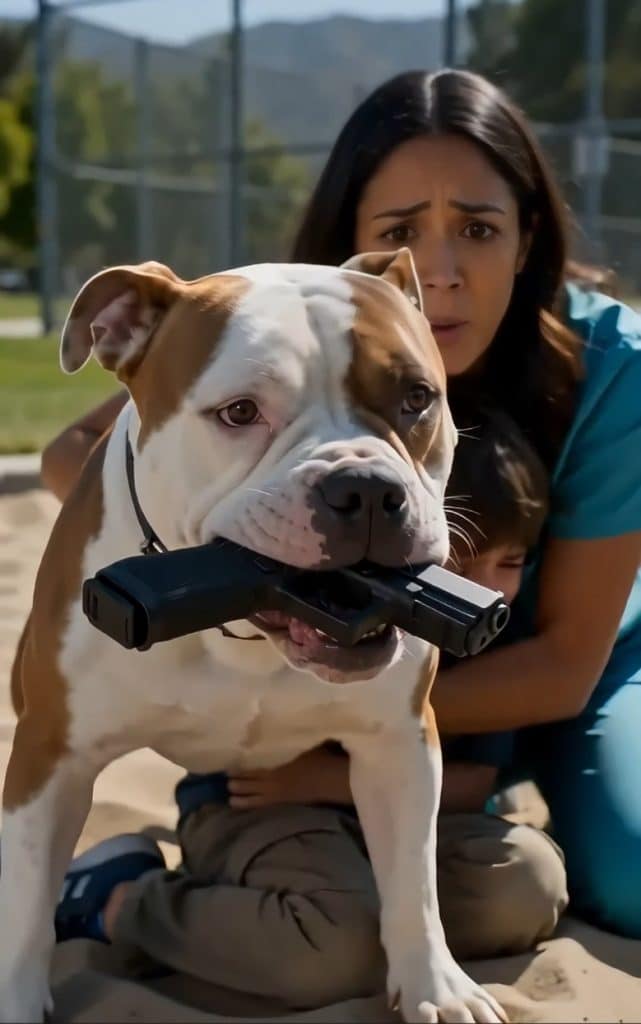
Max stood between them and the man in the hoodie.
His body was rigid.
His breathing was heavy.
And clamped carefully in his mouth was a black handgun.
The entire playground went silent.
Lena stared, her breath catching so sharply it hurt.
Then she looked at the man.
“He pushed him away from him,” she whispered.
The man in the hoodie exploded.
“That dog stole my gun!” he shouted. “I have a concealed carry permit. Get that animal away from me right now!”
But Max did not move.
He stood in the sand, weapon held away from the child, eyes fixed on the man who suddenly looked very afraid of being seen.
In the distance, police sirens began to rise.
Ryan kept his hands visible and his voice steady.
“Max,” he said carefully. “Drop it, boy.”
Max did not obey.
Not yet.
The police SUV pulled up behind the chain-link fence with red and blue lights flashing.
And by then, everyone in the park understood one thing.
The dog had not attacked Noah.
He had saved him.
Act II
Max had never been the kind of dog people trusted at first glance.
He was too muscular. Too fast. Too intense when he focused on something. People saw his broad head and brindle coat and took half a step back before they knew his name.
Ryan was used to it.
He had adopted Max three years earlier from a county shelter where the dog had been labeled difficult.
Not dangerous.
Difficult.
Max hated shouting. Hated sudden movement. Hated men who walked too close to children. He had scars beneath his short fur that explained some of it, though Ryan never asked the shelter staff to describe them in detail. He did not need the story carved into words.
He saw it in the way Max flinched at raised hands.
So Ryan trained him.
Not to be aggressive.
To be steady.
He worked with a retired K9 handler who taught Max to follow commands, ignore crowds, and alert when something felt wrong. Max learned quickly. Too quickly, sometimes. He noticed everything. A gate left open. A child wandering toward the parking lot. A jogger dropping keys. A man loitering too long beside the school fence.
Ryan called him nosy.
The trainer called him gifted.
That sunny afternoon at the park was supposed to be simple.
Ryan had taken Max for a long walk after work. The dog needed exercise, and Ryan needed air. He had been struggling lately, caught between bills, night shifts, and the quiet loneliness that followed him home to his small apartment.
Max made life feel less empty.
They reached the playground just after three.
Kids were climbing the blue slide. Parents sat on benches with coffee cups and sunscreen bags. The mountains stood clear in the distance behind the fence. Everything looked safe in the ordinary way public places look safe until one small detail changes the entire scene.
Max noticed the man in the black hoodie first.
Ryan did too, a few seconds later.
The man stood near the sandpit, not watching a child of his own, not checking a phone, not waiting for anyone. Just standing there with his shoulders tight, eyes moving across the park.
Then he looked at Noah.
Noah was playing alone at the edge of the sandpit while his mother stood a few yards away near a stroller, digging through a diaper bag for wipes. She looked tired in the way hospital workers often looked tired, like her body had carried too many emergencies already.
The man shifted closer to Noah.
Max stopped walking.
His ears changed.
Ryan felt the leash go tight.
“Easy,” he said.
Max’s eyes locked onto the man’s right side.
The man’s hand moved toward his pocket.
Ryan’s stomach dropped.
He did not see the weapon clearly. Not then. Only the shape of danger forming too quickly for thought to keep up.
Max saw enough.
He broke forward with such force that the leash slipped from Ryan’s hand.
“Max!”
The dog sprinted across the grass.
People shouted.
Lena turned just in time to see the dog hit her son.
She thought Max was the danger.
But Max had already made the decision no human in that park had time to make.
Knock the child down.
Get him away.
Then take the threat out of the man’s hand.
Act III
Officer Dana Briggs arrived expecting a dog attack.
That was how the call came through.
Possible aggressive dog. Child knocked down. Weapon mentioned. Public playground.
Those words together made every officer move faster.
But when Dana stepped from the SUV and saw the scene through the fence, she slowed.
A mother sat in the sandpit, wrapped around her crying son. A man in athletic clothes stood several steps away, palms open, speaking softly to a dog. A muscular man in a black hoodie shouted at everyone.
And the dog stood still in the sand with a handgun held by the grip in his mouth.
Dana had been a police officer for eleven years.
She had seen chaos.
But she had never seen a dog look more like the only calm witness in a crime scene.
“Everybody stay where you are!” she called.
Her partner moved toward the suspect. Dana moved toward the sandpit.
The man in the hoodie pointed toward Max.
“That thing attacked a kid and stole my property!”
Lena looked up through tears.
“No,” she said, voice shaking. “No, he pushed my son away from you.”
The suspect’s face tightened.
Dana heard that.
So did everyone.
Ryan spoke without taking his eyes off Max.
“Officer, my dog is trained. He won’t drop it while that man is still close.”
Dana looked at Max again.
The dog’s body was angled perfectly between Noah and the suspect.
Not random.
Deliberate.
“Sir,” Dana said to the suspect, “keep your hands visible.”
He scoffed. “I told you, I have a permit.”
“I didn’t ask that.”
“You should be dealing with the dog.”
“I’m dealing with the person yelling near a child after a firearm ended up in a dog’s mouth.”
The crowd murmured.
The suspect’s eyes flashed toward the fence.
Too late.
Dana’s partner had moved behind him.
“Hands where I can see them.”
The man hesitated.
That hesitation told its own story.
Then he raised his hands, furious.
Ryan took one slow step toward Max.
“Good boy,” he said softly. “Hold.”
Max’s breathing remained steady.
Dana glanced at Ryan. “Can you get him to release it safely?”
“Yes,” Ryan said. “But only after the child is farther back.”
Lena heard him and pulled Noah closer, scooting backward through the sand until Dana guided them toward the grass. Noah’s face was streaked with tears and sand, but he was not injured beyond the shock and a scraped elbow.
Dana crouched in front of him.
“Hey, Noah,” she said gently. “I’m Officer Dana. You’re doing great.”
Noah sniffled.
“The dog scared me.”
“I know.”
“He pushed me.”
Dana looked at Max.
“Yes,” she said softly. “I think he did.”
Noah looked past her at the suspect.
“He was standing too close.”
Dana’s eyes sharpened.
“What did you see?”
Noah swallowed hard.
“He said my shovel was cool. Then he asked if I wanted to see something.”
Lena froze.
The suspect shouted, “That’s not true!”
Max growled around the object in his mouth.
Ryan’s face hardened.
Dana stood slowly.
The playground no longer felt bright.
It felt exposed.
Act IV
The suspect’s name was Caleb Voss, though the first name he gave officers was fake.
That was the second problem.
The third was that his permit had expired.
The fourth was that the weapon had not been secured in the way he claimed.
The fifth was what officers found on his phone.
Pictures of the playground taken from behind the fence.
Several days’ worth.
Photos of children near the sandpit.
Photos of parents distracted by strollers, phone calls, snack bags, younger siblings.
One photo showed Noah and Lena from earlier that afternoon.
Lena saw it only for a second before Dana angled the screen away, but one second was enough.
Her knees weakened.
Ryan stepped closer, but did not touch her without permission.
“Ma’am,” he said gently, “sit down.”
Lena sat in the grass with Noah in her lap, shaking so badly that he stopped crying and began patting her shoulder like she was the one who needed comforting.
“I’m okay, Mommy,” he whispered.
She broke then.
Not loudly.
Just folded over him, holding his head against her chest while tears dropped into his hair.
Max finally released the weapon only after Voss was handcuffed and moved away.
Ryan gave the command in a low voice.
“Drop.”
Max lowered his head and let the object fall onto a police evidence cloth Dana had placed in the sand. Then the dog backed away on command and sat, still watching the patrol car where Voss was being detained.
Ryan knelt beside him.
“Good boy,” he whispered, voice thick.
Max leaned briefly into him, then looked back at Noah.
Noah stared at the dog from his mother’s arms.
“Is he mad at me?” the boy asked.
Ryan shook his head.
“No. He was worried about you.”
Noah wiped his nose with the back of his hand.
“He knocked me down.”
“I know. Sometimes saving someone looks scary when it happens fast.”
Lena looked up at Max.
Her eyes were wet, her voice barely there.
“He saved him.”
Ryan nodded.
“I think he did.”
Dana’s partner came back from the patrol car, expression grim.
“He’s got an outstanding warrant under another name,” he said quietly. “Different county.”
Dana looked toward Voss.
He had stopped yelling now.
That was worse.
The anger had drained into silence, leaving behind the cold shape of intention.
Witnesses gave statements. Parents gathered their children. The park emptied slowly, as if no one wanted to turn their back on the sandpit.
A little blue shovel still lay where Noah had dropped it.
Lena saw it and started crying again.
Dana picked it up and handed it to her.
“For when he’s ready,” she said.
Lena held the shovel like it weighed more than it should.
Max watched the handcuffed man until the patrol car pulled away.
Only then did his body soften.
Only then did his tail move once.
Not happy.
Relieved.
Act V
The story spread by evening.
At first, the headline was wrong.
Dog attacks child at local park.
Then the videos surfaced.
A father near the slide had recorded Max sprinting across the grass. Another parent caught the moment after the impact, when Max stood between Noah and Voss with the weapon in his mouth. A third video showed the suspect yelling about permits while the dog refused to move.
By morning, the headline changed.
Dog saves boy from armed suspect at playground.
Ryan hated both versions.
Max did not attack.
Max did not perform.
Max made a choice.
A choice that could have gotten him hurt. A choice that could have gotten him misunderstood badly enough to lose his life. A choice he made because a child had no time to run.
Lena called Ryan two days later.
She had gotten his number from Officer Briggs after asking three times and crying twice. When Ryan answered, she did not know how to begin.
So she said the only words that mattered.
“Thank you.”
Ryan was quiet for a moment.
Then he said, “You don’t have to thank me.”
“I’m not thanking you because I have to.”
Another silence.
Behind him, Lena could hear Max breathing.
“Can Noah see him?” she asked.
Ryan hesitated. “Are you sure?”
“No,” Lena admitted. “But Noah keeps asking.”
The meeting happened in a quiet training field outside town, not the playground. Ryan brought Max on a leash. Lena brought Noah, who hid behind her legs at first, clutching the little blue shovel.
Max did not rush him.
He sat.
Waited.
Noah peeked around his mother.
“He’s big,” he whispered.
Ryan smiled. “He thinks you’re small.”
Noah considered that. “I am.”
“Then he’s right.”
Slowly, Noah stepped forward.
Max lowered his head.
The boy reached out one hand and touched the white patch on Max’s chest.
“Thank you for pushing me,” Noah said.
Lena turned away, pressing a hand to her mouth.
Ryan blinked hard.
Max simply leaned forward and licked Noah’s wrist.
After that, Noah laughed.
It was the first real laugh Lena had heard since the park.
The case against Caleb Voss grew stronger over the following weeks. Investigators connected him to several suspicious incidents near public spaces in neighboring towns. His claims unraveled one by one. The permit he shouted about in the sandpit became useless beside the evidence of stalking, false identity, and intent.
Lena testified at a pretrial hearing.
So did Ryan.
So did Officer Dana Briggs.
Noah did not have to stand in open court. A child specialist recorded his statement in a bright room with crayons, snacks, and a stuffed dog that looked nothing like Max but was apparently “close enough.”
When asked what happened, Noah said, “The man wanted me to come closer. Max said no.”
The specialist asked how Max said no.
Noah looked confused by the question.
“With his whole body,” he said.
That sentence stayed with everyone who heard it.
Months later, the city held a safety day at the park.
Lena almost refused to go.
The sandpit was still there. The blue playground structures still bright beneath the sun. The same fence. The same mountains. The same place where her ordinary afternoon had almost become something unthinkable.
But Noah wanted to go.
And Max would be there.
So Lena went.
The city gave Max a certificate, which he tried to chew until Ryan gently took it away. Children lined up to pet him under supervision. Parents who had once stepped away from dogs like him now leaned down and called him a hero.
Ryan watched quietly, one hand resting on Max’s back.
Officer Briggs stood beside him.
“Strange, isn’t it?” she said.
“What?”
“How fast people change their minds once they understand what they’re looking at.”
Ryan looked at Max.
“Yeah,” he said. “Funny how that works.”
Lena overheard and lowered her eyes.
Later, she found Ryan near the edge of the field.
“I was scared of him,” she said.
Ryan looked at her kindly. “You were scared for your son.”
“I thought he was hurting Noah.”
“I know.”
She looked over at Max, who was sitting patiently while Noah showed him the blue shovel as if explaining sand engineering.
“I want to teach Noah the right lesson,” Lena said. “Not that dogs are all safe. Not that people are all dangerous. Just…”
“That you pay attention,” Ryan said.
She nodded.
“And that sometimes help doesn’t look gentle at first.”
Across the grass, Noah threw both arms around Max’s neck.
The dog sat perfectly still, steady as a wall.
The sandpit remained part of the park, but it was different now. A new sign stood near the entrance reminding parents to report suspicious behavior. The fence had better cameras. The city added emergency call posts. Officer Briggs started a program teaching children how to get help from trusted adults without making them afraid of every stranger.
And Max became, unofficially, the guardian of Saturday mornings.
Ryan still brought him to the park, but always on leash, always careful. Some parents waved. Some kids called his name. Noah always ran to him first.
He was not afraid anymore.
Not of Max.
Not of the sandpit.
Not of remembering.
One bright afternoon, nearly a year after the incident, Noah sat beside Max under a tree while Lena watched from a bench. He leaned close to the dog and whispered something no one else heard.
Ryan smiled.
“What did he tell him?”
Lena shook her head. “Probably a secret.”
Noah looked up. “I told him he can push me again if he has to.”
Everyone laughed softly.
But Lena’s laugh broke at the edges.
Because she knew.
In the moment that mattered, Max had done what no one else had time to do. He crossed the grass faster than fear. He took the blame before anyone understood the danger. He let the world think he was the threat because the child behind him was more important than being understood.
That was the kind of courage people rarely recognized while it was happening.
It did not come with words.
It did not ask permission.
It did not wait for the crowd to agree.
It came with paws thudding across grass, sand flying into sunlight, and one powerful body placing itself between innocence and harm.
Sometimes protection looks like panic.
Sometimes a rescue begins with a scream.
And sometimes the one everyone fears first is the only one who sees the danger in time.