Act I
The dog found the bag before the machine did.
It came out of the white blur like a shadow with breath, paws breaking through the crusted snow, muzzle dusted with ice, barking so sharply that Hank Mercer killed the snowplow’s engine without thinking.
The sudden silence made the winter road feel even colder.
Hank leaned out of the yellow cab and squinted across the roadside ditch. The dog was circling something half-buried near the snowbank, a dark fabric shape tucked against the edge of the road where the plow blade would have reached it in another minute.
At first, Hank thought it was trash.
People dumped things out here all the time. Torn tarps. broken suitcases, old clothes in garbage bags. The road to Miller’s Ridge was lonely enough that people treated it like the world’s forgotten drawer.
But the dog did not bark like it had found trash.
It barked like it had found someone.
“What is it, boy?” Hank called.
The dog lowered its head, grabbed the tied mouth of the bag in its teeth, and pulled.
The fabric dragged a few inches across the snow. The knot held. The dog growled, planted all four paws wide, and jerked backward again, desperate now, whining between each tug.
Hank climbed down from the snowplow.
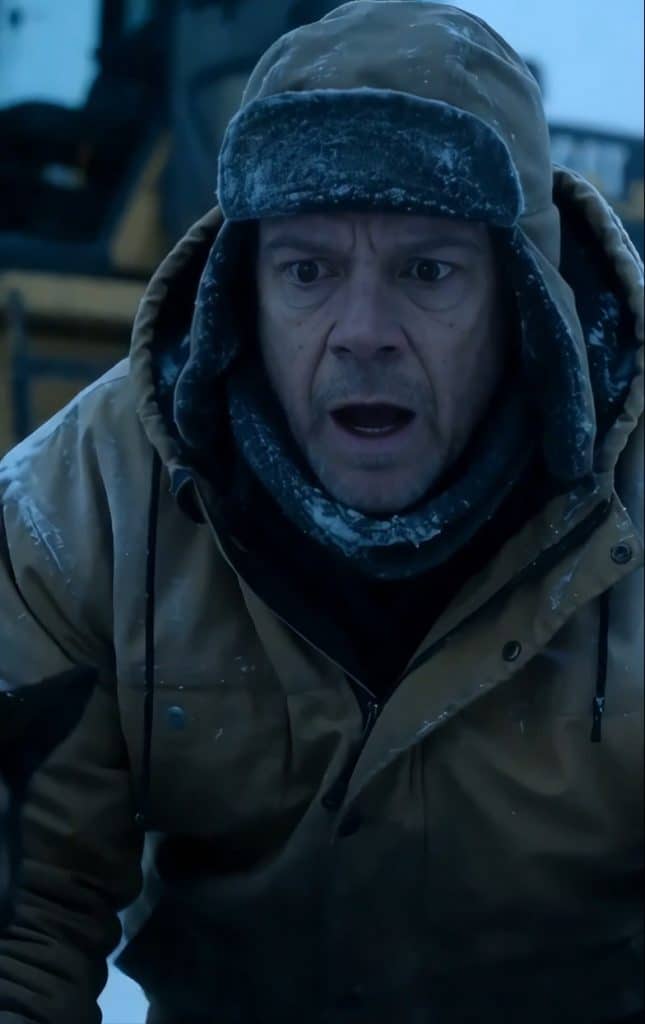
The wind hit his face hard. Snow crunched under his boots. He moved carefully across the icy roadside, watching the animal’s eyes. Stray dogs could be unpredictable, especially frightened ones, but this dog was not looking at Hank with fear.
It was begging.
The bag was dark canvas, heavy-looking, cinched tight with a thick drawstring. Snow had gathered along the folds. One side had nearly frozen to the ground.
The dog barked once at Hank, then shoved its nose toward the knot.
“Easy,” Hank muttered, kneeling.
His gloved fingers worked at the drawstring. The knot was tight, stiff from cold. He had to pull one loop loose, then another. The dog stopped tugging and stood beside him, trembling, eyes fixed on the opening.
The bag shifted.
Hank froze.
He heard something from inside.
Not the wind.
Not the fabric.
A breath.
Small.
Weak.
Living.
Hank tore the opening wider.
Inside, curled beneath layers of cold cloth, was a little boy.
For one second, Hank could not move. The child’s face was pale, his lashes wet with frost, his small body tucked into itself for warmth. His eyes fluttered, barely open.
The dog whined and pressed closer, gentle now.
Hank’s voice came out broken.
“My God. How is this possible…”
Then the boy’s lips moved.
And Hank heard one word.
“Mom.”
Act II
Hank Mercer had driven snowplows for twenty-seven winters, and he had learned that storms revealed what people tried to hide.
Snow covered everything at first. Broken fences. abandoned cars, tire tracks, ditches, mistakes. But give it time, give it wind, give it a plow blade and a man with tired eyes, and the truth came back up.
He had found wrecks buried under drifts. Lost cattle. A hunter who wandered too far from the trail and lived because Hank saw the corner of an orange sleeve above the snow.
But never a child.
Never a little boy in a tied bag on the side of a frozen rural road.
Hank pulled off his heavy coat and wrapped it around the boy, careful not to jostle him. The dog hovered close, pacing in tight circles, whining whenever Hank shifted.
“Stay with me,” Hank said, though he did not know if the child could hear. “You hear me, son? Stay with me.”
The boy’s eyelids trembled.
The dog barked toward the road.
Hank grabbed his radio.
“Dispatch, this is Mercer on Ridge Route Seven. I need an ambulance and sheriff out here now. I found a child. Repeat, I found a child alive in a tied bag near the north snowbank.”
For a moment, there was only static.
Then the dispatcher’s voice sharpened. “Say again, Hank?”
“You heard me,” he snapped, fear turning his voice rough. “Send everybody.”
The boy made a faint sound.
Hank bent closer. “What’s your name?”
The child tried to speak, but only a whisper came out.
“Leo.”
“Leo,” Hank repeated, gripping the name like a rope. “Okay. Good. You’re doing good.”
The dog pushed its nose gently against the boy’s sleeve.
Leo’s eyes opened a little more.
“Scout,” he breathed.
Hank looked at the dog.
The animal froze at the sound of its name, then let out a soft, shaking whine.
“You know this dog?” Hank asked.
Leo’s lips moved again.
“My dog.”
Hank’s stomach tightened.
That meant the dog had not stumbled on the bag.
It had followed him.
Through the storm. Through the fields. Across frozen roadside ditches. Maybe for miles.
The dog had tracked the boy when no human knew where to look.
Hank looked back toward the road, the snowbanks, the empty gray horizon.
“Who did this to you?” he whispered.
Leo’s eyes filled with fear.
Before he could answer, a sound came from beyond the trees.
An engine.
Slow.
Approaching.
Scout’s whole body changed.
The dog turned toward the bend in the road, ears forward, teeth showing, a deep growl rolling out of his chest.
Hank stood slowly.
The snowplow was behind him. The boy was at his feet. The tied bag lay open like evidence.
And someone was coming back.
Act III
The truck appeared through the blowing snow without headlights.
That was the first thing Hank noticed.
A black pickup rolled around the bend, slow and cautious, tires crunching over packed ice. It stopped twenty yards away.
Scout stepped in front of Leo.
Hank reached for the long-handled shovel strapped to the plow.
The driver’s door opened.
A man got out in a dark winter coat and a knit cap pulled low. He looked at Hank, then the open bag, then the child wrapped in Hank’s coat.
His face went still.
“Hank,” the man said.
Hank recognized him then.
Derek Voss.
Local contractor. Loud mouth. Always bidding on county jobs and complaining when he lost them. Hank had seen him at council meetings twice that month, arguing about the Ridge Route expansion, the new resort project, the land surveys.
Derek lifted both hands.
“Listen, this isn’t what it looks like.”
Hank’s grip tightened around the shovel.
“There’s a child in a bag.”
Derek took one step forward.
Scout snarled.
Derek stopped.
“The kid wandered off,” he said quickly. “I found him. I was going for help.”
“You tied him in a bag to get help?”
Derek’s eyes flicked to the road behind Hank.
A siren was not visible yet, but Hank imagined it coming. He prayed it was coming.
Derek swallowed.
“There’s money involved you don’t understand.”
Hank stared at him.
That was the wrong thing to say.
Not I didn’t mean to.
Not Is he alive?
Money.
Leo stirred behind the dog.
Scout glanced back, worried, then faced Derek again.
Hank lowered his voice. “What did you do?”
Derek’s face twisted with frustration.
“His mother shouldn’t have been out there. She shouldn’t have been asking questions.”
The cold seemed to pass straight through Hank’s bones.
“What mother?”
Derek said nothing.
Hank remembered then.
Nora Bell.
A young surveyor working for the county. She had been inspecting old property markers near Miller’s Ridge after rumors spread that someone had falsified land boundaries for the resort deal. Two days ago, she and her six-year-old son had been reported missing after their car was found abandoned near a service road.
The sheriff said they were searching.
Everyone feared the storm had taken them.
But Scout had found Leo.
Which meant Nora might still be somewhere out there.
Hank raised the radio again, never taking his eyes off Derek.
“Dispatch, suspect on scene. Derek Voss. Possible connection to Bell missing persons case. Need deputies now.”
Derek lunged toward his truck.
Scout moved first.
The dog shot across the snow and blocked his path, barking so fiercely Derek stumbled backward and nearly fell.
Hank stepped between Derek and the child.
“Don’t.”
Derek looked toward the trees.
For a second, Hank thought he would run.
Then headlights washed across the road behind him.
A sheriff’s cruiser came around the bend, followed by an ambulance.
Derek’s shoulders dropped.
But his eyes did not go to the deputies.
They went to the woods.
Hank saw it.
And he knew.
Leo had been hidden in the bag because Derek had been trying to bury the only witness small enough to survive what happened.
But Nora Bell was still missing.
And the dog was not done.
Act IV
Scout led them into the trees before the ambulance even pulled away.
The medics wanted the dog contained. The deputy wanted the area secured. Hank understood both, but Leo, wrapped in thermal blankets and breathing through an oxygen mask, whispered one sentence that changed every order.
“Scout knows where Mommy fell.”
No one argued after that.
Derek was handcuffed beside the cruiser, shouting now, claiming Hank had misunderstood, claiming Leo was confused, claiming the storm had made everyone crazy.
Scout ignored him.
The dog stood at the edge of the tree line, looking back once, waiting.
Hank went with the deputies because he knew the terrain. Sheriff Albright went too, along with two rescue volunteers who arrived from town with ropes and winter packs.
The woods beyond Ridge Route Seven were steep, tangled, and dangerous in winter. Snow disguised holes between rocks. Ice formed over shallow gullies. A person could fall ten feet and vanish under drifts before anyone heard them.
Scout moved with terrifying certainty.
He ran ahead, then circled back, barking whenever the humans slowed. The path crossed broken branches, a torn strip of gray scarf, and finally a narrow ravine hidden beneath windblown snow.
At the edge, Scout stopped.
He looked down and howled.
Hank’s heart clenched.
Below, half-sheltered beneath a fallen pine, lay Nora Bell.
She was alive.
Barely.
The rescue took nearly an hour.
They used ropes. Blankets. A backboard. Every careful hand they had. Nora was weak, disoriented, and so cold she could barely speak, but when Sheriff Albright told her Leo was alive, she began crying without sound.
Scout tried to reach her twice and had to be held back gently.
When they finally lifted Nora from the ravine, the dog pressed his head against her gloved hand.
She moved her fingers weakly over his fur.
“Good boy,” she whispered.
Hank turned away.
He had seen men cry in storms. He had seen families collapse with relief. But something about the dog, the boy, the mother, and the silence of the snowy woods broke something open in him.
Later, the truth came in pieces.
Nora had discovered that Derek Voss and two partners had moved property markers on county land, shifting protected forest boundaries to make room for a resort access road. She took photos. Derek confronted her. Leo hid with Scout in the back seat of her work vehicle.
Nora ran.
Derek followed.
In the chaos, Nora fell into the ravine.
Leo saw enough.
Derek found the boy afterward, cold and terrified, and panicked. He put him in the fabric equipment bag from his truck, planning to move him before the search teams expanded.
But Scout escaped.
Scout followed the truck. Followed the road. Followed the scent through snow and diesel fumes until he found the bag.
Then he barked until Hank listened.
That was the part the sheriff repeated later.
The dog barked until someone listened.
Act V
Leo recovered before Nora did.
Children often frighten adults that way.
One day they are pale and silent under hospital blankets. The next, they are asking for apple juice, their dog, and whether snowplows are allowed to honk at moose.
Nora took longer.
Her body healed slowly. Her voice came back in pieces. For weeks, she woke from dreams of falling, reaching for a child she could not find.
But Leo was there.
Scout was there.
And sometimes, that was enough to begin.
Hank visited once and felt awkward the moment he stepped into the hospital room. He brought a stuffed snowplow for Leo and a grocery-store bouquet for Nora because he did not know what else people brought after saving and nearly losing everything.
Leo smiled when he saw him.
“You opened the bag.”
Hank swallowed.
“Scout told me to.”
Leo nodded, serious. “He’s bossy.”
Scout, lying beside the bed with special permission from a nurse who pretended not to be emotional, lifted his head at the sound of his name.
Hank looked at the dog.
“Good thing.”
The investigation into Derek Voss spread wider than anyone expected. His partners turned on him quickly. Records surfaced. False maps. payments, forged approvals, threats sent anonymously to Nora after she refused to back down.
The resort project collapsed.
The protected forest remained protected.
Derek went to prison, though no sentence felt long enough to Hank when he thought of Leo curled inside that dark bag under the snow.
Still, justice came.
Not perfect.
But real.
Spring arrived late in Miller’s Ridge.
The roadside where Hank found the bag thawed slowly. Snowbanks shrank into dirty ridges. Brown grass showed through. Meltwater ran along the ditch where Scout had stood barking into the wind.
One April morning, the county placed a small marker near the tree line.
Not a memorial.
A tribute.
It was simple metal, bolted to a wooden post.
SCOUT’S TURN
WHERE A DOG REFUSED TO GIVE UP
JANUARY 17
Hank said it was too sentimental.
Then he cleared the snow around it every winter himself.
Nora returned to work by summer, though not quietly. She testified before the county board and helped rewrite oversight rules so no contractor could alter land records without independent review. She stood there with a faint scar near her eyebrow, voice steady, while the same officials who once ignored her notes now leaned forward to hear every word.
Leo started first grade with a new backpack and a fear of dark closets that faded slowly. He told his classmates Scout was a rescue dog. When his teacher asked if he meant Scout had rescued him, Leo said, “No. I mean he rescues everybody.”
No one corrected him.
Hank saw them often after that.
Small towns do not let heroes disappear, even when the heroes are uncomfortable men who drive snowplows and dogs who prefer sandwiches to applause.
Every winter, on the first heavy snow, Leo and Nora brought Scout to the county garage. Leo would climb into Hank’s parked plow, sit in the driver’s seat, and pretend to steer while Hank made engine sounds badly enough to make Nora laugh.
Scout always went to the same corner of the lot.
He would sniff the air, stare toward Ridge Route Seven, and stand very still.
Hank never rushed him.
Some memories belong to dogs too.
Years later, when Scout grew old and gray around the muzzle, the town held a small ceremony at the roadside marker. No news crews. No speeches long enough to embarrass anyone. Just Nora, Leo, Hank, Sheriff Albright, and a few people who understood that some stories should be remembered close to where they happened.
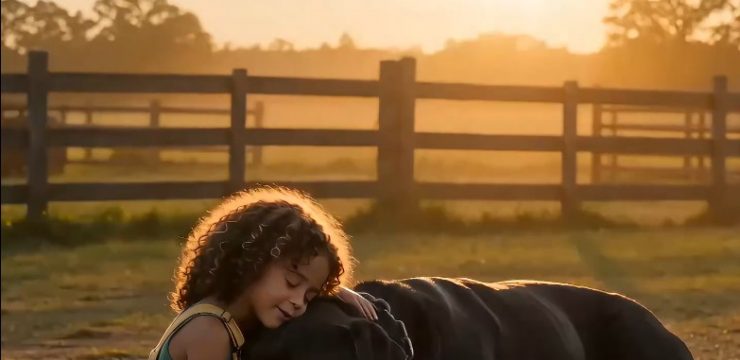
Leo, now taller and less afraid of winter, knelt beside Scout and pressed his forehead to the dog’s.
“You found me,” he whispered.
Scout leaned into him, eyes half-closed.
Hank looked out at the road.
He could still see it sometimes.
The dark bag in the snow.
The dog pulling at the knot.
The tiny breath inside.
The moment the world stopped being an ordinary workday and became the kind of day that divides a life into before and after.
People later called Hank a hero.
He always shook his head.
He had climbed down from a machine. Untied a knot. Called for help.
Scout had done the impossible part.
Scout had refused to let snow become silence.
That was what Hank remembered every time the wind rose over Ridge Route Seven and the plow blade pushed through another drift.
Snow could hide almost anything.
A road.
A crime.
A child.
A truth someone hoped would freeze before morning.
But sometimes, through all that white emptiness, a dog hears what people miss. Smells what fear buried. Runs where no one thinks to look.
And barks.
Barks until the machine stops.
Barks until the man climbs down.
Barks until the knot is opened.
Barks until the child inside the dark bag is no longer forgotten by the world.