Act I
The courtroom went silent when Richard Vale leaned forward and pointed at the trembling boy in the gray hoodie.
“The money was in his bag,” he said. “Punish him.”
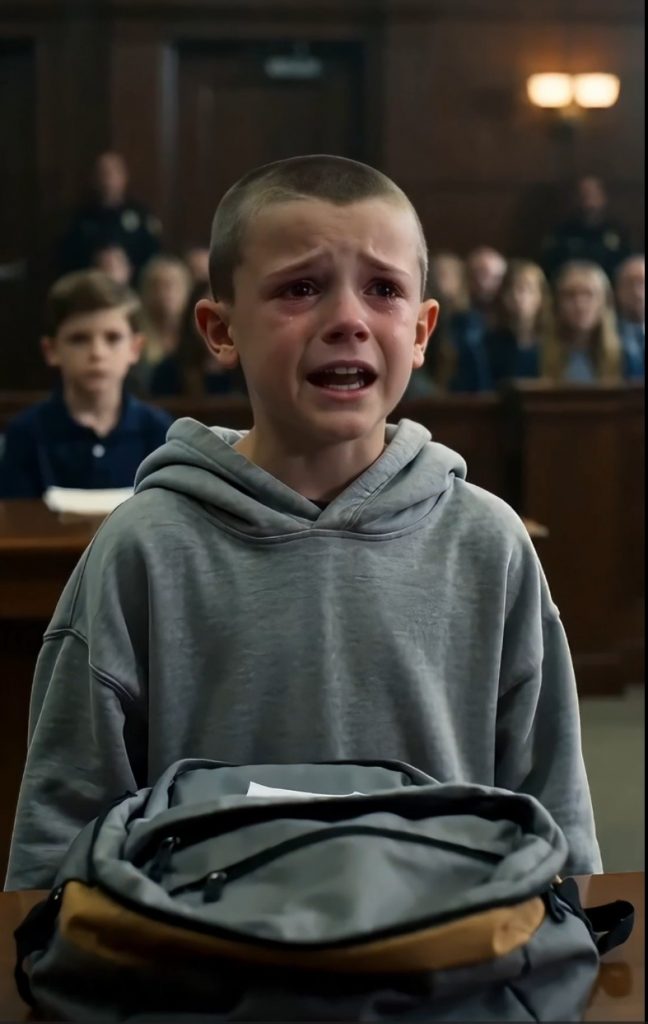
Mason Walker stood behind the defense table like the floor had disappeared under his sneakers. His hoodie hung off his narrow shoulders, the sleeves swallowed half his hands, and the wooden walls around him made him look even smaller.
On the table in front of him sat the backpack.
It was open.
Inside were crumpled notebooks, a broken pencil, a folded lunch bag, and a plastic evidence sleeve containing a stack of cash. On top of it all was a printed sheet with two words in bold black ink.
STOLEN FUNDS.
The words looked almost too loud for the room.
Mason stared at them like they belonged to someone else’s life.
“I didn’t take it, sir,” he whispered.
His voice cracked before the last word.
Behind him, people shifted in the gallery. A few parents from Mason’s school lowered their eyes. Others watched him with the cold curiosity people save for someone else’s disaster.
Across the aisle sat Preston Vale, the boy who had accused him.
Preston wore a clean navy polo and had his brown hair combed perfectly to one side. He looked nothing like Mason. No red eyes. No shaking hands. No panic.
He looked ready.
“He stole from my locker,” Preston said.
Not loud. Not angry. Just certain.
That certainty hit harder than a shout.
Mason turned toward him slowly, his face folding in disbelief. Two days earlier, Preston had smiled at him in the hallway. Not kindly, exactly, but the kind of smile that made Mason think maybe the worst of it was over.
Now Preston looked at him like a stranger.
Then a small sob broke through the silence.
Mason’s little sister, Ellie, sat in the second row with both hands pressed against her mouth. Her blond hair was messy from crying into her sleeves, and her cheeks were wet.
“Please,” she choked out. “Don’t take my brother.”
That was when Mason almost fell apart.
Not when the father accused him.
Not when Preston lied.
Not when everyone stared at the poor kid with the bad shoes and assumed they already knew the truth.
It was Ellie’s voice that did it.
Mason swallowed hard. A tear slipped down his face, but he didn’t wipe it away. He looked up at the judge, an older man with silver-gray hair and a face that gave nothing away.
“Damn, Your Honor,” Mason said, barely holding himself together. “I’m poor, but I ain’t a thief.”
Something changed in the room.
It was small. Almost invisible.
A woman in the back stopped whispering. One of the deputies glanced toward the judge. Even Richard Vale’s smug smile tightened at the edges.
Judge Harlan stared at Mason for a long moment.
Then he looked down at the backpack.
At the cash.
At the paper.
At Preston.
Finally, he opened the laptop on the bench and began typing.
The sound of the keys was soft, but it landed in the courtroom like a countdown.
Richard Vale’s face hardened.
Preston sat a little straighter.
Mason held his breath.
Judge Harlan lifted his eyes and spoke in a voice that cut through every corner of the room.
“Play the hallway footage.”
And that was when the first crack appeared in the story everyone had been told.
Act II
Before that morning, Mason Walker had never been inside a courtroom.
He had seen them on TV, all polished floors and angry adults, but he had never imagined standing in one while strangers decided whether he was a criminal.
His mother had not made it to court.
That was the part people whispered about without understanding. She worked overnight at a care facility forty minutes away, then picked up extra shifts cleaning offices when the bills got bad. That week, the bus route changed, her phone died, and by the time she reached the courthouse, everything had already started moving without her.
So Mason stood there with only Ellie in the gallery, a court-appointed attorney beside him, and a backpack that suddenly looked like it belonged to an enemy.
At school, Mason was the kid everyone noticed for the wrong reasons.
He wore the same gray hoodie almost every day because it was warm and because it had been his uncle’s before it was his. His sneakers had white tape near one toe. He kept his lunch in a paper bag and pretended he liked sitting alone because pretending was easier than asking to be included.
But he was not trouble.
His teachers knew he helped stack chairs after assemblies. The cafeteria staff knew he saved half his apple for Ellie. The janitor knew Mason stayed late sometimes because the library had heat and his apartment did not always have enough.
None of that mattered once the money appeared in his bag.
The money had belonged to the school’s winter assistance fund.
Every December, students collected donations to buy coats, groceries, and gift cards for families who needed help but were too proud to ask. Preston Vale had been chosen to manage the collection because his father sat on the school foundation board and because Preston knew how to sound responsible when adults were listening.
The Vales were the kind of family whose last name was on banners.
Vale Field.
Vale Technology Lab.
Vale Scholarship Breakfast.
Richard Vale smiled for newspaper photos with his hand on Preston’s shoulder, looking like the kind of father other fathers were supposed to admire.
But Mason had seen the other version.
He had seen Preston corner smaller kids near the lockers and laugh when they flinched. He had seen Richard Vale walk through the school office like he owned the air. He had seen teachers grow careful when either of them entered a room.
Mason had tried to stay invisible.
Then, three weeks before court, he made one mistake.
He found Preston’s phone under a bleacher after basketball practice.
It was unlocked.
Mason did not mean to look. He picked it up to return it, but a message lit across the screen before he could hand it over.
Make sure the transfer sheet disappears. No audit before the charity event.
It was from Richard Vale.
Mason did not know what it meant, but Preston saw his face.
The next day, Preston started smiling at him in the hallway.
Not friendly.
Warning.
After that came the little things.
A shove near the water fountain. A joke about Mason’s clothes. A loud comment about “charity cases” right as Mason walked by.
Mason said nothing.
He had learned early that poor kids were not allowed to be angry. Anger made adults nervous. Silence made them comfortable.
Then the charity money vanished.
Preston told the principal he had locked the envelope in his locker after the fundraiser. He said when he returned, the locker was open and the cash was gone.
By noon, a school security officer had searched bags.
By 12:07, the envelope was found in Mason’s backpack.
By 12:09, Preston was crying in the principal’s office, saying he felt “betrayed.”
By 12:20, Richard Vale had arrived in a dark suit, demanding consequences.
And Mason?
Mason kept saying the same thing until his throat hurt.
“I didn’t take it.”
No one asked why a thief would leave stolen cash sitting on top of his own math folder.
No one asked why the printed sheet saying STOLEN FUNDS looked fresh, flat, and untouched.
No one asked why Preston seemed more excited than scared.
They saw Mason’s hoodie, his taped shoe, his empty lunch bag, and the accusation settled over him like a verdict.
The school called it a disciplinary matter.
Richard Vale called it theft.
By the time the case reached Judge Harlan, it had become something bigger than missing money. It became a question of what kind of child Mason was. Whether Ellie could remain with him at home. Whether their mother was “managing.” Whether Mason needed intervention before he became, as Richard put it, “a danger to the community.”
Mason heard those words from across the courtroom.
A danger.
He wanted to laugh, but he was too scared.
He thought about Ellie sleeping on the couch because she was afraid of the dark. He thought about the cereal he made her when their mother worked late. He thought about how she still held his hand crossing the street even though she was old enough not to.
A danger to the community.
He looked at Richard Vale and finally understood something.
This was never only about money.
Richard Vale did not want Mason corrected.
He wanted him erased.
But the hallway footage was about to show more than anyone expected.
Act III
The screen came down from the ceiling with a low mechanical hum.
A deputy dimmed the lights. The courtroom shifted in its seats, suddenly less certain of itself.
Judge Harlan did not look at Preston first.
He looked at Richard Vale.
That was the detail Mason would remember later.
The judge watched the father before he watched the footage, as if he already suspected the loudest man in the room had spoken too quickly.
The video loaded on the laptop.
A frozen image appeared on the screen.
The hallway outside the seventh-grade lockers.
Timestamp: 11:42 a.m.
Mason saw himself in the frame immediately. He was walking away from his locker with his backpack slung over one shoulder. His head was down. He was moving quickly, like always, trying not to take up space.
Then he disappeared around the corner.
Nothing happened for seven seconds.
Then Preston entered the frame.
The courtroom went still.
Preston’s face changed.
Not much. Just enough.
He leaned toward his father, but Richard did not look at him. Richard kept his eyes on the screen, jaw tight, fingers locked together.
In the footage, Preston glanced both ways down the hallway.
Then he pulled something from under his shirt.
A key.
Someone in the gallery gasped.
Preston used it to open Mason’s locker.
The deputy paused the video only because the room erupted. The judge struck the bench once with his gavel, and the sound shut everyone down.
“Continue,” Judge Harlan said.
The footage resumed.
Preston opened Mason’s locker, removed Mason’s backpack, unzipped it, and slid in a thick envelope.
Then he added the printed sheet.
STOLEN FUNDS.
The same sheet now sitting in evidence.
Mason’s knees went weak.
His attorney put a hand lightly on his shoulder, not holding him up exactly, but reminding him he was not alone.
Ellie let out a sob that sounded different from the others.
This one had relief inside it.
Preston sat frozen in the gallery. His polished confidence had drained out of him, leaving behind a pale, frightened boy who looked younger than he had five minutes before.
But Judge Harlan did not stop the video.
The timestamp jumped forward.
11:46 a.m.
A man entered the hallway.
Richard Vale.
The room seemed to inhale at once.
Richard walked with the same confident stride he had used entering court. He checked the hallway, then approached Preston. The camera had no audio, but the body language was clear.
Richard held out his hand.
Preston gave him the key.
Richard tucked it into his jacket pocket.
Then he placed a hand on Preston’s shoulder and guided him away from Mason’s locker.
No accident.
No misunderstanding.
No childhood mistake.
A plan.
Richard Vale stood abruptly.
“This is being taken out of context,” he said.
Judge Harlan’s eyes snapped to him.
“Sit down, Mr. Vale.”
“I will not sit here while a manipulated recording—”
“Sit. Down.”
The words were quiet, but they carried the full weight of the room.
Richard sat.
For the first time all morning, he looked smaller.
Mason turned toward Preston. He expected to feel anger, maybe even satisfaction. Instead, he saw tears gathering in Preston’s eyes and felt something messier.
Preston had lied.
Preston had tried to ruin him.
But Preston was looking at his father like a boy who had followed orders he was now terrified to explain.
Judge Harlan leaned back, his expression unreadable.
“Mr. Vale,” he said, “that key was not a student key.”
Richard said nothing.
The judge looked to the court clerk. “Pull up the access log from Franklin Middle School for locker master keys. It was provided with the discovery file.”
Richard’s mouth tightened.
The clerk typed.
The courtroom waited.
A document appeared on the judge’s laptop. He read it without expression, but the longer he read, the heavier the silence became.
Then he looked up.
“The master key used that morning was signed out by Assistant Principal Darden,” he said. “At 10:58 a.m.”
Richard exhaled sharply. “Then speak to him.”
“I intend to,” the judge said. “But that is not the only record in this file.”
He clicked again.
A scan appeared on the screen.
Mason could not read it from where he stood, but Richard could.
And whatever it was, it made the color leave his face.
Judge Harlan turned the laptop slightly toward the courtroom.
It was not a student disciplinary form.
It was an audit memo from the school foundation.
At the top were the same words as the planted paper.
STOLEN FUNDS.
Only this one was dated two weeks earlier.
And Richard Vale’s name was printed in the middle of the page.
The courtroom had come to watch a poor boy be punished.
Instead, it was about to watch a powerful man explain why his name was on the real missing money.
Act IV
Richard Vale reached for his briefcase, but the deputy stepped closer.
It was not dramatic. No one shouted. No one rushed him.
That made it worse.
Power did not leave Richard Vale all at once. It slipped from him quietly, piece by piece, in front of everyone who had once feared his name.
Judge Harlan read from the memo.
The school foundation had been under internal review for irregular transfers. Funds meant for student assistance had been redirected into a consulting account. The account was tied to a company no one at the school recognized.
But the mailing address matched Richard Vale’s office suite.
The charity money Preston claimed was stolen from his locker had not been random cash.
It was supposed to cover the missing amount long enough to survive a board review.
Mason listened, barely breathing.
He did not understand every legal word. He did not know what “misappropriation” meant until his attorney whispered it softly beside him.
But he understood enough.
Richard Vale had been caught.
And instead of facing it, he had chosen a boy nobody expected the system to protect.
Mason.
The kid with the taped shoe.
The kid whose mother could not afford to miss work.
The kid people would believe had stolen money because believing it cost them nothing.
Judge Harlan looked at Preston.
“Did your father tell you to put that envelope in Mason Walker’s backpack?”
Preston’s lips parted.
Richard turned sharply. “Preston.”
One word.
A command wrapped in a warning.
Preston flinched.
For a moment, the boy in the navy polo disappeared. The smugness, the polish, the practiced confidence—all gone. He was just a child looking between the truth and the man who had trained him to fear it.
Judge Harlan’s voice softened, but only slightly.
“Preston, this is your chance to tell the truth.”
Preston stared at the floor.
Then he nodded.
Ellie grabbed the bench in front of her.
Mason closed his eyes.
The nod was tiny, but it broke the case open.
“He said Mason saw the message,” Preston whispered.
Richard’s face hardened.
Preston kept going, each word dragging itself out of him.
“He said Mason would talk. He said nobody would believe him anyway.”
A sound moved through the gallery, low and horrified.
Mason looked down at his hands.
Nobody would believe him anyway.
There it was.
The whole thing.
Not in legal language. Not hidden in documents. Not dressed up in adult excuses.
Just the truth.
Richard Vale had counted on Mason being invisible.
Judge Harlan removed his glasses and set them on the bench.
“Mason Walker,” he said.
Mason’s head snapped up.
“Yes, sir?”
“The allegation against you is dismissed.”
For one second, Mason did not react.
The words reached him, but his body did not trust them.
Dismissed.
Not delayed.
Not questioned.
Dismissed.
Then Ellie was crying again, but this time she was trying to smile through it. Mason’s attorney squeezed his shoulder. Someone in the back whispered, “Thank God.”
Richard Vale stood again.
“This is outrageous. My son is a minor. This court has no right to humiliate my family like this.”
Judge Harlan’s expression turned cold.
“Mr. Vale, you brought a child into this courtroom and demanded punishment based on evidence you helped manufacture. You do not get to object to humiliation now that it has become accurate.”
The words landed cleanly.
Richard had no answer.
The judge ordered the court officer to preserve all footage, audit records, access logs, and school communications. He directed the clerk to forward the matter to the district attorney’s office. He ordered that Assistant Principal Darden be notified to appear.
Then he did something no one expected.
He looked at Mason’s backpack.
“Bring that here.”
The deputy carried it to the bench.
Judge Harlan did not touch the cash. He did not touch the evidence sleeve. He reached instead for the front pocket, the one Mason always kept zipped because it held the only things that mattered.
A library card.
A worn bus pass.
A folded photo of Mason, Ellie, and their mother at a park two summers earlier.
And beneath that, a small envelope.
Mason’s face went pale.
“That’s mine,” he said quickly. “It’s not— I didn’t—”
The judge held up a hand.
“I know.”
He opened the envelope gently.
Inside was $18 in small bills.
Mason stared at the table.
Ellie whispered, “That’s for Mom’s medicine.”
The courtroom went quiet again, but differently this time.
Not with suspicion.
With shame.
Mason’s attorney explained softly that Mason had been saving lunch money and coins from helping the janitor after school. Their mother had refused to let him pay for anything, but he kept trying anyway.
Judge Harlan placed the envelope back inside the backpack.
Then he looked out at the gallery.
“Let the record reflect,” he said, “that the only money this child had hidden was money he was saving for his family.”
Richard Vale looked away.
And in that moment, the entire courtroom understood exactly what kind of theft had taken place.
It was not only money that had been stolen.
It was dignity.
It was safety.
It was a child’s belief that telling the truth would be enough.
But Mason was not done standing.
Act V
When the hearing ended, Mason did not run to the door.
He stayed where he was for a moment, one hand resting on the backpack that had almost destroyed him.
The same bag. The same broken zipper. The same worn straps.
But now everyone saw it differently.
Not as evidence of guilt.
As evidence of how easily a lie can be planted when people are willing to look away.
Ellie broke first.
She slipped past the gallery rail and ran to him. The deputy started to move, then stopped when Judge Harlan gave the smallest nod.
Mason caught her in both arms.
She held on like someone might still try to take him.
“I told them,” she cried into his hoodie. “I told them you didn’t.”
“I know,” Mason whispered. “I heard you.”
Their mother arrived just as people began leaving the courtroom.
Her work shoes squeaked against the polished floor. Her uniform was wrinkled, her eyes frantic, her hair pulled back too tightly because she had clearly done it on the bus.
“Mason,” she said.
He turned.
For the first time that day, he looked like a kid.
Not an accused kid.
Not a poor kid.
Just a son who had been scared and had waited too long for his mother’s arms.
She crossed the room and pulled both children against her. She apologized over and over, but Mason shook his head.
“You came,” he said.
That was all he needed.
Across the room, Preston stood beside his father but no longer close to him.
Richard Vale was speaking to his attorney in a low, furious voice. The attorney was not smiling. Neither was the assistant principal, who had arrived late and looked like a man realizing the hallway cameras had remembered what he hoped people would forget.
Preston looked at Mason once.
His face was wet now.
He opened his mouth like he wanted to say something, but no words came.
Mason watched him for a moment.
There were a thousand things he could have said.
He could have called him a liar.
He could have asked why.
He could have told him he hoped the whole school saw.
Instead, Mason picked up his backpack and said nothing.
That silence hurt Preston more than anger would have.
Two weeks later, the school held an assembly.
At first, Mason refused to go. He did not want to sit in the gym while people pretended they had not whispered about him. He did not want fake apologies from kids who had avoided his table. He did not want teachers using gentle voices like he was made of glass.
But Ellie said, “You should let them see you walk in.”
So he did.
He walked into the gym wearing the same gray hoodie.
No new clothes. No polished costume. No attempt to become someone more acceptable.
Just Mason.
The room quieted when he entered.
That used to mean danger.
This time, it meant respect.
The principal stood at the microphone and apologized publicly. Not in vague words. Not in the soft, slippery language adults use when they want forgiveness without admitting fault.
She said Mason Walker had been falsely accused.
She said the school had failed him.
She said new rules would require two adults present for any student search, all evidence preserved before accusations were made, and no outside donor would ever again be allowed to pressure school discipline.
Then she paused.
“Mason,” she said, “there is something else.”
A woman in a dark blazer stepped onto the stage. She was from the county youth advocacy office. She announced that the winter assistance fund had not only been restored, but doubled through community donations after the truth became public.
Then she looked directly at Mason.
“And the first scholarship from that fund,” she said, “will be named for the student who reminded this community that dignity is not something you earn by having money.”
Mason froze.
Ellie grabbed his sleeve.
“The Walker Family Scholarship,” the woman said.
The gym stood.
Applause rolled over him, loud and overwhelming. Mason did not know where to look. He saw teachers clapping. Students standing. The janitor wiping his eyes near the back wall.
And then he saw Preston.
He was sitting in the last row with his mother.
Richard Vale was not there.
Preston stood slowly, clapping too. His face was pale, uncertain, ashamed. Mason did not smile at him. Not yet.
Forgiveness, he had learned, was not something people got to demand just because the truth came out.
Some things took time.
But Mason also understood something else.
The lie had not ended with everyone punished and everything perfect. His family still had bills. His mother still worked too much. His hoodie still had a frayed cuff.
But the world had shifted.
Now, when Mason walked through the hallway, people made room.
Not because they feared him.
Because they finally saw him.
A month later, a letter arrived at the Walker apartment.
It came in a plain envelope from the courthouse.
Mason opened it at the kitchen table while Ellie leaned over his shoulder and their mother stood behind them with one hand on his chair.
Inside was a short note written in careful handwriting.
Mason,
A courtroom is supposed to be a place where truth matters more than power. That day, you helped remind everyone in it of that duty.
Keep your head up.
Judge Harlan
There was no money inside.
No reward.
No grand miracle.
Just a note.
But Mason folded it carefully and placed it in the front pocket of his backpack, beside the photo, the bus pass, and the small envelope where he still saved what he could.
The next morning, he walked Ellie to school.
She reached for his hand at the crosswalk, then hesitated like she was too old for it.
Mason took her hand anyway.
The light changed.
They crossed together.
And when they reached the other side, Mason looked up at the school doors without lowering his head.
For the first time in a long time, he did not feel small.