Act I
Daniel Mercer knew he looked out of place the second he stepped into the bank.
The lobby was too clean.
White walls. Polished floors. Curved counters so glossy they reflected the ceiling lights. Even the potted plants looked expensive, trimmed into quiet little shapes that seemed to belong to a world where nothing ever broke, leaked, rusted, cracked, or ran out of time.
Daniel had come straight from a job site.
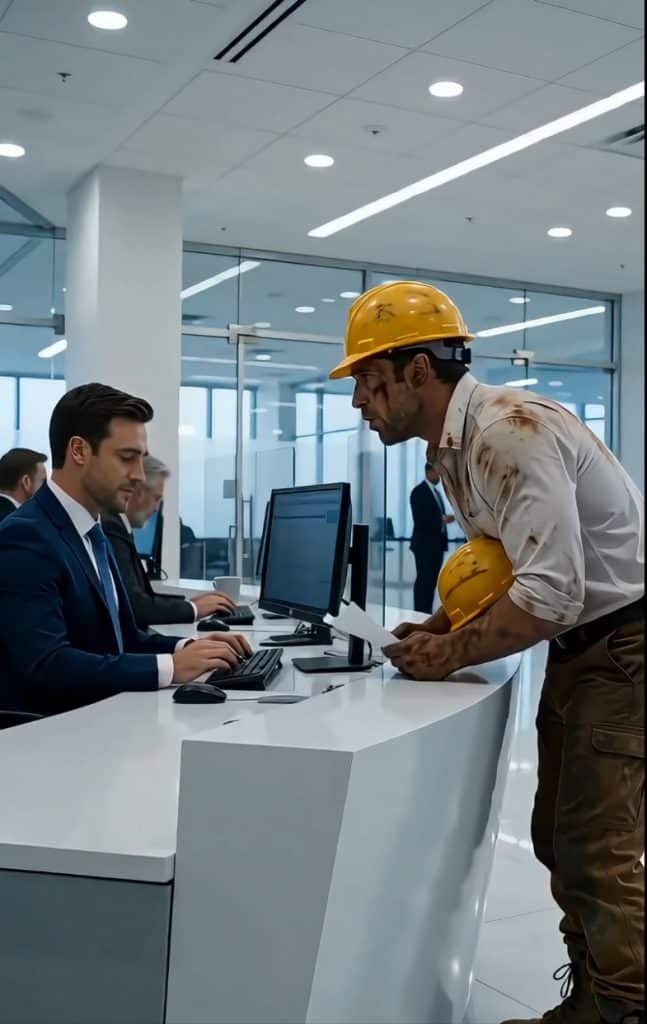
His white button-down was stained with grease and rust. Sweat had dried into the collar. His work boots left faint dusty marks on the polished floor no matter how carefully he walked.
In one hand, he held a folded cash-flow statement.
In the other, he held a scratched yellow hard hat.
He stood at the counter, trying not to sound desperate.
“Sir,” he said, “I just need a bridge loan. One month. That’s all.”
The bank officer did not look at him right away.
Tyler Grant kept his eyes on the computer screen, one hand resting near a silver pen, his navy suit pressed so sharply it looked untouched by weather, pressure, or consequence.
Daniel waited.
The whole bank seemed to keep moving around him. A teller smiled at a woman in pearls. A printer hummed. Somewhere, fingers tapped across a keyboard. Life continued as if his entire company was not hanging over a cliff.
Finally, Tyler looked up.
“Your numbers don’t qualify.”
The words were calm.
That made them worse.
Daniel tightened his grip on the paper. “I know what the report says. But those receivables clear in four weeks. I’ve got signed contracts, purchase orders, a verified invoice from city work. I just need payroll covered until the payment lands.”
Tyler leaned back slightly.
He looked at Daniel’s shirt. Then at his hands. Then at the hard hat pressed against his chest.
Not like he was evaluating a client.
Like he was evaluating a stain.
“If I miss payroll,” Daniel said, his voice roughening, “my company is gone.”
Tyler’s mouth twitched into something that almost resembled a smile.
“Maybe hard work isn’t enough.”
The sentence landed quietly in the bright lobby.
Daniel stopped breathing for half a second.
He thought about the twelve men and women waiting for checks that Friday. He thought about Rosa, whose husband had just started chemo. Andre, who had twins in day care. Luis, who sent money to his mother every month and never once complained when overtime ran long.
“My crew has families,” Daniel said.
He looked down at his own hands.
The grime was worked into the lines of his palms. Oil under the nails. Small cuts from sheet metal. A bruise across one knuckle from a pipe that had slipped at dawn.
“I built this business with my own hands.”
Tyler picked up the pen and signed a form without looking at him.
“Then your hands should’ve built better credit.”
Daniel lowered his head.
Not because he agreed.
Because for one terrible second, he could not trust himself to speak.
His jaw trembled. His fingers pressed into the hard hat until the plastic creaked softly under his grip.
Across the lobby, an older man sat in a leather chair with a newspaper raised in front of his face.
No one had noticed him.
Not really.
He wore a gray suit that looked custom-made, a dark tie, and polished shoes. His salt-and-pepper beard was neatly trimmed. He had the stillness of someone who had never needed to raise his voice to be heard.
The headline on his newspaper mentioned Nala Cuyd Capital.
Then the paper lowered.
The man’s eyes settled on Tyler Grant.
And the bank officer had no idea that the most powerful person in the building had just heard every word.
Act II
Daniel Mercer had not always owned Mercer Industrial Repair.
For years, he had just been “Dan with the wrench.”
He fixed busted pumps, replaced cracked beams, repaired ventilation systems in factories that smelled like dust and metal. He worked nights, weekends, holidays, and every terrible hour nobody else wanted.
He was good because he had to be.
His father had taught him that.
Ray Mercer had been a foreman with bad knees and a laugh loud enough to shake a kitchen. He used to say a man’s name was written twice in life: once on paper, and once in the way people talked about him when he was not in the room.
Daniel believed that.
So when his father died and left behind nothing but a toolbox, a truck with engine trouble, and a list of people who still trusted the Mercer name, Daniel built something from it.
At first, it was just him.
Then two workers.
Then five.
Then twelve.
He took jobs bigger companies ignored because the margins were ugly and the hours were worse. Emergency repairs. City drainage failures. School boiler replacements during winter break. Late-night structural fixes after storms.
His company did not look impressive from the outside.
The office was a rented space behind an auto-glass shop. The chairs did not match. The coffee machine only worked if someone hit the side twice.
But every person on his crew got paid before Daniel paid himself.
Every time.
That was the one promise he had never broken.
Until now.
The trouble started with the East Harbor project.
It was the biggest contract Daniel had ever landed: emergency reinforcement and utility repair for an old municipal building being converted into a community medical center. The job had come through a partnership between the city and a private fund connected to Nala Cuyd Capital.
Daniel had underbid the giants and still won because his plan was faster, safer, and honest.
That was what the city inspector had said.
Honest.
Daniel had held that word in his chest for three months.
Then the payment delay hit.
First, accounting said the invoice was under review.
Then the project manager stopped answering calls.
Then a bank notice arrived saying his credit line was frozen pending updated risk assessment.
By the time Daniel understood how bad it was, payday was five days away.
His company had the contracts.
His company had the work.
His company had the money coming.
But not yet.
And not yet could kill a business faster than failure.
That was why he came to the bank still wearing the day’s dirt. He had planned to change first, but a pump failure at a manufacturing plant had kept him under a rusted platform for three hours.
He almost went home.
Then he thought of Rosa texting him a photo of her daughter’s school project. Andre asking whether checks would clear before rent. Luis laughing over a gas-station sandwich because the crew was too tired to drive anywhere else.
Daniel drove straight to the bank.
He did not come to beg for comfort.
He came to ask for thirty days of trust.
Tyler Grant had been assigned to his account six months earlier.
Daniel had never liked him. Tyler smiled with only half his face and spoke to small business owners like they were children learning expensive lessons. But Daniel thought numbers would matter more than personality.
He was wrong.
Tyler did not see purchase orders.
He saw grease stains.
He did not see signed contracts.
He saw worn boots.
He did not see a man fighting for twelve families.
He saw someone who did not belong at a polished counter.
The humiliation should have ended there.
A refusal. A signature. A cold dismissal.
But Tyler wanted one more cut.
He wanted Daniel to leave understanding his place.
That was why he said it loud enough for the nearby teller to hear.
“Men like you always think effort makes you entitled to money.”
Daniel lifted his head.
Tyler slid the rejected application across the counter.
“This bank invests in stability, Mr. Mercer. Not desperation.”
Daniel stared at the paper.
Denied.
The word was stamped in blue ink.
Behind him, the newspaper rustled again.
The older man stood.
And the lobby, without realizing why, began to change.
Act III
The man in the gray suit folded his newspaper with careful precision.
Not fast.
Not angry.
That was the strange part.
He crossed the lobby at the pace of someone walking into a room he already owned.
Tyler noticed him halfway there.
His posture changed instantly.
The smirk vanished. His shoulders straightened. The pen stopped tapping. His voice, when he spoke, became polished and warm.
“Mr. Whitmore,” Tyler said. “We didn’t realize your appointment had arrived early.”
Daniel turned slightly.
Elias Whitmore.
Even Daniel knew that name.
You could hardly work in construction, infrastructure, or private development in the state without hearing it. Whitmore sat on boards, funded civic projects, and controlled investment groups that moved more money in a week than Daniel had seen in his life.
The newspaper headline suddenly made sense.
Nala Cuyd Capital was Whitmore’s firm.
And the East Harbor project, the contract Daniel had bet everything on, was connected to him.
Daniel’s stomach tightened.
Great.
Now the man whose project payment was delayed had just watched him get humiliated in public.
Elias did not return Tyler’s smile.
Instead, he looked at Daniel’s hard hat.
There was an old sticker on the side, half-scraped by years of work.
MERCER INDUSTRIAL REPAIR.
Elias stared at it a moment too long.
Then his eyes moved to Daniel’s face.
“Your father was Raymond Mercer,” Elias said.
Daniel froze.
The bank seemed to fall away.
“Yes, sir.”
Elias nodded slowly, as if a memory had just stepped into the room.
“Ray Mercer pulled three men out of a collapsed maintenance corridor in the eighties,” he said. “One of them was my younger brother.”
Tyler’s face flickered.
Daniel had heard the story, but never with names. His father had mentioned it only once, and even then he had brushed it off like it was nothing more than a bad day at work.
A storm. A failed support beam. Men trapped in a service passage beneath a municipal building.
Ray Mercer had gone in before rescue crews arrived.
He had come out with a fractured wrist and ruined lungs from dust exposure.
Daniel remembered the cough more than the medal.
“My father never talked much about that,” Daniel said quietly.
“No,” Elias replied. “The best men rarely talk about what others owe them.”
Tyler cleared his throat. “Mr. Whitmore, I apologize if this interaction disturbed your waiting time. We were simply following underwriting standards.”
Elias turned to him.
“Were you?”
The temperature in Tyler’s face seemed to drop.
“Of course.”
Elias reached toward the rejected application on the counter.
“May I?”
Daniel hesitated, then slid it over.
Elias read the first page. Then the second. His eyes narrowed at the risk notes.
“Payment delays. Frozen credit line. Revenue concentration concern.” He looked up. “This is tied to the East Harbor medical conversion?”
Daniel nodded. “Yes, sir.”
“And your invoice is overdue?”
“Twenty-seven days.”
Elias said nothing for a moment.
Then he took out his phone and made one call.
“Marian,” he said. “Pull payment status on East Harbor vendor Mercer Industrial Repair. Yes, now.”
Tyler shifted behind the counter.
It was subtle, but Daniel saw it.
So did Elias.
The lobby had grown quieter. Employees were pretending not to watch. Clients held deposit slips without moving. The teller who had overheard Tyler’s insult now stared at her monitor with wide eyes.
Elias listened to the phone.
His expression changed.
Not surprise.
Confirmation.
“Send it to my email,” he said. “And include the change-order chain.”
He ended the call.
Tyler forced a laugh. “Large projects have delays. I’m sure there’s nothing unusual.”
Elias opened an email on his phone.
He read.
Then he looked at Tyler again.
“Mr. Mercer’s invoice was approved eleven days ago.”
Daniel’s heart kicked.
“What?”
Elias did not take his eyes off Tyler.
“The release was held after a dispute notice was filed.”
Daniel shook his head. “No one told me about a dispute.”
“I imagine that was the point.”
Tyler’s hand moved toward the keyboard.
Elias’s voice cut through the motion.
“Don’t touch that computer.”
The bank manager emerged from an office near the back, smiling nervously.
“Is there a problem, Mr. Whitmore?”
Elias finally turned from Tyler.
“Yes,” he said. “And I believe your bank is standing in the middle of it.”
Then he placed his phone on the counter, screen facing up.
A name appeared in the email chain.
Grant Strategic Services.
Daniel saw Tyler’s face go white before he understood why.
The same last name.
Grant.
And suddenly the denied loan was no longer just cold banking.
It was a trap.
Act IV
The manager read the email twice.
By the second time, her smile was gone.
Grant Strategic Services had filed the dispute claiming Mercer Industrial Repair failed to complete portions of the East Harbor work. The filing had triggered a payment hold. That hold weakened Daniel’s cash position. That weakness was then cited by Tyler Grant as a reason to deny the bridge loan.
It was clean.
Too clean.
Daniel stared at the screen, trying to keep up as the pieces snapped into place.
Grant Strategic Services had bid against him for the East Harbor repair package.
He remembered the name now.
They were more expensive, slower, and better connected. Rumor was they expected to win until Daniel’s company came in with a plan the city could not ignore.
Tyler’s jaw flexed.
“My cousin owns that firm,” he said carefully. “That doesn’t mean—”
“No,” Elias interrupted. “It means there is a conflict of interest. The rest depends on how much you knew when you marked this man’s company as high risk.”
Tyler’s professional mask cracked.
“This is absurd. I process applications based on available data.”
“Available data that your family helped poison,” Elias said.
The words moved through the lobby like a match catching dry paper.
Daniel felt heat rise in his chest.
For hours, days, weeks, he had blamed himself. He had replayed every invoice, every estimate, every decision. He had wondered whether he had grown too fast, trusted too much, promised too much.
Now he understood.
Someone had not simply refused to help him.
Someone had pushed him toward failure and then mocked him for falling.
Tyler looked at the manager. “This is a private client matter.”
Elias picked up the denied form.
“It became something else when your employee insulted a business owner in the lobby while sitting on a conflict he had every obligation to disclose.”
Tyler’s eyes sharpened.
“He came in here filthy and unprepared.”
Daniel flinched, but this time he did not lower his head.
Elias stepped closer to the counter.
“He came in here from work.”
No one spoke.
The difference was small.
It changed everything.
Filthy meant shame.
From work meant honor.
Tyler looked around and seemed to realize, too late, that the room was no longer on his side.
The manager turned to him. “Tyler, step away from the station.”
His face tightened. “You can’t be serious.”
“Now.”
He stood slowly, still trying to hold on to dignity, but the polished suit no longer protected him. Not from the emails. Not from the witnesses. Not from the fact that every cruel word he had spoken now sounded like evidence.
Daniel remained at the counter, his hard hat still in his hands.
Elias turned to him.
“Mr. Mercer, how much do you need to make payroll?”
Daniel gave the number.
He hated saying it out loud. It felt too large to need and too small to explain twelve lives.
Elias nodded once.
“My office will wire the overdue East Harbor payment today.”
Daniel blinked. “Today?”
“Today.”
The word nearly broke him.
His fingers loosened around the hard hat.
Elias continued. “And Nala Cuyd Capital will issue a written correction confirming that your work was completed and approved. The dispute will be withdrawn, and our legal department will review who filed it.”
Tyler looked sick.
But Elias was not finished.
“As for the bridge amount,” he said, “you won’t need this bank’s approval.”
Daniel swallowed. “Sir, I’m not asking for charity.”
“I know.”
Elias’s voice softened for the first time.
“That’s why I’m not offering charity. I’m offering an advance against work you already earned.”
Daniel looked away fast, because his eyes had started to burn.
For a month, he had held himself together with duct tape and stubbornness. He had smiled for his crew, answered calls he dreaded, lied to his mother when she asked if he was sleeping.
Now relief hit him so hard it almost felt like pain.
The manager moved quickly after that.
She apologized to Daniel in a voice that sounded both sincere and frightened. She promised an internal review. She asked whether he would like a private office.
Daniel looked at the polished glass walls, the silent employees, the clients watching from carefully turned faces.
“No,” he said.
His voice was quiet, but steady.
“I stood here when he humiliated me. I can stand here while you fix it.”
The manager nodded.
Elias looked almost proud.
Within twenty minutes, Daniel’s phone buzzed.
A pending wire.
Then another email.
Payment release confirmation.
Then a message from his bookkeeper.
Dan. Tell me this is real.
Daniel stared at the screen.
For a second, he could not move.
Then he typed back with hands that were still dirty, still rough, still his.
It’s real. Payroll clears Friday.
The lobby blurred.
He pressed the heel of his palm against his eye, embarrassed by the emotion rising in him.
Elias looked at the hard hat again.
“Your father carried one like that,” he said.
Daniel let out a shaky breath. “This was his.”
Elias’s expression changed, just barely.
“Then he was in the room before I was.”
Daniel looked down at the scratched yellow plastic.
All those years, he had thought the hard hat was just a keepsake.
But that day, in the cleanest bank he had ever entered, it felt like proof.
Some things survived being dismissed.
Some names survived being underestimated.
And sometimes, the hands people mocked were the only hands holding a community together.
But the real reversal came one week later, when Daniel walked back into that same lobby without a loan application in his hand.
Act V
Daniel returned on a Friday morning.
This time, he was not alone.
Rosa came with him in a clean denim jacket, holding a folder of payroll receipts like they were sacred documents. Andre stood beside her, nervous and broad-shouldered. Luis wore his best shirt and kept looking at the ceiling lights as if banks still made him uncomfortable.
Daniel wore the same work boots.
He had changed his shirt, but he carried the yellow hard hat under one arm.
Not as a plea.
As a witness.
The bank had called him three times asking to “restore the relationship.” The regional director wanted a meeting. The manager wanted to apologize formally. Someone from corporate used the phrase “values alignment,” which made Daniel almost laugh.
He did not come back for the bank.
He came because Elias Whitmore had asked him to meet there.
When Daniel entered, people noticed.
The teller who had watched his humiliation looked up and gave him a small, ashamed smile. The manager came out immediately, face composed but pale.
Tyler Grant was gone.
His station had been cleared.
No silver pen. No neat stack of forms. No polished little kingdom behind the glass.
Elias was waiting near the same leather chairs, no newspaper this time.
Beside him stood a woman with a tablet and a leather folder.
“Mr. Mercer,” Elias said. “Good to see you.”
Daniel shook his hand.
A week earlier, he would have worried about the grease under his nails.
Now he did not.
Elias turned to the crew. “You must be the families he was fighting for.”
Rosa’s eyes filled instantly.
Andre cleared his throat and looked away.
Luis nodded once, hard.
Elias opened the folder.
“Nala Cuyd Capital has reviewed all current repair and emergency maintenance contracts attached to the East Harbor project,” he said. “We found your company’s performance record exceptional.”
Daniel stood very still.
“So we are extending your contract,” Elias continued. “Two years. Priority vendor status for regional infrastructure response. Fair rates, prompt payment terms, and a mobilization advance so you are never again forced to risk payroll because a larger firm decides to play games.”
For a moment, Daniel heard nothing.
Not the bank.
Not the soft footsteps.
Not even Rosa’s quiet gasp beside him.
Two years.
Prompt payment.
Priority vendor.
It was not rescue.
It was oxygen.
It was future.
Daniel looked down at the hard hat in his hands.
His father’s hard hat.
His company’s beginning.
His proof that dignity did not need polish to be real.
“I don’t know what to say,” Daniel managed.
Elias smiled faintly.
“Say you’ll keep doing good work.”
Daniel nodded.
“That I can do.”
The regional director arrived then, perfectly dressed and visibly uncomfortable. He offered Daniel a formal apology on behalf of the bank. He said Tyler Grant had been terminated pending further investigation. He said all related lending decisions would be audited. He said the bank deeply regretted the treatment Daniel had received.
Daniel listened.
He did not interrupt.
When the man finished, Daniel asked one question.
“Would you have regretted it if Mr. Whitmore hadn’t been sitting there?”
The director opened his mouth.
Closed it.
That was answer enough.
Daniel nodded slowly.
“I appreciate the apology,” he said. “But my account is moving.”
The manager lowered her eyes.
The director tried to speak, but Elias’s presence beside Daniel made every excuse sound smaller before it could leave his mouth.
Daniel turned to his crew.
“Let’s go.”
They walked out together.
No dramatic speech. No raised voices. No scene that would make the evening news.
Just four working people leaving a bank that had mistaken clean floors for character.
Outside, the morning sun bounced off the windows of the downtown buildings. Trucks moved through traffic. Somewhere nearby, a jackhammer rattled against concrete.
Real work.
Real noise.
Real life.
Daniel stopped at the curb and finally let himself breathe.
Rosa hugged him first. Then Andre pulled him in with one arm. Luis slapped his shoulder and said, “Boss, you scared us.”
Daniel laughed then.
A rough, tired laugh.
“I scared myself.”
His phone buzzed again.
A message from his bookkeeper.
All checks cleared.
Daniel read it twice.
Then he showed the crew.
Rosa covered her mouth. Andre looked up at the sky. Luis turned away, pretending to check traffic, but his shoulders shook once before he got himself together.
Daniel held the phone in one hand and the hard hat in the other.
For weeks, he had imagined this moment as relief.
But it felt bigger than that.
It felt like every early morning, every unpaid weekend, every job nobody else wanted, every time he chose payroll over his own mortgage, had finally stood up in the room and spoken for him.
That afternoon, Daniel returned to the job site.
The crew was waiting.
Some had already heard. Some had only seen the cleared deposits and refused to believe it until Daniel said it out loud.
He climbed onto the tailgate of his truck, the yellow hard hat tucked beneath one arm.
“We’re still here,” he said.
The crew went quiet.
Daniel looked at their faces. Tired faces. Worried faces. Loyal faces.
“Payroll cleared. East Harbor paid. And we’ve got two more years of work if we want it.”
For half a second, nobody moved.
Then the yard erupted.
Not fancy. Not polished. Not corporate.
Just cheers, hands clapping shoulders, laughter breaking through weeks of fear.
Daniel looked toward the half-finished medical center rising beyond the fence.
Steel beams caught the sunlight. Workers moved across platforms. The building looked unfinished, but not fragile.
Like something still becoming what it was meant to be.
That evening, after everyone left, Daniel stayed behind.
He set his father’s hard hat on the hood of the truck and wiped dust from the old Mercer Industrial Repair sticker.
He thought of Tyler Grant’s voice.
Then your hands should’ve built better credit.
Daniel looked at his hands.
They were still rough.
Still scarred.
Still carrying grease that soap never fully removed.
But those hands had built paychecks. They had built trust. They had built a company strong enough to survive a trap laid by men in cleaner clothes.
He picked up the hard hat and smiled for the first time all week.
Hard work had been enough.
Not by itself.
Not without truth.
Not without someone powerful finally paying attention.
But enough to leave evidence everywhere.
In steel.
In payroll.
In loyalty.
In the way twelve families slept easier that night because one man refused to let humiliation be the final word.
The next morning, Daniel walked onto the East Harbor site before sunrise.
He put on the yellow hard hat.
Then he picked up his tools.
And when the first beam lifted into the pale morning sky, Daniel Mercer stood beneath it with his head high, no longer begging anyone to see his worth.