Act I
The owner came out of the restaurant like the sidewalk belonged to him.
“Get away from my restaurant!”
His voice cracked across the lunch crowd so sharply that people at the outdoor tables stopped mid-bite. Red chairs scraped against concrete. A woman holding a sandwich slowly lowered it back onto its paper wrapper.
The boy froze beside his mother.
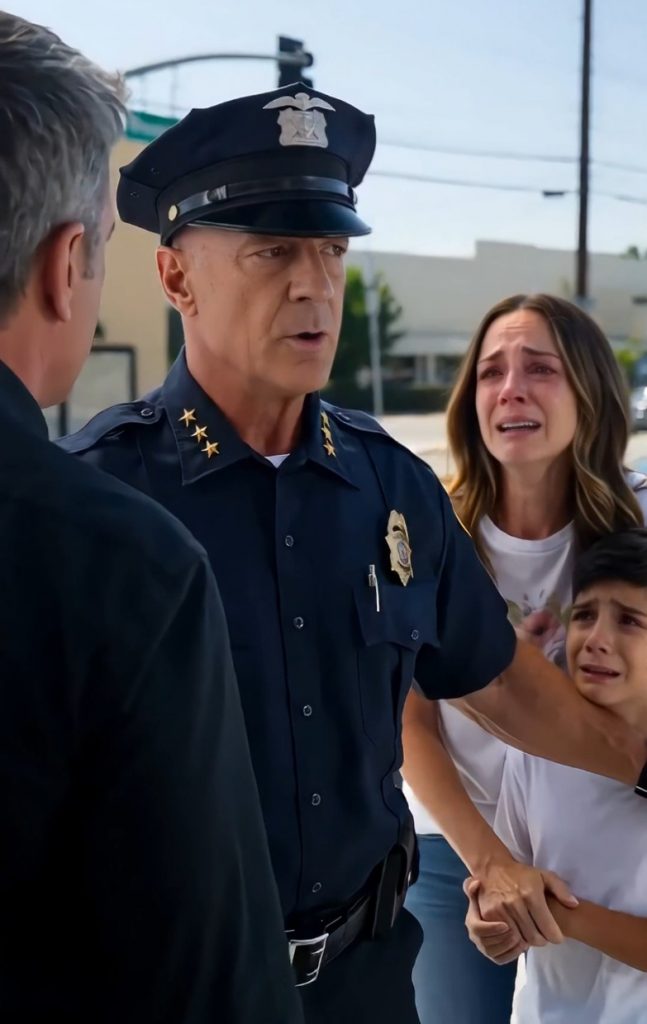
He was no more than eight, thin in a plain white T-shirt, with dark hair falling over his damp forehead. One hand clutched his mother’s jeans. The other held a wrinkled paper voucher so tightly it had begun to tear at the corners.
His mother, Rachel Moreno, stumbled back from the glass door.
“Please,” she said, tears already wet on her cheeks. “My son…”
But Victor Hale did not let her finish.
Victor owned the restaurant, or at least acted like the name above the door gave him permission to decide who was allowed to look hungry in front of it. He wore a black button-up shirt tucked into gray trousers, his hair neatly cut, his face twisted with disgust.
“I said move,” he snapped. “You’re bothering my customers.”
Rachel pulled her son closer.
“I’m not asking anyone for money,” she said, her voice trembling. “We have a voucher. It says this location accepts—”
“I don’t care what it says.”
The boy looked up at her, terrified.
“Mom,” he cried. “Are you okay?”
That question broke something in her.
Not because she was hurt.
Because he was still worried about her when he was the one who had not eaten since the night before.
Rachel bent one arm around him and tried to guide him away from the door without letting anyone see how badly her knees were shaking. The humiliation burned worse because it was daylight, public, clean, and ordinary. People watched from behind iced drinks and paper baskets, unsure whether to help or keep chewing.
Victor pointed toward the street.
“This is a business, not a shelter.”
Rachel flinched like the words had touched her.
Then heavy boots struck the pavement behind them.
A police officer stepped quickly from beside a parked patrol car, one hand raised, his voice cutting through the sidewalk like a siren.
“Hands where I can see them!”
Victor stopped.
The mother froze.
The boy hid against her side.
The officer moved between them, broad-shouldered in a dark blue uniform. Three gold stars shone on each collar. He was older, with a rugged face and eyes that had seen too many people pretend cruelty was policy.
Victor’s confidence faltered.
“Officer,” he said quickly, “she was bothering customers.”
The officer did not move aside.
He looked once at Rachel, then down at the boy, then at the crumpled voucher in the child’s hand.
His jaw tightened.
“You pushed a hungry mother out over food?”
Victor lifted his chin.
“I was protecting my business.”
A silence fell over the tables.
The officer stared at him, not angry in the way people expect, but disappointed in a way that felt heavier.
“No,” he said. “You were forgetting how to be human.”
Rachel looked up at him with red, pleading eyes.
“Sir,” she whispered, clutching her son so tightly he could barely move. “Please. Don’t take him away.”
The officer’s expression changed.
He had heard fear before.
But this was not fear of a restaurant owner.
This was fear of a mother who believed one hungry afternoon could cost her the only person she had left.
And then the officer looked again at the voucher in the boy’s hand.
The paper carried a seal he recognized.
Act II
Rachel Moreno had not always been the kind of woman people looked past on sidewalks.
Six months earlier, she had worn pressed scrubs to work and packed lunch for her son, Leo, in a blue container with a cracked lid. She had a small apartment over a bakery, a used sedan that complained in cold weather, and a calendar taped to the fridge with every bill marked in blue ink.
She was tired, but she was standing.
Then her mother got sick.
Then the hours at the clinic were cut.
Then the rent went up.
By the time Rachel realized how fast a normal life could collapse, most of it was already gone.
She sold the sedan first. Then her wedding ring, though she had been divorced long enough to tell herself it was only metal. Then the little gold earrings Leo had bought her at a school holiday market with money he had saved in quarters.
She told him they were just moving for a while.
A smaller place. A temporary place.
Children believe temporary until they see their mother sleeping sitting up in a bus station with one arm locked around a backpack.
Rachel never let Leo sleep outside. That was the promise she made herself. If she had to choose between food and a motel, she chose the motel. If she had to choose between a coat for herself and cereal for him, she chose cereal.
But hunger has a way of finding the spaces between promises.
That morning, Rachel had gone to the community outreach office before sunrise. She had stood in line with people who all tried not to look desperate and failed in the same quiet way.
A volunteer gave her a food voucher.
“It works at participating restaurants,” the woman said gently. “Your son can get a meal today.”
Rachel almost cried right there.
Not because of the value printed on the paper.
Because it meant she could give Leo something warm without making him watch her count coins.
The voucher listed several locations, and the closest one was Victor Hale’s sandwich shop.
Geway & Rexton’s.
The place had bright signs, clean windows, and posters near the counter bragging about “community partnership meals.” Rachel had seen those posters before. Smiling children. A slogan about dignity. A photo of Victor himself shaking hands with a city official.
She thought it would be safe.
That was the mistake.
Inside, the cashier looked at the voucher, then at Rachel’s clothes, then called Victor from the back. Rachel tried to explain before Victor even spoke. She said she only needed the basic meal. She said the voucher covered it. She said Leo could eat outside if they were too busy.
Victor took the paper between two fingers like it smelled bad.
Then his expression changed.
“Not today,” he said.
Rachel blinked. “It says it doesn’t expire until next month.”
“We’re not doing those right now.”
“But the office sent us here.”
Victor lowered his voice then, not out of kindness, but so the customers in line would not hear the whole truth.
“People like you come in here and scare away paying customers.”
Rachel felt Leo’s hand tighten around hers.
She could have left.
Part of her wished she had.
But Leo’s stomach had made a small, hollow sound in the quiet between them, and a man behind them had looked down with pity. Not sympathy. Pity. The kind that makes a child feel ashamed for needing what adults promised was available.
So Rachel stood her ground.
“My son is hungry,” she said. “Please.”
That was when Victor walked around the counter, opened the glass door, and forced them out in front of everyone.
Now, on the sidewalk, with a police chief standing between them and the man who had thrown them out, Rachel’s shame became something sharper.
Fear.
Because she had heard stories.
A mother without stable housing. A hungry child. Police called to a public disturbance. One report. One file. One person deciding she had failed.
Leo pressed his face into her side.
“Mom,” he whispered, “I’m sorry.”
Rachel closed her eyes.
He thought this was his fault.
That was when Chief Samuel Granger lowered his gaze to the paper in Leo’s hand.
The voucher bore the seal of the city’s emergency family meal program.
A program created after a little girl fainted from hunger in a school nurse’s office the previous winter.
A program Granger had personally helped fund.
A program this restaurant had proudly agreed to serve.
The chief reached out, slow and gentle.
“May I see that, son?”
Leo looked at his mother first.
Rachel nodded.
With shaking fingers, Leo handed it over.
Chief Granger read the restaurant name printed clearly beneath the approved vendor list.
Then he looked at Victor.
And Victor suddenly stopped looking like a businessman defending his storefront.
He looked like a man hoping a piece of paper could disappear.
Act III
Chief Granger held the voucher up so Victor could see it.
“This location accepts these.”
Victor’s mouth tightened.
“It’s my restaurant. I reserve the right to refuse service.”
“To customers causing danger,” Granger said. “Not to a child holding a city-issued meal voucher.”
Victor glanced at the outdoor tables. Too many people were listening now. One customer had taken out her phone but kept it low against her lap. Another man leaned forward, elbows on the table, no longer pretending this was none of his business.
Victor forced a laugh.
“You don’t understand how these programs work. They send people here all day. Half the time the paperwork is wrong. I lose money on every one.”
Chief Granger did not answer immediately.
He looked past Victor, through the glass door, at the poster taped near the register.
FEEDING FAMILIES WITH DIGNITY.
His face hardened.
“You have that sign in your window.”
Victor shifted.
“It’s marketing.”
The word came out before he could catch it.
Even the traffic seemed to quiet.
Rachel looked down at Leo. He was staring at the sign too, trying to understand why adults would advertise kindness and then punish people for believing it.
Granger folded the voucher once and handed it back to Rachel.
“Ma’am, did he touch either of you?”
Rachel hesitated.
Victor jumped in. “I escorted them out. That’s all.”
The chief’s eyes did not leave Rachel.
“You can tell me.”
Rachel’s lips trembled.
“He grabbed my arm,” she said. “Not hard enough to leave a mark. Just enough to make sure we moved.”
Victor scoffed.
“Oh, come on.”
Granger turned on him.
“Do not.”
Two words.
Victor shut his mouth.
The authority in the chief’s voice was not loud, but it carried. It made clear that the sidewalk had changed ownership. Not legally. Morally.
A young cashier appeared behind the glass door. She was maybe nineteen, pale with anxiety, still wearing her green visor.
“Mr. Hale,” she said softly.
Victor snapped, “Go back inside.”
But she did not.
She looked at the chief.
“He told us not to take them anymore,” she said.
Victor’s head whipped toward her.
The cashier’s hands shook, but once she started, the words came faster.
“The vouchers. He said we could scan a few for records when inspectors came, but if families looked homeless, we had to say the system was down or the program was paused.”
Rachel stared at her.
The young woman’s eyes filled.
“I’m sorry,” she whispered.
Victor’s face went red.
“She’s disgruntled. I cut her hours last week.”
Another employee stepped into view behind her.
Then another.
Neither spoke, but their presence said enough.
Chief Granger reached for the radio on his shoulder.
“Unit Twelve, I need a supervisor at Geway & Rexton’s on Harper Avenue. Also notify Family Services liaison, city vendor compliance, and consumer fraud intake.”
Victor’s confidence cracked.
“Consumer fraud? Are you serious?”
The chief looked at the sign again.
“Yes.”
Victor stepped closer, lowering his voice.
“Chief, listen. You don’t want to make this bigger than it is.”
Granger’s eyes narrowed.
“And how big is it?”
Victor said nothing.
The chief stepped one pace closer.
“How many vouchers did you redeem without serving meals?”
The sidewalk went cold.
Rachel understood then.
This was not only about her and Leo.
There were other mothers.
Other children.
Other people who had walked up to that glass door with paper promises in their hands and left hungry because Victor Hale had learned how to turn public kindness into private profit.
Leo tugged Rachel’s shirt.
“Mom,” he whispered, “did we do something wrong?”
Rachel crouched in front of him, wiping his cheeks with her thumbs.
“No, baby,” she said, even though her voice broke. “We did everything right.”
Chief Granger heard her.
Something in his expression shifted again, softer now, but deeper.
He turned to Victor.
“This child walked in with a valid voucher. His mother asked for food. You put them on the sidewalk and made him think hunger was his fault.”
Victor looked away.
For the first time, he had no quick answer.
Then a second patrol car pulled up.
The customers at the red tables stayed silent as the officers stepped out.
Nobody touched their food.
Nobody looked at Victor with admiration anymore.
The restaurant owner had wanted to protect his image.
Instead, he had placed the truth in broad daylight.
Act IV
Rachel expected the chief to ask more questions.
She expected forms. Warnings. Maybe a ride somewhere. Maybe that careful, official tone adults use when deciding whether a mother is good enough.
Instead, Chief Granger turned to one of the arriving officers.
“Get them meals.”
Rachel stiffened.
“No,” she said quickly. “I can pay back—”
“I didn’t say buy them charity,” Granger said gently. “I said get them the meals the city already promised them.”
The officer nodded and walked inside with the cashier, who wiped her eyes and immediately went behind the counter.
Victor started to follow.
Granger lifted one hand.
“You stay out here.”
“This is my restaurant.”
“And right now, it’s part of an active complaint.”
Victor’s jaw clenched so hard the muscle jumped.
A few minutes later, the officer came back carrying two paper bags and two drinks. He handed them to Rachel like they were not a spectacle, not a favor, not a reason for shame.
Just food.
Leo looked at the bag, then at his mother.
“Can I?”
Rachel nodded.
He opened it carefully, as if someone might snatch it away.
The smell of warm bread rose into the air. Leo took one bite and closed his eyes.
Rachel turned her face aside.
She had been holding back tears all morning, but that nearly undid her.
Not the shouting. Not the humiliation. Not even the fear.
It was watching her child eat like he was trying to be polite to hunger.
Chief Granger noticed.
He did not comment. He only positioned himself so the crowd had to look at him instead of her.
That small act of protection mattered more than Rachel could explain.
A woman from one of the outdoor tables stood and approached slowly.
“I was here last week,” she said. “I saw him do this to another family.”
Victor snapped, “Stay out of this.”
The woman ignored him.
“She had two little girls. He told them the voucher scanner was broken. Then I watched him scan something after they left.”
Another customer raised his hand.
“My church donates to that meal program,” he said. “We were told this location served over three hundred meals this quarter.”
The cashier shook her head.
“No,” she said, voice small. “Not even close.”
Granger looked toward one of the officers.
“Document every witness willing to provide a statement.”
Victor’s face changed from anger to calculation.
“Chief,” he said quietly, “we can resolve this. I’ve donated to the police foundation. I sponsored the youth safety breakfast last year.”
Chief Granger stared at him.
Rachel saw something old and tired pass across the officer’s face.
There it was.
The hidden belief beneath men like Victor.
That kindness was a costume.
That donations bought silence.
That a logo on a poster mattered more than a crying child at the door.
Granger took one step closer.
“You donated for photos,” he said. “Not people.”
Victor’s mouth opened, but nothing came out.
Then a city vehicle arrived.
A woman in a navy blazer stepped onto the sidewalk, badge clipped to her belt, tablet in hand. She introduced herself as Dana Wells from Family Services.
Rachel’s entire body tightened.
Leo felt it and pressed against her.
“Please,” Rachel whispered before Dana could even speak. “Please don’t take him. I’m trying. I swear I’m trying.”
Dana’s expression softened immediately.
“No one is taking your son because you asked for food.”
Rachel stared at her like the words were in another language.
Dana crouched slightly so Leo could see her face.
“Your mom did the right thing,” she said. “She used the help that was made for families. That is exactly what she was supposed to do.”
Leo looked up at Rachel.
“She’s not in trouble?”
“No,” Dana said. “She’s not.”
Rachel covered her mouth.
The relief did not come gently. It rushed through her, shaking her shoulders, bending her almost in half until Chief Granger quietly offered his arm to steady her.
She did not take it at first.
Then she did.
The gesture was small, but for Rachel, it felt like stepping back from the edge of a cliff.
Dana asked where they were staying. Rachel told her the truth. A motel when she could pay. The bus station when she could not. A friend’s couch twice, until the friend’s landlord complained.
No excuses.
No performance.
Just the truth.
Dana listened without judgment. She made calls. She found an emergency family room through a partner shelter. She arranged transportation. She gave Rachel a number that did not go to voicemail or a maze of recorded messages.
Then Chief Granger did something Rachel did not expect.
He asked Leo if he liked police cars.
Leo paused with half a sandwich in his hand.
“A little,” he admitted.
Granger smiled faintly.
“Then you can ride up front today. Just until we get you and your mom somewhere safe.”
Leo looked at Rachel for permission.
She nodded through tears.
For the first time all day, Leo smiled.
Victor watched from the sidewalk, arms crossed, face drained of power.
The customers were watching too.
But now they were not witnesses to humiliation.
They were witnesses to correction.
And before Rachel climbed into the car, Chief Granger turned back toward the restaurant one final time.
“Take down the dignity sign,” he told Victor. “You haven’t earned it.”
Act V
The story did not end on the sidewalk.
For Victor Hale, it began there.
By the next morning, the city suspended his restaurant from the family meal program. By the end of the week, investigators were reviewing voucher records, staff statements, reimbursement forms, and security footage.
The numbers told a story even colder than the shouting.
Hundreds of meals had been claimed.
Only a fraction had been served.
Victor had not merely rejected hungry families.
He had profited from them.
The poster came down first.
Then the partnership badge disappeared from the window.
Then customers stopped coming, not all at once, but steadily, the way trust leaves a place after people realize the kindness was fake.
For Rachel, the days after that were not magical.
No one handed her a perfect life in a gift bag. The emergency room at the shelter was clean but small. Leo still woke up twice the first night asking if they had to leave. Rachel still had to fill out forms, make appointments, and explain her situation to strangers.
But for the first time in months, the help felt like a bridge instead of a trap.
Dana connected Rachel with a clinic hiring intake assistants. The hours were steady. The manager did not ask why there was a gap in her work history like it was a stain. She asked when Rachel could start.
Chief Granger checked in once.
Then twice.
Not because he distrusted her.
Because he had promised Leo he would.
On the third visit, Leo showed him a drawing he had made at school. It showed a restaurant, a police car, his mother, and a huge sandwich floating in the sky like a trophy.
Granger studied it seriously.
“Good detail on the patrol car,” he said.
Leo beamed.
Rachel laughed for the first time in so long that the sound surprised her.
Two months later, the city held a public meeting about the meal voucher program.
Rachel almost did not go.
She hated microphones. She hated rooms where people stared. She hated the idea of speaking about the worst day of her life while officials sat behind nameplates and nodded solemnly.
But Leo asked if the meeting was how they would make sure other kids got food.
Rachel said yes.
So she went.
She wore a blue blouse Dana had helped her find from a donation closet. Leo sat in the front row beside Chief Granger, swinging his feet, his hair combed flat for almost ten minutes before it escaped again.
Victor Hale was not there.
His attorney was.
Rachel took the microphone with both hands.
For a moment, she could only see the sidewalk in her mind. The red chairs. The glass door. Victor’s finger pointing toward the street. Leo’s little voice asking if she was okay.
Then she looked at her son.
And she spoke.
“My child was hungry,” she said. “I had a voucher that said he could eat. I followed the rules. I went where I was told to go. And I was treated like asking for help made me dirty.”
The room stayed silent.
Rachel swallowed.
“I don’t want revenge. I want the next mother to walk into a restaurant and not have to beg to be seen as human.”
Chief Granger lowered his eyes.
Dana wiped one tear quickly before anyone could pretend not to notice.
Rachel finished with a steady voice.
“Food should not depend on whether someone looks comfortable feeding you.”
That sentence made the room move.
Not with applause at first.
With shame.
Then the applause came.
Slow. Heavy. Real.
After that meeting, the program changed.
Restaurants could no longer self-report voucher meals without receipt confirmation from families. Mystery audits were added. Staff training became mandatory. A hotline was printed directly on every voucher in bold black letters.
And near the top, in language Rachel helped write, was one simple sentence:
You are allowed to ask for the help this voucher provides.
Rachel kept one copy taped inside the shelter room cabinet until the day she and Leo moved into their own apartment.
It was not large.
The bedroom window faced a brick wall. The kitchen drawer stuck if pulled too fast. The heater clicked loudly at night.
But it had a lock.
It had a table.
It had a place where Leo could leave his backpack without fearing they would have to carry everything again by morning.
On their first night there, Rachel made grilled cheese on a pan borrowed from Dana. Leo sat at the table coloring while Chief Granger’s business card stayed tucked under a magnet on the fridge.
“Mom,” Leo said suddenly.
Rachel turned from the stove.
“Yeah, baby?”
“Were we bad that day?”
She walked over and knelt beside him.
“No,” she said. “We were hungry.”
He thought about that.
“And the chief helped because he’s police?”
Rachel brushed his hair from his forehead.
“He helped because he remembered people matter.”
Leo nodded, accepting this as children sometimes accept truths adults spend years making complicated.
Later, after he fell asleep, Rachel stood by the window and looked out at the brick wall.
It was not a beautiful view.
But it was hers.
She thought of Victor’s voice telling her to get away from his restaurant. She thought of the customers who had watched. She thought of the cashier who found the courage to speak. She thought of Chief Granger placing himself between cruelty and a child.
And she realized the moment that had humiliated her in public had also exposed something in public.
Not her failure.
Victor’s.
The next morning, Rachel walked Leo to school.
He carried his backpack with both straps on. She carried her work badge in her purse. At the crosswalk, he slipped his hand into hers without looking up.
A city bus hissed to a stop nearby.
A restaurant opened its shutters down the block.
Life kept moving.
Rachel squeezed Leo’s hand.
This time, when they passed a café with a sign in the window offering free breakfast for kids, Rachel did not lower her head.
She looked through the glass.
The woman behind the counter smiled.
Not with pity.
With welcome.
And for the first time in months, Rachel opened the door without apologizing for needing to walk through it.