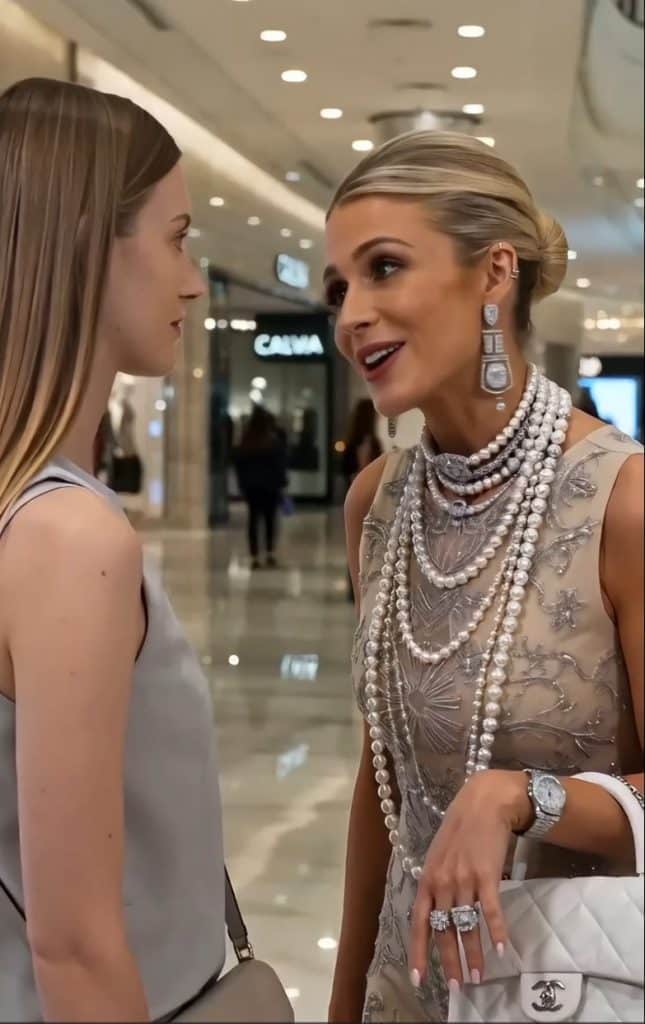
Act I
The insult arrived wrapped like a compliment.
“Honestly,” Celeste Whitcomb said, smiling beneath the bright lights of the luxury lobby, “I admire you.”
Nora Ellis looked at her calmly.
Around them, the mall gleamed like wealth had been polished into the floor. Marble pillars rose into recessed ceiling lights. Storefronts shimmered behind glass. A glowing sign reading CALIA curved above one boutique entrance, its gold letters reflected on the glossy tiles below.
Celeste belonged to that world at first glance.
Her blonde hair fell in perfect waves. Her beige dress glittered with silver embroidery. Pearls rested at her throat. Rings flashed on almost every finger. A white quilted designer handbag hung from her wrist like proof of citizenship.
Nora, beside her, wore a simple light gray sleeveless top, wide-leg cream trousers, and a small neutral handbag with no visible logo.
She looked elegant, but quiet.
To Celeste, quiet meant vulnerable.
“Why?” Nora asked.
Celeste’s smile widened.
“In this day and age, it’s rare to see someone dressed this simply and still be so confident.”
The words floated between them, soft enough that anyone passing might mistake them for kindness. But the meaning was sharp. Celeste’s eyes moved from Nora’s plain top to her understated bag, then back to her face.
Nora did not blush.
She did not step back.
She only blinked once.
“I don’t really think about that,” she said.
That answer irritated Celeste more than embarrassment would have.
She had expected a flinch. A nervous laugh. Maybe an apology disguised as a joke.
Instead, Nora stood there as if the marble lobby, the luxury signs, the expensive perfumes in the air, and Celeste’s jewelry meant exactly nothing to her.
Celeste tilted her head.
“It shows,” she said. “Personally, I wouldn’t have the confidence to come to a place like this dressed like that.”
A man in a suit slowed nearby. A pair of shoppers pretended to admire a window display while listening. The sales associate at the CALIA entrance looked down quickly, as if she had heard this kind of cruelty before.
Nora’s mouth curved slightly.
Not a smile of defeat.
A smile of recognition.
Celeste noticed it and stopped smiling for half a second.
“What?” she asked.
Nora held her gaze.
Then she lowered one hand to her small, unbranded handbag and slipped her fingers inside.
The lobby seemed to hold its breath.
Celeste’s pearls shifted faintly against her throat.
For the first time, she wondered whether she had chosen the wrong woman to humiliate.
And she had.
Act II
Celeste Whitcomb had built her life on rooms like this.
Not houses. Not work. Not love.
Rooms.
Private lounges. Charity previews. Hotel openings. Designer trunk shows where the champagne was free but the access was not. She knew where to stand, how to tilt her chin, when to laugh, and which names to drop before anyone asked for proof she belonged.
Her mother had taught her early.
Never look impressed. Never ask the price. Never admit you don’t know someone.
Celeste had followed those rules until they became her personality.
Online, she was admired as a style tastemaker. In person, she was tolerated because her last name still opened doors, even after the family money had become more memory than fact. The Whitcombs had once owned old real estate, old art, old influence.
Now Celeste owned the performance of all three.
That afternoon, she had come to the mall for CALIA.
Everyone in her circle wanted into CALIA’s private launch. The brand had become the obsession of women who wanted luxury without looking like they were trying. No loud logos. No obvious status symbols. Just clean tailoring, hand-finished details, and waiting lists that made wealthy people feel hungry.
Celeste hated the brand’s restraint.
But she wanted its approval.
A partnership with CALIA would fix everything. The stalled sponsorships. The unpaid stylist invoices. The whispers that her designer bags were borrowed. The quiet panic that followed her home every night after the lights and compliments disappeared.
She needed the launch.
She needed to be photographed there.
She needed people to believe she was still untouchable.
Then she saw Nora standing near the CALIA entrance.
No entourage. No diamonds. No makeup mask. No visible invitation.
Just calm.
That calm unsettled Celeste.
Because Celeste knew how to compete with women who tried too hard. She knew how to outshine sequins, outtalk heiresses, and make nervous girls feel cheap before they could threaten her.
But Nora did not seem to be competing at all.
That was unforgivable.
Nora had learned the opposite lesson from life.
Her mother, Elise, had been a seamstress who entered luxury hotels through service doors with garment bags over both arms. She repaired torn linings for women who never learned her name. She hemmed gowns that cost more than her rent. She taught Nora that real quality rarely announced itself.
“Loud things are afraid of being missed,” Elise used to say.
Nora remembered being twelve years old, sitting quietly in a hotel corridor while her mother altered a dress for a woman attending a gala upstairs. The woman had stepped into the hallway, looked down at Elise kneeling near the hem, and said, “Be careful. That fabric costs more than your car.”
Elise had only smiled.
But Nora saw her hand shake when she picked up the needle again.
Years later, when Elise died, Nora found sketchbooks hidden in a sewing cabinet. Page after page of designs. Clean lines. Soft structures. Clothes made for women who did not need to beg a room for approval.
Nora built CALIA from those sketches.
At first, no one knew her name. Investors wanted a louder founder. Magazines wanted a more glamorous face. Publicists wanted Nora in diamonds, not cotton. But Nora refused to build a brand about quiet confidence while pretending to be someone else.
So she stayed mostly private.
She let the clothes speak.
And they did.
CALIA became a secret first, then a whisper, then a name printed in gold above marble floors.
That day, Nora had come to the flagship quietly.
No cameras. No announcement. No security circle.
She wanted to watch how people behaved before they knew who she was.
Her mother had taught her that too.
People reveal themselves when they think there are no consequences.
Celeste had just done exactly that.
And inside Nora’s handbag was the one thing that could turn the entire room around.
Act III
Nora pulled out a small black envelope.
Celeste’s eyes flicked to it.
The envelope was matte, thick, and sealed with a gold CALIA emblem pressed into wax.
Celeste recognized it instantly.
Her own invitation had not arrived in that envelope.
She had spent three weeks calling assistants, messaging stylists, and pretending she had misplaced a confirmation that had never been sent. The private launch list was rumored to be impossible to access unless the founder herself approved the name.
Celeste stared at the seal.
Nora broke it with one clean motion.
Inside was a cream card.
But she did not hand it to Celeste.
She handed it to the young CALIA sales associate standing near the entrance, the one who had been pretending not to listen.
The associate looked down.
Her eyes widened.
Then her posture changed completely.
“Ms. Ellis,” she said softly.
Celeste went still.
Nora gave the associate a warm nod.
“Please tell Marianne I’ll be inside in a moment.”
The associate swallowed, suddenly nervous.
“Of course. We weren’t expecting you until four.”
“I came early.”
Celeste stared at Nora.
“Ms. Ellis?”
Nora turned back to her.
The faint smile remained, but now it carried weight.
“Nora Ellis,” she said. “Founder and creative director of CALIA.”
The silence after that was almost beautiful.
The shoppers nearby stopped pretending. The man in the suit looked over fully. Somewhere behind the glass storefront, another employee froze with a garment bag in hand.
Celeste’s face changed in layers.
Confusion first.
Then disbelief.
Then calculation.
Finally, fear.
“You’re joking,” she said.
Nora said nothing.
The associate stepped forward carefully, holding the card as if it were a legal document.
“Ms. Ellis founded the house,” she said. “This is her flagship.”
Celeste’s hand tightened around her white quilted handbag.
Her rings looked suddenly excessive under the lights.
“I didn’t mean anything by what I said,” she said quickly. “You misunderstood me.”
Nora’s eyes remained calm.
“No,” she said. “I understood you perfectly.”
Celeste laughed once, too sharply.
“I was complimenting you.”
“You were measuring me.”
That landed.
Celeste glanced around and realized, with growing panic, that the lobby had become a stage. But this time, she was not directing the scene.
Nora looked at her dress, her jewelry, her perfect hair, not with envy or contempt, but with something worse.
Clarity.
“You assumed simple meant less,” Nora said. “That a woman without visible labels must be lost, or brave, or beneath you.”
Celeste’s mouth opened.
No defense came out.
Nora looked toward the CALIA sign.
“My mother used to sew for women who spoke exactly like you,” she said. “They wore beautiful things and made every room uglier.”
The associate lowered her eyes.
Celeste’s face flushed.
“That’s unfair.”
“Is it?”
Celeste’s voice dropped.
“Do you know who I am?”
Nora’s smile faded.
“Yes,” she said. “That’s the problem.”
Then Nora reached back into her handbag.
This time, she removed a folder.
Celeste saw her own name printed on the top page.
And the color drained from her face.
Act IV
The folder was not thick.
It did not need to be.
Nora opened it slowly, not for drama, but because she had no desire to humiliate anyone the way Celeste had tried to humiliate her.
That restraint made the moment sharper.
“Celeste Whitcomb,” Nora read. “Requested launch access through three agencies, two stylists, one board acquaintance, and one charitable committee.”
Celeste looked toward the shoppers.
“This is private.”
“It was,” Nora said. “Until you made character public.”
Celeste stepped closer, lowering her voice.
“You can’t judge me for one comment.”
Nora looked at her.
“One comment is a window. Yours was very clear.”
Celeste’s lips tightened.
The mask was slipping now. Not all at once. Just enough for the fear beneath it to show.
“I support women-owned brands,” she said. “My platform could bring you visibility.”
Nora almost smiled.
“Visibility is not the same as value.”
A woman in a cream suit emerged from inside CALIA. Marianne, the boutique director, moved quickly but gracefully, her face composed in the way only luxury retail veterans could manage.
“Ms. Ellis,” she said. “The preview room is ready.”
Nora handed her the folder.
“Remove Ms. Whitcomb from the guest consideration list.”
Celeste’s eyes widened.
“You can’t be serious.”
Marianne hesitated only half a second.
Then she nodded.
“Of course.”
Celeste turned red.
“This is ridiculous. Because I said her outfit was simple?”
Nora’s voice remained even.
“No. Because you saw a woman you believed had less power than you, and your first instinct was to make her feel small.”
The words struck deeper than an insult would have.
Celeste looked away first.
But then pride returned, desperate and ugly.
“You think you’re better than me because you hide behind minimalism?” she said. “At least I know how this world works. People buy fantasy. They buy status. They buy what other women envy.”
Nora looked around the lobby.
At the marble.
At the bright lights.
At the shoppers watching.
At the storefront her mother would never have believed could carry the name born from her sketches.
Then she looked back at Celeste.
“My mother built clothes for women like you,” Nora said. “Not because she admired them. Because she had bills to pay. But every time one of them dismissed her, she went home and drew something better than anything they wore.”
Celeste’s expression flickered.
For one second, she looked almost human.
Then Nora gave the final cut, softly.
“I did not build CALIA for women who need other women to feel poor.”
Nobody spoke.
The sentence seemed to settle into the marble itself.
The associate at the door quietly wiped at one eye. Marianne stood straighter. The man in the suit gave the smallest nod, as if he had just witnessed a verdict.
Celeste’s phone buzzed in her hand.
She glanced down.
Then looked sick.
A message.
No doubt from someone nearby. Perhaps a stylist. Perhaps a friend already inside the preview room. News traveled fast in places where reputation mattered more than truth.
Her access was gone.
The launch photos were gone.
The partnership was gone.
And the worst part was that Celeste could not even claim she had been attacked.
She had simply been seen.
Nora closed the folder.
Then she turned away.
That should have been the end.
But Celeste whispered one sentence behind her.
“You have no idea what it’s like to be terrified of becoming nobody.”
Nora stopped.
For the first time, she turned back without the calm armor.
And what she saw on Celeste’s face was not arrogance.
It was panic wearing pearls.
Act V
Nora had every right to walk away.
Everyone expected her to.
Marianne waited by the boutique entrance. The associate held the door. The lobby remained suspended in that delicate silence that follows public downfall.
Celeste stood alone now, her white handbag hanging from her wrist, her jewelry suddenly too bright.
The woman who had entered the scene as if she owned the room looked stranded inside it.
Nora studied her for a long moment.
Then she said, “Being afraid does not give you permission to be cruel.”
Celeste’s eyes shone, but she refused to let a tear fall.
“I know.”
The words were barely audible.
Nora stepped closer, lowering her voice enough that the crowd could no longer feed on the exchange.
“My mother spent her whole life being made invisible by women who were scared of losing status,” she said. “I will not reward that. Not in my house.”
Celeste nodded once, stiffly.
“But I will tell you something I wish someone had told them,” Nora continued. “You don’t become nobody when people stop envying you. You become nobody when admiration is all you have.”
Celeste looked down.
For once, she had no polished reply.
Nora turned to Marianne.
“Cancel the partnership consideration,” she said. “But leave her general purchase account alone.”
Marianne nodded.
Celeste looked up, startled.
Nora’s voice stayed firm.
“Consequences are not the same as destruction.”
That sentence changed the room again.
It did not save Celeste from embarrassment. It did not restore her invitation. It did not erase what she had said.
But it refused to make cruelty the final language of the moment.
Nora walked into CALIA.
The glass doors opened for her, and the entire boutique seemed to brighten. Inside, models stood near ivory curtains. Editors murmured over champagne flutes. A photographer lowered his camera when she entered, suddenly aware that the founder had arrived without spectacle.
Nora did not head toward the cameras.
She went first to the young associate at the entrance.
“What’s your name?” she asked.
“Amelia.”
“You handled that with grace.”
Amelia flushed. “Thank you.”
“Come inside. I want you in the preview room.”
Amelia blinked.
“Me?”
“Yes,” Nora said. “You saw what the brand is for.”
In the lobby, Celeste watched through the glass.
No one spoke to her for a while.
Then slowly, the mall began moving again.
Footsteps returned. Shoppers whispered. The world resumed its polished rhythm, but Celeste remained still, staring at her reflection in the CALIA window.
For years, she had trusted that reflection more than anything.
Hair perfect.
Jewelry correct.
Dress expensive.
Smile sharp.
But now she saw what Nora had seen.
Not elegance.
Armor.
A week later, the CALIA launch appeared across every fashion page.
There were photos of Nora Ellis in her simple gray top, standing beside models in clean silk and structured linen. There were articles about her mother, Elise, the seamstress whose sketchbooks became the foundation of a global luxury house.
But the image that traveled farthest was not of any celebrity.
It was a photograph of Amelia, the young associate, wearing the first piece from the new collection: a soft ivory jacket with hand-stitched seams, designed from one of Elise’s original sketches.
The caption was simple.
Confidence does not need permission.
Celeste saw it alone in her apartment.
No glam team. No champagne. No white marble lobby.
Just the blue light of her phone and the quiet truth that she had been close to something real and had mistaken it for something beneath her.
For the first time in years, she opened her closet and felt exhausted by everything inside it.
The borrowed bags.
The unpaid dresses.
The jewelry selected not because she loved it, but because someone else might.
She sat on the floor for a long time.
Then, quietly, she removed the pearls from her neck.
Months later, Celeste returned to the same mall.
She did not announce herself. She wore black trousers, a white shirt, and no visible jewelry except a small ring that had belonged to her grandmother.
At the CALIA entrance, Amelia recognized her immediately.
Celeste almost turned around.
But Amelia did not smirk.
She did not punish her.
She simply said, “Good afternoon.”
Celeste took a breath.
“I’m not here for an event,” she said. “I wanted to buy something. For myself this time.”
Amelia nodded.
“Then we can help.”
Celeste looked past her into the boutique.
Nora was not there.
That made it easier and harder.
She stepped inside slowly.
The store was quiet. Warm. Filled with pieces that did not beg to be noticed but became more beautiful the longer one looked. Celeste touched the sleeve of an ivory jacket and saw the tiny hand-finished stitches along the cuff.
For once, she did not ask who had worn it.
She asked who had made it.
Amelia smiled.
And for the first time in a long time, Celeste listened without preparing an insult.
That same afternoon, Nora stood in the old workroom behind CALIA’s headquarters, holding one of her mother’s sketchbooks.
The page was yellowed at the edges. Elise had drawn a simple dress with a note beneath it.
For the woman who walks in quietly and changes the room.
Nora ran her fingers over the words.
She thought about the marble lobby, Celeste’s cruel smile, Amelia’s courage, and the little black envelope that had turned an insult into a reckoning.
Then she closed the sketchbook and looked out over the cutting tables, where young designers bent over fabric with careful hands.
Her mother had never walked through luxury doors as a guest.
But her work had built one.
And now, because of her, women like Nora did not need to dress loudly to be allowed inside.
They could enter calmly.
They could carry no logo.
They could wear simplicity like a crown.
And when someone tried to make them feel small, they could smile, open a quiet little handbag, and let the truth do what diamonds never could.