Act I
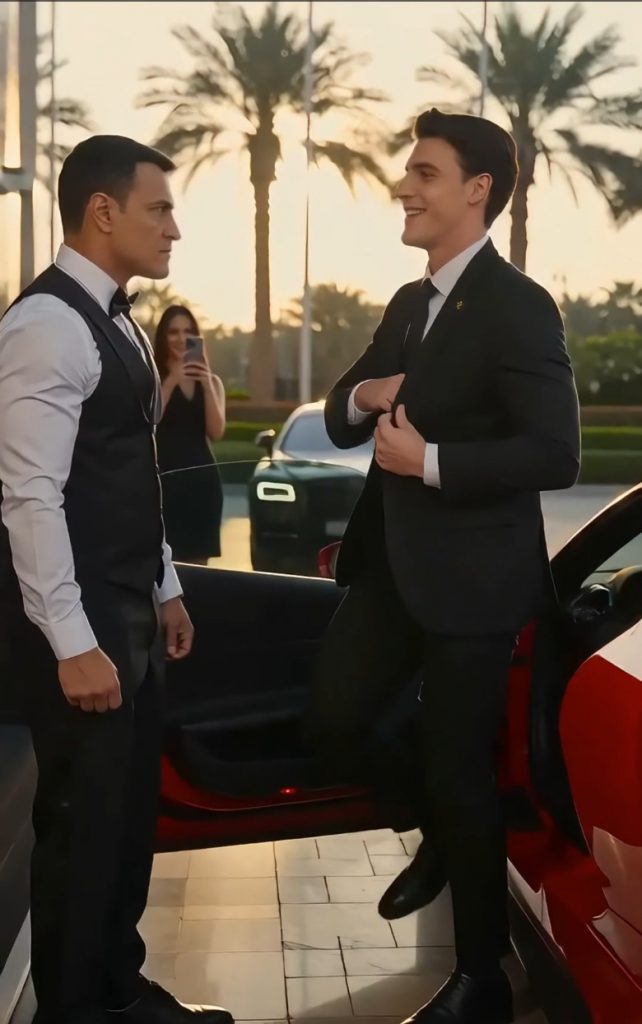
The red supercar arrived like a warning.
Its engine tore through the quiet entrance drive of the Aurelia Grand, bouncing off marble columns and glass doors until every valet, guest, and security guard turned toward the sound. The late-afternoon sun glared against the polished stone tiles, turning the driveway into a mirror. Palm trees trembled in the warm breeze. A row of black sedans waited in perfect silence near the curb.
Marcus Hale stood at the valet post in a crisp white shirt, black vest, black bowtie, and polished shoes.
He did not flinch.
The car swung into the entrance too fast, tires squealing against the glossy stone. It stopped so close to Marcus that a younger valet behind him took a step back.
Marcus only adjusted his stance.
Professional. Controlled. Unreadable.
The driver’s door lifted open with a smooth mechanical hiss. A polished black shoe touched the pavement first, then a young man in a tailored black suit stepped out as if the driveway had been built for his entrance.
Adrian Voss was twenty-six, wealthy, and painfully aware of it.
His dark hair was slicked back. A small gold pin flashed on his black tie. He looked around just long enough to make sure people were watching.
They were.
A young woman in a sleek black dress near the entrance raised her phone and started recording. Adrian noticed and smiled wider.
Marcus approached the car door with the quiet precision of a man who had done this a thousand times.
“Welcome to the Aurelia Grand, sir.”
Adrian looked him up and down.
Not at his face.
At his uniform.
Then he laughed softly.
The sound was small, but it carried.
Marcus held out his hand for the keys.
Adrian dangled them for one second, letting the metal catch the sun.
Then he dropped them.
They hit the polished stone at Marcus’s feet with a sharp, humiliating clatter.
A few people near the entrance froze.
The woman with the phone gave a faint laugh.
Adrian tilted his head.
“Pick it up yourself,” he said. “That’s your job anyway, right?”
Marcus looked down at the keys.
For one second, he did not move.
The red car idled behind him. The hotel doors gleamed ahead. The guests watched from a safe distance, the way people watch discomfort when they are glad it is not happening to them.
Marcus bent slowly.
He picked up the keys.
When he stood again, his face was calm.
Only his hand betrayed him.
His fingers closed around the key ring tighter than necessary.
Adrian turned toward the entrance, then stopped as if he had remembered one last insult.
“Be careful,” he said, pointing back at the supercar. “That car is worth more than your entire life.”
The words landed in the sunlight.
Marcus said nothing.
He watched Adrian walk toward the glass doors, watched the woman keep recording, watched the doorman pretend not to hear.
His jaw tightened once.
Then his eyes dropped to the key fob in his palm.
And that was when Marcus saw the silver tag attached to the ring.
It had one name engraved on it.
A name Marcus had been waiting all week to see.
Act II
The Aurelia Grand had always been a place where people learned what they were worth.
Guests learned it from the marble floors, the private elevators, the silent staff who remembered their names before they introduced themselves. Investors learned it from the gold fixtures, the rooftop restaurant, the palm-lined entrance, the cars lined up like trophies.
Employees learned it differently.
They learned it from the way some guests snapped their fingers instead of speaking. From the complaints filed over shoes not polished enough, doors not opened fast enough, smiles not wide enough. From men like Adrian Voss, who treated a uniform like permission to be cruel.
Marcus Hale knew every corner of that hotel.
Not because he had worked there for a month.
Because he had helped build it.
Twenty-one years earlier, Marcus had been a young security guard at the old Aurelia, back when the hotel had peeling paint, leaking pipes, and a lobby that smelled faintly of rain whenever storms came in from the coast. He worked nights and sent half his paycheck home to his mother. He knew which elevators jammed, which guests were kind, which managers stole tips, and which employees cried in the locker room but walked back out smiling anyway.
The original owner, Eleanor Whitcomb, had noticed him.
Not because he was charming. Marcus was not charming.
He was steady.
When a fire broke out in the kitchen one summer night, Marcus carried an elderly guest down three flights of stairs and went back in for two housekeepers trapped behind a service corridor door. The local paper printed his photo for one day.
Eleanor remembered longer.
She promoted him. Then promoted him again. She taught him the business from the loading dock up. Contracts. vendors. security systems. payroll. unions. property taxes. liability. reputation.
“Luxury is not marble,” she told him once. “Luxury is trust. The second your staff stops trusting you, the building is just expensive furniture.”
When Eleanor died, the city expected the Aurelia to be sold to a corporation.
Instead, her will stunned everyone.
Marcus Hale inherited thirty percent of the hotel.
Another thirty percent went into an employee trust.
The rest stayed with the Whitcomb family.
Marcus never became the kind of owner who liked speeches. He stayed mostly invisible. He worked behind the scenes, sat on the board, reviewed security reports, and walked the property when no one expected him.
Then complaints began arriving.
A valet shoved by a guest.
A housekeeper called “invisible” to her face.
A bellman tipped with a coin thrown into a fountain.
Three resignations in two weeks.
All from the front entrance.
So Marcus put on the old uniform.
Not as a stunt.
As a test.
He wanted to see what his employees saw when the powerful thought no one powerful was watching.
That afternoon, he got his answer.
And the man who gave it to him was not just any guest.
Adrian Voss was the son of Victor Voss, chairman of Voss Meridian, a private investment firm that had been circling the Aurelia for months. Victor wanted to buy the Whitcomb family’s stake and push the employee trust out through a legal loophole. He called it modernization. Marcus called it stripping the soul out of the building and selling the bones.
Tonight, Victor was hosting a private reception upstairs.
A “partnership dinner.”
A room full of bankers, city officials, lifestyle reporters, and board members would hear him explain why the Aurelia needed a new future.
Marcus had planned to attend quietly.
Then Adrian threw the keys at his feet.
The silver tag attached to the key ring carried the Voss Meridian crest.
Not Adrian’s initials.
Not a personal tag.
Company property.
Marcus looked back at the red supercar.
It was not just expensive.
It was a message.
A red, roaring announcement that the Voss family believed they already owned the place.
Marcus handed the keys to the younger valet.
“Park it in bay seven,” he said calmly. “Photograph every panel before and after. Full record.”
The young valet nodded, still pale from what he had witnessed.
“Mr. Hale,” he whispered, “are you okay?”
Marcus looked toward the glass doors where Adrian had disappeared.
“No,” he said.
The young valet stared at him.
Marcus adjusted his black bowtie.
“But I will be.”
Then he walked toward the entrance with the quiet anger of a man who had just decided the evening was no longer going to follow the agenda.
Act III
Inside the Aurelia, the air smelled of citrus, polished wood, and expensive flowers.
The lobby rose three stories high beneath a chandelier that scattered gold light across the marble floor. Guests drifted toward the private elevators, laughing softly, holding champagne, pretending they had never heard anyone being humiliated outside.
Adrian was already near the elevator bank, telling the story.
Marcus saw him before Adrian saw Marcus.
He stood among a small circle of young investors, one hand in his pocket, the other lifting a glass he had taken from a passing tray. The woman in the black dress still had her phone in her hand.
“He just bent down,” Adrian said, laughing. “Didn’t say a word. These people know their place when you remind them.”
The woman smiled, but this time it looked weaker.
Maybe the video seemed funnier when it was still happening.
Maybe cruelty lost its shine when repeated indoors.
Marcus kept walking.
One of the older board members near the lobby entrance noticed him and began to step forward.
Marcus gave him a small shake of the head.
Not yet.
He moved past Adrian without speaking and entered a service hallway beside the ballroom. The staff corridor was quieter. Narrower. Less beautiful. It was the part of the hotel guests never saw, which meant it was the part that kept the whole place alive.
A houseman pushed a cart of linens past him.
“Evening, Mr. Hale.”
“Evening, Tomas.”
Tomas stopped. “You’re still in uniform?”
“For a few more minutes.”
Marcus entered the security office and closed the door.
On the monitor, the driveway footage was already saved. The red car’s arrival. The door opening. The keys falling. Adrian’s insult. The bystander filming. Marcus bending down.
It looked worse from the camera angle.
Cleaner. Colder.
There was no confusion. No accidental drop. No playful misunderstanding.
It was humiliation by design.
Marcus copied the clip to a secure drive, then opened another file.
The Voss proposal.
He had read it three times that week, each time growing more certain that Victor Voss did not want to save the Aurelia. He wanted to gut it. Cut pensions. Reduce staffing. Outsource housekeeping. Replace longtime employees with cheaper contractors. Turn the employee trust into cash and call it efficiency.
Buried on page forty-two was the line Marcus hated most.
Legacy labor structure presents significant margin obstruction.
Legacy labor.
That was what Victor called people like Tomas, who had worked banquets for eighteen years. Maria in laundry, who knew every sheet by texture. Paul at the door, who had carried guests’ luggage through hurricanes. Denise in reservations, who could calm an angry bride, a grieving widow, and a lost tourist in the same hour.
People reduced to obstruction.
Marcus looked at the paused frame of Adrian pointing at the supercar.
That car is worth more than your entire life.
He printed one page of the Voss proposal.
Then he printed a still image from the security footage.
Then he changed clothes.
Not into a tuxedo.
Into a dark suit.
Simple. tailored. quiet.
The black valet vest stayed folded on the chair behind him.
When Marcus entered the ballroom ten minutes later, Victor Voss was already at the front of the room.
Victor had the same slick confidence as his son, but aged into something smoother and more dangerous. Silver hair. expensive watch. warm smile. Cold eyes.
He stood before a room of investors and board members, one hand resting on the podium.
“The Aurelia Grand is an icon,” Victor said. “But icons must evolve. Sentiment cannot be allowed to suffocate growth.”
A few people nodded.
Marcus stepped inside.
One by one, heads turned.
Victor’s smile faltered almost invisibly.
He recognized Marcus, of course.
Adrian did not.
Adrian stood near the bar and frowned at the former “valet” walking into a private reception like he belonged there.
Then someone near the front whispered, “Mr. Hale.”
Adrian’s face changed.
Not fear yet.
Confusion first.
Then the first cold edge of realization.
Marcus walked to the center aisle.
Victor cleared his throat.
“Marcus. We weren’t expecting you to join quite so soon.”
Marcus looked at him.
“No,” he said. “I imagine you weren’t.”
The room went quiet.
And for the first time that evening, Adrian Voss stopped smiling.
Act IV
Marcus did not raise his voice.
That made it worse.
Men like Victor and Adrian Voss understood shouting. They could dismiss shouting as emotion, bitterness, lack of discipline. Calm was harder. Calm meant control had moved to someone else’s hands.
Marcus turned to the room.
“Before we discuss the future of the Aurelia,” he said, “I think we should discuss what kind of future is being proposed.”
Victor’s jaw tightened. “This is neither the time nor the format.”
Marcus held up the printed page.
“This is your format, Victor. Page forty-two.”
Several board members shifted.
Marcus read the line aloud.
“Legacy labor structure presents significant margin obstruction.”
He lowered the paper.
“That is how Voss Meridian refers to the people who run this hotel.”
Victor gave a thin smile. “A technical phrase in a financial analysis.”
“Of course,” Marcus said. “Technical phrases are useful. They make people sound less human before you remove them.”
A murmur spread through the room.
Adrian set his drink down.
Marcus turned slightly toward him.
“I spent this afternoon working the valet post.”
Adrian’s face went pale.
The woman in the black dress lowered her phone, as if the device had suddenly become evidence.
Marcus continued.
“I wanted to understand why employees at our entrance have been resigning. I wanted to know whether the abuse reports were exaggerated.”
He looked directly at Adrian.
“They were not.”
Victor stepped away from the podium.
“Marcus, if there was an incident, we can handle it privately.”
“That is what men like you count on,” Marcus said. “Privacy after public cruelty.”
The room froze.
Marcus nodded to the audiovisual technician near the wall.
The large screen behind the podium flickered.
Then the driveway appeared.
The supercar roaring in.
The door opening.
The keys dangling.
The drop.
The clatter sounded through the ballroom speakers with painful clarity.
Then Adrian’s voice filled the room.
“Pick it up yourself. That’s your job anyway, right?”
No one moved.
The footage continued.
Adrian turning back.
Pointing at the car.
“Be careful. That car is worth more than your entire life.”
The video stopped on Marcus standing still, keys clenched in his hand.
The silence after it was worse than gasps.
Victor looked at his son.
Adrian looked at the floor.
Marcus turned back to the room.
“I have no interest in partnering with a family that treats workers as props when cameras are rolling and obstructions when documents are drafted.”
Victor’s face hardened.
“You are emotional.”
“Yes,” Marcus said. “I am. That is what happens when a person remembers he is talking about human beings.”
Someone near the back began to clap.
It was quiet at first.
Then another person joined.
Then Tomas, standing near the service door with a tray in his hands, clapped once, slowly, like he was not sure he was allowed.
More followed.
Board members. Staff. Guests. Even a city councilwoman who had been smiling politely through Victor’s speech now stared at him with open disgust.
Victor lifted a hand.
“Everyone should understand that Mr. Hale owns only a minority position.”
Marcus nodded.
“I own thirty percent.”
Victor’s smile returned slightly.
“And the Whitcomb family controls the deciding stake.”
“That was true this morning,” Marcus said.
Victor stopped smiling.
Marcus reached into his jacket and removed a folded document.
“An hour ago, Eleanor Whitcomb’s grandchildren signed a voting agreement with the employee trust. Effective immediately, no sale, restructuring, or labor reduction plan can proceed without trust approval.”
Victor’s expression tightened.
The employee trust attorney rose from a table near the front.
“That is correct.”
Adrian whispered, “Dad.”
Victor ignored him.
Marcus looked toward the staff gathered along the side wall.
“This hotel was built by people in uniforms. Not by men who drop keys at their feet.”
Then he looked at Adrian again.
“As for the car, it is safely parked. Documented before and after, because my staff are professionals even when guests are not.”
Adrian’s mouth opened.
Nothing came out.
Marcus walked toward him.
Not quickly.
Not aggressively.
Just enough that Adrian had to stand there and receive the moment he had created.
Marcus held out the keys.
This time, he did not lower them.
Adrian had to reach up and take them from his hand.
That small reversal cut deeper than any speech.
Marcus leaned close enough for only Adrian to hear.
“A car can be replaced,” he said. “A reputation is harder.”
Then he stepped back.
And the whole ballroom watched Adrian understand that the man he had ordered to bend was the one person in the building he should never have tried to break.
Act V
The video reached the internet before dessert.
Not because Marcus released it.
Because the woman in the black dress had already posted her version when she thought humiliation was entertainment.
She deleted it too late.
By the time Victor Voss left the Aurelia through a side exit, reporters had begun calling. By midnight, Voss Meridian issued a statement about “behavior inconsistent with company values.” By morning, three board members from other projects quietly distanced themselves from the firm.
Adrian’s red supercar stayed in bay seven until after midnight.
No one scratched it.
No one touched it.
No one took revenge on the machine.
That mattered to Marcus.
Anger could expose the truth, but discipline decided what happened next.
The next day, Marcus returned to the valet post.
Not because he had to.
Because the staff would talk more honestly there than in conference rooms.
The young valet from the day before, Julian, saw him and straightened.
“Mr. Hale, you don’t need to be out here.”
Marcus looked at the driveway.
“No,” he said. “But I should have been out here sooner.”
Julian did not know what to say.
So he said the truth.
“He made you bend down.”
Marcus nodded.
“He did.”
“I wanted to say something.”
“I know.”
“I didn’t.”
Marcus turned toward him.
“You were afraid for your job.”
Julian lowered his eyes.
Marcus placed a hand on his shoulder.
“That is my failure, not yours.”
By noon, every entrance employee had been called into a meeting.
No speeches about family. No glossy posters. No empty promise that the Aurelia cared.
Marcus announced policy.
Any guest who threw, dropped, snapped, shoved, insulted, or filmed staff for humiliation would be denied service.
No employee would be required to kneel for keys. Key trays would be placed at every valet station.
All abuse reports would go directly to the employee trust, not just management.
Tips stolen or withheld through “service penalties” would be investigated.
The staff listened in silence at first.
Then Maria from laundry raised her hand.
“What happens when the guest is important?”
Marcus looked at her.
“Then the report becomes more important.”
That was when people finally believed him.
Three days later, Adrian Voss returned.
Not in the red supercar.
Not with his friends.
He arrived in a black sedan with tinted windows and stepped out wearing a plain gray suit that made him look younger and smaller. His hair was still perfect, but his confidence was not.
Marcus was at the valet post.
Adrian stopped a few feet away.
For a moment, neither man spoke.
The driveway seemed to remember.
The polished stone. The sunlight. The place where the keys had fallen.
Adrian looked at Marcus, then at Julian, then at the other employees watching from carefully chosen distances.
“I came to apologize,” he said.
Marcus waited.
Adrian swallowed.
“What I did was disgusting. What I said was worse. I thought money made me untouchable. It made me small.”
The words sounded rehearsed at first.
Then his voice cracked slightly.
“I’m sorry, Mr. Hale.”
Marcus studied him.
Apologies from men under pressure are easy. Remorse is harder.
“Don’t apologize to my title,” Marcus said.
Adrian turned slowly toward Julian.
Then toward the doorman.
Then toward the staff by the entrance.
“I’m sorry,” he said again. “To all of you.”
No one rushed to forgive him.
Marcus respected that too.
Forgiveness was not another service wealthy men could request at the entrance.
Adrian reached into his pocket and removed a small envelope.
“This is for the staff fund.”
Marcus did not take it.
“Leave it with payroll. And understand something clearly. A donation is not a receipt for forgiveness.”
Adrian nodded.
“I understand.”
Maybe he did.
Maybe he was only beginning to.
That was not Marcus’s concern.
His concern was the hotel, the people who kept it breathing, and the line that had finally been drawn on the polished stones outside.
Months later, guests still arrived in expensive cars.
Some were kind. Some were careless. A few tested the new rules and learned quickly that the Aurelia Grand had changed.
One man snapped his fingers at a bellman and was asked to leave.
A woman mocked a housekeeper’s accent and found her suite reservation canceled.
A celebrity shoved a valet’s shoulder during a late-night arrival and was escorted off the property before his luggage made it inside.
People complained.
Marcus let them.
The hotel did not collapse.
It became stronger.
Staff stopped quitting. Service improved. Guests who valued dignity stayed. Guests who missed cruelty went elsewhere and called it decline.
Marcus called it repair.
The red supercar never returned.
But the story did.
Again and again, new employees heard about the day a rich man threw his keys on the ground and told a valet the car was worth more than his life.
They heard how Marcus Hale bent down.
How he stood back up.
How he carried the insult silently into a room full of powerful people and turned it into proof.
One evening, long after the scandal had faded from headlines, Marcus walked past the valet stand at sunset. The polished stone reflected gold light. Palm trees moved softly above the parked cars. Julian, now promoted to entrance supervisor, stood with the same disciplined posture Marcus once had.
A guest stepped out of a sedan and started to toss his keys casually.
Julian did not move.
The guest caught himself.
Then he placed the keys carefully in the tray.
“Sorry,” the guest said.
Julian smiled.
“Welcome to the Aurelia Grand.”
Marcus watched from the doorway.
No applause. No cameras. No dramatic music.
Just a small moment of respect where humiliation used to live.
He looked down at his own hands, remembering the weight of Adrian’s keys in his fist, the heat in his chest, the choice not to strike back in the language cruelty understood.
He had not damaged the car.
He had not raised his voice.
He had not needed to.
The arrogant driver had been right about one thing. The car was expensive.
But Marcus knew what Adrian had learned too late.
A man’s dignity is worth more than anything parked at the curb.