Act I
The boy did not ask for a free meal.
That was what Mateo Alvarez would remember years later.
Not the dirt on his shirt. Not the plastic bag full of cans dragging against his leg. Not even the hunger in his eyes, though that was impossible to miss.
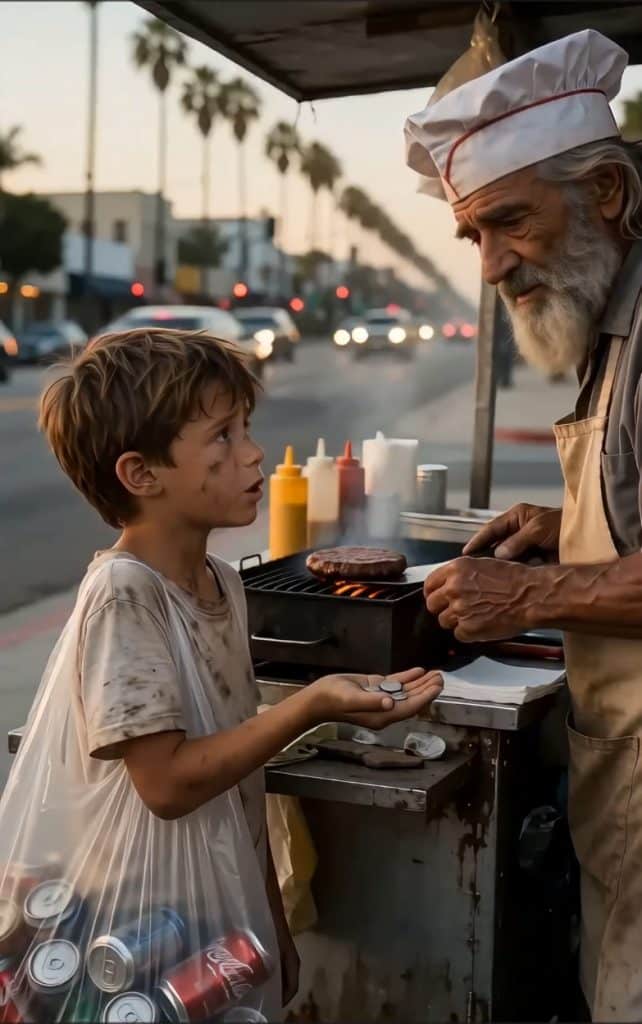
He remembered that the boy opened his palm and showed him three coins.
“Can I buy the cheapest burger?” the boy asked.
The city moved around them like it always did at sunset. Cars rolled slowly past the corner. Palm trees cut dark shapes against a gold-orange sky. Smoke lifted from Mateo’s charcoal grill, carrying the smell of sizzling beef, toasted buns, and onions into the warm evening air.
The boy stood in front of the weathered burger cart with his shoulders hunched, like he was trying to make himself smaller than his hunger.
He was maybe nine.
His brown hair stuck up in uneven pieces. His white T-shirt was smudged with dust and something dark near the collar. Beside him, a translucent plastic bag bulged with aluminum cans he had collected from sidewalks, trash bins, and alley corners.
Mateo looked at the coins.
Then he looked at the boy’s face.
The child was not begging. That was what made it hurt.
He had come prepared to pay what he could. He had counted those coins. He had likely walked past the cart twice before finding the courage to stop.
Mateo’s menu board hung crooked from the cart.
Cheapest burger: $3.50.
The boy had seventy-three cents.
Mateo wiped his hands on his tan apron. His beard was full and gray, and the paper chef’s cap on his head had gone soft from the day’s heat. He had been on that corner for thirty-two years. He had seen bankers drunk after happy hour, tourists lost near the bus stop, mothers splitting one meal between three kids, construction workers too tired to chew.
But there was something about this boy.
Something familiar.
The way he stood with his hunger hidden behind manners.
Mateo reached across the counter and gently closed the boy’s fingers around the coins.
The boy blinked.
“I can pay some,” he said quickly. “I can bring more tomorrow.”
Mateo shook his head.
Then he pulled a clean paper tray from the hanging pouch beside the grill. He set it on the prep surface, placed a fresh burger on it, added golden fries still hot from the basket, and wrapped a napkin around the side so the boy would not burn his fingers.
He set the tray into the child’s two hands.
“Eat,” Mateo said. “You don’t owe me anything.”
The boy stared down at the food.
For a moment, he did not move.
Then his eyes filled.
A single tear slid through the dust on his cheek, leaving one clean line behind.
“I’ll never forget this,” he whispered.
Mateo smiled gently.
Most people said things like that when they were grateful and hungry. Then life swallowed the promise. Mateo knew that. He did not mind.
Kindness was not a loan.
He watched the boy sit on the curb beneath the fading light and eat slowly at first, then faster when his body stopped pretending it was not starving.
Mateo turned back to the grill before his own eyes could betray him.
He had no idea that one paper tray had just changed both of their lives.
And he had no idea how long that promise would take to return.
Act II
The boy’s name was Adrian Cole.
That night, he carried the empty tray with him for six blocks before finally folding it and placing it inside his can bag.
He did not know why.
It was only paper.
Grease-stained. Soft at the corners. Worth nothing.
But to Adrian, it felt like proof that the world had not completely closed its doors.
He lived then in a motel room on Figueroa with his mother, Tessa, who cleaned office buildings at night and coughed every morning like her chest was full of broken glass. She had once worked front desk at a dental clinic, wore pressed blouses, and kept a jar on the counter labeled Adrian College Fund.
Then his father left.
Then rent rose.
Then Tessa got sick.
The college jar became grocery money. The grocery money became motel rent. The motel rent became one more thing they were always nearly losing.
Adrian collected cans after school because he hated watching his mother count bills with her thumb pressed against her forehead. He told her he liked walking. He said recycling was good for the planet. He came home with coins and pretended they were luck.
Tessa always knew.
Mothers know when children begin lying to protect them.
That evening, when Adrian returned with a full stomach and no explanation, she looked at him from the edge of the bed.
“You ate?”
He nodded.
“How?”
He pulled out the folded paper tray.
“A man gave me a burger.”
Tessa went still.
Adrian rushed to explain. “I tried to pay. I showed him the coins. He said I didn’t owe him anything.”
His mother took the tray carefully.
“What was his name?”
Adrian looked down.
“I don’t know.”
Tessa nodded, then pressed the tray flat beneath the motel Bible so it would not curl.
“Then remember his face,” she said.
“I will.”
“No, baby.” Her voice became firm despite the cough sitting in it. “Really remember. Some people give because they want to own you. Some people give because they want to be seen. But every now and then, somebody gives because they still know what it means to be human. You remember those people.”
So Adrian remembered.
He remembered Mateo’s gray beard. The paper cap. The old cart with the dented metal corner. The smell of smoke. The way the vendor closed his hand over the coins, not to reject him, but to protect his dignity.
For weeks after that, Adrian passed the cart often.
He did not ask for more.
Mateo noticed.
Sometimes he called him over anyway.
A burger at closing time. A cup of lemonade on a hot day. A bag of fries wrapped in paper and pushed across the counter with no fuss.
“You sweep the sidewalk for me,” Mateo would say.
Adrian swept.
“You stack napkins.”
Adrian stacked.
“You make sure nobody steals my ketchup.”
Adrian guarded the ketchup like it was gold.
Mateo let him work because he understood pride.
He had come to Los Angeles at nineteen with twenty dollars, a cousin’s address, and no English beyond yes, no, and thank you. He had washed dishes, hauled crates, slept on storeroom floors, and learned that hunger was less painful when no one was watching.
Years later, when he finally bought the burger cart from a man retiring to Arizona, Mateo promised himself he would never let a hungry child walk away from his grill if he could help it.
Still, he was careful.
He did not rescue Adrian loudly.
He did not call attention to the boy.
He gave him small jobs, warm food, and the feeling of earning without being exploited.
That mattered more than either of them understood.
By thirteen, Adrian could help prep onions and restock supplies. By fifteen, he could do mental math faster than Mateo’s old calculator. By seventeen, he was fixing the cart’s payment reader with a borrowed phone and a patience Mateo found suspiciously impressive.
“You got a business brain,” Mateo told him once.
Adrian laughed.
“I collect cans.”
Mateo pointed his spatula at him.
“Business starts with seeing value where other people see trash.”
The words stayed with Adrian.
Long after the motel.
Long after his mother’s illness worsened.
Long after the hardest night of his life, when he sat beside her hospital bed and she squeezed his hand with what little strength she had left.
“Remember the man with the burger,” she whispered.
“I do.”
“Be like that when you can.”
Adrian promised.
And unlike most promises made through tears, this one became the road he walked.
Act III
Adrian did not become successful quickly.
That was the part nobody saw later when he stepped out of a black sedan in a tailored suit.
They did not see the years of taking community college classes before dawn. They did not see him repairing phones from a folding table. They did not see him sleeping in the back of a delivery van between shifts because driving home would cost too much gas.
They did not see him fail.
And he failed plenty.
His first idea was a recycling pickup app for apartment buildings. It crashed constantly. His second idea connected small vendors to last-minute food supplies. It made no money but taught him everything. His third idea almost bankrupted him.
But Adrian had learned something from hunger.
Hunger made him notice waste.
Restaurants threw away good food. Construction sites discarded usable materials. Offices replaced equipment that still worked. Whole cities were full of things people ignored because they were too busy chasing what looked new.
Adrian built a company around that truth.
CivicLoop started small: a logistics platform that connected small food vendors, recyclers, shelters, and neighborhood markets. It helped cart owners buy surplus produce at lower costs. It helped restaurants donate unsold food safely. It helped kids like Adrian once was find nearby community meals without shame.
Investors did not understand it at first.
Then cities did.
Then nonprofit networks.
Then national chains.
By twenty-eight, Adrian Cole was the founder of a company people called innovative, disruptive, and socially conscious.
He hated most of those words.
To him, it was simple.
He was building the system he wished had existed when his mother was alive.
On the day CivicLoop closed its largest funding round, reporters asked Adrian who inspired him.
They expected him to mention a famous CEO.
He said, “An old man with a burger cart.”
The answer went viral for half a day, then disappeared into the internet’s endless appetite.
But Adrian meant it.
He had looked for Mateo before.
Twice.
The first time, the cart was gone from the corner because of street repairs. The second time, a new smoothie kiosk had taken the space, and the worker there knew nothing about an old burger vendor with a gray beard.
Adrian kept searching when he could.
Then, one afternoon, after a meeting downtown, his driver took a route near the old neighborhood. Traffic slowed at a corner glowing with sunset, and Adrian looked out the window.
He saw smoke.
A weathered cart.
A white paper chef’s cap.
His breath caught.
“Stop the car,” he said.
The driver pulled over.
Adrian sat still for a moment, staring through the tinted window.
Mateo was still there.
Older now. Thinner. His shoulders slightly bent. He stood behind the same cart, looking over a stack of papers with a tired expression Adrian recognized too well.
It was not ordinary tiredness.
It was the look of someone counting what he could no longer afford.
Adrian stepped out.
The city smelled the same as memory.
Grill smoke. Warm pavement. Traffic. Salt in the distant air.
His polished shoes touched the sidewalk where his taped sneakers had once stood.
Mateo glanced up.
At first, there was no recognition in his eyes.
Why would there be?
The boy with the can bag had become a man in a black suit, white shirt, and black tie. His hair was neatly cut now. His jaw carried groomed stubble. He looked like the sort of man who might walk past a street cart without seeing the person behind it.
But Adrian saw Mateo.
He walked straight to him and took the old man’s hands in both of his.
“I came back for you,” Adrian said, voice thick with feeling. “Do you remember?”
Mateo stared at their joined hands.
Then at Adrian’s face.
His eyes narrowed, searching the years.
Adrian smiled, but his eyes were wet.
“Cheapest burger,” he said. “Seventy-three cents. A bag full of cans.”
Mateo’s lips parted.
The papers slipped from his other hand and scattered across the prep shelf.
“No,” he whispered.
Adrian nodded.
“I told you I’d never forget.”
And on that busy corner, with cars passing and smoke curling into the sunset, the old vendor finally saw the hungry boy again.
Act IV
Mateo tried to speak three times before any words came out.
“Adrian?”
The name sounded fragile in his mouth.
Adrian laughed softly through the emotion. “You remember my name?”
Mateo gripped his hands harder.
“Of course I remember. You reorganized my napkins like a little general.”
Adrian smiled, and for one brief second, they were back there: the old cart, the broom, the coins, the ketchup bottles lined up like soldiers.
Then Adrian saw the papers again.
A city notice. A permit fee increase. A warning about unpaid renewal costs. Another letter from a property management company announcing that street vending spaces near the newly developed corner would be restructured.
Polite words.
Cruel meaning.
Mateo was being pushed out.
Adrian’s face changed.
“How bad is it?”
Mateo pulled his hands back gently and began gathering the papers.
“It is nothing.”
“Mateo.”
The old man froze at the seriousness in Adrian’s voice.
Adrian picked up one notice and read it.
The fee was absurd. Not impossible for a restaurant group. Devastating for a man selling burgers from a cart.
“They want the corner,” Mateo said finally. “New hotel going in. Fancy shops. They say carts make the block look old.”
Adrian looked around.
The corner was changing. A boutique hotel had risen where the old laundromat used to be. A coffee shop with black walls and eight-dollar pastries occupied the former discount pharmacy. Even the sidewalk had been redone, smoother and colder than before.
But Mateo’s cart remained, weathered and stubborn, smelling of smoke and memory.
“They offered me a buyout,” Mateo said. “Small. Enough to disappear quietly.”
“Are you taking it?”
Mateo looked down at his hands.
Those hands had fed generations of workers, children, drivers, nurses, and late-night wanderers. They were scarred now. Slower. Still steady around a spatula.
“I don’t know,” he said.
Adrian felt something hot move through his chest.
Not anger alone.
Recognition.
This was what the world did when kindness got old. It smiled, raised the rent, changed the rules, and called disappearance progress.
A woman stepped out of Adrian’s sedan and approached quietly. She wore a cream blouse and carried a tablet.
Adrian turned to her.
“Maya, call legal. I need vendor protection status for this corner, property ownership records, city permit history, and the development agreement.”
Mateo blinked.
“Legal?”
Adrian looked back at him.
“You gave me dinner when I had nothing. Let me read some paperwork.”
Mateo shook his head quickly.
“No, no. I did not feed you so you would owe me.”
“I know.”
Adrian’s voice softened.
“That’s why I do.”
Mateo looked away.
His eyes had begun to shine.
Customers gathered slowly, recognizing something important was happening even if they did not understand it. A delivery driver paused with his helmet under one arm. A woman holding a grocery bag stopped near the curb. Two teenagers whispered and stared at Adrian’s car.
Adrian did not care.
He took off his suit jacket, folded it over a stool, and stepped behind the cart.
Mateo frowned.
“What are you doing?”
Adrian reached for the napkin stack and straightened it.
“Checking the ketchup.”
For one stunned second, Mateo stared at him.
Then he laughed.
Not politely.
A full, cracked, astonished laugh that shook his shoulders and brought one hand to his chest.
Adrian laughed too.
The sound pulled people closer.
For the next hour, the millionaire founder of CivicLoop worked beside the old burger vendor who had once fed him for free. Adrian wrapped burgers, served fries, took payments, and told every customer, “Best burger in the city. Don’t argue.”
Some recognized him.
Phones came out.
Videos started.
By nightfall, the corner was crowded.
Not because of celebrity.
Because the story moved faster than traffic.
The boy who had once been fed at the cart had returned to save it.
But Adrian did not want a viral moment.
He wanted a permanent answer.
The next morning, he held a meeting in a glass conference room overlooking downtown Los Angeles.
Across the table sat the hotel developer, two city officials, a public relations consultant, and a property attorney who kept saying things like “activation strategy” and “street-level modernization.”
Adrian listened.
Then he placed an old folded paper tray on the table.
Everyone stared at it.
The grease marks had faded with time. The corners had softened. But it was still there, preserved in a plastic sleeve.
“This,” Adrian said, “was the first investment anyone ever made in me.”
No one spoke.
He looked at the developer.
“You see that cart as clutter. I see it as infrastructure. He fed workers before your building existed. He fed kids when systems failed. He turned one corner into a place where people knew they could be seen.”
The developer shifted.
Adrian slid a proposal across the table.
CivicLoop would fund a protected vendor plaza integrated into the new development. Mateo’s Burger Cart would remain as the anchor vendor. Other legacy street vendors would be offered stabilized permits, sanitation support, and equipment grants.
The city would receive positive press.
The hotel would receive cultural credibility.
The neighborhood would keep part of its soul.
“And if you refuse?” the attorney asked.
Adrian smiled without warmth.
“Then I buy the parcel next door and make this story the center of my national campaign about cities erasing the people who made them worth visiting.”
The room went quiet.
The developer picked up the proposal.
Three days later, Mateo received the call.
He would not be removed.
His permit would be renewed.
His cart would be restored, not replaced.
And the corner that almost erased him would be named the Alvarez Legacy Vendor Plaza.
Mateo sat down on a milk crate and cried into his apron.
Act V
The plaza opened six months later.
Mateo hated the ceremony at first.
He said speeches made burgers nervous.
Adrian told him burgers would survive.
The city placed new lights along the sidewalk, warm instead of harsh. Planters lined the curb. A permanent awning shaded the cart. A small brass plaque was installed near the prep counter.
MATEO ALVAREZ
For feeding a city one person at a time.
Mateo pretended not to care.
Then Adrian caught him polishing the plaque with a napkin before the cameras arrived.
The crowd gathered before noon.
Old customers came first. Bus drivers. Nurses. Construction workers. Former students now grown. A retired teacher who said Mateo had given her coffee on the worst morning of her career. A man who remembered eating there after losing his job, then returning years later after finding a new one.
Then came families.
Children tugging parents toward the smell of fries. Teenagers taking photos. Reporters waiting for Adrian to speak.
Adrian wore a suit again, but no tie this time.
Mateo wore his tan apron and white paper cap.
The same cap, according to him, though Adrian suspected he had bought a new one and aged it with stubbornness.
When it was time for the ribbon cutting, the city official began with polished remarks about small business resilience and community heritage.
Mateo leaned toward Adrian.
“What does resilience mean?”
Adrian whispered, “It means you survived people who used bigger words.”
Mateo nodded seriously.
“I don’t like it.”
Adrian nearly laughed during the speech.
Then Mateo was asked to say a few words.
He stepped up to the microphone and looked at the crowd.
For a man who had spent decades calling orders over traffic, he suddenly seemed shy.
“I only made burgers,” he said.
Someone in the crowd shouted, “Good burgers!”
People laughed.
Mateo smiled.
“I came here with nothing. Many people helped me. So sometimes, when someone came hungry, I helped too.” He looked at Adrian. “I did not know one burger could come back wearing a suit.”
The crowd laughed again, softer this time.
Adrian looked down.
Mateo continued.
“If you feed someone, maybe they remember. Maybe they don’t. That is not why you do it. You do it because hunger is heavy, and if you can take it from someone for one meal, you should.”
The plaza went still.
No polished slogan could have said it better.
Adrian stepped forward next.
He looked at Mateo, then at the cart, then at the people gathered around them.
“When I was a child, I thought success meant getting far away from the places where I had been hungry,” he said. “I was wrong. Success is being able to come back with enough power to protect the people who protected you.”
Mateo wiped his eyes and pretended it was smoke.
The ribbon was cut.
The crowd cheered.
Then Mateo did what he had always done.
He went back behind the grill.
By sunset, the plaza was full. Smoke rose into the orange sky. Cars crawled past. Palm trees moved gently in the warm air. The same corner, but changed. Protected.
Adrian stayed until closing.
When the last customer left, Mateo pulled one final paper tray from the pouch.
He placed a burger on it.
Added fries.
Then set it in front of Adrian.
“Cheapest burger,” he said.
Adrian smiled.
“How much?”
Mateo closed Adrian’s hand gently, just as he had years before.
“Eat,” he said. “You don’t owe me anything.”
Adrian looked down at the tray.
For a second, he was nine again.
Dust on his face. Coins in his palm. A bag of cans at his feet. Hunger so deep it made kindness feel unreal.
Then he looked up at Mateo.
The old man’s beard was whiter now. His hands slower. His eyes still bright.
Adrian took one fry.
Then he reached into his pocket and placed something on the counter.
Mateo frowned.
It was not money.
It was the old folded tray, sealed in plastic, the one Adrian had kept all these years.
Mateo stared at it.
“You saved this?”
Adrian nodded.
“My mother told me to remember the people who give because they know how to be human.”
Mateo touched the plastic sleeve with two fingers.
The city hummed around them.
The grill cooled.
The lights of the new plaza reflected softly on the metal cart.
Adrian’s voice dropped.
“I built everything from that night.”
Mateo shook his head, overwhelmed.
“No. You built it.”
Adrian smiled.
“With my hands, yes. But you gave me something to build toward.”
Mateo looked away, blinking hard.
Above them, the first streetlights flickered on.
Maya waited near the black sedan, smiling quietly. The woman who had once watched Adrian return to the cart now watched him sit beside the man who had helped him survive childhood.
No cameras remained.
No reporters.
No speeches.
Just two people at a burger cart, sharing food in the glow of a city that had nearly forgotten one of them.
Adrian picked up the burger and took a bite.
It tasted like smoke, salt, bread, memory, and mercy.
Mateo watched him carefully.
“Still good?”
Adrian nodded, unable to speak for a moment.
Finally, he said, “Best burger in the city.”
Mateo smiled.
This time, he did not pretend not to cry.
The boy had remembered.
The man had returned.
And on that warm corner under the palm trees, one act of kindness proved it had never been small at all.