Act I
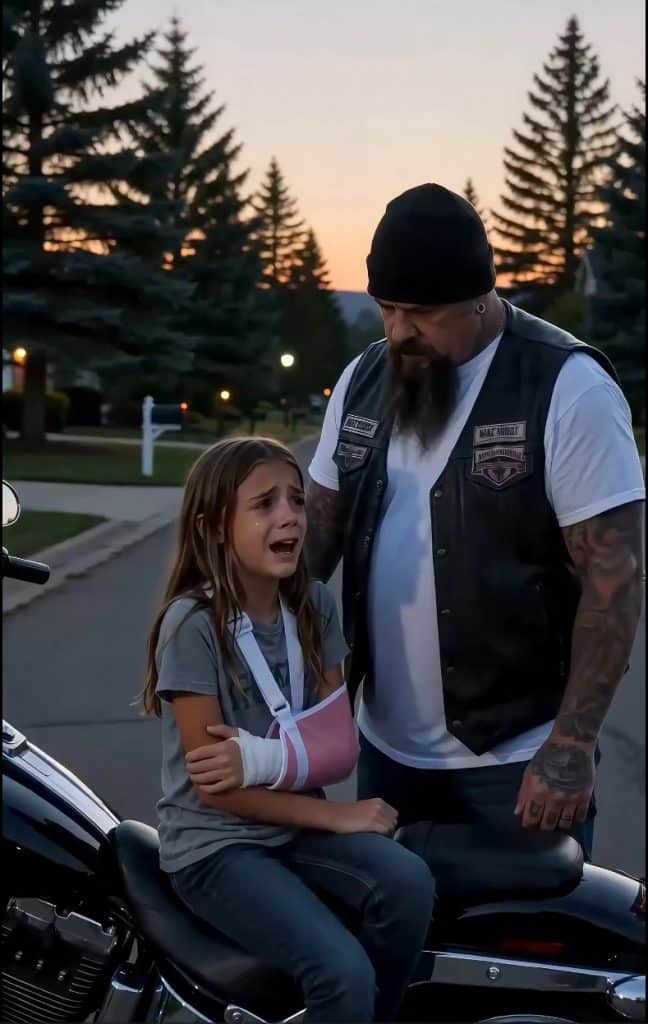
The girl was sitting on Bear Callahan’s motorcycle when he found her.
Not beside it.
Not near it.
On it.
She had climbed onto the black leather seat like it was a lifeboat, her small legs tucked close, her left arm held carefully in a pink-and-white sling. Dusk had settled over the suburban street, turning the pine trees into dark shapes and the warm windows of nearby houses into small squares of gold.
Bear stopped six feet away.
He was a large man, bald under a black beanie, with a long dark beard and tattooed arms that made strangers lower their eyes in grocery stores. His leather vest carried old road patches, club colors, and a stitched name across the chest.
BEAR.
Most people saw him and thought danger.
The girl saw him and whispered, “Mister, I need help.”
Her voice shook so badly the words nearly fell apart.
Bear’s face changed.
Slowly, he lowered himself to one knee beside the bike so he would not tower over her.
“Yeah,” he said, voice gravel-deep but gentle. “I can see that.”
Tears streamed down her cheeks. Her long brown hair stuck to her face. Her gray T-shirt was wrinkled, her jeans dusty at the knees, and her whole body trembled around the injured arm she was trying not to move.
“My arm hurts bad,” she said.
Bear looked at the sling, then at her eyes.
“Who did this to you, kid?”
The girl leaned back as if the name itself might appear in the street behind him.
“My stepdad,” she whispered. “He ain’t gonna stop.”
A streetlamp flickered on.
Bear’s jaw tightened.
For one breath, the quiet neighborhood seemed too calm for what she had just said. Sprinklers ticked somewhere in a yard. A dog barked behind a fence. A minivan rolled slowly past, then kept going.
Bear reached for his phone.
The girl flinched.
He noticed and softened his voice.
“Not calling him.”
Her lips trembled.
“Then who?”
Bear unlocked the screen.
“People who know how to stand still when somebody dangerous wants to come through.”
He dialed.
When the call connected, his voice changed. It became colder, steadier, the voice of a man who had made promises before and kept them.
“Yeah, it’s me. I’ve got a child hurt on Pine Hollow Road. Call 911. Bring everyone.”
He listened for half a second, eyes scanning the street.
Then he looked back at the girl.
“What’s your name?”
“Lily.”
“Okay, Lily. Not tonight he ain’t.”
From the far end of the street, the first motorcycle engine answered.
Then another.
And Lily, still shaking on the seat of a stranger’s bike, stared at the approaching headlights like hope had finally learned how to make noise.
Act II
Bear Callahan had not come to Pine Hollow Road for trouble.
He had come for Mrs. Donnelly.
Every Thursday evening, the eighty-two-year-old widow at number 16 paid him in oatmeal cookies to tighten whatever hinge, bolt, pipe, or porch rail had offended her that week. Bear always told her not to pay him. She always called him stubborn and handed him a container anyway.
That evening, he had fixed a loose step and listened to Mrs. Donnelly complain about teenagers, raccoons, and the new family at number 22.
“Something wrong in that house,” she had muttered.
Bear had looked across the street.
Number 22 sat behind trimmed hedges and a freshly painted mailbox. A porch light glowed. Curtains were closed though the evening was still warm.
“What kind of wrong?” he asked.
Mrs. Donnelly lowered her voice.
“Little girl cries sometimes. Mother looks scared. Man smiles too much.”
Bear did not dismiss old women.
Old women noticed what the world ignored.
So when he stepped outside and saw Lily sitting on his motorcycle, he understood immediately that Mrs. Donnelly’s wrong had found its way across the street.
Bear knew fear in children.
He knew how it made them watch doorways. How it made them apologize for things they did not do. How it made them explain injuries with phrases adults had coached into them.
I fell.
I’m clumsy.
It was an accident.
Years earlier, Bear had been a different man. Louder. Faster to anger. Too sure that strength meant making people afraid. Then his younger sister, June, came to him one night with her son asleep in the back seat and a bruise-like mark hidden poorly beneath her sleeve.
Bear did what angry men often do first.
He wanted revenge.
June stopped him.
“Don’t make it worse,” she had said. “Make us safe.”
Those words changed the course of his life.
After that, Bear and a handful of riders started the Iron Oaks, a motorcycle club with one rule above all others: if a child or survivor needed witnesses, escorts, transport, or a line of calm bodies between them and danger, the Oaks showed up.
They were not vigilantes.
Bear made that clear to every new rider.
They called police. They documented. They protected. They did not become the thing they stood against.
But protection still mattered.
Especially in the minutes before sirens arrived.
Lily sat on the motorcycle seat, trying not to cry too loudly, and Bear saw how carefully she held her injured arm. The sling was clean, but the way it wrapped her shoulder looked rushed, not professional. Her breath came in tight little pulls.
“Does your mom know you’re out here?” he asked.
Lily shook her head.
“She’s at work. He said if I called her, he’d say I was lying again.”
Again.
Bear kept his face calm.
“Has he done that before?”
Lily looked at the house with the closed curtains.
“He tells people I make stuff up. He says I’m difficult because I don’t like him.”
“Are you difficult?”
She blinked at him, confused by the question.
Bear’s mouth softened.
“I’ve met some difficult people. They don’t usually run to strangers with hurt arms asking for help.”
A tiny breath left her. Almost a laugh. Almost.
Then a door slammed down the street.
Lily went rigid.
Bear stood.
From number 22, a man stepped onto the porch.
He was tall, clean-cut, wearing a navy pullover and khaki pants. The kind of man who looked like he coached Little League, shook hands firmly, and remembered neighbors’ names.
He stared across the street at Bear’s motorcycle.
Then at Lily.
His face changed.
“Lily,” he called, voice smooth and dangerous. “Come here.”
The girl curled tighter around her sling.
Bear stepped between her and the house.
The man started down the walkway.
And the headlights behind Bear grew brighter.
Act III
The first two motorcycles rolled in slow.
Not loud in the reckless way.
Controlled.
Deliberate.
Their headlights cut through the dusk and washed over the curb, the pine trees, the parked cars, and the man crossing the street from number 22.
Mara Quinn dismounted first.
She was small, gray-haired, and sixty-one, with a leather vest over a paramedic jacket and a medical bag strapped to the back of her bike. Anyone expecting only huge men with beards usually made the mistake of underestimating her.
The second rider was Deacon Wells, tall and quiet, a retired school resource officer who still carried himself like hallways straightened when he entered.
Mara went directly to Lily.
“Hi, sweetheart,” she said. “I’m Mara. Bear asked me to check your arm. Is that okay?”
Lily looked at Bear.
He nodded.
“You get to say yes or no.”
That sentence mattered.
Lily swallowed.
“Yes.”
The man from number 22 reached the street.
“What the hell is going on?” he demanded.
Bear turned toward him.
“Evening.”
“That is my stepdaughter.”
Lily’s breathing changed behind Bear.
Mara saw it and positioned herself closer to the girl.
The man lifted both hands in a performance of patience.
“She’s upset. She has behavioral issues. I’ll take her inside.”
“No,” Lily whispered.
The man’s eyes flicked toward her.
Just once.
But Bear saw the warning in it.
So did Deacon.
“Police are on the way,” Deacon said.
The man’s smile froze.
“That’s completely unnecessary.”
Bear looked at Lily.
“She says her arm hurts bad.”
“She fell,” the man said too quickly. “Kids fall.”
Mara, who was gently examining the sling without moving the arm, looked up.
“Then you won’t mind medical taking a look.”
His face tightened.
“I said she’s fine.”
Mara’s eyes cooled.
“No. You said she fell.”
The street had begun to notice. Curtains moved. A porch door opened. Mrs. Donnelly stood at number 16 with her phone in her hand, wearing a cardigan over her nightgown and the expression of a woman who had been waiting for this moment longer than anyone knew.
“She came out that side gate,” Mrs. Donnelly called. “Running.”
The man turned sharply. “Stay out of this, Ruth.”
Mrs. Donnelly lifted her phone higher.
“I already called the girl’s mother.”
For the first time, the man lost color.
Lily heard it and began crying harder.
“My mom’s coming?”
Bear looked over his shoulder.
“Yes, kid. Your mom’s coming.”
The man stepped forward.
“I’m not letting a bunch of bikers interfere in my family.”
Bear did not move.
Deacon did not move.
Mara did not move.
Behind them, more motorcycles turned onto Pine Hollow Road, engines low and steady, headlights arriving one by one until the quiet suburban street glowed with witness.
Bear’s voice stayed level.
“Then it’s a good thing this isn’t just your family anymore.”
Act IV
The police arrived before Lily’s mother.
That was probably for the best.
Two patrol cars pulled up with lights flashing silently against the houses. Officers stepped out, hands visible, voices controlled, eyes moving from Lily to Bear to the man in the navy pullover.
The man immediately became someone else.
Relieved. Polite. Injured.
“Thank God you’re here,” he said. “These people are harassing my stepdaughter.”
Lily made a small sound and leaned toward Mara.
Officer Grant, the older of the two, looked at the child first.
Good, Bear thought.
Always look at the child first.
“What’s your name?” Officer Grant asked gently.
“Lily Harper.”
The officer crouched at a distance.
“Lily, do you feel safe going home with him?”
The man snapped, “She is a minor. You need to speak with me.”
Officer Grant did not look at him.
“Lily?”
Lily shook her head.
The man’s face hardened.
“She’s lying.”
That word hit the air like a slap.
Bear took one step, not toward him, just closer to Lily’s line of sight. A reminder that she was not saying it alone.
Mara spoke next.
“She needs evaluation. Sling appears improperly fitted, and she reports significant pain. We need EMS.”
The second officer radioed for an ambulance.
The man’s control thinned.
“This is ridiculous. She had a tantrum. She slammed her arm into a door.”
Lily whispered, “No, I didn’t.”
Everyone heard it.
A car came fast down Pine Hollow Road and stopped crooked near the curb.
A woman jumped out still wearing a grocery store manager’s vest, name tag flashing under the streetlight.
“Lily!”
The girl tried to stand too quickly and cried out from the movement.
Her mother, Hannah Harper, froze at the sound.
Then she ran.
Mara met her halfway with one hand raised gently.
“She’s safe,” Mara said. “But let us help her move carefully.”
Hannah’s face collapsed.
She dropped beside her daughter, not touching the injured arm, and cupped Lily’s face with both hands.
“Oh baby. Oh my God. I knew something was wrong.”
The man barked, “Hannah, do not make a scene.”
Hannah looked at him.
Something shifted in her.
Not fear leaving completely.
That takes longer.
But fear meeting witnesses and realizing it no longer had to carry the whole weight alone.
“She called me from Ruth’s phone,” Hannah said. “She said Lily was hurt.”
“She overreacts,” he said.
Mrs. Donnelly stepped off her porch.
“She has been crying in that house for months.”
The man’s head snapped toward her.
Another neighbor, Mr. Singh from number 18, walked out holding a small security camera in one hand.
“My driveway camera sees your side gate,” he said quietly. “It recorded her running out. It also records sound when loud enough.”
The man stared at him.
Mr. Singh did not blink.
“I saved the file.”
That was when the respectable mask finally cracked.
The officers moved him away from the group. He argued, demanded, threatened complaints, mentioned lawyers, then quieted when Officer Grant told him he was being detained while they investigated.
Lily watched from the motorcycle seat, wrapped now in Bear’s spare flannel shirt over her shoulders.
“Is he leaving?” she asked.
Bear crouched again.
“For tonight, yes.”
“What about tomorrow?”
Hannah heard the question and broke.
Not because she was weak.
Because she understood what her child had been living with: fear so practiced it looked beyond rescue into the next morning.
Hannah took Lily’s uninjured hand.
“There’s not going to be a tomorrow with him in our house,” she said.
Lily searched her face.
“Promise?”
Hannah looked at the police. At Mara. At Bear. At Mrs. Donnelly. At the row of riders standing under streetlights like a wall made of headlights and leather.
Then she looked back at her daughter.
“Promise.”
Act V
The hospital confirmed what Mara had already suspected.
Lily’s arm needed proper treatment, rest, and follow-up care. The injury was serious enough to explain her pain, but not beyond healing. That sentence became the first mercy of the night.
The second came from the social worker.
Hannah and Lily did not return to number 22.
Not that night.
Not the next.
Mrs. Donnelly packed Lily’s favorite stuffed fox into a tote bag while officers stood by. Mr. Singh sent the security footage directly to investigators. Deacon drove behind Hannah’s car all the way to the family shelter, not because Hannah asked him to, but because Bear asked if she wanted an escort and she said yes before shame could talk her out of safety.
The Iron Oaks followed at a respectful distance.
No roaring.
No intimidation.
Just headlights in the dark.
Sometimes protection looks like a line of motorcycles making sure one frightened mother does not have to drive into the unknown alone.
Bear did not see Lily again for three weeks.
He thought about her anyway.
He thought about the way she had climbed onto his motorcycle because it was the biggest thing on the street that did not belong to the man she feared. He thought about her asking what would happen tomorrow. He thought about all the children who learn too young that rescue has to last longer than one night.
Then, on a Saturday afternoon, Hannah brought Lily to the repair shop.
Lily wore a purple cast now, covered in marker hearts and tiny stickers. Her hair was braided. She still stayed close to her mother, but her eyes were clearer.
Bear was changing a tire when they arrived.
He stood slowly, wiping his hands on a rag.
“Well, look who got upgraded,” he said, nodding to the cast.
Lily held it up.
“Mara signed it.”
“Course she did.”
“She drew a motorcycle.”
Bear leaned closer.
Mara had drawn something that looked more like a potato with handlebars, but he did not say that.
“Beautiful work.”
Lily smiled.
It was small.
It was real.
Hannah stepped forward, eyes shining.
“I don’t know how to thank you.”
Bear shook his head.
“You got out. That’s the hard part.”
“I should have seen it sooner.”
Lily looked down.
Bear’s voice became firm, but not unkind.
“No.”
Hannah blinked.
He set the rag aside.
“People like him work hard to make sure you don’t see clearly. That’s on him. What matters is when the truth got loud, you listened.”
Hannah pressed her lips together to stop them from trembling.
Lily reached into her pocket and pulled out a folded piece of paper.
“I made you something.”
Bear took it with care.
It was a drawing.
A giant motorcycle under a streetlamp. A little girl sitting on it. A huge bearded man standing beside her. Behind them were many yellow circles of light, all drawn in crayon.
At the top, Lily had written:
THANK YOU FOR MAKING THE STREET SAFE.
Bear stared at it for a long time.
Then he cleared his throat.
“You mind if I hang this in the shop?”
Lily shook her head.
“You can.”
So he did.
Right beside the office door, where every rider saw it before heading out.
The investigation moved forward. Charges followed. The court granted protective orders. Hannah found a smaller apartment across town, above a bakery where the owner gave Lily day-old muffins and pretended it was company policy.
Healing was not simple.
Lily still startled at heavy footsteps. Hannah still apologized too much. Some nights were harder than others. Some memories arrived without permission.
But the house at number 22 was sold.
Mrs. Donnelly kept calling anyway, checking on them every Sunday after church.
Mara handled every medical appointment she could.
Deacon helped Hannah install new locks.
Bear taught Lily how to identify the parts of a motorcycle, though he made her promise not to touch anything hot, sharp, moving, greasy, electrical, or expensive.
“That’s everything,” she complained.
“Correct,” Bear said.
Months later, when Lily’s cast came off, she came back to Pine Hollow Road one more time.
Not to see the old house.
To sit on the motorcycle again.
Bear parked it under the same streetlamp. The dusk looked almost identical to the night she had found him: pine trees darkening, windows glowing, the sky fading toward blue.
But Lily was different.
She climbed onto the seat with Hannah beside her and Bear steadying the bike.
No tears.
No trembling.
No sling.
She placed both hands carefully on the tank and looked down the street.
“That night,” she said, “I thought he would come get me.”
Bear stood beside her.
“I know.”
“But you didn’t move.”
“No.”
“Were you scared?”
Bear thought about lying.
Then he remembered she deserved better.
“Yes.”
Lily looked surprised.
“You were?”
“Being scared just tells you something matters.”
She thought about that for a long time.
Then she looked toward the end of the street where the headlights had appeared.
“When all your friends came, I thought they were like stars.”
Bear smiled.
“Loud stars.”
She laughed.
The sound moved down Pine Hollow Road softer than any engine.
Bear looked at Hannah, and Hannah looked at Lily, and for one quiet moment the street belonged not to fear, but to after.
After the running.
After the pain.
After the phone call.
After the promise.
The motorcycle was no longer just the place where a hurt child had climbed because she had nowhere else to go.
It had become proof.
That help can look intimidating and still be gentle.
That witnesses can turn a quiet street into a safe one.
That one child’s trembling words can summon an entire line of people willing to stand between her and harm.
And that sometimes the first step toward freedom is climbing onto the nearest solid thing and daring to say, “Mister, I need help.”