Act I
The boy was too small to be selling gold.
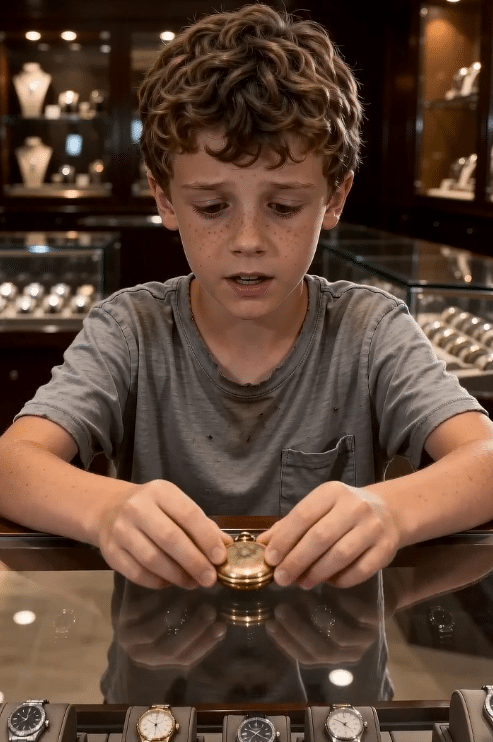
He stood on the other side of the glass counter with both hands clenched at his sides, trying very hard not to cry. His gray T-shirt was clean but faded. His freckles stood out against a face made pale by fear, and his brown hair looked as if he had run his fingers through it a hundred times before finding the courage to walk inside.
The shop was not the kind of place children entered alone.
Alden & Co. Jewelers smelled faintly of cedar polish, velvet boxes, and old money. Diamond necklaces glittered beneath warm lights. Watches sat in perfect rows behind polished glass. Every cabinet, every brass hinge, every quiet tick from the wall clocks seemed to say that nothing desperate belonged there.
But desperation had come anyway.
The boy reached into his pocket and placed a gold pocket watch on the counter.
“My mom is sick,” he said. “She needs medicine. She said to sell this.”
Samuel Alden, the jeweler behind the counter, looked first at the boy, then at the watch.
He had been in the trade for fifty-one years. He could spot fake gold from three feet away and tell by the weight of a chain whether a seller knew its worth. He had seen thieves, widows, gamblers, heirs, and men selling rings they should have returned.
But this boy was none of those things.
He was terrified.
Samuel put on his glasses and lifted the watch carefully.
The gold was old. Real. Scratched near the hinge, worn smooth where fingers had touched it for years. It had the kind of warmth only heirlooms carried, a softness that came not from value, but from being held through grief.
“Where did your mother get this?” Samuel asked.
The boy swallowed. “She’s always had it.”
Samuel turned the watch over.
His fingers stopped.
On the back, beneath years of tiny scratches, was a mark so small most people would have missed it.
A crescent moon inside the letter A.
His father’s maker’s mark.
Samuel’s breath caught.
He pressed the latch.
The watch opened with a faint click.
Inside the cover was a photograph, aged yellow at the edges. A young girl in a vintage white dress smiled into the camera, one hand resting against a garden gate, her dark hair tied with a ribbon.
Samuel’s whole body went still.
The shop disappeared.
The boy disappeared.
For one terrible second, he was back eighteen years earlier, standing in the rain outside a train station, screaming his daughter’s name until his voice broke.
The boy leaned closer.
“Sir?”
Samuel touched the photograph with a shaking thumb.
“Where is your mother?”
The boy’s face tightened with panic. “I can take you. But please, can you give me money first? She’s getting worse, and the lady at the pharmacy said—”
Samuel closed the watch.
Not harshly.
Like something sacred.
Then he looked at the boy with tears already gathering behind his glasses.
“I gave this watch to my daughter,” he whispered. “She vanished eighteen years ago.”
The boy stared at him.
For a moment, neither of them moved.
Then Samuel asked the question that had haunted him for nearly two decades.
“What is your mother’s name?”
The boy answered softly.
“Grace.”
Samuel gripped the counter.
His daughter’s name had been Grace Alden.
And now her son was standing in his shop.
Act II
Eighteen years earlier, Grace Alden had been the brightest thing in Samuel’s life.
She was sixteen when he gave her the pocket watch.
Not because she cared about gold. She didn’t. Grace preferred paint-stained sleeves, messy notebooks, and sneaking pastries from the kitchen before dinner. She had inherited her mother’s laugh and Samuel’s stubbornness, which meant every argument between father and daughter felt like two mirrors refusing to turn away.
The watch had belonged to Samuel’s father before him.
On the outside, it was gold. On the inside, Samuel placed a photograph of Grace from her mother’s garden party, the last picture taken before illness began stealing color from the house.
On the back, he engraved a sentence.
For Grace. Time will always bring you home.
She rolled her eyes when she read it.
“That’s so dramatic, Dad.”
Samuel had smiled. “You’ll thank me when you’re older.”
She slipped it into her pocket anyway.
Three months later, Grace disappeared.
It happened after a fight.
Samuel remembered every word, because grief is cruel that way. It preserves the worst moments in perfect condition.
Grace wanted to leave for art school in Chicago. Samuel wanted her to wait one more year. Her mother had died only six months earlier, and he was terrified of losing the last person in the house who still made it feel alive.
“You don’t want me safe,” Grace shouted. “You want me trapped.”
Samuel shouted back.
He had apologized in his mind ten thousand times since then.
But not that night.
Grace stormed out before dinner. She took her satchel, her sketchbook, and the gold watch.
By morning, she was gone.
The police found her bag near a train station two towns away. Inside were her sketchbook, a scarf, and a ticket she never used. The watch was missing. Grace was missing. Every camera that might have helped had somehow been broken, erased, or pointed the wrong way.
Samuel searched like a man trying to outpace death.
He hired investigators. He printed flyers. He followed leads across three states. He paid strangers for rumors. He stood in morgues when police called him, praying and dreading the same answer.
Nothing.
His brother, Victor, told him to accept the truth.
“She ran away,” Victor said. “You know how dramatic she was.”
Samuel hated him for that.
But years have a way of sanding down outrage when no evidence comes. The world moved on. Customers returned. The shop reopened. People stopped saying Grace’s name because they didn’t know what face to make when they did.
Samuel did not move on.
He left her room untouched.
He kept the old posters. The paintbrushes. The cracked mug on her desk. Every birthday, he bought a small cake from the bakery she loved and ate one bite because he could not bear to throw it away untouched.
Victor called it unhealthy.
Samuel called it fatherhood.
Then, five years after Grace vanished, Victor began pressing harder to sell Alden & Co.
“The business needs fresh blood,” he said. “You have no heir now.”
No heir now.
Samuel never forgot that phrase.
Because Victor said it too easily.
Still, suspicion without proof is a cage. Samuel had lived inside that cage for eighteen years.
Until a frightened boy walked into the shop carrying Grace’s watch.
The boy’s name was Noah.
He was eleven years old and trying to be braver than any child should have to be. His mother, he said, had been sick for days. They lived in a small room above a closed tailor shop on Mercer Street. Grace had refused to go to a hospital because she was afraid of questions, bills, and people who made promises in clean coats.
“She told me to sell the watch only if we had no other choice,” Noah said.
Samuel looked at the watch in his palm.
No other choice.
That sounded like Grace.
Even after eighteen years, it sounded exactly like her.
He reached beneath the counter, pulled out his coat, and locked the front door of Alden & Co. for the first time in the middle of a business day.
Noah stepped back, startled.
“Are you going to buy it?”
Samuel shook his head.
“No,” he said. “I’m going to bring it home.”
But first, he had to see the woman who had carried it.
Act III
The room above the tailor shop was colder than it should have been.
A single radiator knocked weakly beneath the window. Clothes hung over a chair. A chipped mug sat on the floor beside a mattress. On the small table near the wall were bills, medicine receipts, a half-empty jar of coins, and a child’s drawing of a woman and boy standing under a yellow sun.
Grace lay under two blankets, pale and exhausted.
Samuel stopped in the doorway.
For eighteen years, he had imagined finding her.
In some dreams, she ran into his arms. In others, she accused him. Sometimes she was still sixteen. Sometimes she was older, with a life he had not been allowed to see.
Reality was quieter.
Crueler.
She turned her head toward the door, saw the old man with gray hair and glasses, and did not recognize him.
Noah rushed to her side.
“Mom, I found the shop. I found the jeweler.”
Grace pushed herself up slightly, alarmed. “Noah, I told you just to sell it.”
“He said it was his.”
Her eyes moved to the pocket watch in Samuel’s hand.
Something flickered across her face.
Fear first.
Then pain.
“Who are you?” she asked.
Samuel tried to speak.
His voice failed.
He stepped closer and opened the watch, showing her the photograph inside.
Grace stared at it.
Her breathing changed.
“I’ve seen that girl in dreams,” she whispered.
Samuel gripped the back of a chair.
“Your name is Grace Alden.”
She closed her eyes.
“No.”
“Yes.”
“No,” she said again, but weaker this time. “My name is Grace Miller.”
“Who told you that?”
She looked toward a metal box under the table.
“The woman who raised me.”
Samuel’s face tightened.
“What was her name?”
“Ruth Miller.”
Samuel knew that name.
Not well. Not enough to remember at first. But it came back slowly, like a face emerging from fog.
Ruth had worked for Victor years ago.
A bookkeeper.
Quiet. Nervous. Gone the same month Grace disappeared.
Samuel knelt and pulled the metal box closer.
“May I?”
Grace nodded, too stunned to object.
Inside were old papers, a faded scarf, several sketches, and a sealed envelope brittle with age. On the front, in shaky handwriting, were the words:
For Grace, when he finds you.
Samuel’s hands trembled as he opened it.
The letter inside was from Ruth.
I was paid to take you away. I told myself I was saving you because they said your father was dangerous, unstable, and would lock you away. That was a lie. By the time I learned the truth, I was too afraid to undo what I had done.
Grace covered her mouth.
Samuel kept reading.
Your uncle Victor arranged everything. The train station. The missing bag. The false name. He said Samuel would destroy the family business if you stayed, and that your inheritance made you a threat.
Noah looked from his mother to Samuel.
“What does that mean?”
Samuel’s eyes filled.
“It means your mother was stolen.”
Grace shook her head slowly, as if the room itself had become unsteady.
“I remember a car,” she whispered. “Rain. A woman telling me not to cry. She said my father didn’t want me anymore.”
Samuel made a sound like something breaking.
“I never stopped wanting you.”
Grace looked at him then.
Really looked.
At the eyes behind the glasses. At the shaking hands. At the old grief carved into his face. Something inside her seemed to reach through years of fear and false names.
“My birthday,” she whispered.
Samuel could barely breathe.
“October fourth.”
Her eyes flooded.
“You bought lemon cake.”
“Every year.”
She began to cry.
Not loudly.
Not dramatically.
Just a slow collapse of everything she had been forced to believe.
Noah slipped his hand into hers.
Samuel stayed where he was, afraid that if he moved too quickly, the miracle would vanish.
Then Grace looked at the pocket watch.
“There’s something inside it,” she said.
Samuel frowned.
“The photograph?”
“No.” Her brow furrowed. “Ruth used to say the watch was heavier than it should be. She said Victor searched for it once, years ago, after he found out she still had me. She hid it before he came.”
Samuel turned the watch over.
His father had loved secret mechanisms. Hidden hinges. Spring locks. Compartments inside compartments.
Samuel pressed the crescent mark.
The back plate shifted.
A tiny folded document slid into his palm.
And the name at the top made his blood run cold.
Act IV
The document was not a letter.
It was a trust amendment.
Samuel read it once, then again, each line more damning than the last.
Grace Alden was the sole controlling heir to Alden & Co. upon turning twenty-one. If she died without issue, the shares would pass to Samuel. If Samuel died without a living heir, the shares would pass to Victor Alden.
But there was an added clause.
One Samuel had never seen.
If Grace remained missing for more than seven years and was declared legally dead, Victor would be allowed to petition for emergency transfer of management authority.
Samuel’s hands clenched around the paper.
“There it is,” he whispered.
Victor had not only wanted the shop.
He had needed Grace gone.
Noah looked frightened. “Is Uncle Victor bad?”
Grace pulled him closer.
Samuel’s expression hardened.
“He is not your uncle.”
A knock sounded downstairs.
All three of them froze.
Then came a voice from below.
“Samuel? Are you up there?”
Victor.
Grace went white.
Noah grabbed the watch.
Samuel stood slowly.
For the first time since entering the room, he looked less like an old jeweler and more like the man who had built a family business with steady hands and survived eighteen years of unanswered grief.
“Stay behind me,” he said.
Victor appeared at the top of the stairs in a camel coat, breathing hard but smiling as if he had arrived for tea.
The smile died when he saw Grace.
For one second, his face told the truth.
Then he tried to bury it.
“My God,” he said softly. “Grace?”
She flinched.
Samuel stepped in front of her.
“How did you know where I was?”
Victor adjusted his gloves.
“You closed the shop in the middle of the day. That tends to draw attention.”
“No,” Samuel said. “You followed the watch.”
Victor’s eyes moved to Samuel’s hand.
The trust amendment was visible between his fingers.
The room changed.
Victor’s politeness thinned into something colder.
“You don’t understand what that document is.”
“I understand exactly what it is.”
“You were destroying yourself after Margaret died,” Victor snapped. “You were destroying the company. Grace was going to leave. You were going to hand everything to a child with paint on her sleeves and no respect for what generations built.”
Grace’s voice shook. “So you took me?”
Victor looked at her, almost annoyed.
“You were cared for.”
“I was lied to.”
“You survived.”
Samuel’s voice cut through the room.
“She was my daughter.”
Victor turned on him.
“And Alden & Co. was our father’s legacy. Not a memorial chapel for your grief. You would have ruined it.”
Samuel stepped closer.
“No, Victor. You ruined us.”
Victor’s jaw tightened.
Then his eyes dropped to Noah.
A small, calculating movement.
Samuel saw it.
So did Grace.
Noah stepped behind his mother.
Victor noticed the fear and softened his voice.
“Samuel, listen to me. This can still be handled quietly. Grace has been gone too long. Think of her privacy. Think of the boy. Think of the scandal.”
Samuel almost laughed.
Quietly.
That was how powerful men buried people.
Quietly.
He took out his phone.
“I already called my attorney from the cab,” he said. “And the police.”
Victor’s face darkened.
“You always were sentimental.”
“No,” Samuel said. “I was patient.”
Footsteps sounded on the stairs.
A woman in a navy coat entered first, followed by two officers. Samuel’s attorney, Evelyn Hart, had represented Alden & Co. for twenty years. She looked at the document, then at Grace, then at Victor.
Her expression sharpened.
“Mr. Alden,” she said to Victor, “I would advise you not to say another word.”
Victor smiled thinly.
“You work for the company.”
Evelyn took the trust amendment from Samuel’s hand.
“No,” she said. “I work for the legal owner.”
Grace stared at her.
Evelyn turned gently.
“If this document is valid, Mrs. Miller, that may be you.”
Grace’s knees almost gave.
Samuel reached out, then stopped himself, still afraid to presume the right to hold her.
Grace noticed.
Slowly, she took his hand.
It was the first time he had touched his daughter in eighteen years.
Victor looked at their joined hands and understood that the thing he had stolen had finally found its way back.
The pocket watch ticked once in Noah’s palm.
Act V
Grace did not become Grace Alden again overnight.
Names are not coats. A person cannot simply take one off and put another on without feeling the shape of the years between.
For eleven years, she had been Noah’s mother.
For eighteen years, she had been Ruth Miller’s stolen secret.
For one afternoon, she was suddenly an heiress, a missing daughter, a legal case, a newspaper headline waiting to happen, and a woman too tired to stand without help.
Samuel cared about only one title.
Daughter.
He took Grace and Noah to a doctor first. Not to the mansion. Not to the shop. Not to reporters or lawyers or anyone else who wanted to turn pain into paperwork before she had eaten a proper meal.
Grace recovered slowly.
The illness that sent Noah to the jewelry shop was treatable, though Samuel could not stop trembling until the doctor said it twice. Noah slept in a chair beside her bed the first night, one hand tucked around the pocket watch as if someone might try to take time away again.
Samuel sat across the room until dawn.
He watched Grace sleep and counted every breath like an apology.
When she woke, she found him there.
“You don’t have to stay,” she said.
“Yes,” Samuel replied. “I do.”
Grace looked toward the window.
“I don’t remember enough.”
“Then I’ll remember for both of us until you can.”
She turned back to him.
The old anger was not there yet. That would come later, and Samuel knew he deserved some of it. The years had been stolen from both of them, but Grace had been the one forced to live inside the lie.
“Did you really buy cake every year?” she asked.
Samuel nodded.
“Lemon?”
“Always lemon.”
Her mouth trembled.
“I hate lemon now.”
Samuel blinked.
Then Grace laughed.
It was small, weak, and cracked around the edges, but it was hers.
Samuel covered his face and cried.
Victor Alden was arrested two weeks later after investigators uncovered payments to Ruth Miller, falsified police statements, and letters proving he had petitioned for business control while privately funding efforts to keep Grace hidden. He denied everything at first.
Then Ruth’s final letter was authenticated.
Then the watchmaker’s compartment was traced to Samuel’s father.
Then the trust amendment Victor claimed was fake turned out to have been notarized by a family lawyer who had died before Victor could pressure him into silence.
The case became public despite Samuel’s efforts to shield Grace.
Reporters gathered outside Alden & Co. Cameras flashed when Victor was escorted from his townhouse. People who had once called Samuel a tragic old man now called him resilient, as if grief became admirable only when it came with a satisfying ending.
Samuel hated the attention.
Grace hated it more.
Noah, however, read every article with a seriousness that made Samuel smile despite himself.
“They keep saying I saved the company,” Noah said one morning at the breakfast table.
Grace looked over her mug. “You saved me first.”
Noah shrugged, embarrassed.
“I just sold a watch.”
Samuel reached across the table and placed the gold pocket watch between them.
“No,” he said. “You brought it home.”
The shop changed after that.
Not its cabinets or clocks or velvet trays. Those remained. Samuel still believed beautiful things deserved careful lighting. But the atmosphere softened. The locked private office became Grace’s studio. The back room, once full of ledgers and appraisal tools, became a small workshop where Noah learned how to clean watch gears under Samuel’s patient eye.
The first time Noah broke a spring, he looked terrified.
Samuel only handed him another tool.
“Good,” he said. “Now you’ll remember how delicate it is.”
Grace stood in the doorway and watched them.
At first, she could barely enter the shop without feeling the weight of everything she had lost. The smell of cedar polish made her dizzy. The ticking clocks unnerved her. The photograph inside the pocket watch looked like another girl entirely, one who had been taken before she could become real.
But slowly, she found pieces of herself there.
A sketch she had made at sixteen, still framed in Samuel’s office.
Her mother’s blue scarf folded in a drawer.
A tiny mark carved beneath the workbench where she had written G.A. with a pin and lied about it when Samuel asked.
One afternoon, Grace found the untouched bedroom upstairs.
Samuel stood behind her, nervous as a boy awaiting judgment.
“I couldn’t change it,” he said.
Grace walked inside.
The room smelled of dust and lavender. Posters faded on the walls. A paintbrush lay near the window. On the desk sat eighteen small boxes tied with ribbon.
Birthday gifts.
Grace opened the first.
Then the second.
By the sixth, she was sitting on the floor, crying into her hands.
Samuel knelt beside her, older now than he had ever felt.
“I’m sorry,” he whispered. “For the fight. For not finding you. For every year.”
Grace wiped her face.
“You looked?”
“Every day.”
She nodded, as if something inside her had needed that answer more than air.
Then she leaned into him.
It was not the hug Samuel had dreamed of.
It was better.
It was real.
A year later, Alden & Co. unveiled a new display in the front window.
No diamonds.
No necklaces.
No luxury watches.
Just one gold pocket watch resting on dark green velvet.
Beside it was a small card written by Grace.
For those who are lost, and those who never stop looking.
Customers asked if it was for sale.
Samuel always said no.
Noah liked to stand near the counter and watch people read the card. Sometimes they smiled. Sometimes they cried. Sometimes they walked out quietly without buying anything, as if the shop had given them something they could not carry in a bag.
On Grace’s first birthday after coming home, Samuel bought a cake.
Not lemon.
Chocolate, with strawberries and too much cream, because Noah insisted birthdays should taste dramatic.
They ate it after closing, seated around the glass counter where Noah had first placed the watch. The shop lights glowed softly. Outside, rain tapped against the windows. Inside, every clock ticked out of rhythm, hundreds of tiny hearts refusing to agree on time.
Grace looked at the pocket watch in its display case.
“I used to think it was the only thing I had from before,” she said.
Samuel followed her gaze.
“It was.”
She shook her head.
“No.” Her eyes moved to him, then to Noah. “It was the thing that proved before was still waiting.”
Noah leaned against her shoulder.
“So does that make it magic?”
Samuel smiled.
“No.”
Grace touched her son’s hair.
“Maybe a little.”
Later, after Noah fell asleep in Samuel’s old office chair, Grace opened the watch one more time.
The photograph of the girl in the white dress was still there.
Young. Bright. Unaware of what was coming.
Grace did not hate her anymore.
She closed the cover gently.
For eighteen years, time had been used against them. It had hidden the truth, aged the witnesses, blurred memories, and taught a daughter to believe she had been abandoned.
But time had also carried a watch through fear, poverty, motherhood, illness, and one brave boy’s shaking hands.
Until it reached the counter where it had always belonged.
Until a father opened it.
Until the lost were found.