Act I
The burger hit the steel counter like a warning.
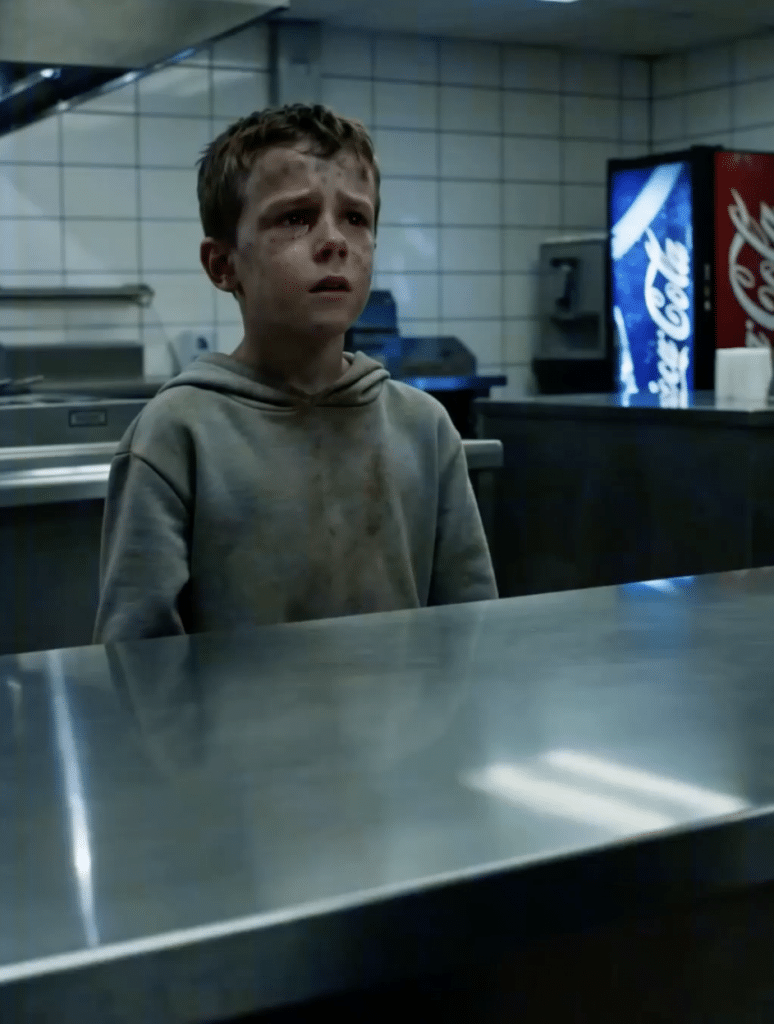
Wrapped in greasy paper, it slid toward the trembling boy and stopped beside the blue Coca-Cola fountain. The kitchen lights buzzed overhead. The tiled walls made everything sound harder than it was supposed to sound.
The boy did not pick it up.
He stood barefoot on the grimy floor, his tan shirt torn at one sleeve, his face streaked with dirt, tears, and dark stains that had dried near his cheek. He looked seven, maybe eight, but fear had made his eyes older.
Across the counter, the biker stared him down.
His name was Dante Mercer, though most people on the road knew him as Bear. Shaved head. Salt-and-pepper beard. Black leather jacket. Tattoos crawling over both hands, thick letters inked across his knuckles from a life he had spent years trying not to explain.
He had seen runaways before.
He had seen kids used as distractions.
He had seen desperate people bring danger through back doors and leave it for someone else to survive.
So he slammed the burger down and said the cruelest thing he could say quickly.
“Get out, kid.”
The boy flinched.
But he did not leave.
His small hands shook at his sides. His stomach growled loudly enough for both of them to hear. Somewhere in the front of the diner, a chair scraped, and the low murmur of late-night customers faded into the hum of the soda machine.
“I’m so hungry,” the boy whispered.
Dante’s jaw tightened.
“Then eat it outside.”
The boy reached into his pocket.
Dante’s tattooed hand moved before he thought about it, ready for trouble. But the child did not pull out a knife or money or a stolen phone.
He pulled out a silver locket on a chain.
It was old. Tarnished. Scratched around the edges. Too delicate for a boy covered in road dust and fear.
He placed it on the counter like payment.
“Mama said it was worth something.”
Dante froze.
The locket sat between them beneath the harsh kitchen light.
No.
His mind rejected it before his hand moved.
No, because some objects belong to the dead. Some things should stay locked in memory where they cannot walk back into your life held by a starving child.
Dante picked it up.
His fingers, thick and tattooed, suddenly felt clumsy. He pressed the tiny latch, and the locket opened with a soft click.
Inside was a black-and-white photograph of a young woman.
Dark hair. Bright eyes. A half-smile that looked like trouble and heartbreak had both tried to claim her, but neither had won yet.
Dante stopped breathing.
The boy looked up through tears.
“Mama kept it.”
Dante’s fist closed around the locket so tightly the chain dangled between his knuckles.
“That locket…” His voice broke before he could stop it.
The boy swallowed.
“Do you know her?”
Dante stared at the photograph.
He had not seen that face in nine years except in nightmares, old birthday pictures, and one missing person flyer he kept folded inside a drawer he never opened.
“Yes,” he whispered.
The boy’s lower lip trembled.
“Then please help me.”
Dante looked at the child again, really looked this time.
The eyes were hers.
The stubborn chin was hers.
The way he stood scared but refusing to collapse was hers too.
“What’s your name?” Dante asked.
“Noah.”
Dante felt the whole kitchen tilt.
Because nine years ago, his little sister Lena Mercer disappeared with that locket around her neck.
And now her son was standing in his diner.
Act II
Dante had given Lena the locket on her seventeenth birthday.
He bought it from a pawnshop two towns over, then spent three nights polishing it at the kitchen table while she teased him for pretending to be sentimental. Their mother had been dead four years by then, and their father had disappeared into bottles and unpaid debts long before that.
For most of Lena’s childhood, Dante had been brother, guardian, cook, driver, and storm wall.
He was not good at softness.
He fixed broken locks. He scared off men who lingered too long outside their apartment. He worked nights at garages and weekends with motorcycle clubs that paid cash and asked fewer questions than decent employers.
Lena used to say he looked like a threat and worried like a grandmother.
He told her the locket was ugly but reliable.
Inside, he placed a photograph of her taken outside Rosie’s Diner, the place where she once dreamed of owning a bakery counter. On the back, he scratched a small message with a tool from the garage.
When you’re hungry, come home.
She laughed when she read it.
Then she hugged him so hard he pretended to complain.
Two years later, she met Caleb Rusk.
Caleb wore clean shirts, drove a black pickup, and spoke in a voice smooth enough to make warning sound like jealousy. He told Lena she was too smart for that town. Too pretty to serve coffee. Too special to be trapped behind her brother’s fears.
Dante saw the rot immediately.
Lena saw escape.
Their last fight tore the house in half.
“You don’t want me safe,” she screamed. “You want me small enough to protect.”
Dante shouted back because anger was the only language he had mastered.
“You leave with him, don’t come crawling back when he shows you who he is.”
He knew it was wrong the moment he said it.
But pride is a fast poison.
By morning, Lena was gone.
For six months, she sent postcards with no return address. Then one phone call came at 2:13 in the morning. Dante still remembered the exact time because he had stared at the clock for years afterward, wondering if one second faster might have changed everything.
Lena was crying.
There was a baby in the background.
“Dante,” she whispered. “I need—”
The line went dead.
He searched for her until the search became a life.
He rode through counties where nobody knew her name. He knocked on motel doors. He questioned truck stop clerks, bartenders, nurses, old club contacts, anyone who might remember a dark-haired woman traveling with a man in a black pickup.
Then the police found Caleb’s truck burned near the river.
No bodies.
No answers.
Just a rumor that Lena had run again, this time from everyone.
People told Dante to grieve.
He refused.
Grief felt too much like permission.
So he bought Rosie’s Diner after the old owner died and turned the back kitchen into a place where the lost sometimes found soup, blankets, and a phone call they were too scared to make.
But the rule hardened over time.
No children after midnight.
No strangers through the kitchen.
No trouble at the back door.
Because years of searching had taught Dante that every rescue could become a trap, and every trap came wearing someone else’s pain.
That was why he told the boy to leave.
And that was why, when the locket opened, shame hit him so hard he had to grip the counter to stay standing.
Noah was still watching him.
He had not touched the burger.
Dante pushed it closer, gentler this time.
“Eat.”
Noah grabbed it with both hands and took a bite like he was afraid someone might change their mind. He chewed too fast, tears still sliding silently down his face.
Dante crouched so they were nearly eye level.
“Noah,” he said. “Where is your mother?”
The boy stopped chewing.
Fear returned all at once.
“At the old washhouse,” he whispered. “She told me to run when the men came back.”
“What men?”
Noah looked toward the rear exit.
“The ones who said she stole from Mr. Rusk.”
Dante’s blood went cold.
Caleb Rusk was supposed to be dead.
But dead men did not send hunters after children.
Act III
Dante locked the kitchen door first.
Then the back entrance.
Then he called out without raising his voice.
“Red.”
A man at the front counter stood immediately.
Red Malloy had worked the griddle for Dante on weekdays and rode with him on Sundays. He was sixty, broad, bald, and gentle with coffee refills until someone threatened the wrong person.
He stepped into the kitchen, took one look at Noah, and stopped smiling.
“Boss?”
Dante held up the locket.
Red’s face changed.
“Lena?”
“Her boy.”
Red crossed himself, though Dante had never known him to be religious unless engines failed.
Noah looked between them. “You know Mama?”
Red’s voice softened. “Yeah, little man. We know your mama.”
Dante turned back to Noah.
“Tell me everything.”
The story came in pieces between bites.
Noah and his mother had been living under another name in a trailer behind an abandoned washhouse outside the county line. Lena cleaned rooms at a motel, paid cash for groceries, and never stayed anywhere long enough for Noah to make friends. She told him they were “waiting for safe.”
That morning, two men arrived.
They asked about a package.
Lena told Noah to hide beneath the floorboards. Through the cracks, he heard one of the men say Caleb wanted what she took. Another man laughed and said Caleb was tired of chasing ghosts.
Then Lena lifted the floorboard after dark, pressed the locket into Noah’s hand, and told him to find the diner with the blue soda machine.
“She said,” Noah whispered, “‘Find the man with letters on his hands.’”
Dante looked down at his knuckles.
HOME.
Four letters he had tattooed there after Lena vanished, as punishment more than hope.
Noah reached into his pocket again and pulled out a folded piece of paper. “She said give you this too.”
Dante opened it.
The note was written in Lena’s hand.
Dante, if Noah found you, I’m sorry it took me so long to come home. Caleb is alive. He has men in uniform, men in trucking, men who can make records disappear. I took his ledger because it has names, payments, routes, everything. He won’t stop. Protect my son first. Hate me later.
Dante read the final line three times.
Protect my son first.
Hate me later.
He folded the note carefully, as if anger might tear it.
Red looked over his shoulder.
“Ledger?”
Dante nodded once.
That was when the front bell rang.
Not the cheerful little bell customers heard during lunch.
The lower one.
The one wired to the side entrance.
Red turned toward the dining room.
“Three men just pulled up.”
Noah slid off the stool, panic flashing across his face.
Dante caught his shoulder gently.
“No running.”
“They’ll take me.”
“No,” Dante said.
Noah looked at him, desperate to believe and too young to know how.
Dante took off his leather jacket and wrapped it around the boy’s shoulders. It swallowed him almost whole.
“Listen to me,” Dante said. “That door leads to the pantry. Behind the flour racks, there’s a small room. Red will take you there.”
Noah grabbed his arm.
“What about Mama?”
Dante’s throat tightened.
“I’m going to get her.”
The boy’s eyes filled again.
“You promise?”
Dante had broken too many promises in his life by making them loudly.
So this one came quiet.
“I promise.”
Red guided Noah toward the pantry just as the kitchen door swung open.
A man in a tan coat stepped inside, smiling like the world owed him space.
Behind him stood two others.
One wore a deputy’s badge.
The man in the tan coat looked at Dante’s tattooed hands, then at the locket still on the counter.
His smile thinned.
“Evening, Bear,” he said. “We heard you found something that belongs to Caleb Rusk.”
Dante closed the locket.
“No,” he said. “I found family.”
Act IV
The deputy was the first mistake.
Not because he wore the badge.
Because he kept touching it.
Men with real authority rarely need to remind themselves where it is pinned.
Dante looked at the badge, then at the man’s face. “Haynes still sheriff?”
The deputy’s eyes flicked away.
The man in the tan coat answered instead.
“Sheriff Haynes doesn’t need to be bothered with a runaway child and stolen property.”
Dante almost smiled.
There it was.
Stolen property.
The phrase men like Caleb used when they forgot people could hear what they really meant.
Red stepped back into the kitchen, wiping his hands on a towel, calm as a church bell.
“Dining room’s empty,” he said. “Sent everybody home through the side.”
The man in the tan coat looked annoyed.
“You shouldn’t have done that.”
Red shrugged. “Health inspection.”
Dante kept his eyes on the strangers.
“What’s your name?”
“Voss.”
“Don’t care. Where’s Lena?”
Voss’s jaw tightened.
“The woman is unstable. Caleb tried to help her for years.”
Dante’s hand closed around the locket.
“You say her name again like that, and we stop having a conversation.”
The deputy stepped forward.
“That a threat?”
Dante looked at him.
“No. That was manners.”
For a second, nobody moved.
Then the blue Coca-Cola fountain hissed behind them, loud in the silence.
Voss glanced toward the pantry.
Dante saw it.
So did Red.
The third man moved.
Red blocked him with one step and a cast-iron pan held loosely at his side.
No one swung.
No one needed to.
The kitchen was suddenly full of men measuring consequences.
Then a voice came from the dining room.
“Dante?”
Everyone froze.
A woman stood just beyond the swinging door, one hand gripping the frame.
Lena.
Older. Thinner. Hair cut short. A bruise shadowing one cheek. But alive.
Dante’s knees nearly failed him.
For nine years, he had imagined the reunion a thousand ways. He had planned angry speeches and apologies, accusations and embraces. But now she stood beneath the weak diner light, trembling, and all the words left him.
Lena looked at him and tried to smile.
“I was aiming for dramatic,” she said. “But I think I mostly look terrible.”
Dante made a sound that was almost a laugh and almost grief.
Voss reacted first.
“Grab her.”
The deputy reached for Lena.
Dante moved between them.
Fast enough that the deputy stopped.
Not because Dante touched him.
Because the room told him what would happen if he did.
Lena reached into her jacket and pulled out a grease-stained notebook wrapped in plastic.
“The ledger,” she said.
Voss went pale.
Dante stared at it.
Lena’s voice shook, but she kept speaking.
“Caleb isn’t just hiding money. He’s moving people, stealing identities, paying officers, bribing judges. The names are all there.”
The deputy’s face hardened.
“That’s evidence. Hand it over.”
Lena looked at his badge.
“You’re in chapter three.”
Red let out a low whistle.
The deputy lunged.
The kitchen exploded into motion, not with chaos, but containment. Red shoved a metal prep cart into the deputy’s path. Dante pulled Lena behind him. The third man tried the rear door and found it locked from outside.
Voss backed toward the hallway, reaching into his coat.
Then Noah’s voice rang from the pantry.
“Don’t hurt my mom!”
The moment broke everyone’s focus.
Lena’s face crumpled.
“Noah?”
The boy appeared in Dante’s leather jacket, pale and shaking.
Lena rushed toward him, and this time Dante did not stop anything.
Mother and son collided near the flour rack. Lena dropped to her knees and held Noah so tightly he disappeared against her. He sobbed into her shoulder, small hands gripping her coat.
Dante turned away for one second.
Only one.
But Voss used it.
He bolted through the swinging door toward the dining room.
Dante followed.
The diner was dim, chairs turned upside down on tables, red booths glowing under the EXIT sign. Voss reached the front door just as headlights swept across the windows.
Not Caleb’s men.
State police.
Six cars.
Then more behind them.
Voss stopped with his hand on the door.
Dante stood behind him, breathing hard.
From the parking lot, Sheriff Haynes stepped out of one car in handcuffs.
Lena came through the kitchen door with Noah in her arms, Red behind her carrying the ledger like it weighed more than gold.
Dante looked at Voss.
“You should’ve eaten somewhere else.”
Act V
Caleb Rusk was arrested before sunrise.
Not in some dramatic hideout or distant mansion, but in a motel office behind a desk stacked with fake invoices and old coffee cups. Men like him did not live like kings when nobody was watching. They lived like accountants of other people’s fear.
The ledger did what Lena said it would.
Names came first.
Then routes.
Then payments.
Then photographs, signatures, license plates, and dates that connected Caleb’s trucking business to a network of crimes he had spent years disguising as logistics. The sheriff’s office went quiet for three days while state investigators took over and half the county pretended not to be shocked.
Dante stayed at the diner.
Not because he was afraid to leave.
Because Noah would not sleep anywhere else.
The boy curled up in the booth nearest the kitchen, wrapped in Dante’s leather jacket, one hand always touching the locket. Lena slept sitting beside him the first night, afraid to close her eyes too long. Every time Noah stirred, she woke fully, ready to run.
Dante watched from the counter and felt guilt settle into places he thought had already gone numb.
On the third morning, Lena found him in the kitchen, scrubbing the same steel counter long after it was clean.
“You’re going to wear a hole through it,” she said.
He stopped.
For a moment, they were not adults with police statements and trauma and nine missing years between them.
They were brother and sister again, standing in a kitchen because neither knew how to say the first true thing.
Dante looked at the locket in her hand.
“I told you not to come crawling back.”
Lena’s eyes filled.
“You were angry.”
“I was cruel.”
She leaned against the counter, exhausted.
“I believed him because he was kind at first. That’s the part nobody wants to hear. People think monsters arrive looking like monsters. Caleb listened. He made me feel chosen. Then one day, every door led back to him.”
Dante swallowed.
“I should have found you.”
“I hid well.”
“Not from him.”
She looked down.
“No.”
The silence hurt.
Then Dante said the thing he had never allowed himself to say aloud.
“I thought you were dead.”
Lena’s mouth trembled.
“I thought you hated me.”
He shook his head once.
“No. I hated myself. It was easier to aim it at you.”
Lena cried then.
Quietly.
Dante did not know whether to hug her. So he stood there like an idiot until she stepped forward and wrapped her arms around him first.
He held her carefully, as if she were both his little sister and proof that time could break open without warning.
Noah found them that way and asked if adults cried when they were hungry too.
For the first time in days, Lena laughed.
It was thin.
But real.
The diner changed after that.
Not the walls. They stayed tiled, grim, and old. Not the soda fountain, which still hissed too loudly and leaked syrup when the weather turned hot. But something shifted in the way people entered.
State troopers came through with paperwork.
Social workers came with soft voices and folders.
Truckers came with rumors.
Women came with stories.
Some had seen Caleb’s vans. Some had signed forms they didn’t understand. Some had lost someone and been told to stop asking. The ledger had opened a door, and behind it were dozens of lives waiting to be believed.
Lena testified.
So did Dante.
So did Noah, though only once, in a private room with crayons on the table and his mother’s hand in his. He told the truth in the plain way children do, without understanding which details adults would later call important.
Mama told me to run.
The man said I belonged to Mr. Rusk.
The biker gave me a burger.
That sentence made Dante leave the courthouse hallway and stand outside in the rain until Red came and handed him a cigarette he did not light.
“You saved him,” Red said.
Dante shook his head.
“After I told him to get out.”
Red looked through the courthouse window at Lena and Noah.
“Then don’t make that the last thing you gave him.”
So Dante didn’t.
He turned Rosie’s Diner into a proper safe stop.
No secret heroics. No reckless promises. Just a clear sign in the bathroom, phone numbers on the wall, staff trained to call real help, and a back room with blankets, food, and a lock that worked. The blue Coca-Cola fountain stayed because Noah insisted it was how he knew he had found the right place.
Months later, after Caleb’s first conviction, Lena took the locket to a jeweler.
The chain was replaced. The hinge was repaired. The photograph remained.
When she brought it back, she placed it in Dante’s palm.
“You should keep it,” she said.
He shook his head immediately.
“No.”
“You gave it to me.”
“And you kept it alive.”
Lena looked toward Noah, who was sitting at the counter drawing motorcycles on napkins.
“He wants to put your picture in the other side.”
Dante frowned.
“There isn’t another side.”
Lena smiled.
“There is now.”
Inside the repaired locket, beside the old black-and-white photograph of young Lena, was a new tiny photograph.
Dante, Lena, and Noah standing outside Rosie’s Diner.
Noah was wearing Dante’s leather jacket again, though it hung to his knees. Lena looked tired but smiling. Dante looked uncomfortable because he hated pictures and because happiness still felt like something that might get taken if he stood too close to it.
Noah loved the photo anyway.
On his ninth birthday, the diner closed early.
Red made burgers. Lena baked a chocolate cake that leaned to one side. Dante hung balloons with the seriousness of a man repairing an engine. Noah sat in the best booth, clean-faced and bright-eyed, the locket resting safely around his neck.
Before cutting the cake, he climbed onto the booth seat and tapped his fork against a glass.
Everyone turned.
“I have a speech,” Noah announced.
Dante groaned. “Of course you do.”
Noah ignored him.
“When I came here, I was hungry,” he said. “And Bear was mean.”
Red coughed into his fist to hide a laugh.
Dante closed his eyes.
“But then he saw Mama’s locket, and he got different.” Noah touched the chain at his chest. “Mama says sometimes people are mean because they are scared first.”
Lena looked at Dante.
Dante looked away.
Noah continued, very serious.
“So now when someone comes here hungry, we should feed them before we act scared.”
The diner went quiet.
Dante’s throat tightened.
Then he nodded once.
“You’re right.”
Noah smiled, satisfied, and sat down.
That rule went up the next morning on a handwritten sign above the kitchen counter.
Feed first. Ask second. Protect always.
Years later, people would tell the story differently.
They would say a starving boy walked into a biker’s kitchen with a bloody face and a silver locket. They would say the biker opened it and found his lost sister’s photograph. They would say a criminal network fell because one child had enough courage to trade the only precious thing he owned for a burger.
But Dante knew the truth was quieter.
The world did not change because of a locket.
It changed because a boy who had every reason to run still stood his ground.
Because a mother, trapped for years, still found a way to send her son home.
Because a hard man opened a small silver door and saw not the past, but a second chance staring back at him.
And every night after closing, when the kitchen lights dimmed and the blue soda fountain hummed softly in the dark, Dante would wipe the steel counter and remember the sound of that burger hitting it.
The sound of who he had been.
Then he would look at the sign above the counter.
Feed first.
Ask second.
Protect always.
And he would make sure no hungry child was ever told to get out again.