Act I
Officer J. Freed had seen enough bad alleys to know when silence was lying.
This one was too beautiful for what it was hiding. Golden afternoon light poured between brick walls and tangled vines, striping the asphalt in warm bands. A rusted fence cast long shadows across the ground like prison bars.
At the far end of the alley, a body lay motionless.
Freed had been first on scene.
No backup yet. No ambulance. No sirens cutting through the city blocks behind him.
Just the quiet.
And the puppy.
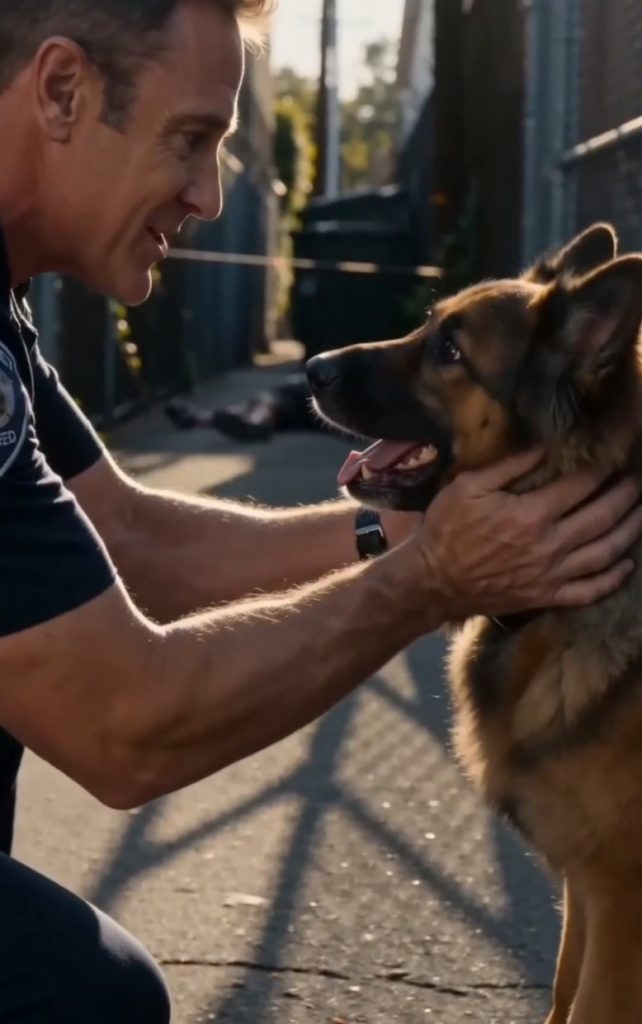
The German Shepherd was barely old enough to fit into the oversized training vest Freed had clipped around him that morning. His paws were too big for his body, his ears still deciding whether to stand or flop, his fur catching the light like soft smoke.
But nothing about him looked soft now.
The second Freed rose from his crouch, the puppy lunged.
He wrapped both front paws around Freed’s shin and barked like the whole world was about to split open.
“Scout,” Freed hissed, trying not to raise his voice. “Let go.”
Scout dug in harder.
Freed’s hand moved toward his holster, not because he expected trouble, but because instinct lived in his bones. Twenty years on the job had taught him that compassion could get a man killed if he didn’t bring caution with it.
Still, there was a body on the ground.
A person who might be breathing.
A person who might have seconds left.
Freed took one step.
Scout yanked him back so hard the officer nearly stumbled.
“Hey. Easy, easy…” Freed dropped to one knee and cupped the puppy’s face between his hands. “It’s just a person in need, buddy. Let me go.”
For half a second, he almost smiled.
Because Scout had done this before.
Barked at trash bags. Growled at umbrellas. Once, during training, he had frozen in front of a cardboard box because a pigeon had moved inside it.
The academy trainers called him too sensitive.
Freed called him honest.
But then Scout stopped barking.
His small body went rigid.
His head snapped toward the body at the end of the alley, and from deep in his chest came a low growl that did not sound like a puppy at all.
Freed followed his gaze.
At first, he saw nothing.
Just sunlight.
Cracked pavement.
The still shape in the distance.
Then his eyes found it.
A thin fishing line stretched across the alley, almost invisible, pulled tight between a drainpipe and a broken metal hook in the wall.
It was inches from where his boot had almost landed.
Freed’s smile vanished.
His breath locked.
And then the body at the end of the alley twitched one hand.
Not in pain.
Not in panic.
On purpose.
A small black remote rested inside its palm.
Freed froze as a red dot appeared on his chest.
Slowly, it began climbing toward his throat.
That was when he whispered the words Scout had known before any human did.
“It’s a trap.”
And somewhere above him, behind the fence shadows, a rifle clicked.
The puppy had saved his life once.
Now Freed had to save them both.
Act II
Three weeks earlier, nobody at the K-9 training yard wanted Scout.
He was too small. Too reactive. Too emotional.
The other dogs charged across the obstacle course like soldiers. Scout stopped at every sound. He smelled every patch of grass, barked at loose wires, refused to cross certain thresholds, and stared too long at people who smiled without meaning it.
“He’s not ready,” Sergeant Bell said, standing beside the chain-link fence with a clipboard under one arm. “Maybe never will be.”
Freed watched Scout sit alone near the edge of the yard.
The puppy’s ears twitched at every shout, every whistle, every slam of a car door. But his eyes were not confused. They were focused.
“He’s not scared,” Freed said. “He’s listening.”
Bell gave him the kind of look cops give other cops when grief has made them sentimental.
“You need a trained dog, Freed. Not a project.”
Freed said nothing.
Everyone in the department knew why he had come back to the K-9 unit.
Six months earlier, his old partner, a veteran Shepherd named Ranger, had been killed during a raid that should never have happened. The suspect was gone before the team arrived. The warrant had holes in it. The building had been cleared too quickly. Someone had known they were coming.
Freed filed questions.
The questions disappeared.
He filed again.
The case was quietly buried beneath department politics, budget meetings, and the tired old phrase no grieving officer ever wants to hear.
Wrong place. Wrong time.
But Ranger had not died because of bad luck.
Freed knew it.
He had found something in Ranger’s torn training collar the night after the raid. A small memory card tucked beneath the leather, almost missed by evidence techs. Ranger’s previous handler, Officer Dana Voss, had hidden it there before she vanished from the department records completely.
The card held fragments.
Vehicle plates.
Encrypted messages.
A name that kept appearing beside suspicious seizures and missing cash.
Marlowe.
Captain Ethan Marlowe, head of Special Operations.
A man with medals on his wall and judges on speed dial.
Freed kept the card hidden. He made copies. He told no one except one person he trusted, an old dispatcher named Lena Ortiz, who had worked the radio room long enough to know which silences were accidental and which were ordered.
“You keep digging,” Lena warned him, “and they’ll stop trying to ruin your career. They’ll start trying to end it.”
Freed believed her.
He just didn’t believe they would use a puppy to find him.
Scout had been born from Ranger’s bloodline, though the department had not advertised it. Ranger’s mate had delivered a litter two weeks after the raid. Most of the pups were sold into official programs across the state.
Scout stayed behind because he was “difficult.”
Because he barked at the wrong people.
Because he would not settle when Captain Marlowe visited the yard.
The first time Marlowe walked past him, Scout planted his tiny paws, lowered his head, and growled.
Everyone laughed.
Freed did not.
He signed the temporary handler forms that afternoon.
“You’re making a mistake,” Bell told him.
Freed clipped the little training vest around Scout’s chest and looked down at the puppy, who stared back like he had been waiting for someone to understand him.
“Maybe,” Freed said. “But so did whoever underestimated him.”
By the time the alley call came in, Scout had been with Freed for twenty-one days.
Long enough to learn his footsteps.
Long enough to sleep beneath his desk.
Long enough to whine every time Freed opened the file cabinet where Ranger’s case notes were hidden.
That morning, Lena had called Freed from dispatch, her voice low.
“Anonymous report,” she said. “Possible injured person. East Crawford alley. No units nearby except you.”
Freed glanced at Scout, who was chewing the corner of an old tennis ball.
“Any caller ID?”
“Blocked.”
“Description?”
“Male. Down on the ground. Not moving.”
Then Lena paused.
It was the kind of pause that carried weight.
“Jared,” she said, using his first name for the first time in years, “something about this feels wrong.”
Freed looked through the windshield at the narrow streets ahead, where sunlight flashed off windows and traffic thinned into the old warehouse district.
“Send backup anyway.”
“I did.”
“Good.”
“But Marlowe canceled it.”
Freed’s hand tightened around the steering wheel.
Scout lifted his head.
Outside, the city kept moving like nothing had changed.
But inside the patrol car, something old and buried had finally stepped into the light.
And when Freed turned onto East Crawford, Scout began to growl before the alley was even in sight.
The call had not been a call for help.
It had been an invitation.
Act III
Freed did not move when the red dot climbed his uniform.
He had trained for this.
Not this exact nightmare, maybe, but the shape of it. The sudden narrowing of the world. The way every sound sharpened until even Scout’s breathing seemed loud.
The tripwire shimmered at ankle height.
The body at the end of the alley kept its hand closed around the remote.
Somewhere above, a hidden shooter had him marked.
Freed’s radio sat on his shoulder, close enough to reach, too dangerous to grab quickly. One wrong motion, and the alley could become a headline written by people who never knew what had really happened.
Scout pressed against his leg, trembling with fury rather than fear.
Freed lowered his eyes just enough to see the puppy.
The red dot hesitated.
Whoever held the rifle was watching for panic.
Freed gave them none.
His voice came out barely above a breath.
“Good boy.”
Scout’s ears flicked.
Freed remembered Ranger then.
Not as the department remembered him, in a framed photo near the lobby and a folded flag in a glass case. He remembered Ranger alive, blocking a doorway before a hidden suspect rushed out. He remembered Ranger refusing to enter the warehouse the night he died, pulling backward, trying to warn them.
Freed had ignored him.
Orders were orders.
Move in, Marlowe had said over the radio. Clear the building.
And Ranger had obeyed because Freed had.
That guilt had lived in Freed like a second heartbeat.
Now Scout was doing what Ranger had done.
And this time, Freed listened.
The body at the end of the alley shifted again.
“Officer,” the man called weakly. “Help me.”
The voice was too clean.
No strain. No confusion.
A performance.
Freed kept his face blank.
“Don’t move,” he said.
The man laughed softly.
It was the wrong sound in a place like that.
“You already did.”
Freed’s mind worked through the alley. Fence above. Shooter to the left. Tripwire low. Remote trigger at the end. Decoy body. Narrow walls. No clear exit backward unless he dragged Scout with him slowly.
His patrol car was parked at the mouth of the alley.
Dashcam running.
Bodycam running.
Scout’s training vest had a small camera too, installed by Freed after Lena insisted on it. “Because men like Marlowe don’t fear truth,” she had said. “They fear truth with a timestamp.”
Freed had thought she was being dramatic.
Now he hoped she had been right.
The red dot moved from his throat to his cheek.
A warning.
From his radio, a burst of static cracked.
Then Lena’s voice came through, faint but clear.
“Unit 14, status?”
Freed did not answer.
He slowly shifted two fingers toward the side button on his radio, making the motion look like a nervous twitch.
The laser dot snapped back to his chest.
Scout barked once.
Sharp.
Commanding.
Then the puppy did something Freed had not expected.
He dropped flat to the ground and crawled backward, pulling at the hem of Freed’s pant leg with his teeth.
Not away from the threat.
Toward the wall.
Freed looked down.
Near the base of the brick, half-buried beneath leaves and dust, was a second line.
Not the tripwire he had seen.
Another one.
Lower.
Meant for a dog.
His stomach turned cold.
They had expected Scout too.
That meant this was not just about killing an officer who asked too many questions.
It was about erasing Ranger’s bloodline, the last living thread tied to a case they thought had been buried.
Freed pressed the radio button.
Only once.
Three short taps.
Then silence.
To anyone listening, it meant nothing.
To Lena Ortiz, who had worked dispatch during hostage calls, riots, and the worst nights the city had ever seen, it meant one thing.
Officer trapped.
Do not announce response.
Send everything.
At the far end of the alley, the decoy man sat up just enough for Freed to see his face.
He was not injured.
He was smiling.
And Freed recognized him from the memory card.
Victor Hale.
Former evidence technician.
Officially resigned.
Unofficially, Marlowe’s cleaner.
“You should’ve let the old dog die a hero,” Hale said.
Freed’s jaw tightened.
Scout growled so hard his small body shook.
Hale lifted the remote a little higher.
“Now you both get to be a lesson.”
Then the alley filled with the sound Freed had been waiting for.
Not sirens.
Not footsteps.
A phone ringing.
Hale glanced down, annoyed.
His own phone buzzed against the pavement beside him.
And on the cracked screen, flashing in bright letters, was a live video call.
Captain Marlowe.
That was the mistake that would destroy them all.
Act IV
Hale should not have answered.
But men who build traps often believe they are the only ones who can spring them.
He tapped the screen with his thumb, keeping the remote balanced in his other hand.
Marlowe’s face appeared, sharp and impatient, lit by the cold glow of an office somewhere far from the alley.
“Is it done?” Marlowe snapped.
Freed did not move.
His bodycam caught the voice.
Scout’s vest camera caught the face.
The dashcam caught Hale holding the remote.
And somewhere in dispatch, Lena Ortiz was recording every second on a private backup channel that Marlowe had forgotten existed because powerful men rarely remember the people they step over.
Hale’s smile faltered.
“Almost.”
“Almost?” Marlowe leaned closer to the screen. “You were told not to talk. Trigger it and leave.”
Freed saw the flicker in Hale’s eyes.
The first crack.
Not fear, exactly.
Realization.
He was not a partner. He was a loose end with legs.
Freed spoke then, calm enough to surprise even himself.
“You hear that, Hale?”
The red dot jerked toward his forehead.
Freed held still.
“He’s not coming for you after this,” Freed said. “You know that, right?”
Marlowe’s face hardened on the phone.
“Shut him up.”
Hale’s hand tightened around the remote.
Scout suddenly barked toward the roofline.
Once.
Twice.
The shooter shifted.
A small scrape above. A loose pebble dropped from the fence ledge and clicked against the pavement.
Freed saw it.
So did Scout.
The puppy launched sideways, not forward, slamming his body into a stack of empty crates near the wall.
The crates toppled with a hollow crash.
The shooter flinched.
The red dot swung off Freed’s face for less than a second.
That was all he needed.
Freed dropped low, grabbed Scout by the vest, and rolled behind a dented metal dumpster just as the alley erupted in noise.
The shot struck brick.
Hale cursed.
The remote flew from his hand when he scrambled backward.
Freed did not chase it.
He pulled Scout close and covered him with his body.
“Stay,” he whispered.
Scout ignored him immediately.
The puppy wriggled free, darted two feet out, and clamped his teeth around the strap of Freed’s dropped radio. He dragged it back behind the dumpster like it weighed as much as he did.
Freed stared at him.
“Good boy,” he breathed.
Through the radio, Lena’s voice came sharp and controlled.
“Jared, hold position. Tactical is on site. Repeat, tactical is on site.”
Hale heard it too.
His face changed.
For the first time, the man at the end of the alley looked like what he had pretended to be.
Helpless.
Above them, boots pounded across the roof.
A command shouted from the far side of the fence.
“Police! Hands where we can see them!”
Another voice from the alley entrance.
“Drop the device!”
Hale reached for the remote.
Scout barked.
Freed moved faster.
He fired one controlled shot into the pavement beside Hale’s hand, close enough to stop him, far enough to spare him. Hale froze, fingers spread, chest heaving.
The remote lay inches away.
A tactical officer swept in from behind a shield and kicked it clear.
The shooter on the roof surrendered seconds later, dragged from the shadows by officers who had entered without sirens, without warning, without giving Marlowe time to cancel another rescue.
But Marlowe was still on the phone.
Still connected.
Still watching the trap collapse.
Freed picked up Hale’s phone from where it had fallen near the wall. The screen was cracked, but Marlowe’s face remained visible.
For once, the captain had nothing to say.
Freed held the phone up to his bodycam.
“Captain Ethan Marlowe,” he said, voice steady now, “you’re on a recorded line.”
Marlowe ended the call.
But it was too late.
The truth had already learned how to breathe.
And by sunset, the whole department would hear it.
Act V
The alley became a crime scene that stretched far beyond its walls.
Investigators found the tripwires. The hidden devices. The rifle position above the fence. The false emergency call routed through a burner phone.
They found Hale’s messages.
They found payment records buried under shell companies.
And because Hale discovered very quickly that Marlowe had planned to sacrifice him too, he started talking before the ink dried on his arrest paperwork.
By midnight, Captain Ethan Marlowe was no longer in his office.
By morning, his medals had been removed from the wall.
The official statement said an internal corruption investigation had expanded into multiple felony charges. It mentioned evidence tampering, obstruction, and conspiracy. It did not mention the way Marlowe stared at Scout during booking, as if the little dog had personally dragged him out of power.
Freed saw that look.
So did Scout.
The puppy sneezed at him.
For the first time in months, Freed laughed.
Not much.
Just enough to feel human again.
Two days later, Lena handed Freed a sealed evidence envelope.
Inside was the complete recovered file from Dana Voss, Ranger’s previous handler. She had not vanished because she quit. She had gone into hiding after discovering Marlowe’s network inside the department.
She had trusted Ranger with the memory card because she trusted no one else.
At the bottom of the file was a handwritten note.
Freed read it alone in the K-9 yard, with Scout sleeping against his boot.
If anything happens to me, Ranger will know who still has a conscience. Follow the dog.
Freed sat with that sentence for a long time.
Then he looked down at Scout.
The puppy opened one eye, as if annoyed that humans took so long to understand simple things.
“You knew,” Freed murmured.
Scout wagged his tail once.
The department held a ceremony the following week.
Freed hated ceremonies.
He hated polished speeches, rows of chairs, forced applause, and the way officials used soft words to cover hard truths. But he went because Lena told him he had to, and because Scout had been fitted with a new vest for the occasion.
This one actually fit.
Sergeant Bell stood near the front, looking uncomfortable in dress blues.
When Scout trotted past him, Bell crouched and scratched the puppy behind one ear.
“I was wrong about you,” he said quietly.
Scout accepted the apology with the dignity of a king.
Freed received a commendation he did not want.
Scout received one he absolutely did.
A small silver tag was clipped to his collar, engraved with his name and the date of the alley rescue. The crowd applauded. Cameras flashed. Someone from city hall tried to call him a mascot.
Freed corrected them immediately.
“He’s my partner.”
The room went still for half a beat.
Then Lena started clapping again.
This time, everyone followed.
Weeks later, Freed returned to East Crawford alley.
Not for duty.
Not for evidence.
For himself.
The vines still caught the sunlight. The fence still cast shadows across the asphalt. The city had painted over the marks on the brick, and rain had washed the dust clean.
But Freed still saw it.
The wire.
The red dot.
The body pretending to need help.
And the puppy who refused to let him die.
Scout stood beside him, taller now, ears fully upright, nose working through the air.
Freed knelt and placed one hand on the ground where his boot had almost stepped.
“I should’ve listened to Ranger,” he said.
The alley gave no answer.
But Scout leaned into him, warm and solid and alive.
Freed closed his eyes.
For months, he had carried the old guilt like a sentence. He had believed he failed his partner because he obeyed an order instead of trusting the warning right in front of him.
But maybe redemption did not always come as forgiveness.
Sometimes it came on four paws, too small for the vest, barking like thunder in a sunlit alley.
Sometimes it grabbed your leg and refused to let go.
Freed stood.
Scout looked up at him, waiting.
This time, the officer did not move first.
He watched the dog.
Scout sniffed the air, glanced down the alley, then turned toward the open street where the light was brighter.
Only then did Freed follow.
Behind them, the alley fell silent again.
But it was not the same silence.
This one had no trap inside it.