Act I
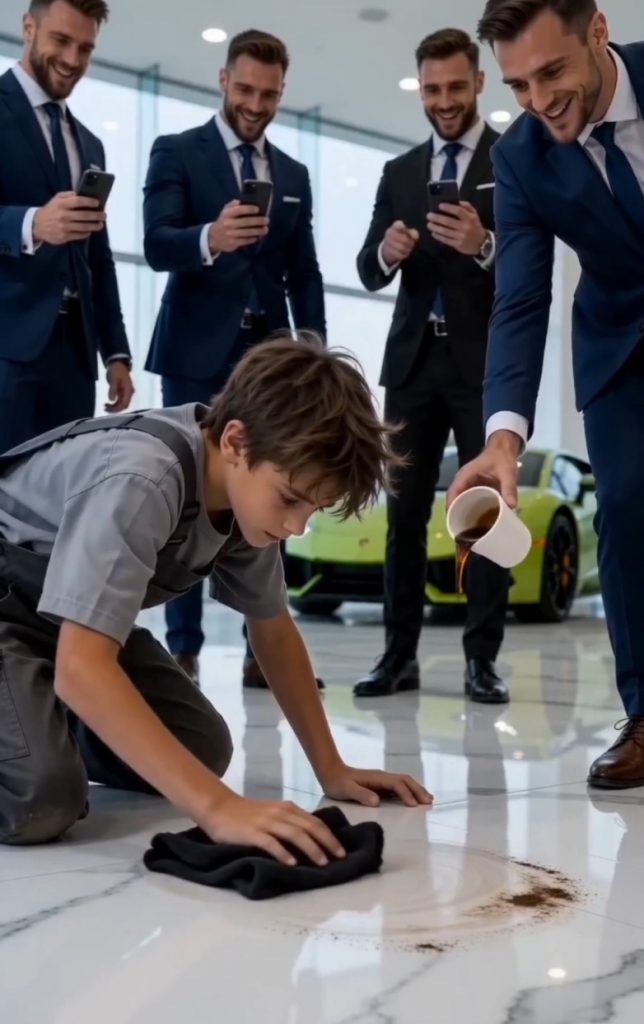
Leo Hart was on his knees when the laughter started.
The marble floor beneath him was so polished it reflected everything: the lime green Lamborghini glowing under the showroom lights, the silver McLaren posed like a sculpture near the glass wall, the five salesmen standing in a loose circle above him in suits worth more than his monthly rent.
And Leo, scrubbing a smudge with a black microfiber cloth.
Again.
His gray jumpsuit clung to his shoulders with sweat. His hair was messy from a twelve-hour shift that should have ended two hours ago. His hands smelled of cleaner, rubber, and burnt coffee.
The lead salesman, Brent Cole, stepped closer with a white paper cup.
Leo saw the shadow before he saw the cup tilt.
Dark espresso spilled across the exact patch of marble he had just cleaned.
It spread slowly, glossy and black, cutting through the reflection of the Lamborghini like a stain through money.
The other salesmen burst out laughing.
“Hahaha! You’re just a cheap worker,” Brent said, loud enough for everyone in the showroom to hear. “Clean it up again.”
One of them lifted his phone and started filming.
“Come on, Leo,” another said. “Smile. This is content.”
Leo did not look up.
He pressed the cloth into the coffee and began wiping.
His jaw tightened, but he said nothing.
That was what angered them most. Not tears. Not begging. Not even embarrassment. It was the way he kept his dignity close, like something they could not reach no matter how low they forced him.
Brent crouched slightly.
“You deaf?”
Leo’s hand paused.
“No, sir.”
“Then say thank you.”
The words hung in the showroom.
Beyond the glass walls, the afternoon sun poured over the parking lot, bright and clean. Inside, beneath recessed lights and million-dollar machines, the air had gone mean.
Leo swallowed.
“Thank you.”
The laughter returned.
Then a voice came from near the entrance.
“Why are you treating him this way?”
The salesmen turned.
An old man stood a few feet inside the showroom doors.
His brown jacket was torn at the sleeve. His gray hair hung in uneven strands around a weathered face. Dust clung to his pants, and one of his shoes looked like it had been repaired with tape.
He did not look frightened.
That was strange.
People who came into places like Blackwood Exotics looking like him usually looked prepared to be thrown out.
This man looked as if he were measuring the room.
Brent’s lip curled.
“Are you lost?”
The old man’s eyes moved from the spilled coffee to Leo on the floor.
“I asked you a question.”
The showroom went still for half a beat.
Then Brent laughed.
“He’s just a cleaner. We do whatever we want here.” He stepped toward the old man, straightening his silk tie. “You want to join him on the floor, old man?”
More laughter.
One salesman pointed at the old man’s torn jacket.
“Maybe he came to test-drive the trash can.”
Leo looked up then.
Not at Brent.
At the old man.
There was something in his eyes that made Leo’s chest tighten.
A terrible calm.
The old man did not answer. His jaw shifted once. The muscles in his neck tightened. For a moment, the warmth in the showroom seemed to drain away.
Then he turned and walked out.
Brent threw his arms wide.
“That’s right. Keep walking.”
The others laughed again, louder now, relieved.
Leo looked down at the coffee spreading through the cloth.
But he had seen the old man’s face.
He had seen the way his eyes changed.
And somehow, Leo knew the laughter had just bought them all a debt they could not afford.
By sunset, the old man would return.
And nobody would be laughing.
Act II
Leo had not planned to become the invisible person in a room full of dream cars.
When he was younger, he thought cars were magic.
Not because they were expensive. Because they moved. Because metal, heat, fuel, wires, and human imagination could become speed. His father used to bring home broken engines from a salvage yard and let Leo sit beside him under a hanging garage bulb while he explained how each part mattered.
“Never worship the car,” his father said. “Respect the hands that built it.”
Leo remembered that every time he cleaned fingerprints off a windshield for men who could not change a tire.
His father, Marcus Hart, had once been a master technician for Blackwood Motors. Not just a mechanic. A problem solver. The kind of man engineers called when a prototype refused to behave and executives had run out of expensive guesses.
Then Marcus died in a highway accident five years ago.
After that, everything shrank.
The house became an apartment. The garage became a storage unit they could no longer afford. Leo’s mother took double shifts at a hospital laundry until her lungs gave out from years of chemical fumes and exhaustion.
Leo quit community college after one semester.
He told himself it was temporary.
Temporary became two years.
The job at Blackwood Exotics was supposed to be a step back toward the world his father had belonged to. He applied as a junior technician. The hiring manager looked at his last name too long, then offered him night cleaning instead.
“Get your foot in the door,” the manager said.
So Leo took it.
He cleaned the glass.
He swept the service bay.
He polished the marble beneath cars he knew better than the men selling them.
At night, when the showroom emptied, he sometimes stood beside the newest Blackwood prototype in the private delivery room, studying the curve of the carbon fiber, the angle of the doors, the impossible quiet of the electric drivetrain.
The car was called the Blackwood Vesper.
Matte gray. Gull-wing doors. Four seats. Silent as a secret.
Only three existed.
One belonged to the founder.
One was locked in the company’s research facility.
One sat in the showroom under a cover, waiting for a private unveiling.
Leo had noticed the fault first.
A wiring irregularity in the door system. Tiny. Intermittent. Dangerous only under a rare failure sequence. The kind of flaw a cleaner should not have been able to see.
But Marcus Hart had taught him to listen to machines.
Leo reported it.
Brent laughed in his face.
“You mop floors,” he said. “Don’t diagnose cars.”
The next morning, the Vesper’s maintenance log had been altered.
Leo’s warning disappeared.
That was when he realized Brent was not only cruel.
He was dangerous.
The sales team at Blackwood Exotics had built their own little kingdom inside the showroom. They decided who deserved respect. They mocked customers who dressed badly, ignored anyone they thought could not buy, and charged “priority access fees” that never appeared on official paperwork.
They took photos beside cars they did not own.
They called themselves closers.
Leo called them thieves, but only in his head.
He had no proof.
And he could not lose the job.
His mother’s medication cost more than rent. His younger sister still needed school supplies. Every paycheck had a destination before it touched his hands.
So he kept quiet.
He kept cleaning.
Until the coffee hit the floor.
Until the old man walked in.
Until Brent said, “We do whatever we want here.”
The sentence bothered Leo more than the humiliation.
Not because it was cruel.
Because Brent believed it.
And men who believed no one was watching always revealed who they really were.
That afternoon, after the old man left, Brent ordered Leo to stay late and polish the showroom again.
“All of it,” he said. “Since you clearly need practice.”
The others smirked.
Leo picked up the mop bucket.
Near the entrance, where the old man had stood, something lay on the marble.
A small gold pin.
Leo crouched and picked it up.
The pin was heavy, shaped like a shield, engraved with two words.
CEO OWNER.
Leo stared at it.
His pulse changed.
He had seen that pin once before, in an old framed photograph in the service hallway.
The founder of Blackwood Motors wore it at the opening of the first showroom thirty years ago.
Elias Blackwood.
The man everyone said had retired from public life.
The man Brent had just threatened to throw onto the floor.
Leo closed his fist around the pin.
Outside, the sun began to lower.
And somewhere beyond the glass, an engine that made no sound was already coming back.
Act III
The Vesper arrived at 5:17 p.m.
It did not roar into the parking lot.
That was what made it terrifying.
It glided.
Matte gray under the amber light, low and impossible, its body reflecting the sunset like liquid steel. The showroom staff saw it through the glass and froze one by one.
Even Brent stopped talking.
The car rolled to a perfect stop in front of the main doors.
For a moment, nothing happened.
Then all four gull-wing doors rose at once with a smooth mechanical hum.
A chauffeur stepped out first.
Then two women in black suits.
Then the old man.
Except he was no longer the old man.
The torn jacket was gone. The dirty hair had been combed back. He wore a flawless charcoal suit, a crisp white shirt, and a gold watch that flashed once in the dying sun.
On his lapel was an empty space where a pin had been.
Leo felt the gold pin burning in his palm.
Brent’s face went pale.
“No,” one of the salesmen whispered.
Elias Blackwood removed his sunglasses as he entered the showroom.
No one greeted him.
No one knew how.
He walked across the marble floor, past the Lamborghini, past the McLaren, past the coffee stain Leo had finally cleaned away.
His eyes stopped on Brent.
“Mr. Cole,” Elias said.
Brent swallowed.
“Mr. Blackwood, sir, we didn’t realize—”
“That I was worth respect?”
The sentence landed cleanly.
No one moved.
Elias turned toward Leo.
“You found my pin.”
Leo opened his hand.
The gold shield sat against his stained palm.
“Yes, sir.”
Elias took it but did not put it on.
Instead, he looked at Leo’s gray jumpsuit.
“What is your full name?”
“Leo Hart.”
The silence changed again.
Elias stared at him.
“Hart?”
“Yes, sir.”
“Marcus Hart’s son?”
Leo nodded slowly.
For the first time since entering the showroom, Elias looked shaken.
Not weak.
Human.
He turned toward the covered Vesper in the private delivery area.
“Your father saved my life once.”
Leo had no answer.
Brent shifted behind them.
Elias heard it.
His expression hardened again.
“Bring me the maintenance logs for the Vesper.”
Brent blinked.
“Sir?”
“Now.”
The assistant manager hurried toward the office.
Elias looked at the five salesmen.
“Phones on the table.”
Nobody moved.
Elias smiled faintly.
It was not a kind smile.
“Let me clarify. Either your phones go on that table, or federal auditors will collect them with warrants.”
One by one, the phones appeared.
The videos were still there.
Leo on his knees.
Brent pouring coffee.
The laughter.
The old man being mocked.
But that was only the top layer.
Elias’s security team pulled records from the sales system. Private messages. Altered customer files. Fake premium fees. Cash transfers. Screenshots of wealthy clients being ranked by how easily they could be manipulated.
Then they found the maintenance log.
The warning Leo had entered about the Vesper was missing.
But a backup existed.
Elias read it on a tablet, his face growing colder line by line.
“Mr. Cole,” he said, “why was this report deleted?”
Brent tried to smile.
“It was probably a clerical issue.”
Leo spoke before fear could stop him.
“No, sir. I reported the door fault last month. Mr. Cole told me I was a cleaner and erased it.”
Brent spun toward him.
“You little liar.”
Elias raised one hand.
Brent shut up.
For a long moment, Elias studied Leo.
“What made you notice the fault?”
Leo glanced at the Vesper.
“The rear left door actuator cycles half a second late when cabin power drops below reserve threshold. It’s almost nothing. But if the emergency latch engages during that delay, the door could lock under pressure.”
One of Elias’s engineers, standing near the Vesper, looked up sharply.
Elias did not blink.
“You learned that cleaning floors?”
“My father taught me to listen.”
The engineer walked to the car, ran a diagnostic, then turned back slowly.
“He’s right.”
The room went dead silent.
Elias looked at the salesmen.
“You mocked the only person in this building who noticed the flaw that could have killed a client.”
Brent’s mouth opened.
No words came.
Then Elias turned to Leo again.
“Your father filed a design complaint twelve years ago. It was ignored by executives who cared more about launch deadlines than safety. After his death, his name disappeared from our internal history.”
Leo’s throat tightened.
“I didn’t know that.”
“I know,” Elias said quietly. “That was my failure.”
Brent tried one final time.
“Sir, with respect, this is being blown out of proportion. The kid is emotional, and the coffee thing was just a joke.”
Elias put the gold pin back on his lapel.
“No,” he said. “A joke requires humanity.”
Then he pressed a button on his watch.
The showroom’s glass doors locked.
And the lights above every car shifted from warm white to cold blue.
The kingdom of the salesmen had just become an interrogation room.
Act IV
By 6:00 p.m., the showroom was full of people Brent had never expected to see.
Corporate legal counsel.
Human resources.
Two auditors.
Three security officers.
A representative from the Department of Motor Vehicles’ dealer enforcement division.
And an elderly woman in a navy dress who walked with a cane but made everyone straighten when she entered.
Her name was Clara Blackwood, Elias’s sister and chair of the company ethics board.
She watched the video of Brent pouring coffee on the floor.
Then she watched it again.
Nobody spoke.
When the video ended, she looked at Leo.
“I am sorry,” she said.
Leo stared down at his shoes.
He had not expected an apology to feel heavy.
“Thank you, ma’am.”
Brent rolled his eyes.
That was his last mistake.
Clara saw it.
“You find this boring?”
“No, ma’am.”
“You should. It is the end of your career.”
One of the auditors placed a folder on the table.
The investigation moved fast because Elias had not arrived unprepared. The ragged clothes had not been random. He had been visiting dealerships across the country undercover for months after receiving anonymous complaints from customers and former staff.
Blackwood Exotics had been the worst.
The salesmen had humiliated anyone they considered beneath them. They had denied test drives to qualified buyers based on appearance. They had inflated fees, falsified waitlists, and pocketed “consultation deposits” through a private account.
But the deeper crime sat inside the Vesper logs.
Brent and two others had been planning to sell priority access to the prototype unveiling by hiding safety reports until after launch. A wealthy collector had already wired money to their shell company.
If Leo’s deleted warning had stayed buried, the defect might have gone public in the ugliest possible way.
Elias listened without interrupting.
The five salesmen slowly deflated as evidence piled up.
Their suits looked less expensive now.
Or maybe Leo was simply seeing them clearly for the first time.
When the auditors finished, Elias stood at the center of the showroom.
“Mr. Cole,” he said, “you are terminated effective immediately. So are the others involved in the scheme. Your licenses will be reported for review. Our attorneys will decide what comes next.”
Brent’s face twisted.
“Over a cleaner?”
Elias stepped closer.
“Over theft. Fraud. Harassment. Tampering with safety documentation. And yes, over a cleaner.”
Brent looked at Leo with pure hatred.
“You think this makes you one of them?” he snapped. “You’ll still be scrubbing floors tomorrow.”
Leo felt the old shame rise.
Then Elias answered for him.
“No,” he said. “He won’t.”
Everyone turned.
Elias walked to the Vesper and pulled the cover away.
The matte-gray car gleamed under the showroom lights.
“Leo Hart identified a critical design flaw my engineering team missed,” Elias said. “His father was one of the finest technicians this company ever had, and I allowed this place to forget that.”
Leo could not breathe.
Elias looked at him.
“Mr. Hart, I am offering you a paid apprenticeship in our advanced engineering program, full tuition support for your degree, and a position in the Vesper safety review team, if you want it.”
Leo stood frozen.
Brent laughed bitterly.
“This is insane.”
Clara tapped her cane once against the marble.
“No, Mr. Cole. This is what happens when merit walks in wearing work clothes and arrogance is too stupid to recognize it.”
The words settled over the room like justice.
Leo’s eyes burned, but he refused to let tears fall in front of Brent.
Elias seemed to understand.
He lowered his voice.
“You earned the offer. It is not charity.”
That sentence broke something open in Leo.
For years, every opportunity had come with a catch, a condescending smile, or a reminder that he should be grateful. But Elias did not look at him like a rescue project.
He looked at him like a person whose value had been there all along.
Brent grabbed his jacket from a chair.
“You’ll regret this.”
Elias’s face went still.
“I already do,” he said. “I regret letting men like you wear my company’s name.”
Security escorted them out.
No shouting.
No dramatic struggle.
Just five men in expensive suits walking across the marble they had once believed belonged to them, past the cars they had used as mirrors, past the cleaner they had mistaken for powerless.
At the door, Brent looked back.
Leo was standing beside the Vesper now.
And Elias Blackwood stood beside him.
That was the image Brent left with.
Not the coffee.
Not the laughter.
The reversal.
Act V
The video leaked before midnight.
Not from Elias.
Not from Leo.
From one of the salesmen, who had posted it earlier in a private group where cruel people laughed at cruel things until the world caught them laughing.
By morning, everyone had seen it.
The cleaner on his knees.
The coffee spill.
The ragged old man asking a simple question.
The salesman saying, “We do whatever we want here.”
The internet did what crowds always do first. It raged. It mocked. It hunted names.
Elias refused to let the story become only a spectacle.
He released the company findings publicly. Not the private details of employees who were not involved, not anything that turned Leo into a circus attraction, but enough truth to make the pattern impossible to deny.
Blackwood Motors announced a full audit of every dealership.
Mandatory anti-harassment reforms.
Transparent pricing.
Customer discrimination reviews.
A whistleblower hotline monitored outside the company chain of command.
And a new training program named after Marcus Hart.
Leo watched the announcement from his mother’s hospital room.
She sat propped against pillows, thinner than he wanted her to be, her hands folded over a blanket. When the reporter said Marcus Hart’s name, she pressed her fingers to her mouth.
“They remembered him,” she whispered.
Leo nodded.
His throat hurt too much to speak.
Elias came to visit that evening.
Not with cameras.
Not with flowers big enough to embarrass a room.
Just a small envelope, a repair manual Marcus had written years ago, and the gold CEO OWNER pin.
Leo’s mother looked at the pin.
“I don’t understand.”
Elias placed it on the table beside her bed.
“I wore that pin the day I opened my first showroom,” he said. “I lost sight of what it meant. Your son reminded me.”
Leo shook his head.
“I just cleaned floors.”
“No,” Elias said. “You kept noticing what everyone else chose not to see.”
His mother looked at Leo then, not with surprise, but with the quiet pride of someone who had always known.
The apprenticeship began two weeks later.
Leo entered the engineering facility through the front doors this time, not the service entrance. He wore a clean work jacket with his name stitched over the chest.
LEO HART
Below it, in smaller letters:
Advanced Vehicle Safety Apprentice
The first time he saw it, he had to look away.
Not because he was ashamed.
Because he was afraid that if he stared too long, he would wake up back on the showroom floor with coffee spreading under his hands.
The work was hard.
That helped.
Machines did not flatter him. Engineers did not clap when he solved a problem. The Vesper still had issues, and Leo spent long nights tracing faults through wiring diagrams while older technicians tested him with questions his father would have enjoyed.
Some welcomed him.
Some doubted him.
He could handle doubt.
Doubt was honest.
Cruelty was something else.
Three months later, Blackwood held the delayed Vesper unveiling.
This time, the showroom looked different.
Not physically. The marble still shone. The glass walls still reflected the sun. The Lamborghini and McLaren still sat beneath perfect lights.
But the air had changed.
No one laughed at staff.
No one filmed humiliation for entertainment.
And near the entrance, mounted discreetly on a dark wood panel, was a sentence Elias had ordered engraved after the scandal.
Respect is not a luxury item.
Leo stood near the Vesper in a black technician’s jacket, checking the door sequence one final time.
Elias approached.
“You ready?”
Leo glanced at the car.
The gull-wing doors rose smoothly.
No delay.
No fault.
No hidden danger.
“Yes, sir.”
Elias smiled faintly.
“You can call me Elias.”
“Not yet, sir.”
“Fair enough.”
Across the showroom, Leo saw a new cleaner polishing the marble near the McLaren. A nervous kid, maybe seventeen, moving carefully as wealthy guests flowed around him.
One guest stepped too close and nearly bumped the bucket.
Leo moved before he thought.
“Careful,” he said, firm but polite.
The guest looked startled, then apologetic.
“Sorry.”
The cleaner looked up at Leo.
For a second, their eyes met.
Leo recognized the expression.
The instinct to shrink.
The expectation that help would come with a price.
Leo gave him a small nod.
“You’re good,” he said.
The kid’s shoulders loosened.
It was not a grand moment. No cameras caught it. No one applauded.
But Leo felt something settle inside him.
Maybe justice was not only about powerful men falling.
Maybe it was also about making sure the next person on the floor did not have to wonder whether anyone saw them.
Later that night, after the guests left and the showroom lights dimmed, Leo stood alone beside the Vesper.
The marble reflected him now.
Not perfectly. The floor still carried faint marks if you knew where to look. The place where Brent poured the coffee had been cleaned a hundred times, but Leo could find it without trying.
He did not hate that.
Some stains should be remembered.
Elias joined him near the glass wall.
Outside, the city glowed under a clear American night.
“You know,” Elias said, “when I came in dressed like that, I expected arrogance.”
Leo looked at him.
“But not that much?”
“I expected arrogance,” Elias repeated. “I did not expect courage from the man they were humiliating.”
Leo swallowed.
“I didn’t feel courageous.”
“Most people don’t when it counts.”
They stood in silence.
Then Elias handed him the gold pin again.
Leo stared at it.
“I can’t take that.”
“Not to keep,” Elias said. “To remember what it means. Ownership is not about having the keys. It is about responsibility for everyone under the roof.”
Leo held the pin carefully.
It was heavier than it looked.
Through the glass, the showroom reflected back at him: the cars, the lights, the old man in the suit, the young man who had once been invisible.
Leo thought of his father’s voice.
Respect the hands that built it.
He closed his fingers around the pin.
For the first time in years, he felt the future opening like a door instead of a bill coming due.
And behind him, under clean lights and quiet glass, the floor shone without anyone on their knees.