Act I
The bus stop was crowded enough for witnesses, but not crowded enough for courage.
Morning traffic crawled past the glass shelter in silver streaks. Steam rose from sewer grates. A delivery truck honked at a cyclist. Everyone looked busy, polished, important, late.
Everyone except the old man on the bench.
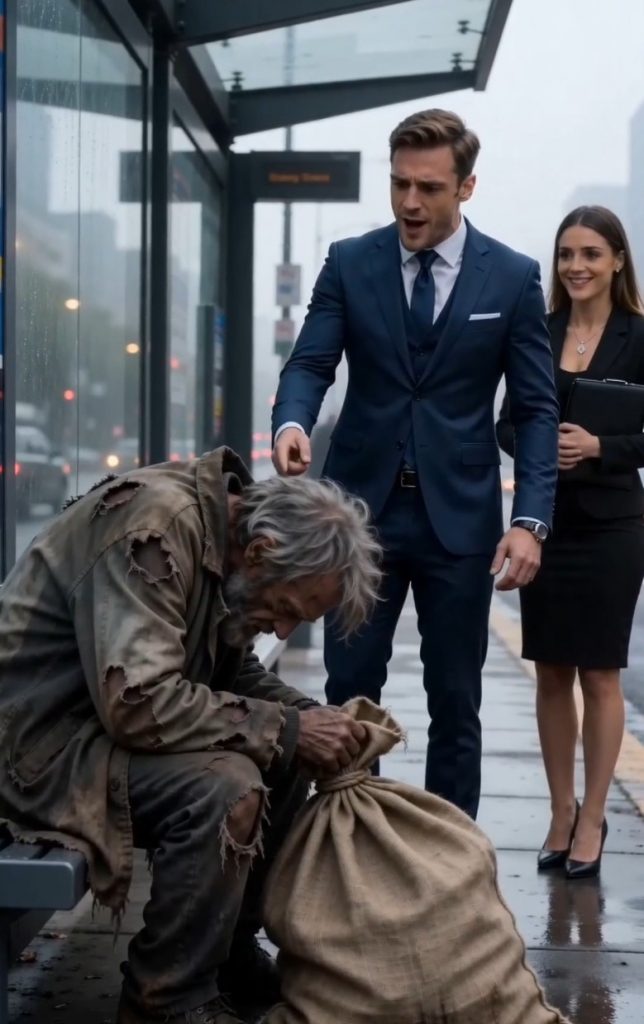
He sat hunched beneath the faded route map, his gray hair tangled by the wind, his field jacket torn at the sleeve and dark with grime. A tightly knotted burlap sack rested beside his shoes. His hands, rough and spotted with age, were folded over his knees.
To most people, he was part of the city’s background.
Something to step around.
Something to avoid noticing too directly.
Mark Ellison noticed him.
Not with compassion.
With irritation.
Mark arrived at the stop in a slim navy suit, briefcase in one hand, phone in the other. At twenty-eight, he already carried himself like someone who believed elevators should open faster for him. Beside him stood Sarah Vale, an associate from his division, dressed in a black blazer and pencil skirt, her diamond pendant catching the hazy morning light.
Sarah wrinkled her nose.
“Unbelievable,” she muttered. “Right outside the building district.”
Mark looked down at the old man.
The old man looked back without speaking.
That seemed to offend Mark most.
“Hey,” Mark snapped. “Poor old man. Get away from here.”
The old man did not move.
Mark’s mouth curled.
“You’re polluting our air.”
A few people shifted uncomfortably, but no one said anything. One woman looked down at her coffee. A man in headphones turned the volume up.
Sarah smirked and stepped back as if poverty were contagious.
Then Mark lifted his polished shoe and kicked the burlap sack off the bench.
It hit the dirty pavement with a heavy, dull thud.
Something inside it clinked.
The old man’s hand tightened.
For a long second, he simply stared at the sack lying near the curb.
Then he bent slowly to pick it up.
When he straightened, something in him had changed.
His back was still bent. His face was still weathered and dirty. But his eyes were no longer tired.
They were sharp.
Cold.
Memorizing.
Mark laughed under his breath. “What? You want to say something?”
The bus arrived with a hiss of brakes.
The old man held his gaze.
He said nothing.
But Mark’s smile flickered for half a second, as if some primitive part of him had recognized danger too late to name it.
Sarah tugged at Mark’s sleeve.
“Come on. We’ll be late.”
They boarded the bus without looking back.
The old man remained at the stop, one hand wrapped around the burlap sack, watching through the glass as Mark and Sarah disappeared into the crowd of commuters headed toward the towers downtown.
By noon, those same two would be sitting in the most important boardroom of their lives.
And the old man would walk in through the double doors.
Act II
Mark Ellison had built his career on being seen by the right people.
He knew how to stand near senior executives at receptions. He knew when to laugh, when to nod, when to mention quarterly growth without sounding desperate. He knew which watch suggested ambition and which suggested insecurity.
He had learned early that talent mattered.
But proximity mattered more.
At Harrington Global, proximity to power meant everything.
The company occupied forty-three floors of a glass tower overlooking the city. Its lobby smelled of polished stone, money, and white lilies replaced every morning before the first executive arrived. On the top floor, behind walnut doors and private security, sat the boardroom.
Mark had never been inside until that day.
The annual leadership meeting was a proving ground. Promotions were whispered there. Careers were accelerated or quietly buried. Mark had spent months preparing a presentation on efficiency restructuring, a phrase soft enough to hide layoffs and sharp enough to excite investors.
Sarah had helped him polish every slide.
She admired Mark because he was going somewhere, and Mark liked Sarah because she reflected him back to himself without discomfort. Together, they had become known in the office as young, hungry, and “executive material.”
No one said kind.
Kind was not a metric.
That morning’s bus stop incident faded from Mark’s mind almost immediately. By the time he stepped into the tower lobby, he had already turned the old man into a passing annoyance, no more important than gum on a sidewalk.
Sarah, however, laughed about it in the elevator.
“Did you see his face when you kicked that bag?” she whispered.
Mark smirked.
“People need boundaries.”
“Exactly. Everyone acts like we’re supposed to apologize for having standards.”
The elevator rose in mirrored silence.
Neither of them noticed the security camera above them.
Neither knew that Harrington Global’s executive security team had already pulled footage from the bus stop across the street, flagged by a private detail following a man the company board had not seen in public for nearly a year.
Elias Harrington.
Founder.
Majority owner.
Chief executive officer.
Officially, Elias was seventy-four, semi-retired, and recovering from a health crisis at his estate in Connecticut.
Unofficially, he had spent the last six months doing something that terrified the board more than any market crash.
Watching.
He watched from distribution floors, call centers, reception desks, parking garages, temp agencies, and city buses. Sometimes he dressed like a maintenance contractor. Sometimes like a retiree with nowhere to be. Sometimes, as he had that morning, like a man society had already trained itself to ignore.
He did not do it for theater.
He did it because numbers had begun telling him a story he did not trust.
Employee complaints buried before reaching HR. Vendor contracts redirected toward friends of directors. Charity funds reduced while executive bonuses grew. Frontline workers resigning in waves while management called it “attrition alignment.”
And then there was the leadership slate.
Mark Ellison’s name sat near the top.
The board saw brilliance.
Elias wanted to see character.
The burlap sack Mark had kicked was not full of trash. It held old company ledgers, letters from laid-off employees, and a dented brass nameplate from the first Harrington workshop, back when Elias had founded the company with twelve workers and a loan no bank wanted to give him.
He had carried it that morning because the annual meeting was supposed to be a reckoning.
Mark had simply moved his name higher on the list.
At 11:57 a.m., the boardroom filled.
Executives settled into plush leather chairs around the massive mahogany table. Floor-to-ceiling windows revealed the city skyline in glittering layers. Assistants arranged water glasses. Tablets lit up. Cufflinks flashed.
Mark sat near the center, smoothing his tie.
Sarah sat beside him, spine straight, lips painted into readiness.
The vice president, Charles Whitaker, stood at the head of the room and adjusted his cuffs. He looked unusually pale.
“Quiet, everyone,” he said. “Our CEO has personally decided to attend this annual meeting. Please show your respect.”
A ripple of shock moved around the table.
Mark sat taller.
Sarah’s eyes widened with ambition.
No one had seen Elias Harrington in months. A personal appearance could mean restructuring, succession, or a chance to impress the man whose signature still determined half their futures.
The walnut doors opened.
And Elias walked in.
Not in rags.
Not bent.
Not forgotten.
He wore a bespoke charcoal-gray three-piece suit, polished oxfords, and a watch so understated only the richest people in the room understood its cost. His gray hair had been combed back. The grime was gone. The cut near his temple was clean and visible.
His eyes were the same.
Mark’s pen slipped from his fingers.
Sarah leaned back as if the chair had vanished beneath her.
Elias stopped at the head of the table and rested one hand on the chairman’s chair.
He looked directly at them.
Only then did Mark understand that the old man at the bus stop had never been beneath him.
He had been above everyone in the room.
Act III
No one spoke.
That was Elias Harrington’s oldest talent. He could silence a room without raising his voice.
He remained standing for a moment, letting the shock finish its work. Around the table, executives straightened papers they were not reading. Charles Whitaker stared at the carpet. Sarah’s hand moved toward her diamond pendant, then froze halfway.
Mark tried to breathe normally.
Failed.
Elias pulled the chairman’s chair back but did not sit.
Instead, he placed the burlap sack on the mahogany table.
The sound was not loud.
It was enough.
Mark stared at it as if it might accuse him by name.
Elias untied the knot with deliberate care. From the sack, he removed the old brass nameplate.
HARRINGTON MACHINE & TOOL
EST. 1978
He set it in the center of the table.
“This,” Elias said, “was on the door of the first building I rented.”
His voice was low, rough, and controlled.
“Twelve people worked there. No marble. No skyline. No executive dining room. Just concrete floors, bad coffee, and workers who trusted me when I had nothing to offer but a promise.”
He looked around the room.
“I have spent the last six months trying to understand when we stopped keeping that promise.”
No one moved.
Elias removed a stack of letters tied with twine.
“These are from employees who wrote to leadership and never received a response.”
He placed another folder down.
“These are reports from managers who raised concerns and were told to stay quiet.”
Another.
“These are contracts connected to internal favoritism.”
Another.
“And these are recommendations from several of you proposing cuts to health benefits while approving expanded executive incentives.”
Mark’s throat tightened.
That had been one of his slides.
Efficiency restructuring.
Elias finally sat.
The entire table seemed to lower with him.
“Before we begin,” he said, “I want to talk about air.”
Sarah closed her eyes.
Mark’s face went white.
Elias did not look away from them.
“This morning, across the street, I sat at a bus stop. I watched hundreds of employees and executives walk by. Some avoided me. Some looked uncomfortable. A few offered coffee. One junior receptionist asked if I needed medical help.”
His gaze sharpened.
“And one rising executive kicked my belongings into the gutter.”
The room turned toward Mark.
Not fully at first.
Then completely.
Sarah sat frozen beside him.
Mark forced his mouth open.
“Sir, I—”
Elias lifted one finger.
Mark stopped.
“There is footage.”
The words were soft.
They destroyed every possible lie.
Charles Whitaker nodded to a security officer near the door. A screen at the far wall lit up.
The bus stop appeared.
There was Elias, hunched in the field jacket. There was Mark standing above him. There was Sarah smirking. There was the kick. The sack falling. The words played clearly through the camera audio.
You’re polluting our air.
The video ended.
The boardroom was painfully silent.
Mark felt sweat gather beneath his collar.
Sarah whispered, “It was taken out of context.”
Elias turned to her.
“What context improves it?”
She swallowed.
No answer came.
Mark tried again.
“Mr. Harrington, I didn’t recognize you.”
Elias leaned back slightly.
“That is the only truthful thing you have said.”
The words struck harder than shouting.
Mark’s face flushed.
Elias continued.
“You did not recognize me. You did not recognize a human being. You recognized inconvenience. Dirt. Weakness. Someone with no power to punish you.”
His eyes moved from Mark to Sarah.
“And that is why this matters.”
Mark looked toward Charles, hoping for rescue.
Charles looked away.
Then Elias opened a final folder.
“This morning was not the first complaint about either of you.”
Sarah’s face changed.
Mark went still.
Elias removed printed emails, employee reports, and anonymous statements.
“Interns mocked for taking public transit. Assistants threatened for requesting overtime pay. A janitorial contractor referred to in writing as ‘visual clutter.’ A candidate from a community college removed from consideration because he would not ‘fit client optics.’”
Sarah whispered, “Those were jokes.”
Elias nodded once.
“I have noticed cruel people often say that when they are quoted accurately.”
A woman at the far end of the table lowered her gaze.
Mark could feel the room separating from him.
The same people who had praised his ambition now looked at him like a risk.
Not a man.
A liability.
But Elias was not finished.
He turned a page and his expression darkened.
“There is another matter.”
Mark’s pulse began to hammer.
Because some sins were uglier than arrogance.
And Elias had just found the one Mark thought was buried.
Act IV
Elias slid a report across the table.
It stopped directly in front of Mark.
“Three months ago, a warehouse supervisor named Helen Ortiz filed a complaint after her team’s safety bonuses were withheld. The complaint disappeared.”
Mark stared at the folder.
Sarah’s eyes flicked toward him.
Elias continued.
“Two weeks later, Helen was terminated for ‘performance instability.’ Her team had reported defective loading equipment. Repair orders were delayed because the division was trying to meet cost reduction targets.”
A board member murmured something under his breath.
Elias’s voice hardened.
“Last month, Helen’s son wrote to my office. Not the company office. My personal foundation. He said his mother had worked for Harrington Global for nineteen years and lost her job after refusing to falsify safety compliance records.”
Mark’s face drained of color.
He had not known about the son.
He had known about Helen.
He had signed the termination memo.
Sarah had drafted the language.
Elias opened another document.
“The internal investigation shows Helen Ortiz was correct.”
Charles Whitaker looked up sharply.
Elias did not spare him.
“You were copied on the first report.”
Charles seemed to shrink inside his suit.
“I receive hundreds of reports, Elias.”
“And apparently read none that lack a bonus attached.”
The room went colder.
Elias turned back to Mark.
“You built a promotion case around savings created by delayed repairs, suppressed complaints, and staff reductions disguised as modernization.”
Mark’s mouth was dry.
“Sir, those decisions were approved by senior leadership.”
“Yes,” Elias said. “Cowardice usually travels in groups.”
No one breathed.
Sarah suddenly leaned forward.
“Mr. Harrington, Mark led that initiative. I assisted, but I wasn’t the decision-maker.”
Mark turned to her, stunned.
Her loyalty lasted exactly as long as his usefulness.
Elias watched them both with something close to sadness.
“There it is,” he said.
Sarah’s lips parted.
“What?”
“The culture I was warned about. When profit is praised above dignity, people learn to survive by offering someone else to the fire.”
Mark’s shock curdled into panic.
“Sir, please. I made mistakes. I can learn.”
Elias looked at him for a long time.
“When I was twenty-three, I slept in my car for two months after a factory owner decided men like me were replaceable. I promised myself if I ever built a company, no one would have to beg to be seen.”
His hand rested on the old brass nameplate.
“Then I grew rich. Rich men are surrounded by people who turn mirrors into portraits. They show you what they think you want to see. They hide the rot until the floor gives way.”
His gaze moved around the table.
“So today, the floor gives way.”
He stood.
“Effective immediately, Mark Ellison and Sarah Vale are suspended pending formal investigation. Their access to company systems is revoked.”
Mark’s chair scraped back.
“Suspended? For one incident?”
Elias’s eyes flashed.
“No. For revealing that the incident was not an incident. It was a window.”
Security stepped forward.
Sarah began crying, but not with remorse. With disbelief that consequences had found her in public.
“This is unfair,” she said.
Elias looked at her.
“So was being mocked at a bus stop by two people carrying leather briefcases full of stolen confidence.”
Mark gathered his things with shaking hands.
His briefcase would not close.
The papers inside slipped out, scattering across the carpet.
No one helped him.
That may have been the cruelest part for a man who had built his life on being surrounded when he looked powerful.
As security escorted them toward the doors, Elias spoke again.
“Mr. Ellison.”
Mark stopped.
Elias held up the burlap sack.
“You kicked this because you thought it held nothing of value.”
Mark could not meet his eyes.
“It held the first nameplate of this company,” Elias said. “Letters from people you helped silence. And the work gloves of my first employee, a man who taught me that a business without respect is only a machine for grinding souls.”
Sarah began to sob quietly.
Mark stood motionless.
“Do you know what else it held?” Elias asked.
Mark shook his head once.
Elias’s voice dropped.
“My resignation letter.”
Every face in the room turned.
Charles whispered, “Elias…”
The CEO ignored him.
“I came here prepared to step down,” Elias said. “I thought perhaps the company had outgrown me. Perhaps I was too old. Too sentimental. Too attached to promises made on concrete floors.”
He looked at the board.
“But after this morning, I realized something.”
The skyline gleamed behind him.
“I am not leaving this company to people who confuse cruelty with leadership.”
Act V
The meeting lasted six hours.
No one checked their phone.
Not openly.
Elias went through the company piece by piece, not like a man protecting his legacy, but like a surgeon cutting infection from tissue he still believed could live.
Charles Whitaker resigned before dinner.
Two board members followed within the week.
The warehouse safety case reopened. Helen Ortiz was reinstated with back pay and a public apology she accepted only after making the company fund safety upgrades across every facility. Elias called her personally. She did not let him off easily.
Good, he told her.
The company needed people who refused easy forgiveness.
Mark and Sarah became rumors before they became cautionary tales. Their suspensions turned into terminations after the investigation confirmed the buried complaints, the falsified language, the retaliation, and the casual cruelty that had been dismissed for years as “high-performance culture.”
Mark tried to sue.
The bus stop footage ended that.
Sarah wrote an apology email to Elias.
He forwarded it to the ethics office without replying.
Consequences, he believed, should not be mistaken for conversation.
Within a month, Harrington Global announced a leadership overhaul. Not the kind polished for investors while everything stayed the same beneath the glass. This one hurt. Executives lost bonuses tied to cost-cutting that harmed workers. Anonymous complaints were rerouted to an independent outside monitor. Promotion criteria were rewritten to include team retention, ethical conduct, and frontline review.
Some people mocked it.
Soft leadership, they called it.
Elias smiled when he heard.
He had been called worse by better people.
One morning, he returned to the same bus stop.
Not in disguise this time.
He wore a simple wool coat over his suit, and his driver waited half a block away. The glass panels had been cleaned. The bench was still scratched. The city still rushed past with its usual indifference.
A woman in a Harrington security uniform approached hesitantly.
“Mr. Harrington?”
He turned.
She looked nervous, but determined.
“I’m Angela Price. My daughter works reception on thirty-eight. She said you were the old man that day.”
Elias nodded.
Angela swallowed.
“My husband used to say this company was different. Then, the last few years, he stopped saying it.”
Elias waited.
“He died before he could retire,” she said. “Warehouse division. Not the Ortiz site. Another one.”
Elias’s face tightened.
“I’m sorry.”
“I don’t want sorry.” Her voice trembled, but did not break. “I want different.”
Elias looked at the passing buses, the crowded sidewalk, the people moving too fast to notice one another.
“So do I,” he said.
That afternoon, he established the Harrington Floor Council, a permanent worker advisory board with real authority, not ceremonial microphones and catered lunches. Angela Price was one of its first members. Helen Ortiz was another.
At the first council meeting, Elias brought the burlap sack.
He placed it on the table without explanation.
The room went quiet.
Finally, Helen asked, “What’s in it?”
Elias smiled faintly.
“Everything I almost forgot.”
Years passed, and the story became company legend.
New hires heard it during orientation, though HR softened the details until Elias found out and corrected them himself.
No, the executive did not “speak harshly.”
He kicked the bag.
No, the CEO did not “observe incivility.”
He watched arrogance reveal policy.
No, the lesson was not “treat everyone with respect because they might be powerful.”
Elias hated that version most.
“The lesson,” he told every leadership class, “is treat everyone with respect because they are human. If you need a hidden CEO to behave decently, you are not a leader. You are a liability waiting for witnesses.”
The sentence was printed eventually and placed outside the boardroom.
Beneath it, in a glass case, sat the old brass nameplate.
Beside it lay the burlap sack.
Cleaned, preserved, unmistakable.
Elias never retired in the dramatic way the board once hoped. He stepped back gradually, replacing himself with leaders who had done hard jobs without losing soft hearts. The new CEO had started as a night-shift logistics coordinator. Her first act was to move the annual meeting out of the top-floor boardroom and hold it in a warehouse cafeteria.
Investors complained.
Workers applauded.
Elias attended from the back.
He liked the coffee better there.
As for Mark, he did not disappear. Men like him rarely do. He found smaller firms willing to believe his version for a while, then left them when the pattern repeated. Years later, he would sometimes pause outside glass towers and remember the old man’s eyes at the bus stop.
Not with remorse at first.
With resentment.
Then, slowly, perhaps, with understanding.
Sarah left corporate life entirely. Rumor said she became a consultant teaching professional etiquette. Elias found that almost funny, then almost sad.
But the city never knew most of it.
To the city, the bus stop remained a bus stop.
People still rushed past. Some still looked away from pain because noticing it might cost them time. Some still stepped around the elderly, the poor, the tired, the inconvenient.
But sometimes, someone stopped.
A young analyst offering water.
A courier helping a stranger lift a fallen bag.
A receptionist asking if a man on a bench needed medical care.
Small things.
Not profitable.
Not strategic.
Not impressive enough for a presentation.
Just human.
And Elias Harrington, who had once built a company from a concrete floor and nearly lost it to polished cruelty, understood better than anyone that empires rarely collapse all at once.
They begin to fail in tiny moments.
A laugh at someone weaker.
A report buried.
A name forgotten.
A bag kicked into the gutter because the person beside it seems too powerless to matter.
That morning, Mark thought he was humiliating an old man.
He was wrong.
He was revealing himself to the one person who could see the whole company through him.
And when Elias walked into the boardroom in his charcoal suit, every executive in that tower learned what the old man at the bus stop already knew.
Power is not proven by how sharply you step on people below you.
It is proven by whether you still see them when no one can force you to look.