Act I
The cafeteria was loud enough that Timmy Reeves thought nobody would hear him scream.
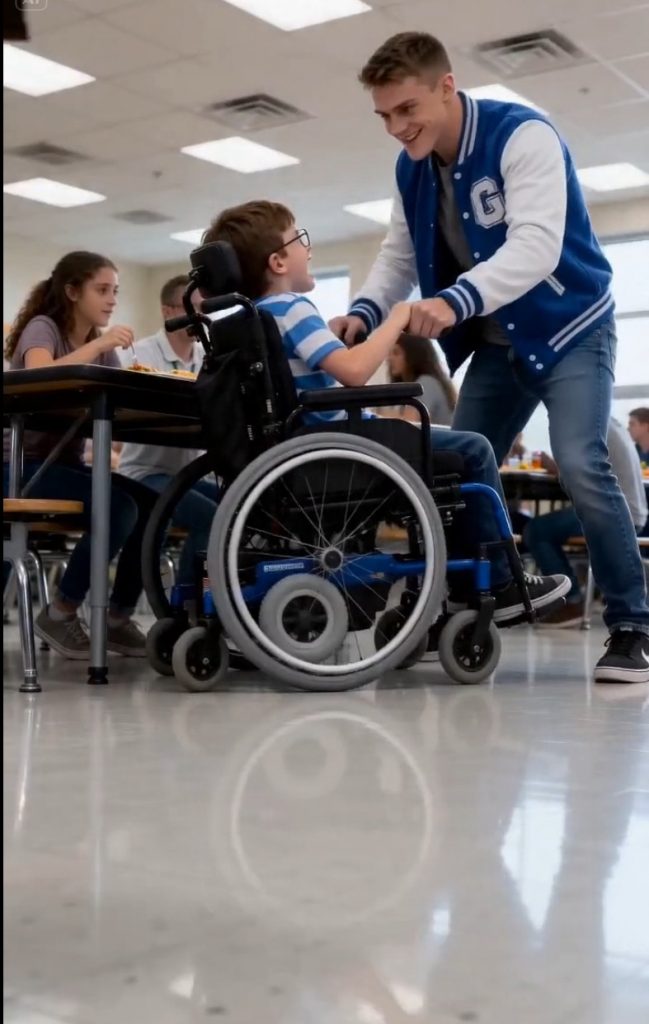
Trays clattered. Chairs scraped. Hundreds of students talked over one another beneath the white fluorescent lights. Sunlight washed through the tall windows at the far end of the room, making the polished tile floor shine like ice.
Then Jackson grabbed the handles of Timmy’s wheelchair.
Before Timmy could lock the wheels, the chair spun.
Hard.
The cafeteria blurred into streaks of faces, tables, backpacks, and ceiling lights. Timmy’s hands clamped around the armrests. His glasses flew from his face and struck the tile with a thin metallic clatter.
Students gasped.
Some laughed.
Most looked away.
Jackson Vance wore his blue-and-white varsity jacket like armor. A white letter G sat proudly on his chest, proof that he belonged to the football team, the pep rallies, the posters in the hallway, the world that moved aside for boys like him.
He leaned close to Timmy’s face, smirking.
“What’s the matter, Twitch?”
Timmy’s eyes watered. Without his glasses, everything became shapes and color. He could see Jackson’s broad shoulders above him, the shadow of him, the cruelty in his voice even if his face was blurred.
“Stop,” Timmy whispered.
Jackson laughed.
Nearby, a teacher stood with her back turned, checking her phone and glancing at her watch. Her green lanyard swung against her white polo shirt. She was close enough to hear.
She did not turn around.
Jackson noticed that too.
It made him braver.
He grabbed Timmy’s lunch tray from the table. On it was a piece of paper Timmy had folded carefully into his backpack that morning, then unfolded at lunch because he wanted to fix one more detail before mailing it.
A drawing.
A soldier standing beside a little girl in a red dress.
The soldier had one hand raised in a wave. The girl was holding a yellow balloon. Above them, in Timmy’s careful handwriting, were the words:
Come home soon, Dad.
Jackson lifted the drawing.
The smile left Timmy’s face completely.
“No,” Timmy said. “Please.”
Jackson held it over the tray of pasta.
“You really think he’s coming back for you?”
Then he dumped marinara sauce across the paper.
Red soaked into the soldier’s boots. It spread across the girl’s dress, the balloon, the words Timmy had written and rewritten until his hand cramped.
Timmy stared at it.
Something inside him went silent.
Jackson shoved the tray back toward him.
“Oops.”
Then he pushed the wheelchair.
The chair hit the edge of the table with a jarring crash. Timmy cried out, his hands flying to the sides to steady himself.
The whole cafeteria seemed to pause.
Even the students who had laughed before stopped laughing.
Because the sound Timmy made was not funny.
It was scared.
Jackson stepped forward again.
Then something heavy dropped onto the tile behind him.
Thud.
A large olive-drab duffel bag landed in the aisle.
A pair of desert-tan combat boots stepped into view.
Jackson froze.
The cafeteria chatter fell away table by table, as if someone had turned down the whole room.
Slowly, Jackson turned.
A soldier stood behind him in camouflage fatigues, tall, broad-shouldered, and still in the way storms are still before they break.
His face was worn from travel. His eyes were calm.
But there was nothing gentle in them.
He looked at Timmy.
Then at the ruined drawing.
Then at Jackson’s hands still gripping the wheelchair.
His voice came low and steady.
“Is there a problem here?”
Jackson’s smirk died so fast it looked like fear had slapped it off his face.
And Timmy, shaking in his chair, whispered one word he had not said in eleven months.
“Dad.”
The soldier had come home.
And he had walked straight into the secret everyone at school had been helping Jackson keep.
Act II
Before the wheelchair, Timmy used to run everywhere.
He ran down hallways even when teachers told him to slow down. He ran across parking lots to beat his mom to the car. He ran to the mailbox every afternoon after school because letters from his father came in tan envelopes with military stamps, and Timmy liked to pretend they had traveled through the whole world just to reach his hands.
His father, Staff Sergeant Caleb Reeves, had been deployed overseas for nearly a year.
Before he left, he made Timmy promise three things.
Take care of your mom.
Be kind to your sister.
Keep drawing.
Timmy took all three seriously.
His little sister, Lily, was five. She loved red dresses, yellow balloons, and stories where their dad came home at the end. That was why Timmy drew the same picture again and again: Dad in uniform, Lily in her favorite red dress, everybody together under a blue sky.
He mailed one drawing every month.
Then came October.
A rainy Thursday. Football practice ending late. Timmy crossing the school parking lot after robotics club because his mom’s car was stuck behind buses.
A truck came too fast around the corner.
The impact knocked Timmy into a world of sirens, white lights, and voices telling him not to move.
After that, everything changed.
Hospital bed. Surgeries. Physical therapy. Adults speaking softly when they thought he was asleep. His mother crying in the hallway. Lily refusing to enter his room until Timmy promised the machines were not hurting him.
The driver was never officially identified.
The school said the security cameras had “malfunctioned.”
The police said the rain made witness statements unreliable.
Jackson Vance said nothing.
But he stopped parking his father’s black pickup near the gym.
Timmy remembered that truck.
He remembered the white scratch across the bumper.
He remembered the varsity helmet sticker hanging from the rearview mirror.
But when he told the principal, the principal smiled with pity.
“Timmy,” he said, “trauma can confuse memory.”
After that, Jackson changed.
At first, he avoided Timmy. Then he realized no one wanted trouble with the star linebacker whose father sat on the school board and donated money for the new athletic wing.
So avoidance became whispers.
Whispers became jokes.
Jokes became hands on the wheelchair.
The first time Jackson grabbed the handles, he called it “helping.”
The second time, he laughed.
By winter, Timmy planned his entire school day around avoiding hallways Jackson used.
Teachers told him to speak up.
When he did, they told him not to exaggerate.
The cafeteria teacher, Mrs. Dale, once saw Jackson move Timmy’s chair away from the table and said only, “Boys, knock it off.”
Boys.
As if cruelty were weather.
As if Timmy’s fear were just part of growing up.
His mother fought. She called. She emailed. She sat across from administrators who nodded like dashboard dolls and promised action in voices empty of it.
Then the principal told her Timmy might be “struggling socially” because of his adjustment.
That night, Timmy heard his mother break a plate in the kitchen.
He wheeled himself into the hallway and found her standing over the sink, hands trembling.
“I’m sorry,” she said, wiping her face quickly. “I’m sorry, honey.”
Timmy did not know how to comfort her, so he held up a new drawing.
Dad. Lily. A yellow balloon.
“He’ll be home soon,” Timmy said.
His mother looked at the drawing and cried harder.
But that morning, nobody knew Caleb Reeves was already on American soil.
His deployment had ended early after an injury to another unit shifted schedules. He had not told Timmy because he wanted the return to be a surprise.
He imagined walking into the cafeteria with balloons.
He imagined his son laughing.
He imagined Lily running into his arms outside the school office.
He did not imagine finding Timmy’s wheelchair being shoved into a table while a room full of children watched.
He did not imagine the drawing covered in red sauce.
He did not imagine seeing his son look smaller than a child should ever have to feel.
And now the man who had crossed oceans to come home stood in the cafeteria aisle, staring at the boy who thought power meant nobody could stop him.
Jackson had no idea who he was facing.
But Timmy did.
For the first time all year, he was not alone.
Act III
Caleb did not touch Jackson.
He did not need to.
Some men mistake violence for strength because they have never seen real discipline standing still.
Caleb stepped around the duffel bag and walked to Timmy’s chair. He crouched, lowering himself until his eyes were level with his son’s.
“You hurt?” he asked.
Timmy tried to answer.
His mouth trembled instead.
Caleb saw the broken glasses on the tile, the red marks where Timmy’s hands had clenched the armrests, the ruined drawing dripping sauce onto the tray.
His jaw tightened once.
Then he picked up the glasses.
One lens was cracked.
He folded them carefully and placed them in Timmy’s lap like they were something sacred.
The cafeteria remained silent.
Mrs. Dale finally turned around.
Her face went pale when she saw the soldier.
“Sir,” she said, walking over too quickly. “There’s been a misunderstanding.”
Caleb looked at her.
No shouting.
No rage.
Just a look so controlled that she stopped two steps away.
“Were you supervising this room?”
Mrs. Dale swallowed.
“Yes, but—”
“Did you see him shoved?”
“I was handling another matter.”
“You were looking at your phone.”
A few students shifted uncomfortably.
One girl near the front table whispered, “She always does.”
Mrs. Dale’s face flushed.
Jackson recovered enough to speak.
“He’s being dramatic. I was just messing around.”
Caleb stood.
Slowly.
Jackson looked up at him and seemed to remember his own height was less useful than he believed.
“What’s your name?” Caleb asked.
Jackson’s throat bobbed.
“Jackson.”
“Full name.”
“Jackson Vance.”
The room reacted before Caleb did.
A small ripple.
A glance.
A lowered head.
Caleb caught it all.
“Vance,” he repeated. “As in Robert Vance?”
Jackson said nothing.
That was answer enough.
Robert Vance owned three car dealerships, sponsored the football team, sat on the school board, and had shaken Caleb’s hand once at a Veterans Day fundraiser while telling him the school “took care of its military families.”
Caleb looked down at Timmy.
“Is this the boy?”
Timmy’s fingers curled around the cracked glasses.
His eyes filled again, but this time the fear inside them was fighting something else.
Truth.
“Yes,” he whispered.
Jackson’s face hardened.
“The boy from what?”
Caleb did not look away from his son.
“The truck.”
The cafeteria seemed to inhale.
Jackson went white.
Not enough for everyone to notice.
But Caleb noticed.
So did a girl sitting two tables away with her phone still in her hand.
Her name was Maya Santos, and she had been carrying her own guilt for months.
She stood suddenly.
“I have video,” she said.
Jackson turned on her.
“Shut up.”
The soldier’s head moved.
Jackson shut up first.
Maya’s hands shook as she stepped into the aisle.
“I recorded today,” she said, voice trembling. “Not the accident. But today. And last week. And the week before.”
Timmy stared at her.
She could barely look at him.
“I’m sorry,” she whispered. “I should’ve said something sooner.”
Caleb’s expression shifted, not softening exactly, but recognizing courage arriving late and still mattering.
“Come here,” he said gently.
Maya brought the phone.
The first video showed Jackson grabbing Timmy’s chair near the vending machines.
The second showed him blocking a ramp.
The third showed Mrs. Dale looking away.
The fourth showed today.
The spinning.
The glasses.
The drawing.
The shove.
Every second.
Mrs. Dale covered her mouth.
Not because she was shocked.
Because the room could now prove what it already knew.
Then another student stood.
“I saw the truck last fall,” he said. “I told Coach it looked like Jackson’s.”
Jackson snapped, “You didn’t see anything.”
The student flinched.
Caleb turned toward him.
“Yes,” he said, voice low. “He did.”
The cafeteria doors opened.
The principal entered fast, his face stretched into the kind of smile adults use when they are trying to control a disaster before it becomes visible.
“Staff Sergeant Reeves,” he said. “Welcome home. Perhaps we should discuss this privately.”
Caleb looked at the principal’s smile.
Then at the cafeteria full of students who had learned all year that private meant buried.
“No,” Caleb said. “We’ll discuss it where my son was humiliated.”
The principal’s smile disappeared.
And the truth, trapped for months beneath fear, finally began to rise.
Act IV
The school office had never felt smaller.
Caleb sat beside Timmy, one hand resting lightly on the back of the wheelchair. Timmy’s mother, Elise, arrived ten minutes later with Lily clinging to her coat.
The moment she saw Caleb, her face broke.
Not because he was home.
Because he was home inside the nightmare she had been trying to fight alone.
He hugged her with one arm and kept the other on Timmy’s chair.
Lily stared up at him.
“Daddy?”
Caleb crouched and pulled her close.
“I’m here, bug.”
For one second, the family was whole.
Then the principal cleared his throat.
Caleb stood again.
Across from them sat Jackson, his father Robert Vance, Coach Miller, Mrs. Dale, and the school resource officer. Robert Vance wore a navy suit and the relaxed expression of a man accustomed to entering rooms where people owed him favors.
“This has clearly gotten emotional,” Robert said. “But let’s be careful before we damage a young man’s future over cafeteria nonsense.”
Elise’s face went cold.
“Nonsense?”
Robert glanced at Timmy, then away.
“No one wants what happened to your son. But blaming Jackson for everything won’t heal him.”
Timmy lowered his head.
Caleb leaned forward.
“Look at my son when you talk about him.”
Robert blinked.
The room went quiet.
Caleb placed Maya’s video on the principal’s desk. Then he placed three printed emails Elise had sent over the past five months. Then a copy of the accident report.
Then one more thing.
A photograph.
The black pickup with the white scratch across the bumper.
It had been taken by Timmy two weeks before the accident, when the robotics club was documenting unsafe parking near the gym entrance for a project.
Jackson’s truck.
Timestamped.
The school resource officer stared at it.
Caleb turned to him.
“Did you ever see this?”
The officer looked uncomfortable.
“No.”
Elise’s eyes widened.
“I sent it to the school.”
The principal shifted.
“It may not have reached the proper channel.”
Caleb’s voice stayed calm.
“Then let’s find out where it stopped.”
Robert stood.
“This is absurd.”
The door opened before he could say more.
A woman in a dark blazer entered with two district officials behind her. Superintendent Anne Keller had been called by someone in the cafeteria, though nobody later admitted who.
She looked at the room.
Then at Timmy.
Then at the evidence spread across the desk.
“I want everyone to remain seated,” she said.
Robert Vance laughed once.
“Anne, we can handle this without theater.”
“No,” she said. “We handled it your way for months.”
That sentence changed everything.
The principal stared at her.
Mrs. Dale began to cry silently.
Superintendent Keller opened a folder.
“Mrs. Reeves filed seven complaints. Two were marked resolved without parent confirmation. One included a photograph that does not appear in the official student safety file. One teacher submitted a witness statement after the parking lot incident, then withdrew it after speaking with Coach Miller.”
Coach Miller went red.
Caleb turned slowly toward him.
The coach looked down.
Robert Vance’s confidence thinned.
“My son made mistakes,” he said carefully. “But this is a school matter.”
The resource officer stood.
“No, sir,” he said. “If there’s evidence connected to a hit-and-run, it isn’t.”
Jackson’s chair scraped backward.
“I didn’t mean to hit him,” he blurted.
Robert turned.
“Jackson.”
But it was too late.
Everyone heard it.
Timmy’s face drained of color.
Elise covered her mouth.
Caleb closed his eyes for one second, as if holding back every terrible thing a father might feel.
When he opened them, he looked at Jackson.
“Say it again.”
Jackson shook his head.
Robert reached for his son’s shoulder.
The resource officer stepped between them.
“Don’t coach him.”
Jackson started breathing too fast.
“It was raining,” he said, voice breaking. “I was late. He came out from behind the bus. I panicked. Dad said—”
“Stop,” Robert snapped.
Superintendent Keller’s voice cut through the room.
“Let him speak.”
Jackson looked smaller now. Not innocent. Just finally stripped of the crowd that made cruelty feel safe.
“Dad said nobody could prove it,” he whispered. “He said if I admitted it, I’d lose my scholarship.”
Timmy stared at him.
All those months of being mocked by the person who had changed his life.
All those adults calling it adjustment.
All those closed doors.
The room seemed to sway.
Caleb knelt beside Timmy again.
“You okay?”
Timmy’s voice was barely audible.
“No.”
Caleb nodded.
Honest was better than brave.
“Then we’ll not be okay together for a while.”
Lily climbed into Elise’s lap, holding the ruined drawing Maya had rescued from the tray. The paper had dried wrinkled and red-stained, but the soldier’s face was still visible.
She looked at Jackson and said, with the pure confusion of a child who still believed adults stopped bad things, “Why were you mean to my brother?”
Nobody answered.
Because the real answer was too ugly for a child.
Because he could.
And because too many people let him.
Act V
Jackson Vance did not return to school the next day.
Neither did Mrs. Dale.
Coach Miller was placed on leave. The principal resigned before the end of the month. Robert Vance lost his seat on the school board after the police reopened the accident investigation and the community learned how many complaints had been buried under polite language and donor pressure.
None of that fixed Timmy’s chair.
None of it erased the months he spent planning routes through his own school like a soldier crossing hostile ground.
But something changed.
The cafeteria changed first.
Not the tables or the tile or the harsh overhead lights. The students changed it.
Maya stood up in homeroom and apologized to Timmy in front of everyone. Her voice shook, but she did not sit down until she had said the whole truth.
“I was scared of Jackson,” she said. “But Timmy was scared too, and he was the one getting hurt. I should’ve helped sooner.”
After that, others came forward.
Quietly at first.
A boy who had laughed because he wanted Jackson to like him.
A girl who had turned away because she did not know what to do.
A freshman who had seen Timmy stuck near the ramp and thought a teacher would handle it.
Timmy did not forgive everyone.
At least not right away.
His father told him he did not have to.
“Forgiveness is yours,” Caleb said one night while fixing the brake on Timmy’s chair. “Nobody gets to demand it because they feel guilty.”
Timmy liked that.
It made forgiveness feel less like homework.
Caleb stayed home for six weeks before his next assignment. Long enough to attend meetings. Long enough to take Timmy to therapy. Long enough to build a ramp in the garage and teach Lily how to salute badly enough that everyone laughed.
He also came to school.
Not every day.
Just enough.
The first time he walked Timmy into the cafeteria after the incident, the room went quiet again. Timmy hated that. He hated being watched. He hated that everyone knew.
Then Lily, who had insisted on coming for the family lunch day, marched ahead in her red dress and placed a yellow balloon on Timmy’s tray.
“For the new drawing,” she said.
Timmy looked at her.
Then at his dad.
Caleb smiled.
“Only if you want to.”
Timmy took out a pencil.
His hand trembled at first.
Then steadied.
This time, he drew the cafeteria.
The tables. The windows. The shiny floor. His wheelchair. Lily’s balloon. His mother standing behind him. His father in uniform beside the aisle.
But he added something else.
Students.
Not laughing.
Not looking away.
Standing.
It was not exactly how it had happened.
It was how he needed the next time to be.
The picture was later framed in the main office, not as decoration, but as a promise. Superintendent Keller ordered new policies, real reporting systems, independent complaint review, and staff training that did not begin and end with posters about kindness.
Caleb was asked to speak at the school assembly.
He almost refused.
Then Timmy asked him to do it.
So he stood on the gym floor in uniform while hundreds of students sat on bleachers, quieter than they had ever been during a pep rally.
“My son was not hurt because one boy was cruel,” Caleb said. “He was hurt because cruelty had an audience. Some laughed. Some looked away. Some adults made it easier to stay silent than to tell the truth.”
No one moved.
Caleb looked across the students’ faces.
“You do not have to be the biggest person in the room to protect someone. You do not have to be fearless. You only have to decide that fear is not a good enough reason to abandon another human being.”
Timmy sat in the front row with his mother and Lily.
Maya sat two seats away, hands folded tightly.
When Caleb finished, nobody cheered at first.
Then Timmy clapped.
One quiet clap.
Then another.
Soon the whole gym joined.
But this time, the noise did not feel like a performance.
It felt like something breaking open.
Months later, Timmy still had hard days.
He still flinched sometimes when someone walked behind his chair too quickly. He still hated the sound of trays dropping. He still kept his drawings in a hard folder so no one could spill anything on them again.
But he also joined robotics club again.
He rolled into the cafeteria without checking every corner first.
He got new glasses with blue frames Lily picked because she said they made him look like a scientist.
And on the last day before spring break, he found a note taped to his locker.
No name.
Just one sentence.
I’m sorry I looked away.
Timmy read it twice.
Then he folded it and placed it in his backpack.
Not because it fixed everything.
Because it meant someone had finally seen the real problem.
That afternoon, Caleb met him outside school. He was out of uniform, wearing jeans and a plain gray jacket, but Timmy still thought he looked like the strongest person in the world.
“How was lunch?” Caleb asked.
Timmy adjusted the folder in his lap.
“Normal.”
Caleb’s eyes softened.
“Normal sounds good.”
“It was.”
Lily ran ahead of them with her yellow balloon bouncing in the wind. Their mother waited near the car, smiling in that tired, relieved way people smile when they have survived something but still need time to believe it is over.
Timmy looked back once at the school.
The windows reflected the afternoon sun.
For a long time, that building had felt like a place where his voice disappeared.
Now it looked smaller.
Not harmless.
But smaller.
His father placed a hand gently on his shoulder.
“Ready to go home?”
Timmy nodded.
Then he looked down at the new drawing in his folder.
A soldier.
A boy in a wheelchair.
A little girl in a red dress.
And behind them, not a perfect world, but an open door.
“Yes,” Timmy said.
This time, when he moved forward, nobody pushed him.