Act I
The first tear sounded too loud in the cabin.
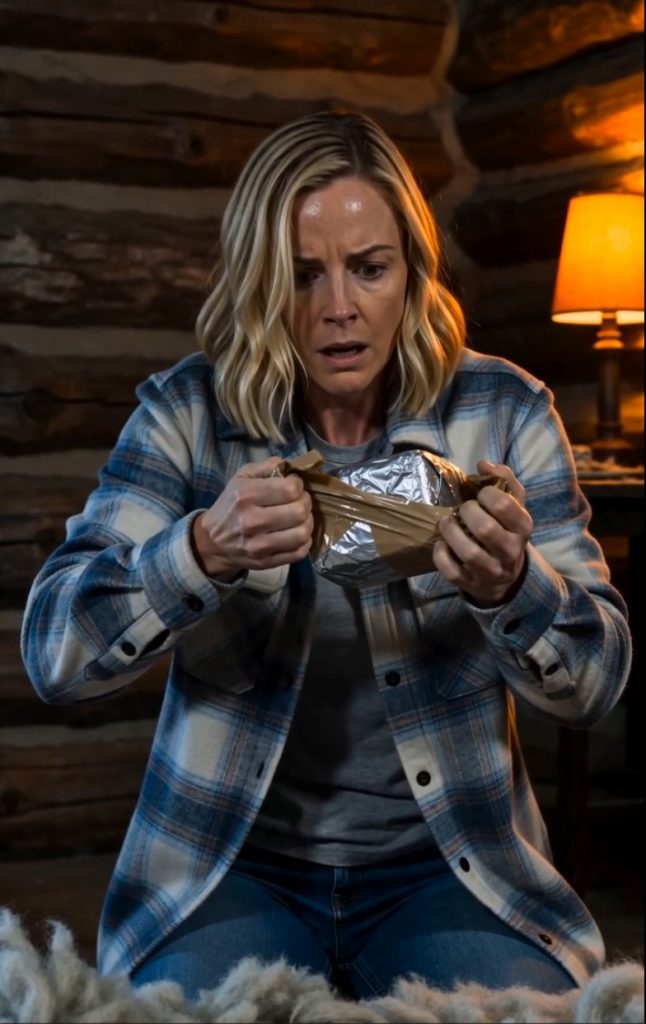
Claire Whitman froze for half a second, both hands buried in the rotting fabric of the old mattress, listening to the sound fade into the log walls. The room was dim except for the amber glow of a vintage lamp on the side table. Its shade was crooked. Its light stretched long shadows across the wooden floorboards, making every crack look like it was hiding something.
Then she ripped again.
Dust burst into the air.
Grey fibers clung to her flannel sleeves. Yellowed stuffing spilled across her jeans. The mattress had been in the attic room for as long as Claire could remember, sagging against the wall of her father’s hunting cabin like a dead animal no one wanted to touch.
She had come here to clean.
That was the lie she told herself.
Her father had been dead for twelve days. The lawyers wanted signatures. Her husband wanted the property sold. Her older brother wanted “closure,” which was the word people used when they wanted grief to become convenient.
But Claire had not driven four hours into the mountains for closure.
She came because of the voicemail.
Her father had left it the night before his truck went off the road.
Claire, if they say I was drinking, don’t believe them. If they say I was confused, don’t believe them either. Go to the cabin. The old mattress. Middle seam. Don’t trust anyone until you see what I hid.
Then the line cut out.
For twelve days, she had replayed it in secret until the words lost shape and became a pulse under her skin.
Now she was kneeling in the cabin attic, tearing open the mattress with bare hands.
Her fingers struck something hard.
Claire stopped breathing.
She reached deeper into the torn cavity, past the dense padding, and gripped a heavy brick-shaped object wrapped in crinkled silver plastic and thick brown tape. It took both hands to pull it free.
The weight shocked her.
Not soft. Not random. Deliberate.
She held it against her chest, staring at the package as dust floated through the lamplight.
“Oh my God,” she whispered.
Then she looked back into the mattress.
There were more.
Four. Five. Maybe six.
Neatly packed inside the stuffing, identical silver bricks hidden where no one would ever think to look unless a dead man told them exactly where to tear.
Claire’s hands began to shake.
She clawed at the tape on the first package, peeling back one stubborn layer after another. The plastic snapped and crackled beneath her fingers. Her breath came too fast. Every sound in the cabin suddenly felt enormous.
The old refrigerator downstairs.
The wind pressing against the roof.
The creak of the porch.
Claire froze.
The tape hung half-peeled from the package.
Another creak came from below.
Not wind.
Weight.
Someone was on the porch.
And whoever it was had not knocked.
Act II
Claire had not spoken to her father for almost eight years before his death.
That was the first thing people mentioned when they offered condolences.
Not directly. Never directly.
They said things like, “At least you made peace in your heart,” or “Families are complicated,” or “He always loved you in his way.”
In his way.
Claire hated that phrase.
Her father, Raymond Whitman, had been a hard man to love and an even harder man to understand. He could fix any engine, sharpen any knife, track a deer through rain, and sit through an entire dinner without saying more than six words. He smelled of cedar smoke, black coffee, and motor oil.
When Claire was little, she worshiped him.
He taught her how to cast a fishing line and identify constellations. He carried her on his shoulders through this very cabin when the snow trapped them for three days. He called her “little hawk” because she noticed everything.
Then her mother died.
Raymond changed after that.
He drank too much for a while, then not at all. He stopped attending church. Stopped visiting neighbors. Stopped opening mail unless it looked official. When Claire asked him what happened the night her mother’s car went into the river, he always gave the same answer.
“Bad road. Worse weather.”
But his eyes never matched the words.
At nineteen, Claire left for college and did not come back for summers. At twenty-six, she married Grant Bellamy, a polished attorney who spoke gently in rooms where Raymond looked trapped. Grant called her father unstable. Bitter. A man who chose loneliness and blamed others for it.
Claire believed him because it was easier than believing her father’s silence had a reason.
Three years ago, Raymond appeared at her office without warning.
He looked older than he should have. His beard had gone almost white. His hands were cracked from cold.
He asked to speak with her alone.
Grant insisted on staying.
Raymond looked at him for a long moment and said, “That’s exactly the problem.”
Claire was humiliated. Furious. She told her father he could not keep showing up like a ghost and insulting the life she had built.
Raymond left without defending himself.
That was the last time she saw him alive.
Until the funeral.
At the funeral, Grant stood beside her with a hand at the small of her back. He accepted sympathy as though he were the grieving son. Claire’s brother, Michael, cried loudly near the casket and said their father had “finally found peace.”
Claire did not cry.
She kept hearing the voicemail.
Go to the cabin. The old mattress. Middle seam.
She told Grant she needed a weekend alone to pack up a few things before the sale.
He hated the idea.
“That place is dangerous,” he said. “Your father was paranoid. Don’t let his madness become yours.”
Madness.
That word followed her up the mountain road.
Now, in the attic room, with silver-wrapped bricks hidden inside a mattress and footsteps moving below, Claire understood something with terrible clarity.
Her father had not been mad.
He had been afraid.
The footsteps stopped beneath the attic stairs.
Claire looked around wildly.
No weapon. No phone signal. No easy way out except the narrow staircase and the back window overlooking a drop into pine trees and rock.
The half-open package rested in her lap.
She peeled one final strip of tape.
Inside was not cash.
Not drugs.
Not gold.
It was a stack of photographs sealed in plastic.
On top was a picture of her mother standing beside Grant Bellamy.
Twelve years before Claire ever met him.
And on the back, in her father’s handwriting, were four words.
He knew her first.
Act III
Claire’s mouth went dry.
For a moment, she forgot the footsteps.
The photograph filled the whole world.
Her mother, Elaine Whitman, stood outside a courthouse in a navy coat, one hand gripping a folder. Beside her was a younger Grant Bellamy, clean-shaven, smiling in that smooth, patient way Claire had once mistaken for kindness.
Her mother had never mentioned him.
Grant had never mentioned her.
Claire turned the photograph over again, as if the words might rearrange themselves into something less impossible.
He knew her first.
A floorboard groaned downstairs.
Claire shoved the photo back into the torn package and moved silently toward the attic door. The lamp threw her shadow against the wall, huge and trembling.
“Claire?”
Her blood turned cold.
Grant.
His voice came from the foot of the stairs.
“Claire, sweetheart, are you up there?”
Sweetheart.
He used the word the way people used gloves to touch dirty things.
Claire looked at the torn mattress, the exposed packages, the fibers scattered across the floor. There was no hiding what she had found. Not quickly.
She grabbed one silver-wrapped brick and slid it under her flannel shirt against her back, tucking it into the waistband of her jeans. Then she pulled the torn fabric of the mattress over the hole as best she could and stood.
Grant appeared at the top of the stairs.
He wore a black wool coat, city shoes, and an expression of wounded concern. Behind him stood Michael, her brother, red-faced from the cold, avoiding her eyes.
Claire stared at them.
“What are you doing here?”
Grant smiled gently.
“You weren’t answering your phone.”
“There’s no signal.”
“That’s why I was worried.”
Michael shifted behind him.
“Claire, just come downstairs.”
She looked at her brother.
“You knew he was coming?”
Michael swallowed.
Grant stepped into the attic room.
His eyes moved once.
To the mattress.
To the fibers.
To her dusty hands.
The gentle smile did not move, but something behind it hardened.
“What did you find?” he asked.
Claire forced herself to breathe.
“Old stuffing. Mold. Probably mice.”
Grant looked at the torn mattress for a long time.
Then he laughed softly.
“Your father always did make trash feel dramatic.”
Claire’s hand curled into a fist.
“Don’t.”
Grant turned to her.
There was still no anger on his face. That was what made him frightening. His cruelty never needed volume.
“Claire, your father was sick. We all knew it. He left messages. Accusations. Strange instructions. This is exactly why I didn’t want you alone here.”
Michael whispered, “He’s right.”
Claire turned on him.
“You heard the voicemail?”
Michael looked miserable.
Grant sighed.
“I asked him to help because I knew you might become emotional.”
Emotional.
Mad.
Confused.
The words were different rooms in the same prison.
Claire took one step back.
Grant noticed.
His gaze dropped to her posture, to the stiffness in her spine, to the way she kept one arm close to her side.
“What are you hiding?” he asked.
The cabin seemed to shrink.
Michael looked between them, suddenly unsure.
“Grant,” he said, “maybe we should just—”
“Stay out of this,” Grant said.
The mask slipped just enough.
Michael flinched.
Claire saw it.
And in that small flinch, she understood her brother had not simply come along. He had been pressured. Maybe threatened. Maybe bought. But not innocent.
Grant stepped closer.
“Give me whatever you took.”
Claire held his eyes.
“You knew my mother.”
The silence after that was deep enough to hear the lamp buzz.
Grant’s face changed.
Not much.
Enough.
Michael whispered, “What?”
Claire reached behind her back and pulled out the package.
Grant’s eyes fixed on it.
For the first time since she had known him, fear entered his face.
Then from inside the torn mattress, one of the remaining silver packages shifted and slid onto the floor.
The plastic split at the corner.
A small black recording device fell out.
Its red light was blinking.
Act IV
Nobody moved.
The little recorder lay among the mattress fibers, blinking like an eye that had been open the entire time.
Claire stared at it.
Grant stared harder.
Michael said, “What is that?”
Grant recovered first.
“It’s nothing.”
Claire bent toward it.
Grant lunged.
She moved faster.
Her fingers closed around the recorder just as Grant grabbed her wrist. His grip was hard enough to hurt, but she did not let go.
“Claire,” he said through his teeth, “give it to me.”
Michael stepped forward.
“Let her go.”
Grant turned his head slowly.
“Michael, unless you want your debts discussed in court, I suggest you remember why you’re here.”
Michael went white.
So that was it.
Claire’s heart twisted, but she had no time for the pain.
She drove her knee into Grant’s thigh and tore free. He stumbled backward into the side table. The lamp rocked wildly, throwing the room into a frenzy of shadows.
Claire pressed play.
Her father’s voice filled the attic.
“If this is playing, then I’m either dead or close enough that it doesn’t matter.”
Grant went still.
Claire’s breath caught.
Raymond’s voice was rough, tired, but clear.
“Claire, I’m sorry. I should have told you everything years ago. I thought silence would keep you safe. It didn’t. It only left you alone with him.”
Grant moved toward her again.
Michael blocked him.
“Don’t,” Michael said, voice shaking.
The recording continued.
“Your mother did not die because of weather. She was working with a federal investigator on a money-laundering case tied to Bellamy & Vale. Grant was a junior attorney then. He helped move documents, names, accounts. Elaine found out.”
Claire’s knees weakened.
Grant’s face had gone blank.
Not innocent blank.
Empty.
The way a locked door is empty.
Raymond’s voice cracked slightly.
“She was going to testify. The night she died, she called me from the road and said someone was following her. The police called it an accident before the sun came up.”
Claire covered her mouth.
The room blurred.
Her mother, not lost to rain. Not taken by chance.
Silenced.
“I spent years collecting proof,” Raymond said. “Photos. account records. copies of deposition notes. Names. Dates. I hid them in the mattress because no one in that family would touch anything they thought was beneath them.”
Michael looked at Grant in horror.
Grant whispered, “You have no idea what he was.”
Claire looked at him.
“What my father was?”
“A drunk. A liar.”
“He stopped drinking after Mom died.”
Grant’s mouth shut.
The recording went on.
“Grant came back into your life on purpose. I tried to warn you, but he had already made me look unstable. If he can control my daughter, he controls the one person who could reopen Elaine’s case.”
Claire’s eyes filled with tears.
She had invited the danger into her home.
She had married it.
Grant’s voice became soft again, which frightened her more than shouting.
“Claire, listen to me. Your father built a fantasy because he couldn’t accept losing your mother. You know me.”
She laughed once.
It sounded broken.
“No,” she said. “I know the man you performed.”
Grant’s eyes hardened.
Outside, tires crunched over gravel.
Headlights swept across the attic wall.
For one wild second, Claire thought help had arrived.
Then Grant smiled.
“Good,” he said quietly. “That should be my driver.”
Michael turned toward the window.
A dark SUV stopped below the cabin.
Two men stepped out.
Claire looked at the recorder in her hand, the packages in the mattress, her brother trembling beside her, and the man she had once trusted standing between her and the stairs.
Her father had left her the truth.
But he had also left her trapped with it.
Act V
The first knock shook the cabin door.
Grant did not blink.
“Claire,” he said, “this can end quietly.”
She held the recorder against her chest.
“You sound like you’ve said that before.”
His face tightened.
Below, the door opened.
Not kicked. Opened.
Someone had a key.
Michael whispered, “I didn’t know.”
Claire believed him and hated that believing him did not undo anything.
Heavy footsteps moved across the first floor.
Grant extended his hand.
“The packages. The recorder. Everything. We’ll say grief overwhelmed you. You came here, tore up the room, imagined things. I’ll get you help.”
There it was.
The final kindness of men who build cages.
Help.
Claire looked at the torn mattress.
The remaining packages sat half-hidden in the stuffing, waiting like buried witnesses.
Then she remembered something from childhood.
The attic window stuck in summer but opened in winter because the wood shrank in the cold.
Raymond had taught her that during a snowstorm.
Little hawk, always know your exits.
Claire backed toward the window.
Grant saw it and lunged.
Michael hit him from the side.
They crashed into the mattress together, sending silver packages across the floor. Grant cursed. Michael shouted. Downstairs, the men began running toward the stairs.
Claire shoved the window upward.
It stuck.
“Come on,” she whispered.
The wood groaned.
Grant threw Michael off and rose.
Claire slammed both palms against the frame.
The window shot open.
Cold mountain air rushed into the room.
She grabbed two packages and the recorder, then climbed through onto the narrow roof ledge outside. Her boots slipped on damp shingles. For one terrifying second, the valley tilted beneath her.
Grant reached the window behind her.
“Claire!”
She did not look back.
She dropped.
The fall knocked the breath from her, but the snowbank below softened the landing enough for pain instead of ruin. She rolled, clutched the packages to her chest, and crawled behind the stacked firewood.
The two men burst from the cabin seconds later.
Grant shouted orders.
Claire stayed low, barely breathing, while headlights cut across the yard.
Then another sound rose from the road.
Sirens.
Not distant.
Close.
Grant froze.
Claire lifted her head.
Red and blue lights flashed through the trees, bouncing against the cabin walls. Three county cruisers tore into the clearing, followed by a black sedan she did not recognize.
The men from the SUV ran.
They did not get far.
Deputies moved fast, surrounding the cabin with weapons lowered but ready. Grant stood on the porch with both hands slightly raised, already trying to become a respectable attorney again.
A woman in a dark coat stepped from the sedan.
She was in her sixties, with silver hair cut neatly at her jaw and a federal badge hanging from her hand.
Claire stood slowly from behind the firewood.
The woman saw her and walked straight across the snow.
“Claire Whitman?”
Claire nodded.
“I’m Agent Mara Ellison. Your father sent me copies of the first package before he died. We’ve been trying to reach you.”
Claire stared at her.
“My father trusted you?”
Agent Ellison’s face softened.
“Your mother did too.”
That was when Claire finally cried.
Not loudly. Not fully. Just enough for the cold air to catch the sound and carry it away from the cabin that had held too many secrets for too long.
Grant was arrested before dawn.
He said nothing when deputies placed him in the back of the cruiser. Not to Claire. Not to Michael. Not even when Agent Ellison lifted one of the silver packages from the snow and told him the chain of custody would be very clean.
Michael sat on the porch steps, shaking, his face in his hands.
Claire stood a few feet away.
“I owed money,” he said. “Grant said he’d help. Then he said Dad was unstable. Then he said you were becoming unstable too. I swear I didn’t know about Mom.”
Claire looked at him for a long time.
Forgiveness did not come.
Neither did hatred.
Only exhaustion.
“You can tell the truth now,” she said.
Michael nodded, crying.
“I will.”
The packages from the mattress changed everything.
Inside were bank records, photographs, sworn statements, copied court filings, insurance documents, old phone logs, and one final letter sealed in a plastic sleeve with Claire’s name written across the front.
She opened it three days later in a federal office, under fluorescent lights, with Agent Ellison sitting quietly across the table.
Little hawk,
I failed you by staying silent. I thought if I kept digging alone, I could hand you the truth without making you carry the danger. But danger does not disappear because a father loves his daughter.
Your mother was brave. Braver than me. She believed the truth deserved daylight even when powerful men paid good money for darkness.
If you are reading this, then I am asking you to do what I should have done sooner.
Open the window. Let the light in.
Dad
Claire pressed the letter flat beneath her hands and wept for the years she had misunderstood him.
The investigation spread quickly once it began. Bellamy & Vale collapsed under subpoenas, seized files, and frightened former partners suddenly eager to cooperate. Grant’s careful life unraveled in public: the polished attorney, the loyal husband, the man who had entered Claire’s grief like a rescuer and stayed like a lock.
Elaine Whitman’s case was reopened.
Raymond’s death was no longer treated as an accident.
The cabin became evidence for months.
When Claire finally returned, spring had softened the mountain. Snowmelt ran in silver lines beside the road. Pine needles shone wet in the sun. The attic smelled of dust and old wood, but not fear.
The mattress was gone.
In its place, Claire set a wooden trunk.
Inside she placed copies of her mother’s photograph, her father’s letter, and the old recorder that had carried his voice back from the dead.
She did not sell the cabin.
Grant had wanted it gone. That alone would have been reason enough to keep it.
But there was more.
This place had not been her father’s madness. It had been his fortress. His archive. His apology. His last attempt to protect the daughter who had stopped believing him because the lies around her had been dressed better than the truth.
Months later, Claire stood in court while Grant avoided her eyes.
He looked smaller without the performance of concern. Smaller without tailored certainty. Smaller without her doubt to hide inside.
When asked if she wished to make a statement, Claire stood.
Her hands shook, but her voice did not.
“For years,” she said, “I thought my father’s silence meant he had abandoned me. Now I know silence can be forced on people in many ways. Through fear. Through shame. Through being called unstable until even the people who love you stop listening.”
She looked at Grant then.
“You taught me to doubt my own memories. My father left me proof. My mother left me courage. I intend to use both.”
The courtroom was quiet.
Afterward, Agent Ellison met her in the hallway.
“Your mother would be proud,” she said.
Claire looked down at the envelope in her hands.
“And my father?”
The older woman smiled sadly.
“He already was.”
That evening, Claire drove back to the cabin alone.
She lit the vintage lamp in the attic room and sat on the wooden floor where the torn mattress had once been. For a long time, she listened to the wind move through the trees.
No footsteps.
No engines.
No voices telling her what was real.
Only the cabin settling around her, old logs holding old secrets that no longer had to stay hidden.
Claire took one silver scrap of plastic wrapping from her pocket, a leftover piece from the evidence team’s collection. She turned it between her fingers, remembering the moment she first pulled the package from the mattress and felt the whole world tilt.
She had thought she was uncovering danger.
She was.
But she was also uncovering love.
Not soft love. Not easy love. Not the kind that arrives with perfect words and clean hands.
The kind that hides proof in a rotten mattress because it has run out of safe places.
The kind that leaves a voicemail with death close behind.
The kind that waits years in dust and darkness for one daughter to tear open the past and finally see what had been buried for her.
Claire switched off the lamp.
For the first time, the cabin went dark without feeling like a threat.
The truth was out now.
And darkness, once opened, was never quite as powerful again.