Act I
Elias Whitmore saw the babies before he understood the danger.
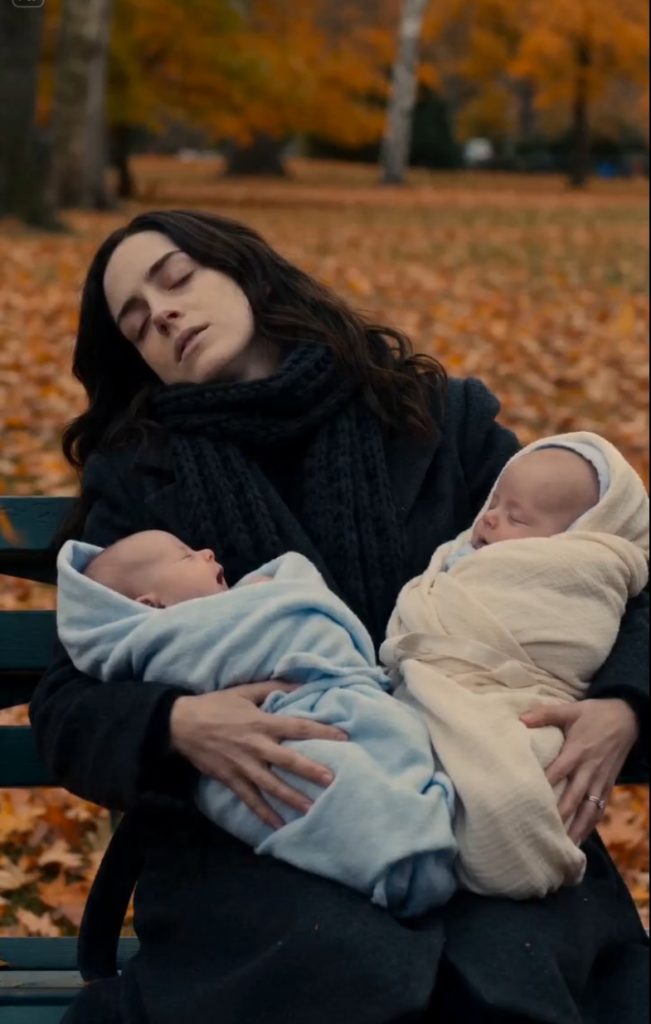
They were bundled tightly in Margaret’s arms, one in a pale blue blanket, the other in cream, both so still beneath the amber autumn light that the whole park seemed to stop breathing around them.
Margaret sat slumped on a green wooden bench beneath a canopy of maple trees. Fallen leaves covered the ground in thick orange and gold layers, softening every sound. Her head was tilted back. Her dark hair spilled over the collar of her black coat. Her face looked almost translucent, drained of every bit of warmth the day had left.
Beside Elias, his mother Martha gasped.
“Oh… my God.”
Her gloved hand flew to her mouth. The pearls at her ears trembled as she stared at the young woman on the bench.
Elias could not move.
For three days, the whole city had been looking for Margaret.
For three days, the police had called her unstable. The newspapers had called her a fugitive. His family’s attorneys had called her dangerous.
But none of them had seen her like this.
Half-conscious.
Frozen.
Holding the twins like the last living things in the world.
Across the narrow park road, nearly hidden beneath a heavy blanket of fallen leaves, a dark blue sedan sat by the curb. Its roof, hood, and trunk were buried so completely that it looked abandoned by time itself.
Elias recognized the car.
It belonged to Margaret.
His pulse sharpened.
She had not just arrived.
She had been here for hours.
Maybe all night.
“MARGARET!”
His shout tore through the park.
The baby in the blue blanket stirred first, squirming weakly beneath the fabric. The other infant shifted a moment later, making a tiny, breathless sound that sent relief and terror through Elias at the same time.
Margaret’s eyes snapped open.
For one second, she looked at the trees as if she did not know where she was.
Then she saw Elias.
Fear broke across her face.
She clutched the infants tighter against her chest and tried to push herself upright, but her body failed her. She trembled violently, lips pale, eyes wide with exhaustion and panic.
Elias reached the bench in long strides.
“What are you doing here?!” he demanded.
The question came out harsher than he meant it to. Fear had turned his voice into a weapon.
Margaret flinched.
Martha hurried behind him, her elegant camel coat brushing through the leaves.
“Elias,” she whispered. “The babies.”
He looked down.
The twins were alive.
Cold, but alive.
Margaret’s arms tightened around them.
“Don’t take them back,” she rasped.
Elias froze.
“What?”
Her eyes filled with tears.
“Please,” she said. “If you take them back to that house, they won’t survive the night.”
The park fell silent except for leaves skittering across the path.
Elias stared at her, anger collapsing into something far colder.
Because the babies she held were his brother’s children.
And the house she was talking about was his own.
Margaret looked past him toward the leaf-covered sedan.
“There’s proof in the car,” she whispered. “Before they find it.”
That was when Elias understood.
She had not been running from his family.
She had been running from someone inside it.
Act II
Margaret Bell had entered the Whitmore house six months earlier through the servants’ entrance.
That was how she described it later, though the Whitmores insisted they did not have servants. They had staff. Assistants. Household managers. Care specialists. Words polished smooth enough to hide the old truth.
People with money still preferred those who served them to come in quietly.
Margaret came with two suitcases, three references, and a college degree she had never finished because her mother’s medical bills had swallowed the tuition. She was hired first as a night nurse for the twins, then gradually became the only person in the mansion who seemed to know when they needed feeding, changing, warmth, quiet, or simply a hand resting against their backs.
The twins had been born early.
Noah and Lily Whitmore.
Their mother, Caroline, had died from complications soon after delivery, leaving Elias’s younger brother Adrian broken in a way no one in that house knew how to handle. Adrian walked through rooms like a ghost in a tailored shirt. He looked at his children with love, then guilt, then fled to his office because their faces reminded him of what he had lost.
So Margaret stayed.
Night after night, she sat in the nursery under the soft glow of a rabbit-shaped lamp, rocking one baby while the other slept. Sometimes Martha came in, still graceful in her silk robe, eyes red from crying. Sometimes Elias stopped by after late meetings, pretending he was only checking the security system.
He noticed Margaret then.
Not romantically.
Humanly.
He noticed the way she hummed to Lily when the baby cried. The way she kept a notebook tracking every feeding. The way she stood between the twins and any guest who tried to touch them without washing their hands.
The staff liked her.
Martha trusted her.
The babies settled for her when they settled for no one else.
That was exactly why Vivian Whitmore hated her.
Vivian was Adrian’s aunt by marriage, though she preferred “family advisor.” She had moved into the mansion after Caroline died, claiming Adrian needed help managing the estate while he grieved.
Within weeks, she controlled the calendar, the household accounts, the visitors, and nearly every conversation around the twins.
She smiled constantly.
Margaret feared her from the beginning.
Not because Vivian was cruel openly. Cruel people with power rarely are. Vivian was worse. She was kind in front of witnesses and sharp when doors closed.
“You’re very attached to them,” she told Margaret one night in the nursery.
“They’re babies,” Margaret replied. “They need attachment.”
Vivian’s smile did not move.
“They need structure. Not sentiment.”
After that, small things changed.
Margaret’s notes disappeared.
A bottle she had prepared was replaced.
The twins’ pediatric appointments were rescheduled without telling her.
Then Noah became sick.
Not dramatically. Just enough. Fussing. Sweating. Refusing milk. Sleeping too long.
Margaret raised the alarm.
Vivian said she was overreacting.
The private doctor said premature babies had difficult days.
Adrian, hollow-eyed and medicated for grief, signed whatever forms Vivian placed in front of him.
Elias was traveling in London when Margaret called him.
He missed it.
Then she called Martha.
Martha answered but heard only static and a muffled voice before the line cut.
That same night, a diamond bracelet disappeared from Martha’s dressing room.
The next morning, Vivian found it in Margaret’s suitcase.
By noon, Margaret Bell was accused of theft.
By evening, she was accused of kidnapping when the twins vanished with her.
The story spread quickly because Vivian knew exactly how to feed it.
Poor young employee becomes obsessed with wealthy children.
Trusted caregiver becomes unstable.
Grieving family betrayed.
Elias believed none of it completely, but fear had a way of demanding immediate targets. The babies were gone. Margaret was gone. The bracelet was in her suitcase. His brother was near collapse.
So he searched for her with police, attorneys, and private security.
Not knowing that Margaret, already dizzy from panic and exhaustion, had driven through the night with two infants in the back seat because she had found something far worse than stolen jewelry.
A locked medical file.
A forged trust amendment.
And a recording of Vivian saying the twins only needed to be gone long enough for the inheritance to shift.
Act III
The sedan door was frozen shut by damp leaves.
Elias yanked once, then again, until the rubber seal gave way with a wet crack. A wave of stale, cold air escaped from the car.
Inside, everything smelled like fear and baby formula.
A diaper bag lay open on the passenger seat. Empty bottles rolled near the floor. The back seat was layered with blankets, towels, and emergency heat packs long gone cold. Margaret had not slept in a hotel. She had not gone to a friend. She had hidden in plain sight, under trees, while the city walked past.
Martha stood beside the bench, holding Lily now, rocking her with trembling arms.
Elias found the folder beneath the driver’s seat.
It was wrapped in a plastic grocery bag.
His name was written across the front in Margaret’s handwriting.
ELIAS ONLY.
He opened it with numb fingers.
The first page was a copy of the twins’ medical chart.
The second was a lab report.
The third was a revised trust document naming Vivian Whitmore as temporary executor if Adrian was deemed unfit and if the children were “medically incapacitated or deceased.”
Elias’s stomach turned.
The final item was a phone.
Margaret’s phone.
The screen was cracked, but it still had power.
There was one video saved at the top.
Elias pressed play.
The footage was dark, shot from somewhere low, maybe inside a half-open cabinet in the nursery. Vivian’s voice came through clearly.
“You are confusing morality with outcome,” she said.
A man answered.
The private doctor.
“They’re infants.”
“They are legal obstacles.”
Elias stopped breathing.
Vivian continued, calm as polished glass.
“Adrian will sign whatever I put in front of him once the doctors say he’s unfit. Elias is too busy trying to save the company. Martha is sentimental but useless. The girl is the only problem.”
“The nanny?”
“She watches too closely.”
The doctor lowered his voice.
“And if she talks?”
Vivian laughed softly.
“Poor girls steal. Poor girls break. Poor girls run. No one believes them when enough diamonds fall into their luggage.”
The video ended.
Elias stood beside the leaf-buried car, unable to move.
Across the path, Margaret watched him from the bench with hollow, terrified eyes.
She knew the moment he understood.
Elias walked back slowly.
“I’m sorry,” he said.
Margaret looked down.
It was not enough.
They both knew it.
Martha’s face had gone ashen. “Vivian did this?”
Margaret nodded weakly.
“I heard them after midnight. I went to get Mr. Adrian, but he was locked in his room and wouldn’t wake. I tried to call you. Then I found the bracelet in my bag.”
Her breath hitched.
“I knew if I waited, they’d take the babies somewhere I couldn’t follow.”
Elias crouched in front of her.
“Why come to the park?”
“My mother used to bring me here.” Her voice shook. “Before she died. I thought if I could just stay awake until morning, I’d find a police station outside Vivian’s reach.”
“Why didn’t you go to a hospital?”
“I was afraid the doctor would find us.”
Elias closed his eyes.
Of course she was.
They had built a world around Margaret where every official-looking person might be part of the trap.
Then Margaret’s fingers tightened around Noah.
“There’s one more thing,” she whispered.
Elias opened his eyes.
Margaret looked at Martha, then at him.
“Caroline knew.”
Martha went still.
“What do you mean?”
Margaret swallowed.
“The twins’ mother. She left a letter. Vivian didn’t know I found it.”
Elias’s voice dropped.
“Where?”
Margaret looked toward the stroller folded behind the bench, almost hidden under leaves.
“In the lining.”
And with that, Caroline Whitmore, dead for three months, reached out from the grave to name the person who had been waiting for her children.
Act IV
The letter was sewn into the stroller canopy.
Martha found it by touch, fingers shaking against the fabric until she discovered the uneven seam. Elias cut it open with the small knife on his key ring.
A cream envelope slipped out.
Caroline’s handwriting covered the front.
For Adrian, Elias, and Martha, if anything happens to me.
Martha made a sound like a wounded animal.
Elias opened the envelope because his mother could not.
The letter was four pages long.
Caroline had written it two weeks before the twins were born.
She had discovered Vivian moving money through Adrian’s accounts. She had found emails between Vivian and the private doctor discussing Adrian’s “future incapacity.” She suspected Vivian had been encouraging Adrian’s dependence on sedatives even before Caroline went into labor.
Caroline feared she would not survive delivery.
Not because she expected childbirth to kill her.
Because she thought Vivian would use any crisis to take control.
The final paragraph made Elias’s hands shake.
If I am gone, do not trust Vivian with my children. Do not trust Dr. Harlow. Trust Margaret Bell. She has more courage than anyone in that house knows. I chose her because she sees the babies as people, not heirs.
Martha wept openly.
Elias looked toward Margaret.
She was crying too, silently, from exhaustion more than relief.
Then Elias heard tires on wet leaves.
A black SUV rolled slowly along the park road.
Another followed.
Margaret saw them and panicked.
“They found us.”
Elias stood.
The commanding part of him returned all at once, sharpened now by purpose instead of fear.
“Martha, take the babies behind the bench.”
His mother obeyed without question.
The SUVs stopped near the leaf-covered sedan.
Three men stepped out.
Private security.
Not police.
Vivian’s men.
One of them spotted Elias and hesitated.
That hesitation told him everything. They had expected Margaret alone, weak, easy to take. They had not expected a Whitmore heir standing in the road with Caroline’s letter in his hand and murder in his eyes.
“Mr. Whitmore,” the lead man said carefully. “We were sent to recover the children.”
Elias walked toward him.
“No,” he said. “You were sent to recover evidence.”
The man’s expression tightened.
Margaret tried to stand behind him, but nearly collapsed. Elias caught her with one arm.
The lead guard reached inside his coat.
Elias’s voice cut through the cold air.
“If you pull anything out of that pocket except your hand, the police will find this video uploaded to every news station in the state.”
The man froze.
A siren sounded in the distance.
Then another.
Margaret looked up, startled.
Elias did not take his eyes off the guards.
“I called Detective Ramos before I opened the car,” he said quietly. “And my driver has been live-streaming from the east gate for the last four minutes.”
Across the road, Elias’s black town car sat half-hidden behind trees.
The driver raised his phone.
The guards looked at one another.
Power works only when it is unseen.
Now they were visible.
By the time police arrived, Vivian’s men were standing with their hands raised, claiming they had only followed instructions. Men like that always did.
The twins were taken to the hospital under police protection.
Margaret refused to be separated from them until Elias promised she would ride in the ambulance.
“I promised Caroline,” she whispered.
Elias nodded.
“I know.”
At the mansion, Vivian was waiting in the front hall in pearls and black silk, wearing grief like perfume.
She had gathered reporters.
That was her final mistake.
She expected cameras to capture the tragic return of stolen babies.
Instead, they captured Elias walking through the doors with Detective Ramos, Caroline’s letter, Margaret’s phone, and a warrant.
Vivian’s face did not crack immediately.
She was too practiced for that.
But when Martha stepped forward, holding Lily in her arms, something ancient and furious burned through the old woman’s elegance.
“You came into my son’s house,” Martha said, voice trembling, “and tried to bury his children under paperwork.”
Vivian’s smile vanished.
Elias placed Caroline’s letter on the marble table between them.
“Caroline knew,” he said.
For the first time, Vivian looked afraid.
Not ashamed.
Afraid.
Because the dead woman she thought she had outmaneuvered had left the truth in the hands of a maid everyone else underestimated.
Act V
Vivian Whitmore was arrested before midnight.
Dr. Harlow followed before dawn.
Adrian learned the truth in a hospital room, still fogged by grief and the medications Harlow had prescribed too freely. When Elias told him what Caroline had written, his brother folded forward and sobbed into both hands.
“I failed them,” Adrian said.
Elias stood beside him.
“So did I.”
Martha sat between them, holding both of her grandbabies while nurses checked their temperature, breathing, and hydration for the third time.
“No,” she said, voice fierce despite her tears. “We were deceived. There is a difference. But now we will not be.”
Margaret slept for fourteen hours in a hospital bed two rooms away from the twins.
When she woke, she tried to apologize.
Elias stopped her.
“Don’t.”
Her eyes filled.
“I ran with your brother’s children.”
“You saved my brother’s children.”
“I was so scared.”
“I know.”
“No,” she whispered. “You don’t.”
He accepted that.
Some truths should not be argued with just because they hurt.
The investigation became public within days.
The city loved the scandal first. Wealth, inheritance, a dead young mother’s hidden letter, a nanny accused of kidnapping who turned out to be the only person brave enough to act. Reporters camped outside the gates. Commentators argued. Lawyers issued statements.
But inside the Whitmore house, the story became smaller and more important.
Bottles at 2:00 a.m.
Lily’s first real smile.
Noah gripping Elias’s finger with surprising strength.
Adrian learning to hold his children without flinching from grief.
Martha sitting in the nursery every afternoon, humming lullabies she had not sung since her sons were small.
And Margaret, no longer in uniform, resting in the armchair near the crib because both babies slept better when she was there.
At first, she tried to leave.
Not dramatically.
Quietly.
She packed a bag one morning after Vivian’s arraignment and placed Caroline’s letter on the nursery dresser. Elias found her in the hallway with her coat on.
“Where are you going?”
Margaret looked embarrassed.
“I don’t belong here.”
“The twins disagree.”
“They’re babies.”
“They have excellent judgment.”
She almost smiled.
Then her face tightened.
“I can’t live in a house where everyone knows me as the girl accused of stealing and running.”
Elias stepped closer.
“Then we change what everyone knows.”
The official statement came that afternoon.
Margaret Bell is not a suspect. She is the reason Noah and Lily Whitmore are alive.
Elias made sure her name was spoken clearly.
Not as staff.
Not as a poor girl.
Not as a footnote in a wealthy family’s disaster.
As the woman Caroline trusted. As the woman who acted when everyone with more power hesitated.
Months later, at the peak of winter, the park bench was dedicated quietly.
No cameras.
Margaret did not want them.
A small brass plaque was fixed to the green wood beneath the maple trees.
For those who protect the vulnerable when no one else is watching.
Margaret stood before it with gloved hands tucked into her coat pockets. Elias stood beside her, holding Noah. Martha held Lily. Adrian stood slightly apart, thinner now, humbled by grief and recovery, but present.
Leaves no longer covered the ground.
Snow did.
Margaret looked across the road to the curb where her car had been buried under autumn leaves. The sedan had been taken as evidence, but she could still see it in memory. The dark shape beneath gold and orange. The cold night. The babies sleeping. Her own body giving out as morning broke through the trees.
“I thought I was going to die here,” she said softly.
Elias looked at her.
“But you didn’t.”
“No.” She watched Lily reach for Martha’s pearl earring. “They woke up.”
He knew she meant the babies.
He also knew she meant everyone else.
Caroline’s letter was later framed in the nursery, not as a shrine to tragedy, but as a promise. The twins would grow up knowing their mother was not only a portrait in a hallway. She had been sharp, loving, afraid, and brave enough to leave a map through the dark.
Vivian’s trial took nearly a year.
Margaret testified for two days.
Her voice shook at first. Then steadied. When Vivian’s attorney suggested she had exaggerated her fear, Margaret looked at the jury and said, “Fear is what kept those children alive long enough for the truth to catch up.”
No one questioned her courage after that.
On the twins’ first birthday, the family returned to the park.
This time, there was no panic.
No hidden car.
No slumped figure on a bench.
Just balloons tied to a stroller, cake in a box, and two babies grabbing at fallen leaves with the serious concentration of tiny scientists.
Martha laughed when Lily tried to eat one.
Adrian cried when Noah took three wobbling steps toward Margaret.
Elias saw it all beneath the amber autumn light.
The same light.
The same path.
The same bench.
But the story had changed.
What had once looked like abandonment had been devotion.
What had once looked like kidnapping had been rescue.
What had once looked like a fragile young woman collapsing under the weight of stolen children had been the moment a family’s false peace finally broke open.
Margaret sat on the bench with both twins in her lap, one in blue, one in cream, just as Elias had first seen them.
Only now her eyes were open.
And when Elias asked, gently this time, “What are you doing here?”
Margaret smiled through tears.
“Keeping my promise.”