Act I
The cathedral was so quiet that the candles seemed loud.
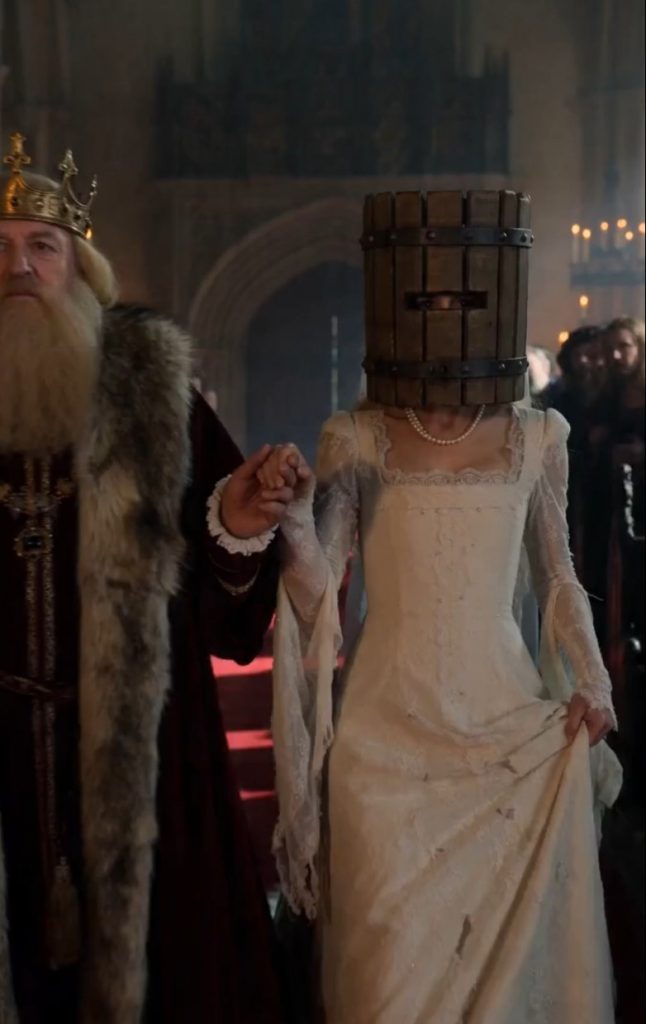
Their flames trembled along the stone pillars, throwing long shadows across the red carpet as King Roderic walked his daughter down the aisle. His crown sat heavy on his pale hair. His red velvet robe dragged behind him, trimmed in white fur that brushed the ancient floor like snow stained by power.
Beside him, the bride moved slowly.
Not because she was shy.
Because her head was trapped inside a wooden cage.
The mask was shaped like a barrel, built from dark slats bound with iron bands. Only a thin horizontal slit had been carved where her eyes should have been. Beneath it, her white lace gown swept the carpet in tattered waves, and one trembling hand clutched the skirt just high enough to keep her from stumbling.
The guests whispered from the pews.
Some crossed themselves.
Others looked away.
No princess of Eldermere had ever been married like this.
At the altar, Prince Adrian of Veyr stood frozen in royal blue velvet, his fingers clenched so tightly that the gold embroidery on his cuffs dug into his palms.
He had heard the rumors.
Everyone had.
Princess Evelyne had been ill. Princess Evelyne had been cursed. Princess Evelyne had offended God. Princess Evelyne had been hidden for seven years because no man could bear to look upon her face.
But a treaty demanded a bride.
And kings had never cared much whether daughters were willing.
Roderic stopped in front of Adrian and lifted the bride’s right hand with his own.
His voice rolled through the cathedral, deep and final.
“My daughter is now your wife.”
Adrian stared at the hand being placed into his.
It was cold.
Too cold.
The bride’s fingers trembled once against his palm. Then her left hand rose and settled over his, sealing the gesture. The movement should have been graceful, ceremonial, obedient.
Instead, it felt like a plea.
Adrian’s eyes lifted toward the slit in the mask.
Behind it, he saw nothing but darkness.
The priest whispered the next command.
The husband must behold the wife.
A custom older than the kingdom. Older than the throne. No marriage of blood and crown was considered complete until the groom lifted the veil and saw the face of the woman he had sworn to protect.
But this was no veil.
This was a prison.
Adrian raised both hands.
The iron latch beneath the eye slit was rusted and stiff. His fingers fumbled once, and somewhere behind him a woman gasped. The metal gave a sharp little clink. Then a long, protesting creak.
The mask opened.
Long blonde hair spilled down the bride’s back.
Adrian looked inside.
All the blood left his face.
“Oh my God,” he whispered.
Across the aisle, a young woman in an orange and red dress clapped both hands over her mouth, recoiling as though she had seen a ghost.
The bride did not scream.
She did not faint.
She simply looked at Adrian with tear-bright eyes and moved her lips around the first words she had been allowed to speak in seven years.
“Don’t let him take me back.”
And behind her, the king reached for his sword.
Act II
Seven years before the wedding, the kingdom had lost a princess.
That was the official story.
Princess Evelyne, only fifteen then, had vanished during a winter hunt near the Blackmere woods. The king had returned at dusk with a torn cloak, a bloodless face, and twelve riders who refused to meet anyone’s eyes.
The court mourned for forty days.
Bells tolled. Black banners fell from the towers. The queen, already weak from illness, died before spring. King Roderic blamed grief, wolves, bandits, and treason in whatever order suited him that day.
Then he made a proclamation.
The princess lived.
But she had been injured beyond recognition.
From that day forward, no one outside the royal household would see her face until the day of her marriage. Not physicians from foreign courts. Not noblewomen who had once dressed her hair. Not even the old nurse who had raised her from birth.
The wooden mask appeared a month later.
Roderic called it protection.
The servants called it punishment.
Behind locked doors, the masked girl learned to walk without stumbling, eat without being seen, and speak only when permitted. She attended chapel behind screens. She watched festivals from shuttered windows. She became a rumor living inside the palace walls.
But one person never believed the story.
Prince Adrian.
He had known Evelyne as a child.
Before their fathers negotiated treaties and dowries, before their names became pieces on a political board, Adrian and Evelyne had spent one golden summer together at Eldermere. She had outrun him through apple orchards, stolen candied almonds from the kitchens, and beaten him at chess so badly he overturned the board and accused her of sorcery.
She had laughed in his face.
That was what he remembered most.
Not her beauty. Not her rank.
Her laugh.
Bright. Unafraid. Impossible to command.
The masked bride had no such laugh.
When King Roderic first offered Adrian the marriage, he said Evelyne was fragile.
“Her mind wanders,” the king warned. “She has suffered greatly. A good husband will not trouble her with questions.”
Adrian’s father urged him to accept.
Veyr needed peace. Eldermere controlled the mountain pass. One marriage could prevent ten thousand men from dying in winter mud.
So Adrian came.
He told himself a prince did not marry for love.
He told himself that if Evelyne was truly alive and suffering, perhaps marriage might take her out of her father’s shadow.
But the moment he saw the wooden mask, his doubt became dread.
No healer built such a thing.
No loving father locked his daughter inside wood and iron.
And when the king placed her hand into Adrian’s, the bride pressed something into his palm.
Small.
Sharp-edged.
Hidden beneath her glove.
Adrian closed his fingers around it before anyone saw.
A silver chess piece.
A queen.
The same piece Evelyne had stolen from his set when they were children, after declaring that a prince too foolish to defend his queen did not deserve to keep her.
Adrian’s heart began to pound.
The masked bride was Evelyne.
Not broken.
Not mad.
Not cursed.
Trapped.
And if he opened the mask, whatever waited behind it would not shame her.
It would condemn the king.
Act III
The sword whispered halfway from Roderic’s scabbard before the priest found his courage.
“Your Majesty,” Father Alaric said, stepping between the king and the bride, “this is holy ground.”
Roderic’s eyes did not leave Adrian.
“That woman is my daughter,” he said. “And no man opens what I have ordered sealed without my command.”
Adrian stood in front of Evelyne, still holding the loosened mask in both hands.
Now that the cage had opened, the truth was worse than rumor.
Evelyne’s face was not monstrous.
It was not cursed.
It was pale from years without sun, thin from years of careful starvation, and marked by exhaustion no young woman should have carried. But she was alive. Her eyes were blue, clear, and burning with a strength that made the entire cathedral feel suddenly too small for the lie it had contained.
The horror in the room came not from what she was.
It came from what had been done to her.
The young bystander woman in the orange dress took a step into the aisle.
“Mira,” someone hissed. “Stay back.”
But Mira did not stay back.
She had once served in the princess’s chambers. She had been dismissed without reason the year after the hunt. Now, standing among the guests, she looked at Evelyne and began to cry.
“My lady,” she whispered.
Roderic’s face hardened.
“Remove that girl.”
No guard moved.
That was the first crack.
Adrian looked from Mira to the priest, then to the rows of nobles staring from the pews.
“If she is your daughter,” he said, “why was she locked away?”
Roderic’s voice turned cold. “Because she was dangerous.”
Evelyne lifted her chin.
“No,” she said.
The word was rough from disuse, but it carried.
Roderic turned on her. “Silence.”
Evelyne flinched.
Adrian saw it.
Every noble saw it.
The flinch told them more than any speech could have.
Mira pushed forward, trembling but determined. “She tried to tell the queen.”
The king’s eyes snapped toward her.
Mira swallowed.
“She tried to tell the queen what happened in the woods.”
A murmur passed through the cathedral.
Roderic smiled then, but it was the kind of smile men used when they were deciding where to place a knife.
“And what,” he asked softly, “does a dismissed chambermaid know of royal matters?”
Mira reached into the bodice of her dress and withdrew a folded piece of cloth.
Not paper.
Cloth lasted longer when hidden beneath floorboards.
She unfolded it with shaking hands.
On it, stitched in faded blue thread, was a message.
If I vanish, Lord Caspar did not betray the crown. My father did.
The cathedral went still.
Lord Caspar had been the queen’s brother, executed six years earlier for treason. The king had accused him of plotting to sell Eldermere to Veyr. His death had nearly started the war this marriage was supposed to prevent.
Adrian stared at the stitched words.
Evelyne’s eyes filled.
“I wrote it before they locked me away,” she said. “I gave it to Mira.”
Roderic laughed once.
“She was a child.”
“I was fifteen,” Evelyne replied. “Old enough to see you meet the border lords in secret. Old enough to hear you promise them my uncle’s lands after he was dead.”
The king’s hand tightened around his sword.
“You understand nothing of rule.”
“I understood enough,” she said. “That is why you put me in the mask.”
The guests were no longer whispering now.
They were listening.
And Roderic, for the first time in his reign, looked less like a king than a man standing too close to the truth.
Act IV
Roderic drew his sword fully.
The sound rang through the cathedral.
Several women cried out. Men stood from the pews. Guards stepped forward, then hesitated, because the blade was not pointed at an invader.
It was pointed at the bride.
Adrian moved before thought could slow him.
He pulled Evelyne behind him and drew his own sword, the blue velvet sleeve of his wedding doublet brushing against the white lace of her gown.
The priest raised both hands.
“In God’s name, stop!”
But Roderic was far beyond holy names.
“You think this is justice?” he thundered. “You think kingdoms survive because children tell the truth? I kept Eldermere alive while fools wept over honor.”
Evelyne stepped from behind Adrian.
Her mask, half-open, still hung around her head like a broken cage. Candlelight touched her hair. Her voice shook, but she did not retreat.
“You killed Uncle Caspar because he would not support your war.”
“I punished a traitor.”
“You made him one.”
Roderic’s face darkened.
“And your mother?” Evelyne asked.
The question struck harder than any blade.
Even the candles seemed to shrink.
Roderic said nothing.
Evelyne’s eyes shone. “She did not die of grief, did she?”
Father Alaric turned slowly toward the king.
The silence that followed was monstrous.
Mira sobbed.
Adrian felt the chess piece still cutting into his palm. He held it tighter, as if the pain could keep him steady.
Evelyne faced the court.
“My mother discovered what he had done. She demanded he confess before council. The next morning she was too weak to rise. By dusk, she was dead. By nightfall, my chambers were sealed.”
The accusation rolled through the cathedral like thunder.
Roderic shouted over it.
“Lies!”
Then the elderly Lord Bellamy rose from the front pew.
He was nearly eighty, with a cane of blackthorn and a voice old enough to have seen three kings crowned.
“No,” he said. “Not lies.”
Roderic turned.
Lord Bellamy reached into his cloak and pulled out a packet sealed with cracked red wax.
“The queen gave this to me the day before she died,” he said. “She told me to keep it hidden unless Evelyne ever stood before the court unmasked.”
The king’s face went gray.
Lord Bellamy broke the seal.
Inside were letters.
Not rumors.
Not stitched warnings.
Letters in the queen’s own hand, naming witnesses, payments, forged orders, and the king’s plan to frame Lord Caspar for treason.
Father Alaric crossed himself.
Adrian looked at Evelyne.
She was not crying now.
She was watching the letters as if her mother had just walked into the room and taken her hand.
Roderic stepped backward.
The guards saw it.
That small retreat changed everything.
Power depends on people believing it cannot fall. The moment a tyrant steps back, everyone remembers he is only a man.
Lord Bellamy struck his cane against the stone.
“By the laws of Eldermere, a king who murders kin, falsifies treason, and imprisons the blood heir forfeits crown and command.”
Roderic raised his sword again.
“Touch me and I’ll have every one of you—”
But no one finished the sentence for him.
The captain of the guard moved first.
He lowered his blade, not toward Evelyne, but toward the king.
Then another guard did the same.
Then another.
Roderic looked around the cathedral at the nobles, the soldiers, the priest, the people whose fear had fed him for years.
And found, at last, that fear had run out.
Adrian reached up and removed the broken mask from Evelyne’s head.
The iron bands slipped free.
The wooden cage dropped onto the red carpet with a heavy, hollow thud.
That sound ended the reign of King Roderic.
Act V
The wedding never finished.
Not that day.
The cathedral bells did not ring for marriage. They rang for council. They rang for arrest. They rang until the people of Eldermere poured into the square, demanding to know why their king had been led from the cathedral without his crown.
By sunset, the answer was already spreading.
The princess was alive.
The mask was a lie.
Lord Caspar had been innocent.
The queen had left proof.
And King Roderic, who had hidden behind velvet and gold for seven years, was finally placed behind iron.
Evelyne did not watch him taken away.
When the guards seized her father, she turned her face toward the open cathedral doors and breathed cold air as if she had forgotten the world could enter her lungs freely.
Adrian stood beside her, careful not to touch her without permission.
He had been handed a bride like property.
Instead, he had found a queen returning from a prison.
“I am sorry,” he said quietly.
Evelyne looked at him.
“For what?”
“For being part of this.”
“You opened the mask.”
“I should have questioned it before.”
She looked down at the wooden cage lying on the carpet.
“Yes,” she said. “You should have.”
The honesty stung.
Adrian accepted it.
Then Evelyne picked up the silver chess queen from his palm. The piece had left a red mark in his skin.
“You kept losing this,” she said.
A startled laugh rose in his throat, broken and disbelieving.
“You stole it.”
“I rescued it from poor leadership.”
For the first time since the cathedral doors opened, something almost like her old smile crossed her face.
Almost.
But freedom, Adrian learned, did not arrive whole. It came trembling. It came thin. It came with shadows attached.
In the weeks that followed, Evelyne refused to rush into any marriage, treaty or no treaty. Some nobles grumbled. Others warned that Veyr might take offense.
Adrian silenced them himself.
“I came here to marry a princess,” he told the council. “I found a sovereign. She owes me nothing.”
That sentence traveled far.
Farther than he expected.
People who had spent years afraid to speak began arriving at the palace gates with stories. Servants who had seen locked doors. Guards who had carried sealed trays. A physician who had been dismissed after asking why the princess was never allowed sunlight. A laundress who had washed blood from the king’s hunting cloak the night Lord Caspar was accused.
The truth did not come as one clean blade.
It came as a thousand small cuts.
Together, they opened the kingdom.
Roderic was tried by council under the old laws. He raged, denied, threatened, and finally sat in silence while the queen’s letters were read aloud. He was stripped of the crown and sent to the northern fortress, where kings who mistook themselves for gods learned how cold stone could be.
Evelyne was crowned in spring.
No mask.
No veil.
No father’s hand gripping hers.
She walked the cathedral aisle alone.
Her gown was not white but deep green, the color of new leaves after winter. Mira stood among her attendants. Lord Bellamy placed the crown before her with shaking hands. Father Alaric, humbled by all he had nearly helped bury beneath ceremony, asked the ancient question.
“Do you accept the burden of this realm?”
Evelyne looked at the people filling the cathedral.
The nobles who had feared her father.
The servants who had whispered her name.
The soldiers who had lowered their swords.
Adrian, standing not at the altar as groom, but among the witnesses.
Her voice carried to the highest vault.
“I accept the burden,” she said. “But I will not call cruelty order. I will not call silence peace. And I will never again allow a cage to be mistaken for protection.”
The crown touched her hair.
The bells rang.
This time, no one wondered what they meant.
Months passed before Evelyne invited Adrian to the old orchard where they had played as children. The trees were older now, twisted and silver in places, but blossoms still opened along the branches.
She brought the silver chess queen.
He brought the rest of the set.
They sat beneath an apple tree with the board between them, and for a while neither spoke of treaties, fathers, prisons, or crowns.
She beat him in twelve moves.
Adrian stared at the board.
“That was merciless.”
Evelyne leaned back, sunlight on her face.
“That was mercy. I could have done it in ten.”
He laughed, and this time she did too.
Not the bright, careless laugh of childhood.
That girl was gone.
This laugh was lower, rougher, earned through darkness and returned by force of will. It did not erase what had happened. Nothing could.
But it lived.
And that was enough to make Adrian look away before she saw the tears in his eyes.
Years later, people would still tell stories about the wedding that became a trial and the bride who wore a cage to the altar.
Some would make it sound like legend.
A wicked king. A masked princess. A prince brave enough to open what others feared to touch.
But Evelyne never liked that version.
It made Adrian the hero.
And the truth was simpler.
He opened the latch.
She told the truth.
The kingdom listened.
That was how cages broke.
Not with one hand.
With many.
And in the cathedral where she had once stood trembling beneath wood and iron, Queen Evelyne later ordered the mask hung on the wall beside the old war banners.
Not hidden.
Not destroyed.
Displayed.
Beneath it, carved into stone, were the words she chose herself.
Let no one call a prison love.
Every bride who passed beneath it after that lifted her face to the light.