Act I
The laughter hit the metal walls first.
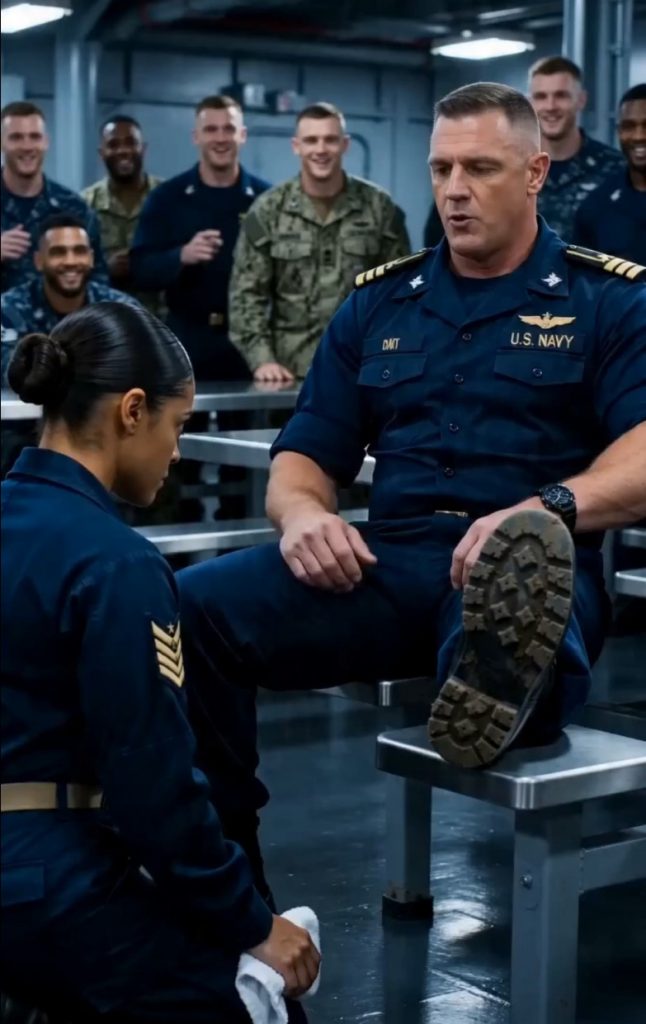
It rolled through the mess hall, loud and ugly, bouncing off the stainless steel tables and the dark polished floor until it sounded bigger than the men making it. Dozens of sailors stood around the room in uniform, some leaning against benches, some with trays still in their hands, all watching the woman on the floor.
She was kneeling.
Her name, as far as they knew, was Ava Mercer.
A new transfer. Quiet. Small enough to underestimate. Disciplined enough to irritate men who mistook silence for weakness.
Commander Grant Rourke sat above her with one boot planted on the table.
He was broad-shouldered, clean-cut, and polished in the way officers learn to polish themselves when they know fear does half their work for them. His navy shirt stretched across his chest. Gold stripes sat on his shoulders. Pilot wings gleamed beneath the fluorescent lights.
His left boot was filthy.
Mud clung to the sole. Gray dirt streaked the leather. The toe was crusted from whatever yard, dock, or restricted field he had crossed before entering the mess hall like a king returning from battle.
He leaned back and smiled.
“Wipe my boots.”
The men erupted.
Ava did not move.
Her dark hair was tied in a neat bun. Her uniform sleeves were buttoned. A white cloth rested in her right hand, folded once over her fingers. Her face remained so still that a few men laughed harder, as if they needed to prove her silence had no effect on them.
Rourke lowered his chin.
“Did you hear me, Mercer?”
She raised her eyes.
For half a second, the room changed.
Not enough for the men to understand. Not enough for Rourke to feel danger. But something cold passed through the air, something precise and controlled, like the click of a lock inside a sealed door.
“Yes, sir,” Ava said.
Her voice was calm.
Too calm.
Rourke’s grin widened. “Good. Then make yourself useful.”
She bent toward the boot.
The cloth touched the sole.
The men began clapping.
Slow at first. Then louder. A rhythm of humiliation. Hands striking hands as Ava wiped mud from the bottom of a commander’s boot in front of an entire mess hall.
Rourke watched her like a man enjoying a performance he believed he owned.
“Careful around the heel,” he said. “That’s officer-grade dirt.”
More laughter.
Ava cleaned the sole, then the edges, then the toe. Her movements were slow, deliberate, almost ceremonial. She did not rush. She did not flinch. She did not give them tears, which annoyed some of them more than open defiance would have.
Then her hand moved upward.
The cloth slid from the boot toward Rourke’s ankle, then stopped just below his knee.
Rourke’s smile flickered.
Only for a second.
Ava’s head lifted.
Her eyes locked onto his.
The laughter thinned.
One sailor stopped clapping.
Then another.
The mess hall grew quiet in uneven pieces, like a machine losing power.
Rourke stared down at her, still trying to look amused.
“What?” he said. “You waiting for a tip?”
Ava rose slowly from her bent position, the cloth still in her hand.
She was not tall.
But when she stood, the room seemed to lower around her.
And for the first time, Commander Grant Rourke noticed the white cloth was not just covered in mud.
It was inside a clear evidence sleeve.
Act II
Three weeks earlier, Ava Mercer had arrived on the installation with a duffel bag, a forged transfer packet, and a name that was not completely hers.
The Navy knew her as Lieutenant Ava Mercer, Judge Advocate General’s Corps.
The men in the mess hall knew her as Seaman Mercer, a newly assigned administrative recruit with no connections, no protection, and no reason to be treated carefully.
That was the point.
Rourke’s unit had been under quiet investigation for five months.
Not officially, at least not where his friends could see it. Official investigations had a strange habit of dying before they reached his office. Complaints were misfiled. Witness statements were rewritten. Junior sailors changed their stories after closed-door meetings. Good people transferred out. Frightened people learned to laugh when Rourke laughed.
But one complaint had survived.
It came from a mother in Nebraska whose son, Petty Officer Caleb Winslow, had left the unit with a broken career and a fear he refused to explain. He did not die. He did not vanish. But something in him had changed so deeply that his mother began writing letters every Monday morning to anyone whose name appeared on a military website.
Most people ignored her.
One person did not.
Rear Admiral Helena Shaw read the seventh letter because it arrived with a photograph.
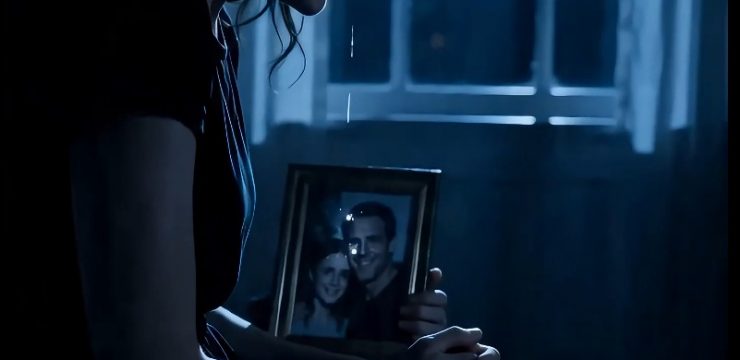
The photograph showed Caleb Winslow before deployment, smiling in dress whites beside his younger sister.
The second photograph showed him eight months later, eyes hollow, jaw tight, standing in a civilian jacket outside a hospital.
On the back of the second photo, his mother had written:
My son did not break. Someone broke the rules around him and called it discipline.
Admiral Shaw had seen enough men like Rourke to know the pattern.
They were never obvious at first. They were decorated. Charming upward, cruel downward. Loyal in front of cameras, poisonous behind sealed doors. They collected frightened subordinates the way other men collected medals.
Rourke’s mess hall was known unofficially as “the pit.”
It was where he tested people.
A spilled tray became a public punishment. A wrong answer became a week of impossible assignments. A sailor who looked too confident might be ordered to sing, crawl, scrub, apologize, or stand while others mocked him.
Nothing too dramatic on paper.
That was how he survived.
Cruelty, when divided into small enough pieces, could be disguised as tradition.
Ava volunteered for the assignment because she understood humiliation better than most officers.
Her father had been enlisted. A boatswain’s mate with scarred hands and a voice that softened every time he spoke to her mother. He used to tell Ava that rank was supposed to carry responsibility downward, not demand worship upward.
“When someone salutes you,” he once said, “you owe them more than they owe you.”
He died when Ava was nineteen, long before he could see her commission.
But his words stayed.
So when Admiral Shaw asked whether Ava could withstand Rourke’s methods long enough to document them, Ava did not hesitate.
She cut her hair shorter. Removed the officer habits from her posture. Learned the rhythm of junior sailors who say “sir” before thinking and never sit with their back to a superior. She entered Rourke’s unit as a nobody.
And Rourke treated her exactly like one.
The first week, he ignored her.
The second, he tested her.
The third, he decided she was useful.
Not because she failed.
Because she did not.
That bothered him.
Ava did not gossip. Did not complain. Did not react when men spoke over her. Did not give him the satisfaction of seeing her afraid.
So he escalated.
That morning, he found her in the corridor and told her to report to the mess hall after evening inspection. No explanation. No witnesses she could choose. No paper trail.
But Ava had learned his pattern.
She knew he liked an audience.
She also knew something else.
The mud on Rourke’s boot did not come from the training yard.
It came from Pier 7.
Pier 7 had been sealed for two weeks after a fuel contamination incident that Rourke claimed he knew nothing about. A report had vanished. A maintenance chief had been blamed. A junior sailor had been pressured into signing a statement he later tried to retract.
Ava needed proof Rourke had been there.
Then he put the boot on the table and ordered her to wipe it clean.
For the first time since the assignment began, Rourke gave her exactly what she needed.
Act III
The mess hall did not understand what it was seeing.
Not yet.
To them, Ava was still the woman who had been kneeling moments earlier. Rourke was still the commander with the gold stripes and the loudest voice in the room. The white cloth in her hand was still just a rag.
Rourke’s eyes narrowed.
“What is that?” he asked.
Ava sealed the evidence sleeve.
“Material sample, sir.”
A few sailors looked at one another.
Rourke stood so abruptly the bench behind him scraped against the floor.
“Excuse me?”
Ava’s voice remained even. “The soil on your boot appears to contain fuel residue and red dock silt consistent with the restricted area at Pier 7.”
The silence became complete.
Even the fluorescent lights seemed louder.
Rourke smiled, but the expression did not fit his face anymore. “You think you’re clever.”
“No, sir,” Ava said. “I think you walked through a sealed site this afternoon.”
One of the men near the back shifted his weight.
Ava noticed.
So did Rourke.
His head turned sharply. “Nobody move.”
That was when another voice spoke from the entrance.
“I would advise against giving any further orders, Commander.”
Everyone turned.
Rear Admiral Helena Shaw stood in the doorway with two investigators behind her.
She was not tall, but command moved with her like weather. Her silver hair was pulled back beneath her cap. Her face carried no anger, which somehow made her more frightening.
Rourke went pale, then recovered with impressive speed.
“Admiral,” he said. “This is a misunderstanding.”
Admiral Shaw walked into the mess hall.
Her shoes struck the floor in measured steps.
Ava stood at attention.
Not like a recruit.
Like an officer.
That was when the room began to understand.
Rourke looked from Ava to the admiral, then back again.
“What is this?” he demanded.
Ava reached to her collar.
With one clean motion, she removed the outer tab of her temporary uniform and revealed the insignia beneath.
Lieutenant.
A murmur moved through the sailors.
The men who had laughed at her looked suddenly fascinated by the floor.
Rourke’s jaw tightened. “You planted an officer in my unit?”
Admiral Shaw stopped beside the table.
“No,” she said. “I authorized an officer to observe a command climate that your own reports described as exemplary.”
Her eyes moved over the room.
Several sailors swallowed.
“Apparently,” she continued, “your reports were incomplete.”
Rourke gave a short laugh. “So this is about hurt feelings? A little mess hall joke?”
Ava looked at the boot still resting on the table.
The mud was smeared now, the leather half-cleaned, the humiliation transformed into a record.
“No, sir,” she said. “It is about unlawful hazing, witness intimidation, falsified maintenance reports, and obstruction of safety investigations.”
Rourke’s face hardened.
“You have no idea how this command works.”
Admiral Shaw replied before Ava could.
“That sentence is usually the first shelter of men who believe standards belong only to other people.”
The investigators moved deeper into the room.
One of them collected the evidence sleeve from Ava.
Another placed a small recording device on the table.
Rourke stared at it.
His confidence faltered.
Ava had worn it beneath her uniform every day for three weeks.
Every laugh. Every order. Every threat disguised as discipline. Every sailor forced to applaud someone else’s humiliation.
Recorded.
Rourke looked at the men behind him, silently demanding loyalty.
But loyalty built on fear rarely survives the first appearance of accountability.
No one spoke for him.
Not one.
Act IV
The first sailor to step forward was not the bravest-looking man in the room.
He was young, thin, and pale, with a camouflage sleeve pulled low over one wrist. His name was Torres. Ava remembered him because he always sat near the exit and never laughed until others did.
He raised his hand halfway, as if still in school.
“Admiral,” he said, voice shaking, “I signed the Pier 7 statement.”
Rourke snapped, “Torres.”
The admiral did not look away from the young sailor.
“Continue.”
Torres’s throat worked hard.
“I was told if I didn’t sign, my evaluation would be buried. Commander Rourke said accidents happen to sailors who can’t follow the chain of command.”
Rourke stepped toward him.
Ava moved first.
Not dramatically. Not aggressively.
She simply placed herself between Rourke and Torres.
That single movement changed the room more than any speech could have.
For weeks, the sailors had watched Rourke use space as a weapon. Leaning too close. Blocking exits. Standing over seated men until they agreed with him.
Now someone stood between him and the person he wanted to frighten.
Rourke looked at Ava with open hatred.
“You have no authority over me.”
Ava met his stare.
“Tonight, sir, I don’t need authority. I have witnesses.”
Another sailor stood.
Then another.
A chief petty officer near the far table removed his cap and looked at Admiral Shaw with the exhausted face of a man who had been carrying shame too long.
“I reported the hazing last year,” he said. “My statement disappeared.”
A second voice followed.
“I was ordered to delete camera footage.”
Then another.
“He made us call it corrective training.”
“And if we refused, we were marked unfit.”
“My transfer request was denied after I spoke to medical.”
The room that had laughed at Ava became a room full of voices.
Not loud at first.
But real.
Rourke tried to stop it with rank, but rank without trust is only decoration. Every command he gave fell flat. Every glare met eyes that had finally found somewhere else to look.
Admiral Shaw listened to all of it.
Ava did too.
She kept her face steady, but inside she felt something loosen. Not triumph. This was too heavy for triumph. It was relief sharpened by anger. Relief that the truth had survived. Anger that so many people had been forced to carry it in silence.
Rourke turned on her one last time.
“You think this makes you strong?” he said. “You let yourself kneel.”
The words landed in the room like a slap.
Ava looked at the filthy boot on the table.
Then at the cloth sealed in evidence.
“Yes,” she said. “I did.”
Her voice did not rise.
“I knelt because every person in this room needed to see exactly what you are when you think no one can stop you.”
Rourke said nothing.
Ava took one step closer.
“And I stood because they needed to see that you were wrong.”
For the first time all evening, no one breathed.
Then Admiral Shaw removed Rourke from command.
The words were formal. Controlled. Devastating.
Commander Grant Rourke was relieved pending investigation. He was ordered to surrender his access credentials, communications device, and command authority immediately.
The gold stripes remained on his shoulders.
But they no longer protected him.
Two investigators escorted him toward the exit. He walked past the same sailors who had once laughed for him, clapped for him, obeyed him, feared him.
No one moved aside quickly.
He had to walk around them.
At the doorway, he looked back at Ava.
She was still holding the white cloth.
Still calm.
Still impossible to humiliate now.
And the mess hall that had been his stage became the place where his power ended.
Act V
The investigation did not end that night.
Real justice rarely arrives like thunder. It comes in interviews, documents, sworn statements, recovered footage, chain-of-custody forms, and long rooms where people are finally asked questions by someone who intends to hear the answers.
Rourke’s command unraveled piece by piece.
The Pier 7 incident was reopened. The missing report was found on a private drive. The maintenance chief who had been blamed was cleared. The junior sailors who had been threatened gave testimony. The mess hall recordings were reviewed by people who did not laugh once.
Some men tried to claim they had only gone along with it.
Ava did not argue.
Fear was complicated.
But so was responsibility.
Admiral Shaw made that clear in the weeks that followed.
Every sailor who participated in the humiliation of others faced review. Some received punishment. Some were reassigned. Some, after telling the truth fully, were allowed to rebuild trust from the bottom up.
The command changed because it had to.
The mess hall tables were scrubbed clean.
The boot prints vanished from the stainless steel.
But the memory stayed.
Ava returned once, a month later, after the preliminary hearings ended. She entered quietly during breakfast. Conversations softened when sailors noticed her, then steadied again when she gave no sign that silence was required.
Torres stood from one of the benches.
For a moment, he looked like the same frightened young man from that night.
Then he stepped forward.
“Ma’am,” he said, “I wanted to thank you.”
Ava shook her head.
“Don’t thank me for doing my job.”
He hesitated. “Then what should I say?”
Ava looked around the mess hall.
At the men who had laughed.
At the ones who had been afraid.
At the empty chair where Rourke used to sit like a ruler with a boot on the table.
“Say it sooner next time,” she said. “For someone else.”
Torres nodded.
He understood.
Later that afternoon, Ava was called to Admiral Shaw’s office. The admiral stood by the window, looking out over the gray water beyond the installation. Ships sat in the distance, massive and quiet beneath a low sky.
“You handled yourself well,” Shaw said.
Ava gave a tired smile. “I let a commander make me clean his boot in front of forty people.”
“You turned his cruelty into evidence.”
“That doesn’t make it feel clean.”
The admiral turned.
“No,” she said. “It doesn’t.”
For a moment, neither woman spoke.
Then Shaw reached into a folder and placed a photograph on the desk.
It was Caleb Winslow, the sailor whose mother had written the letters. He stood beside his sister in dress whites, smiling at some sunny family event before Rourke’s command had changed him.
“His mother called this morning,” Shaw said. “She heard the case is moving.”
Ava looked at the photo.
“She should have been heard earlier.”
“Yes,” Shaw said. “She should have.”
That was the closest the admiral came to apology, but Ava knew it was not empty. Some leaders use regret as decoration. Shaw used it as instruction.
Rourke’s court-martial proceedings began three months later.
The press never got the whole story, only the clean version. Abuse of authority. Falsification of records. Conduct unbecoming. Obstruction. The Navy used formal words because institutions always do.
But inside the command, people remembered the truth in simpler terms.
He made her kneel.
She stood up with proof.
During the hearing, Rourke’s attorney tried to frame the mess hall incident as exaggerated discipline. A harsh joke. A misunderstood test of resilience.
Then the recording played.
The laughter filled the courtroom.
Not the harmless kind. Not brotherhood. Not tradition.
Cruelty.
Without the mess hall noise around it, without the crowd’s approval protecting it, the laughter sounded exactly like what it was.
Small men borrowing power from a bigger one.
Ava testified for forty-two minutes.
She did not dramatize. She did not embellish. She described what happened, who was present, what was said, and what evidence was collected.
Rourke did not look at her.
That was fine.
The truth did not need his attention to exist.
When the proceedings ended, Ava walked outside into bright, cold air. Torres and several others waited near the steps, not as a crowd, not as fans, but as witnesses to the ending of something they had survived.
No one cheered.
That would have felt wrong.
Instead, Torres gave a quiet salute.
Ava returned it.
Years later, sailors who passed through that installation still heard a version of the story.
Sometimes the details changed. Sometimes Ava became taller, colder, fiercer than she had been. Sometimes Rourke became more monstrous than human, because people prefer villains to look nothing like themselves.
Ava always corrected that when she could.
“He looked normal,” she would say. “That was the danger.”
The mess hall was renovated eventually. New lighting. New benches. Fresh paint. The old stainless tables were replaced with darker ones that did not show every reflection.
But one table was kept.
Not in the center of the room.
Against the wall near the entrance.
A small plaque was fixed to its side, simple enough that most visitors missed it.
DISCIPLINE WITHOUT DIGNITY IS NOT LEADERSHIP.
Ava saw it once on a later visit.
She stood there for a while, reading the words beneath the hum of the lights.
Then she heard laughter from across the room.
Her body stiffened before her mind understood.
But this laughter was different.
A group of young sailors sat together, teasing one another over bad coffee and burnt toast. No one was cornered. No one was shrinking. No one was being fed to the room for entertainment.
Ava let out a breath.
The Navy was not healed because one cruel man had fallen. No institution was ever that simple. But a room could change. A command could change. A silence could break and never fit back together the same way again.
As she turned to leave, a young female recruit entering the mess hall paused beside her.
The recruit looked nervous, shoulders squared too tightly, eyes scanning the room the way people do when they are trying to be ready for anything.
Ava recognized that look.
She had worn it once.
The recruit noticed her insignia and straightened.
“Ma’am.”
Ava nodded.
“At ease.”
The young woman relaxed by half an inch.
It was enough.
Ava held the door for her and glanced once more at the room where she had been ordered to kneel.
The memory still hurt.
But it no longer belonged to Rourke.
That was the part he had never understood.
Humiliation only wins when it convinces the wounded to stay silent.
Ava had taken his order, his boot, his laughter, his audience, and turned all of it into the one thing men like him fear most.
A record.
Then she walked out, not with revenge in her hands, but with proof.
And behind her, the mess hall kept talking.