Act I
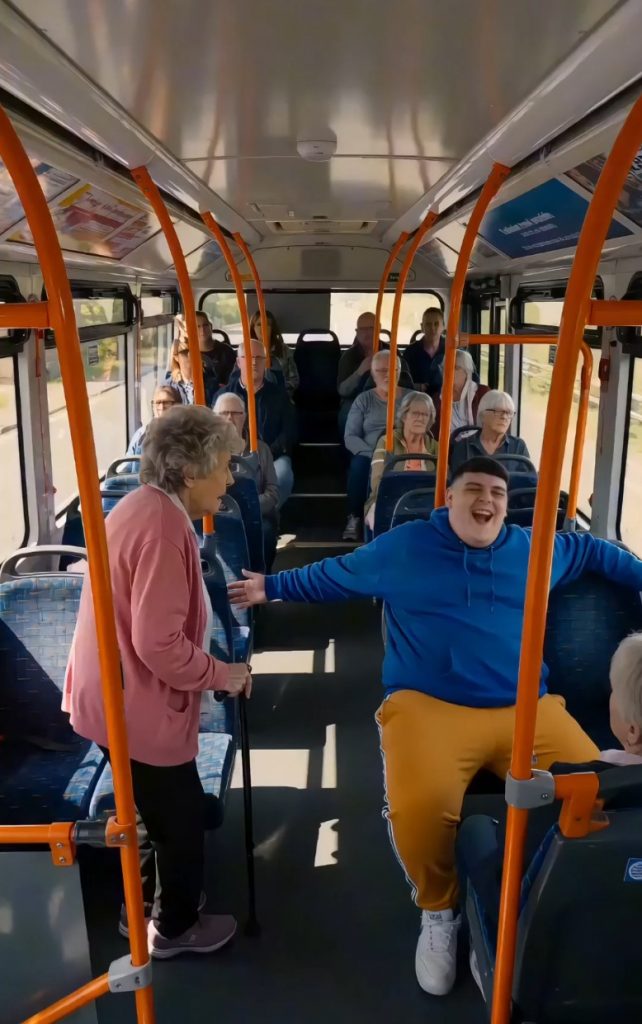
The young man laughed before the old woman even spoke.
It was too loud for the bus.
The kind of laugh meant to fill space, claim attention, and warn everyone nearby that kindness would be treated like weakness. He sat in the second row in a royal blue hoodie and bright yellow sweatpants, one arm draped across the back of the empty seat beside him as if the whole row belonged to him.
The bus rocked through the city, orange handrails swinging gently overhead. Passengers stood shoulder to shoulder in the aisle, tired faces turned toward windows blurred by traffic and rain. The blue patterned seats were nearly full.
Beside the young man stood an elderly woman with a black cane.
Her gray hair was tied in a careful bun. A pink knit cardigan covered her thin shoulders, and beneath it she wore a blue and white floral blouse that had been ironed with love. She looked like someone who had dressed with dignity for a day that already demanded more strength than she had.
She waited for him to notice her.
He noticed.
That was the cruel part.
The woman leaned forward slightly, both hands resting on the handle of her cane.
“Excuse me,” she said politely, her voice trembling. “May I pass and sit beside you?”
The young man stopped laughing.
Slowly, he turned his head and looked at her as though she had asked for his wallet.
“It’s taken.”
The woman blinked.
She looked down at the empty seat.
Then back at him.
“How is it taken? There’s nobody sitting there.”
A few passengers shifted uncomfortably. A middle-aged woman in a navy polo stood directly behind the old woman, arms crossed, disgust written plainly across her face. Still, no one spoke.
The young man grinned.
Then he lifted his right leg and slammed his sneaker onto the empty seat.
The sound cracked through the bus.
The elderly woman flinched.
“It’s occupied,” he said, laughing again. “My leg is sitting there.”
Somewhere near the back, a teenager muttered, “That’s messed up.”
The old woman’s eyes filled, but she did not cry.
She only tightened her grip on the cane and stood a little straighter.
The young man leaned back, triumphant, expecting her to shuffle away in shame.
Instead, she looked at him closely.
At his face.
At his curls.
At the small silver chain around his neck.
And suddenly, the color drained from her cheeks.
“What is your name?” she whispered.
He rolled his eyes.
“Why? You want to report my leg?”
The bus gave a sharp turn. The old woman nearly lost her balance, and the woman in the navy polo caught her elbow.
Then the elderly woman spoke again.
This time, her voice was quiet enough to make the whole bus listen.
“You look exactly like Marcus Price.”
The young man’s laughter died.
Act II
His name was Jordan Price.
And Marcus Price had been his father.
That name had not been spoken gently in Jordan’s house for years. His mother kept one photograph on the mantel, but she dusted around it instead of touching the frame. His grandmother refused to discuss him except on his birthday, when she made peach cobbler and cried into the sink.
Jordan knew the official story.
His father had been a bus driver.
A good one, people said.
A community man.
A hero, if you believed the newspaper clipping folded in his grandmother’s Bible.
Jordan hated that word.
Hero.
Heroes were supposed to come home.
Marcus Price had died when Jordan was six, after a crash on Route 42 during a winter storm. The reports said he swerved to avoid a stalled car, kept the bus from hitting a group of pedestrians, and struck a barrier hard enough to save everyone behind him while taking the worst of it himself.
Passengers survived.
Marcus did not.
Jordan grew up with strangers telling him his father was brave.
They said it in grocery stores, churches, school assemblies, transit memorials, even once in a barber shop when Jordan was eleven and wanted nothing more than to vanish into the floor.
Your daddy saved lives.
You must be so proud.
Jordan had been proud at first.
Then pride turned into anger.
Because his father’s bravery became something everyone else owned. The city named a training room after him. The transit authority gave his mother a plaque. Politicians used his name in speeches about public service while his family struggled with bills after the cameras left.
By sixteen, Jordan had decided respect was a lie people gave the dead instead of help to the living.
So he became loud.
Funny, people said at first.
Then rude.
Then impossible.
He learned that if he embarrassed others first, nobody could pity him. If he took up space, nobody could make him feel small. If he laughed at kindness, nobody could ask why kindness made him ache.
On the bus that afternoon, he had been recording little clips for his friends.
Nothing serious, he told himself.
Just jokes.
Just making the ride less boring.
Then the elderly woman asked for the seat.
And something ugly in him rose fast.
Maybe because she looked frail.
Maybe because the cane reminded him of his grandmother.
Maybe because she asked gently, and gentleness always made him want to prove it had no power over him.
So he humiliated her.
In front of everyone.
What Jordan did not know was that the woman standing beside him had been on Route 42 the night his father died.
Her name was Mrs. Evelyn Carter.
And Marcus Price had given his life partly because of her.
Act III
The bus moved another block before Jordan found his voice.
“You don’t know my father,” he said.
Mrs. Carter’s hands trembled on the cane.
“I knew him.”
“No, you didn’t.”
Her eyes stayed on his face.
“I was sitting behind him that night. Front row. Left side. I had a red scarf and a bag of groceries on my lap. Your father told me not to stand until the bus stopped because the floor was wet.”
Jordan’s jaw tightened.
The woman in the navy polo looked from Mrs. Carter to Jordan.
The whole bus seemed to lean closer.
Mrs. Carter continued softly.
“There was a young mother with a stroller at the next stop. A car slid through the light. Your father turned the bus before it could hit them.”
Jordan stared at her.
He had heard pieces of the story before, but never like this. Never from someone who had been close enough to remember the wet floor.
Mrs. Carter’s eyes shone.
“I fell from my seat when we hit the barrier. I remember glass. I remember people screaming. And I remember your father asking, ‘Is everyone breathing?’ before he closed his eyes.”
The bus went silent.
Jordan’s foot was still on the empty seat.
Suddenly it looked ridiculous.
Childish.
Obscene.
He lowered it slowly.
But Mrs. Carter did not sit.
Not yet.
She looked at the seat, then at him.
“Your father gave up his body so strangers could live. And you used yours to keep an old woman standing.”
The words did not come loudly.
They did not need to.
Jordan’s face flushed.
The woman in the navy polo finally spoke.
“You should apologize.”
Jordan snapped toward her. “Mind your business.”
“It became everyone’s business when you made it a show.”
A man across the aisle nodded. “She’s right.”
Another passenger said, “That’s priority seating anyway.”
The bus driver glanced in the mirror.
“Is everything okay back there?”
“No,” the woman in the navy polo called. “Pull over.”
Jordan’s chest tightened.
He reached for anger because it was easier than shame.
“What, you’re all saints now?” he barked. “Nobody said anything until she brought up my dad.”
Mrs. Carter’s expression softened, and somehow that made him feel worse.
“No,” she said. “Most people are late to courage. That does not mean courage should stop coming.”
The bus slowed at the curb.
The driver stood and turned toward the aisle.
“Son, move.”
Jordan looked around.
Every face was on him.
Not laughing.
Not cheering.
Watching.
For the first time all day, he felt smaller than the space he had tried so hard to occupy.
He stood.
Mrs. Carter sat down slowly, lowering herself with visible pain. The woman in the navy polo helped her settle and placed the cane between her knees.
Jordan remained standing beside the seat, hands clenched at his sides.
Then Mrs. Carter looked up at him.
“I came to the city today because they are dedicating a shelter bench to your father at the downtown terminal.”
Jordan’s breath stopped.
“What?”
She reached into her cardigan pocket and pulled out a folded program.
On the front was a photograph of Marcus Price in his driver’s uniform, smiling beside a bus.
Jordan had seen that smile his whole life.
But on the program beneath it were words he had never seen.
The Marcus Price Courtesy Seat Initiative
For dignity in public transit
Jordan felt the floor move beneath him.
Not from the bus.
From the truth.
Act IV
Jordan reached for the program, but Mrs. Carter did not hand it to him immediately.
She looked at him for a long moment.
Not punishing.
Measuring.
Then she placed it in his hand.
His father’s face stared back from the glossy paper.
Younger than Jordan remembered. Warmer. Alive in a way old family photos never managed to feel after years of being turned into grief.
The event was scheduled for 4:30 p.m.
Downtown terminal.
Platform C.
Jordan looked at the time on his phone.
4:08.
He swallowed.
“My grandmother didn’t tell me.”
Mrs. Carter’s voice was gentle.
“Maybe she thought you would not come.”
That struck harder than judgment.
Because he knew she was right.
He had stopped going to memorial events years ago. He said they were fake. He said the city only cared when cameras were present. He said honoring the dead did nothing for the living.
Some of that was true.
But it was not the whole truth.
The whole truth was that seeing his father’s name on plaques made Jordan feel abandoned all over again.
A phone camera lowered near the back.
The teenager who had been recording slipped it into his pocket, ashamed.
The driver remained at the front.
“We’re headed to the terminal,” he said. “Everybody okay continuing?”
Mrs. Carter nodded.
The bus started moving again.
Jordan stood in the aisle for two stops without speaking.
The seat beside Mrs. Carter remained empty.
Then she tapped it lightly with two fingers.
“You may sit if your leg is finished with it.”
A few passengers let out small, surprised laughs.
Jordan looked at her, startled.
There was no cruelty in her face.
Only tired humor.
That nearly broke him.
He sat carefully, keeping distance, shoulders hunched in a way that made him look younger.
“I didn’t know,” he said.
Mrs. Carter looked out the window.
“About the ceremony?”
“About you.”
She nodded.
“No. You didn’t.”
“I’m sorry.”
Her eyes remained on the passing city.
“For the seat?”
Jordan’s throat tightened.
He stared at the program in his hands.
“For making you stand. For laughing. For…” He stopped, embarrassed by the heat behind his eyes. “For acting like that with his name on me.”
Mrs. Carter turned back to him.
“Do you know what your father said to me once?”
Jordan shook his head.
“It was two weeks before the crash. I was having trouble stepping onto the bus. He lowered the ramp even though I said I didn’t need it. I was proud, you see.”
Her mouth twitched.
“He told me, ‘Mrs. Carter, accepting help doesn’t make you less independent. It just means the world is working properly for once.’”
Jordan looked down.
The words sounded like something his father would say. Kind. Practical. A little too good for the world that took him.
Mrs. Carter studied his face.
“You are angry.”
He flinched.
“That is not an insult,” she said. “I was angry too. After the crash. I was angry I lived and he did not. I was angry that people called me lucky when the man who saved me left a child behind.”
Jordan’s eyes burned.
“People kept telling me he was a hero,” he whispered. “Like that was supposed to make it okay.”
Mrs. Carter’s face softened.
“No. It was never okay.”
The bus rolled toward the downtown terminal.
The woman in the navy polo, still standing nearby, wiped her eyes and looked away.
Jordan held the program tighter.
Mrs. Carter said, “But your father’s goodness does not have to be a debt you can never pay. It can be a direction.”
The terminal appeared ahead through the window.
Banners hung near Platform C.
People were gathering.
Jordan saw his grandmother near the front, holding a framed photograph of Marcus Price.
She looked older than he remembered.
And suddenly, he understood how much pain he had been making louder instead of lighter.
Act V
Jordan almost stayed on the bus.
When the doors opened at the terminal, he remained seated, frozen with the program in his lap.
Mrs. Carter stood slowly with her cane.
The woman in the navy polo offered her arm.
Jordan watched passengers step off around them. Some glanced back at him. Not with hatred now. With expectation.
That was worse.
Mrs. Carter paused at the door and turned.
“Coming?”
Jordan looked toward Platform C.
His grandmother stood beneath a blue banner that read Courtesy Begins With Seeing Each Other. Beside her were transit workers, city officials, drivers in uniform, and people who had once ridden his father’s route.
He saw a photo display.
His father holding a toddler.
His father helping a man with groceries.
His father laughing beside a bus in winter.
A life Jordan had reduced to one wound because he did not know what else to do with it.
“I don’t know if I should,” he said.
Mrs. Carter looked at him.
“Then come anyway.”
He did.
He stepped off the bus behind her, suddenly aware of his bright clothes, his damp palms, the way shame made every sound too sharp.
His grandmother saw him halfway across the platform.
Her mouth opened.
For a moment, she looked as if she might scold him.
Then she began to cry.
Jordan walked to her.
“I’m sorry,” he said before she could speak.
She touched his face with both hands.
“For what, baby?”
He looked past her at Mrs. Carter.
“For not knowing who he was without being mad at him for leaving.”
His grandmother pulled him into her arms.
He bent over her like the child he had been when the knock came at the door years ago. The crowd looked away politely, giving him privacy too late but giving it nonetheless.
During the ceremony, Mrs. Carter was invited to speak.
She stood at the small podium with both hands on her cane.
“I was saved by Marcus Price,” she said. “But not only on the night of the crash. He saved my dignity many times before that. He saw people others rushed past. The elderly. The tired. The disabled. The mothers with strollers. The workers with sore feet. The children who looked frightened. He understood that a bus seat is never just a seat when someone needs it.”
Jordan stood near the back, eyes fixed on the ground.
Mrs. Carter continued.
“Today’s initiative is named for him, but it belongs to everyone who chooses not to look away.”
Then she looked directly at Jordan.
“Especially those who are still learning.”
The crowd applauded.
Jordan did not feel forgiven.
That was not the point.
Forgiveness was not a curtain someone pulled over harm so everyone could feel comfortable again. It was work. It was repetition. It was choosing differently next time when nobody was clapping.
After the ceremony, Jordan approached the transit director and asked if volunteers were needed for the courtesy campaign.
The director looked surprised.
Then cautious.
Then he glanced at Mrs. Carter, who nodded once.
“We could use help,” he said.
Jordan showed up the next Saturday.
And the next.
At first, people watched him like he might turn it into another joke. He did not blame them. He passed out flyers. Helped clean seats. Held ramps steady. Listened to older riders tell stories about his father that made him laugh and cry in the same breath.
One afternoon, a man snapped at a woman with a walker for taking too long to board.
Jordan felt anger rise.
The old kind.
Hot. Defensive. Hungry for a target.
Then he heard Mrs. Carter’s voice in his memory.
Most people are late to courage.
He stepped forward.
“Give her a second,” he said.
The man rolled his eyes but went quiet.
The woman with the walker gave Jordan a tired smile.
“Thank you.”
He nodded, unable to speak.
Months later, the video from the bus still existed online.
The one where he laughed.
The one where he put his foot on the seat.
The one where Mrs. Carter said his father’s name and watched his face collapse.
Jordan hated it.
Then, slowly, he stopped asking people to take it down.
Not because he was proud.
Because it was true.
And because the next video mattered too.
The one a passenger filmed on a rainy morning when Jordan stood from his seat before anyone asked and offered it to a man carrying a sleeping child.
No speech.
No performance.
Just movement.
The caption read:
People can learn.
Jordan saved that one.
Not to show off.
To remember.
On the first anniversary of the Marcus Price Courtesy Seat Initiative, Jordan rode Route 42 from beginning to end with his grandmother and Mrs. Carter. They sat together near the front.
Mrs. Carter by the window.
His grandmother beside her.
Jordan standing in the aisle, one hand holding the orange rail.
There was an empty seat next to him for three stops.
He did not touch it.
At the fourth stop, an elderly man boarded with a cane.
Jordan smiled faintly.
“Sir,” he said, stepping aside. “This one’s open.”
Mrs. Carter watched him.
So did his grandmother.
Jordan pretended not to notice.
Outside, the city passed in blurred colors, messy and impatient and full of strangers trying to get somewhere. Inside the bus, the orange handles swayed, the wheels hummed, and a young man who had once mistaken cruelty for control finally understood what his father had known all along.
A seat could be just a seat.
Until someone needed it.
Then it became a choice.