Act I
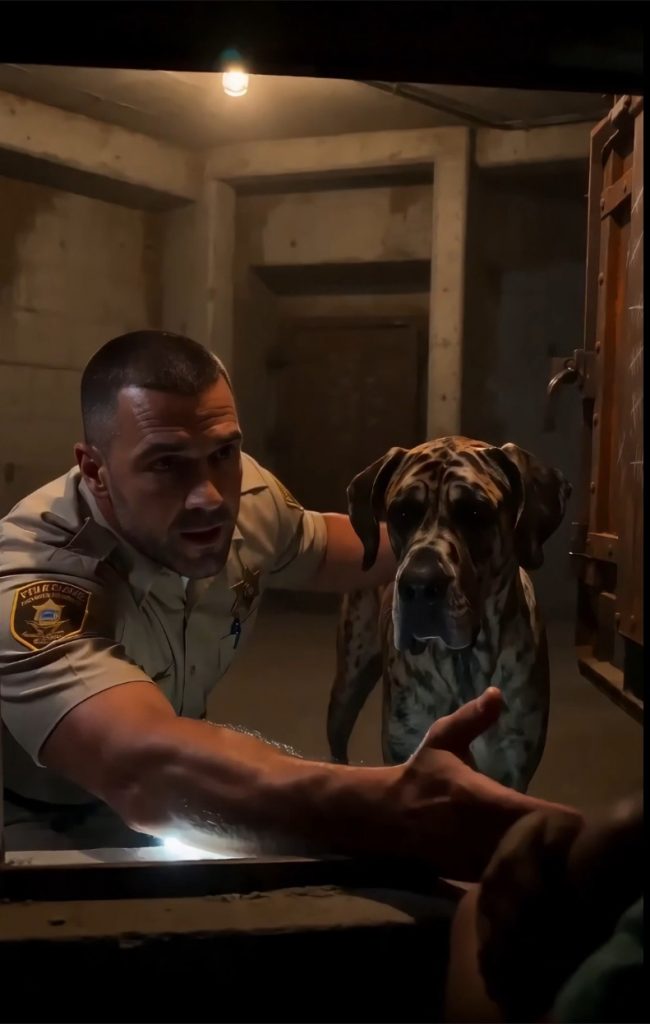
The metal bolt screamed as Officer Caleb Reed forced it sideways.
It had not been moved in a long time. Rust flaked under his palms. Dust shook loose from the concrete wall and drifted through the weak yellow light of the basement bulb.
Beside him, the Great Dane stood perfectly still.
The dog’s brindle coat rose along his spine, and his black collar pulled tight against the leash. For nearly ten minutes, Atlas had refused to leave this wall. He had dragged Caleb past old shelves, broken tools, paint cans, and a dead furnace until he planted his massive paws in front of the metal hatch.
Now Caleb knew why.
The lock gave with a heavy clang.
He gripped the edge of the hatch and pulled.
The door opened with a groan that sounded almost human.
His flashlight cut through the darkness inside.
At first, he saw nothing.
Then something moved.
A small boy, no older than eight, was curled in the narrow crawl space, arms wrapped around his knees. His mint-green shirt hung loose on his thin frame. His brown hair was messy. His eyes were huge and terrified in the light.
Caleb’s breath caught.
“Hey,” he said softly, dropping his voice at once. “Hey, buddy. I’ve got you.”
The boy flinched as if kindness was a sound he no longer trusted.
Caleb crouched lower, keeping his hands visible. He had responded to welfare checks, missing persons calls, custody disputes, and houses where silence carried more danger than shouting.
But nothing had prepared him for a child behind a bolted hatch in a concrete basement.
“What’s your name?” Caleb asked.
The boy’s lips trembled.
For a moment, no sound came out.
Then, barely above a whisper, he said, “Noah.”
Caleb swallowed hard.
Noah Hart.
The boy whose stepmother had told the whole county he had been sent to live with relatives after his father’s death.
The boy whose school counselor kept calling because the paperwork never felt right.
The boy everyone had almost stopped looking for.
Caleb reached toward him, slow and careful.
“You’re safe now, Noah.”
The boy stared past him, not at the flashlight, not at the badge, but at the open hatch door.
Caleb turned the beam.
Dozens of tally marks had been scratched into the inside of the metal.
Line after line.
Week after week.
A calendar made by a child who had no window.
Caleb felt something cold settle in his chest.
Then Atlas growled.
Not at the boy.
Behind Caleb.
The officer turned just enough to see a shadow moving in the basement light.
Vanessa Hart stood a few feet away, both hands wrapped around the wooden handle of a wide kitchen cleaver, her face blank, her eyes fixed on him.
And the weapon was already raised.
Act II
Caleb did not think.
Training moved before fear could.
He pushed himself sideways, putting his body between Vanessa and the hatch, while Atlas erupted into a bark so deep the basement seemed to shake. The dog lunged, not to attack, but to break the moment, to make her hesitate.
It worked.
Vanessa froze for one breath.
One breath was enough.
“Drop it!” Caleb shouted.
His voice filled the low concrete room.
Noah whimpered behind him, shrinking deeper into the crawl space.
Vanessa’s eyes flicked toward the boy. Not with guilt. Not with panic. With calculation.
That frightened Caleb more than rage would have.
“Officer,” she said, forcing a thin smile. “You shouldn’t be down here.”
“Drop it.”
“You don’t understand what he is.”
Atlas barked again, stepping forward with his head low, every muscle locked on her movement.
Vanessa lowered the cleaver slowly, but she did not let it go.
“He lies,” she said. “He causes trouble. He makes people feel sorry for him.”
Caleb’s hand moved to his radio.
“Dispatch, I need immediate backup and medical at the Hart residence. Child located. Suspect armed.”
Vanessa’s smile vanished.
“You had no warrant.”
“I had probable cause the second I heard a child behind a locked hatch.”
Her fingers tightened around the handle.
Caleb stepped closer.
“Set it on the floor.”
For several seconds, only the buzzing bulb and Atlas’s low growl filled the basement.
Then Vanessa released the cleaver.
It hit the concrete with a flat, final sound.
Caleb moved fast. He secured the weapon, guided Vanessa back against the support beam, and kept her there until the first siren cut through the rain outside.
Only then did he turn back to Noah.
The boy had not moved.
His eyes were locked on Atlas.
The Great Dane’s growl faded. He lowered his head, stepped to the hatch, and whined softly.
Noah’s small hand reached out from the darkness.
“Atlas?” he whispered.
The dog pressed his nose against the boy’s fingers.
And Caleb understood.
This was not just a rescue dog sensing danger.
This dog had known exactly who was behind that wall.
Act III
Six months earlier, the Hart house had looked ordinary.
Two stories. White trim. A neat yard. A porch swing Vanessa never used but kept polished because neighbors could see it from the road.
After Noah’s father, Peter Hart, died in a highway accident, people brought casseroles and flowers. Vanessa stood at the front door in a black dress, accepting every sympathy card with dry eyes and a trembling voice.
She played grief beautifully.
Noah did not.
He stopped speaking at school. He stopped turning in homework. When his teacher asked what was wrong, he looked toward the classroom door as if he expected someone to be listening.
Then he disappeared.
Vanessa told everyone he had gone to stay with Peter’s sister in Vermont.
“He needs structure,” she said. “A fresh start. Family support.”
The story made sense because people wanted it to.
Grief makes children strange. Stepmothers get overwhelmed. Families handle things privately.
But Mrs. Larkin, Noah’s school counselor, did not stop worrying.
She called the aunt in Vermont.
No answer.
She checked the transfer request.
It had been filed, but never completed.
She asked Vanessa for proof of enrollment, and Vanessa sent a blurry screenshot of a school website with Noah’s name typed into a form anyone could edit.
That was when Mrs. Larkin called the sheriff’s office.
Caleb visited the Hart house the first time on a Thursday afternoon.
Vanessa met him at the door smiling.
She wore a brown dress, gold earrings, and the calm expression of a woman who had rehearsed concern until it sounded natural.
“Noah is safe,” she said. “I know people don’t understand, but he was unstable after Peter died. He needed more than I could give.”
“Can I speak to him?”
“He isn’t here.”
“With his aunt?”
“Yes.”
“What’s her number?”
Vanessa’s smile tightened. “I don’t have it memorized.”
The answers were smooth.
Too smooth.
Before Caleb left, Atlas came bounding from the side yard.
The Great Dane was enormous, underfed-looking beneath his brindle coat, with a black leash dragging behind him. He did not bark at Caleb. He ran straight to the basement window well and began pawing at the dirt.
Vanessa snapped, “Atlas, stop.”
The dog ignored her.
Caleb noticed.
He also noticed the basement window had been painted black from the inside.
That night, he looked deeper.
Peter Hart’s will had left everything to Noah in trust. The house, the insurance payout, the savings account, and a small piece of lakeside land Peter had inherited from his grandfather.
Vanessa was named temporary guardian.
Temporary.
Not owner.
But if Noah were declared severely unstable, if custody transferred, if the trust needed “management,” Vanessa could petition for broader control.
The next day, Mrs. Larkin found something else.
A drawing Noah had left in his desk.
It showed a dog standing beside a square door in a wall.
Behind the door was a small stick figure.
Above it, in uneven letters, Noah had written:
Atlas knows.
Caleb took that drawing to his sergeant.
By evening, they had permission to return.
By nightfall, Vanessa claimed she was alone in the house.
But Atlas met Caleb at the gate, soaking wet, frantic and silent, and dragged him straight to the basement stairs.
Now, in the concrete room beneath the house, all the pieces lay in front of him.
The forged transfer forms.
The false school records.
The bolted hatch.
The tally marks.
The boy.
And Vanessa Hart, still trying to stare at the world as if it owed her belief.
But the dog had ruined her perfect story.
Act IV
Backup arrived in a rush of boots, radios, and flashlights.
The basement filled with controlled urgency. Deputies secured Vanessa. Paramedics crouched near the hatch. Caleb stayed low, keeping his voice gentle as he coaxed Noah out inch by inch.
No one grabbed him.
No one rushed him.
The boy had spent too long with every movement decided by someone else.
Atlas lay flat on the concrete, his huge head resting between his paws, watching Noah with patient eyes.
That was what finally brought the child forward.
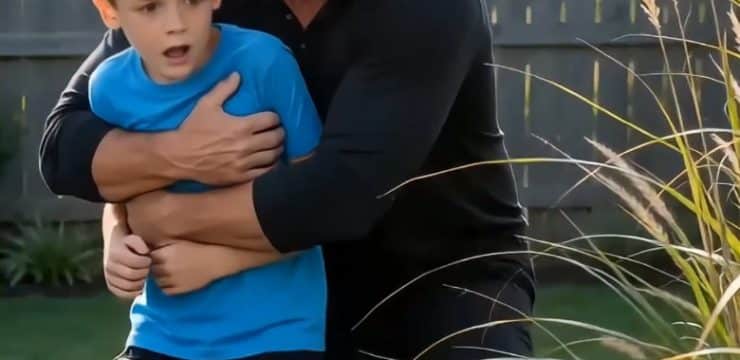
Noah crawled out of the hatch and collapsed against the dog, both arms wrapping around Atlas’s neck.
The Great Dane did not move.
He simply pressed close, steady as a wall.
Caleb turned away for a moment and blinked hard.
A paramedic wrapped Noah in a blanket. Another checked him carefully and spoke in a voice soft enough not to frighten him. Caleb heard the boy answer only one question clearly.
“Who put you there?”
Noah looked at Vanessa.
The basement went silent.
“She said Dad left everything to me,” he whispered. “She said I had to learn to be quiet.”
Vanessa lunged verbally before she could move physically.
“He’s confused. He’s making things up.”
Noah flinched.
Caleb stepped between them.
“Get her upstairs.”
As deputies led Vanessa away, her mask cracked at last.
“You think you saved him?” she shouted. “You have no idea what he’ll cost. Peter always chose him. Always him.”
There it was.
Not fear.
Not regret.
Resentment.
The kind that had sat inside her for years, polished and fed until a child became an obstacle instead of a child.
Caleb followed the evidence through the house.
In Vanessa’s office, deputies found a locked file drawer. Inside were forged letters supposedly written by Noah’s aunt. Medical forms never signed by a doctor. Trust documents with Vanessa’s notes in the margins.
Control funds after incompetency hearing.
Sell lake property once guardianship finalized.
Dispose of dog.
Caleb stared at that final line longer than the others.
Atlas had been another witness Vanessa could not control.
No wonder the dog had been tied outside.
No wonder he had dug at windows, scratched at doors, refused food, and howled at night until neighbors complained.
He had not been misbehaving.
He had been reporting a crime in the only language he had.
Upstairs, Vanessa sat at the dining table in handcuffs, chin lifted, still trying to look like the owner of the house.
When Caleb entered, she smiled coldly.
“You’ll never prove intent.”
He placed Noah’s drawing on the table.
Then the forged school record.
Then the trust notes.
Then a photograph one deputy had taken of the tally marks inside the hatch.
Vanessa’s smile faded piece by piece.
Caleb leaned over the table, voice low.
“Intent is written all over your house.”
For the first time, Vanessa had no answer.
Outside, dawn began to pale behind the trees.
And upstairs in the living room, wrapped in a blanket beside the dog who had refused to forget him, Noah Hart finally fell asleep.
Act V
The town learned the truth slowly.
That was how truths like this had to arrive when people had spent months accepting a lie because it was easier.
First came the patrol cars outside the Hart house.
Then the sealed basement door.
Then the arrest.
Then Mrs. Larkin standing in the school hallway, one hand over her mouth, after Caleb called and said, “We found him.”
Noah spent two nights in the hospital.
He did not say much. He ate little. He startled when doors closed too loudly. But he asked for Atlas every hour until the staff made an exception and allowed the dog to visit.
The reunion was the first time Noah smiled.
Small.
Exhausted.
But real.
Peter’s sister, Rebecca, arrived from Vermont the next morning, furious and heartbroken. She had never received Vanessa’s messages because Vanessa had been using an old email address and inventing replies herself.
When Rebecca entered the hospital room, Noah looked uncertain.
Then she took out a worn photograph from her wallet.
It showed Peter, Rebecca, and Noah at the lake two summers earlier, Atlas standing beside them with his tongue out and his paws in the water.
Noah touched the photo.
“Aunt Becca,” he whispered.
Rebecca broke then, but quietly. She sat beside the bed and told him he never had to hug anyone until he wanted to.
After a while, Noah reached for her hand.
That was enough.
The case against Vanessa grew stronger every week.
Investigators traced forged documents, deleted messages, manipulated trust filings, and false statements made to the school and child welfare office. A contractor confirmed Vanessa had asked him months earlier whether the basement hatch could be “soundproofed better.” A neighbor admitted she had heard a child crying once, but convinced herself it was a television.
She cried when she said it.
Noah’s testimony was handled carefully, with trained advocates and short sessions and no one forcing him to relive more than needed. The tally marks, the documents, and the dog’s behavior built most of the story without making the boy carry all of it.
Vanessa’s defense tried to paint her as overwhelmed.
The jury did not believe it.
There are mistakes made from panic.
And then there are plans written in folders.
Vanessa had folders.
Months later, after custody was settled, Noah moved with Rebecca to a small house near the lake his father had loved. Atlas came too, riding in the back seat with his head resting near Noah’s shoulder.
The house had wide windows, warm floors, and no basement.
Rebecca painted Noah’s room blue because he asked for sky.
For a long time, he slept with the lamp on.
No one told him not to.
Healing did not come like a miracle. It came in ordinary pieces. A full breakfast. A day at school. A night without a nightmare. A laugh when Atlas stole toast from the counter and looked deeply offended when caught.
Caleb visited once a month at first, officially to check in, unofficially because Noah trusted him.
One afternoon, Noah led him down to the dock.
Atlas trotted ahead, tail high, as if supervising both of them.
Noah stood at the edge of the water and looked out across the lake.
“My dad said brave doesn’t mean you’re not scared,” he said.
Caleb nodded. “Your dad was right.”
Noah glanced back at Atlas. “Was he brave?”
“The bravest dog I ever met.”
Noah thought about that.
Then he said, “He kept telling.”
Caleb’s throat tightened.
“Yes,” he said. “He did.”
A year later, the Hart house was sold.
Not to another family.
The county acquired it after the legal process ended, and the basement was sealed permanently. The metal hatch was removed and kept as evidence until the trial was over. The inside surface, covered in tally marks, was photographed and documented.
Caleb never forgot those marks.
He carried them in his mind the way some people carry prayers.
Not because he wanted to remember the darkness, but because he needed to remember what persistence looked like.
A counselor who refused to accept a fake transfer.
An officer who noticed a painted window.
A dog who dragged a leash through mud and would not stop pulling toward the truth.
On the anniversary of Noah’s rescue, Rebecca invited Caleb to the lake house.
There was no ceremony. Noah did not want one. Instead, they grilled burgers, ate watermelon, and watched Atlas chase a tennis ball with the dramatic seriousness of a much younger dog.
Near sunset, Noah brought Caleb a small drawing.
In it, a large brindle dog stood in front of a bright yellow door. Behind the door was a boy, but he was not curled up anymore. He was standing.
Above them, Noah had written:
Atlas knew where I was.
Caleb stared at the drawing for a long moment.
Then he looked at the boy in front of him.
Noah’s hair had grown out. His skin had color again. His eyes still carried shadows no child should have known, but they also carried something else now.
A future.
“Can I keep this?” Caleb asked.
Noah shrugged, pretending it was no big deal.
But he smiled.
That evening, as Caleb walked back to his cruiser, Atlas followed him to the driveway. The dog sat beside the car and looked up at him, quiet and solemn.
Caleb scratched behind his ear.
“You saved us both down there,” he said.
Atlas leaned into his hand.
Across the yard, Noah laughed at something Rebecca said from the porch. The sound floated through the warm air, light and sudden, and Caleb turned toward it.
For months, Vanessa Hart had believed concrete, metal, and lies could erase a child.
But she had forgotten one thing.
Love has a memory.
Sometimes it lives in a school counselor who keeps calling.
Sometimes in an aunt who drives through the night.
Sometimes in an officer who listens when a house feels wrong.
And sometimes, it lives in a dog who stands in the dark, staring at a locked wall, refusing to move until someone finally opens it.